This validation case belongs to an hyperelastic equibiaxial tension test in solid mechanics. The aim of this test case is to validate the following parameters:
- Hyperelasticity under equibiaxial tension
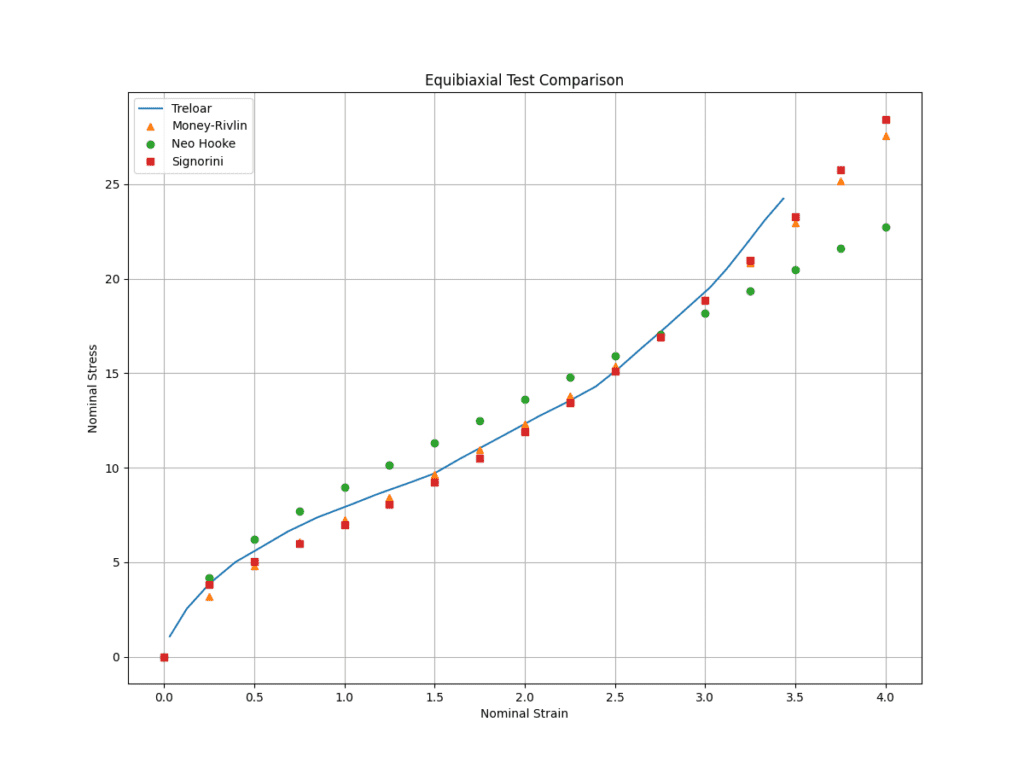
The simulation results of SimScale were compared to the results derived from [Treloar]\(^1\).
Geometry
The geometry used for the case is as follows:
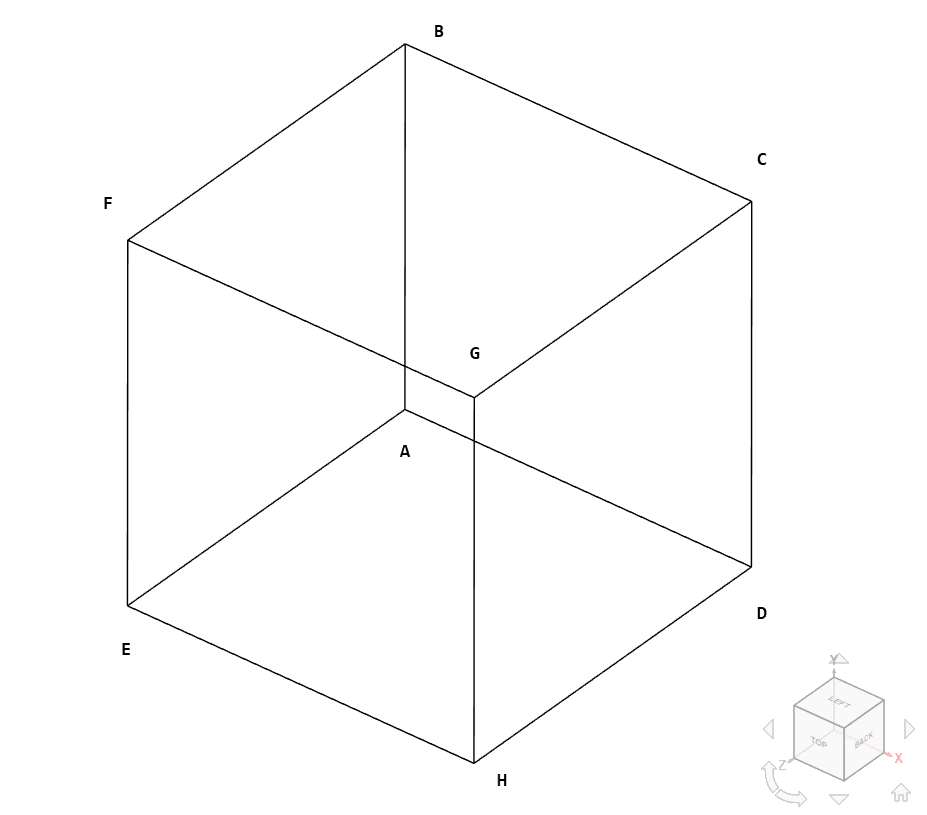
The cube has an edge length of 1 \(m\).
Analysis Type and Mesh
Tool Type: Code_Aster
Analysis Type: Static Non-Linear
Mesh and Element Types:
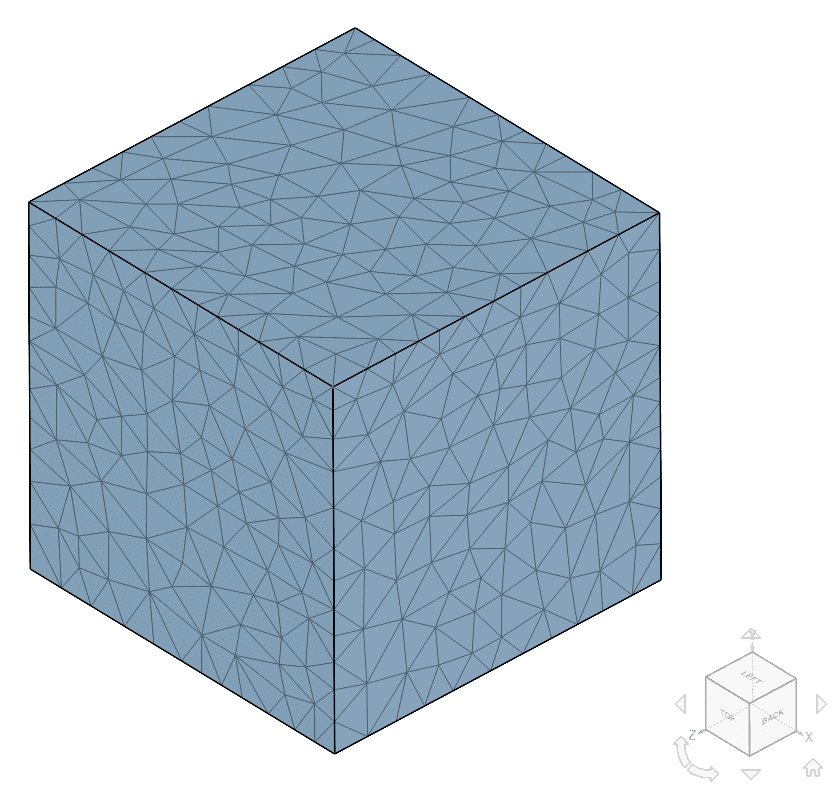
The mesh for the cube geometry was computed using SimScale’s Standard meshing algorithm.
| Case | Mesh Type | Number of Nodes | Element Type |
|---|---|---|---|
| All | Standard | 1184 | 1st order tetrahedral |
Simulation Setup
Material:
Hyperelasticity material, with the following parameters for each type of law:
- Neo Hooke:
- \(C_{10} = \) 2.398 \(Pa\)
- \(D_{1} = \) 1e-6 \(1/Pa\)
- Mooney-Rivlin:
- \(C_{10} = \) 1.751 \(Pa\)
- \(C_{01} = \) 4.625e-2 \(Pa\)
- \(D_{1} = \) 1e-6 \(1/Pa\)
- Signorini:
- \(C_{10} = \) 5.365 \(Pa\)
- \(C_{01} = \) -2.477 \(Pa\)
- \(C_{20} = \) 6.337e-1 \(Pa\)
- \(D_{1} = \) 1e-6 \(1/Pa\)
Boundary Conditions:
- Constraints:
- Face ABFE with zero x-displacement
- Face AEHD with zero y-displacement
- Face ABCD with zero z-displacement
- Face DCGH with imposed 4 \(m\) x-displacement
- Face BFGC with imposed 4 \(m\) y-displacement
Reference Solution
The reference solution is of the experimental type and was extracted from [Treloar]\(^1\). It corresponds with the nominal stress-strain material curve. The values were extracted using WebPlotDigitizer.
Result Comparison
Comparison of the nominal stress-strain curves computed from reaction force on the faces with zero displacement, versus the reference data is shown in Figure 3:
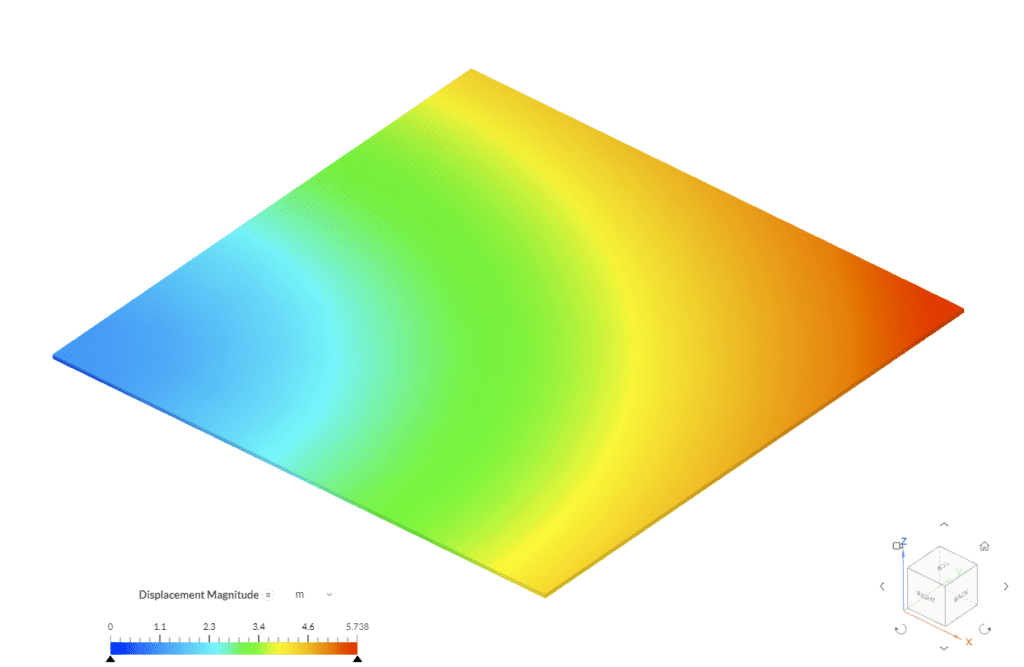
Following are the contours of the final deformed shape and the von Mises stress from the Signorini case results, where the hyperelastic equibiaxial tension load effect can be appreciated:
References
- L. R. G. Treloar, “Stress-strain data for vulcanised rubber under various types of deformation”, Trans. Faraday Soc., 40:59–70, 1944.
Note
If you still encounter problems validating you simulation, then please post the issue on our forum or contact us.