What you’ll take away
A clearer starting point
Understand where Engineering AI can create value and which workflows may be the right place to begin.
Practical use cases
See examples of AI supporting engineering setup, orchestration, analysis, and knowledge sharing.
Lessons from early adopters
Hear what teams have learned while introducing AI into real engineering environments.
A path beyond experimentation
Learn how organizations can turn isolated AI tests into repeatable and scalable ways of working.
Insights for your role
Whether you lead a team, build simulations, or explore new technology, find sessions relevant to the decisions you make.
Direct access to experts
Bring your questions and hear perspectives from the people developing and applying Engineering AI.
Engineering AI,
from possibility to practice
Engineering AI is moving quickly, but turning new capabilities into useful engineering workflows is not always straightforward.
Through practical sessions, expert perspectives, and real-world examples, Agentic Unlocks will explore how teams can apply AI to automate repetitive work, extend specialist knowledge, and make better engineering decisions.
Join us to understand where Engineering AI is already creating value and what it could mean for your team.
Meet the Speakers
David Heiny
CEO & Co-founder

One of the five engineers who co-founded SimScale in a Munich flat in 2012, David has spent over a decade on a single mission: helping engineers innovate faster.
Matthieu Lebas
Global Head of AI Engineering Services

Matthieu focuses on driving transformation initiatives at Capgemini Engineering, currently leading their AI transformation efforts to enhance engineering for the better!
Marco Morone
Mechanical Engineering CoE Leader & Global GEN-AI Product & System Officer
Marco focuses on identifying and developing strategies to embed Generative AI solutions into product development processes, with the goal to increase product reliability, enhance engineering efficiency, and reduce time‑to‑market
Armin Narimanzadeh
Manager, Thermofluids & Simulations

Armin currently heads the Thermofluids & Simulation team at Convion, managing thermal product development, thermal management and system/process simulation.
Dr. Steven Lainé
Director Solution Engineering
Steve is Director of Solution Engineering at SimScale. He has a technical foundation, with a Masters degree in Mechanical Engineering and a Ph.D. in Materials Science. Steve has 7 years of industry-relevant experience from working in aerospace design and engineering simulation.
Dirk Hartmann
Head of Simcenter Technology Innovation

Dr. Dirk Hartmann is a Siemens Technical Fellow and Professor of Digital Twins at TU Darmstadt, an internationally recognized pioneer in simulation technology, industrial AI, and digital twin engineering.
Ian McGann
AI Strategy Lead, Simulation Engineering
Ian McGann, Solution Consultant Director and digital twin expert at Siemens Digital Industries Software, specializing in scaling industrial simulation, cloud-native engineering, and executable digital twin technologies
Todd McDevitt
Developer Relations Manager

Dr. Todd McDevitt, Developer Relations Manager at NVIDIA, bringing extensive industry and CAE vendor expertise in computational design, implicit modeling, and AI-accelerated simulation.
Mohammed N.J.
Executive Director

Executive Director at Dolphin Global Holdings, driving operational growth, productivity, and the transition toward AI-enabled manufacturing.
Padmanabh Nimbhorkar
Group Chief Strategy Officer
Group Chief Strategy Officer at Dolphin Global Holdings, leading strategic transformation, international expansion, and future-growth initiatives.
Ahmed Ali
Design Head
Design Head at Dolphin Manufacturing Limited, bringing over 18 years of thermal engineering expertise in advanced product development and digital transformation.

Ioannis Tsavlidis
Solution Engineering
Ioannis is a Solution Engineer at SimScale with 5+ years of engineering simulation experience in a broad range of physics. He is a Mechanical engineer and holds an MSc in Aerospace Engineering, TU Delft.
Darren Henry
Senior Vice President of General Operations

Senior Vice President of General Operations at Onshape PTC, a pragmatic GTM and operations executive with deep experience bridging engineering, sales, and analytics to scale revenue-producing teams
Jeroen Janssen
Director

Associate Director and CORE Studio UK Lead at Thornton Tomasetti, specializing in bioclimatic urban design, microclimate simulation, and early-stage digital modeling to create comfortable, sustainable environments.

Ajitkumar Ananthu Jeyakumar
Solution Engineering
With a background in Aeronautical/ Aerospace Engineering and a Master’s degree in Computational Engineering from Ruhr University Bochum, Ajit is a part of SimScale’s Application Engineering Team.
Jeremy Andrews
Co-Founder and Chief Technology Officer

Co-Founder and CTO at CoLab Software, a former Tesla and General Dynamics engineer driving modern product and technical innovation.
Calum MacDougall
Senior Mechanical Design Engineer

Senior Mechanical Design Engineer at Dexory, specializing in CAD, FEA, and CFD to drive high-performance engineering, electric vehicle innovation, and hardware design.
Jon Wilde
Vice President of Product
With more than 20 years of experience in the industry, Jon is an expert in simulation and is responsible for product management at SimScale.
Jack Sandiford
Product Lead

Product Lead at Ai Build – Jack’s function focuses on leveraging AI, simulation, and software to automate additive manufacturing and empower engineering workflows.
Sessions highlights
The Arrival of Agentic Engineering: A Call to Action for the Industry
SimScale CEO David Heiny frames the stakes for the day ahead: agentic engineering has moved from research labs to production reality, and the gap between organizations using it and those still watching is starting to compound. Heiny previews the practitioner and partner stories to come, real teams running AI agents inside CFD, FEA, and design workflows, and issues a direct challenge to the audience: the opportunity in front of the industry right now won’t stay open indefinitely.

AI as a Utility: How to Scale Engineering AI Beyond the Pilot
Most engineering organizations are stuck treating AI like another software tool — bolted onto existing workflows instead of built into how engineering actually runs. Matthieu Lebas, who leads AI engineering transformation projects across the world’s largest industrial and automotive manufacturers, makes the case for a different mental model: AI as a utility, secure and embedded by default across systems, data, and culture — not a pilot to prove out. He’ll share what separates organizations converting AI investment into real productivity and time-to-market gains from those still stuck experimenting.

From Months to Minutes: How Convion Trained a Physics AI Model to Cut Design Time by 90%
Convion’s ejector design involves a set of tightly interdependent parameters where traditional CFD optimization could take months per cycle. Armin Narimanzadeh, Manager of Thermofluids & Simulations, shares how his team instead trained a physics-based AI surrogate model, used it to cut a full optimization run down to tens of minutes, surfacing a design 50% smaller than the original that no one on the team would have proposed manually. Expect candid advice on how to validate AI results before trusting them, and how surrogate models can become a shared, reusable asset across distributed engineering teams.

LIGHTNING DEMO ⚡: Thousands of Designs with Physics AI
Traditional CFD or FEA optimization can mean testing one design at a time, often for hours per run. This lightning quick demo shows how Physics AI changes that: watch how an engineer trains a surrogate model on a batch of simulation results, then uses it to evaluate thousands of design variants in seconds, live. See how the model’s predictions are validated against real solver results.

EXPERT PANEL: From Frontier to Foundation: Deploying Agentic Engineering Across the Stack
AI agents that can plan, reason, and act are no longer a research curiosity. They’re impacting CAD, CFD, FEA, and entire simulation workflows today. But there’s a wide gap between an impressive demo and an agent your engineering team, your safety case, and your IT department will trust in production. In this panel, SimScale CEO David Heiny is joined by leaders from NVIDIA and Siemens Digital Industries Software — the compute layer and the industrial software layer of the emerging agentic engineering stack — to talk candidly about what’s real today, what’s still hype, and what engineering leaders need to get right (data, trust, orchestration, and talent) as they move agentic workflows from pilot to production.



From Four Decades of Engineering Knowledge to Agentic AI
For more than forty years, Dolphin’s engineering knowledge has been built through experience, problem-solving, and thousands of real-world manufacturing decisions. Today, the company is turning that knowledge into structured, AI-ready assets that support faster product development, stronger decision-making, and scalable engineering workflows. Bringing together executive, strategic, and engineering perspectives, the session shares Dolphin’s approach to deploying agentic AI across its engineering ecosystem — the emerging blueprint, early results, key challenges, and a practical adoption path for industrial organisations moving from AI experimentation to meaningful implementation.


LIGHTNING DEMO ⚡: Agentic Simulation Runs, Start to Finish
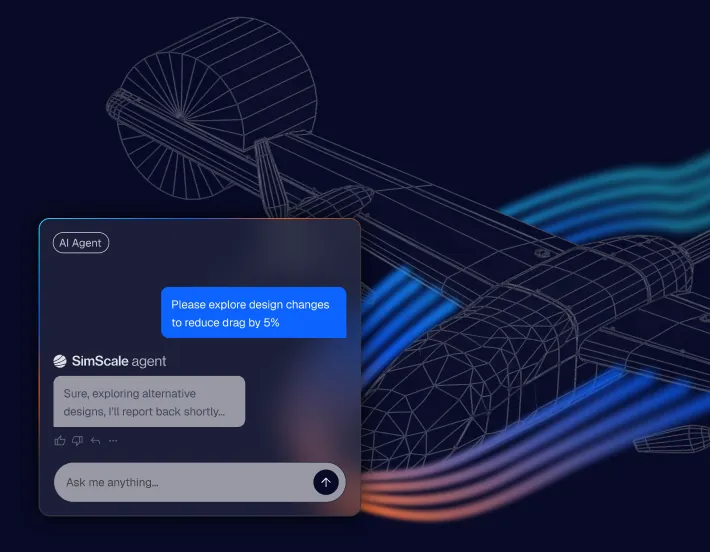
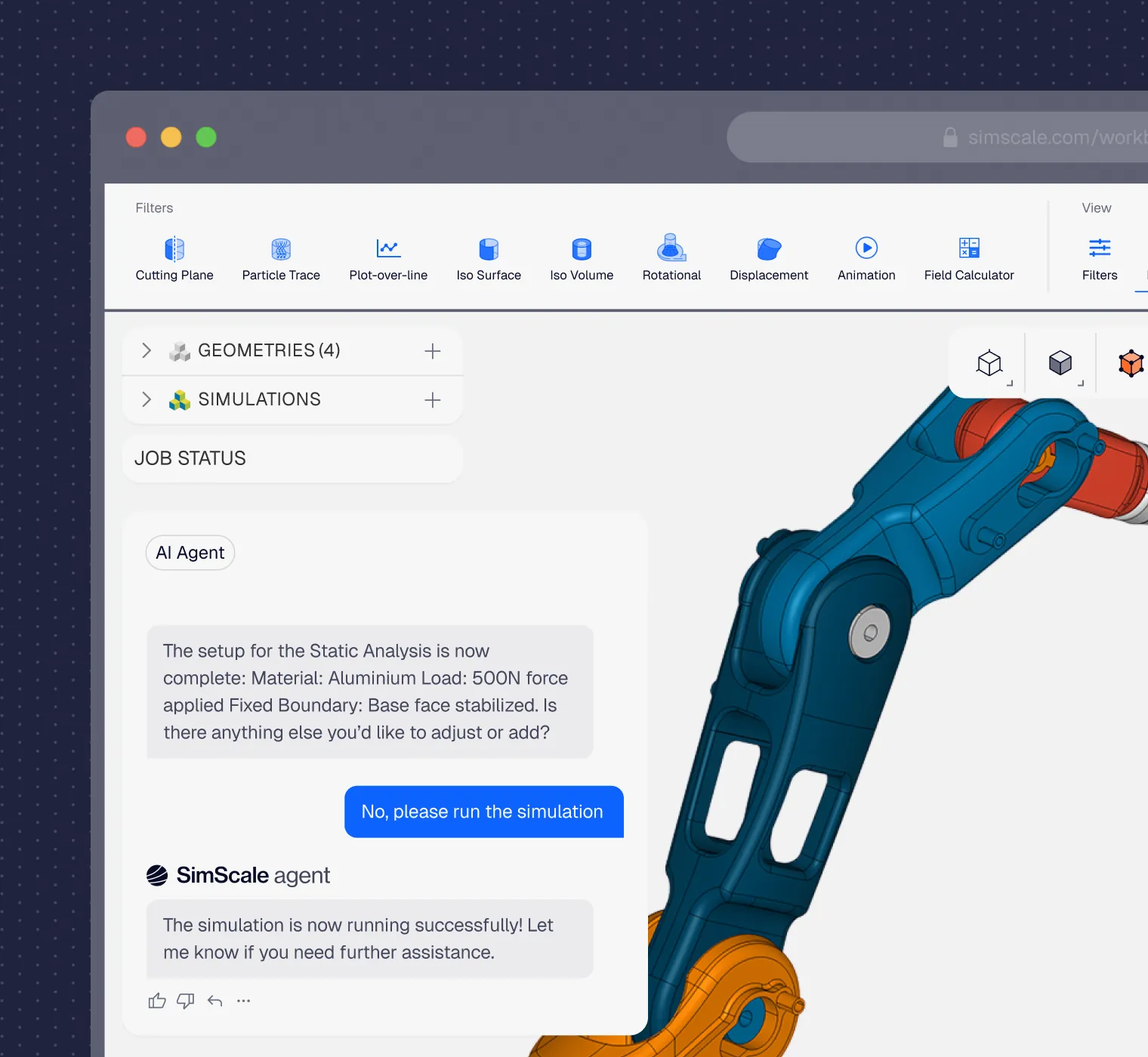
This lightning quick demo shows Engineering AI in action: taking a raw CAD and plain-language prompt, selecting the right physics, setting up boundary conditions, meshing the model, running the simulation, and interpreting the results, autonomously! This is the orchestration layer that turns simulation from a multi-step, multi-tool process into a single guided workflow, with engineers in the loop.
Beyond Agentic CAD: Building Your Own Engineering Intelligence
AI in CAD is moving fast—from discrete AI tools and advisors to agents that can take action inside the design environment. But the bigger opportunity may be what comes next: using AI to customize CAD itself. Imagine engineering teams building intelligent, reusable design tools tailored to their specific domain, products, standards, and processes—without waiting for their CAD vendor to build them. CAD platforms are starting to expose their own automation surfaces to AI, turning natural language into code, and code into native, parametric CAD. These custom engineering toolsets can capture institutional knowledge, automate design intent, and ultimately become valuable intellectual property and competitive advantage.

From Simulation to App: Building AI Into Engineering Workflows at TT
Most simulation data gets used once and set aside. Director Jeroen Janssen shares how Thornton Tomasetti is turning that data into fast, reusable engineering tools — from Asterisk 2.0, which uses models trained on structural design data to deliver early-stage sizing, material quantities, and embodied-carbon estimates in seconds, to AI Jam workflows that turn simulation results into live services engineers can call from tools like Grasshopper. The session also previews TT’s move toward agents that plan multi-step tasks such as spec review and first-pass methodology drafting. Expect a candid take on where trust, validation, and human judgment still have to lead.

LIGHTNING DEMO ⚡: Engineering AI as Your Simulation Co-Pilot
This lightning quick demo shows Engineering AI agents working alongside an engineer in real time: flagging a bad mesh or unrealistic boundary condition before the run starts, explaining why a result looks off, and suggesting the next design iteration to try. It’s a look at how AI can extend what a less experienced engineer can safely do, without taking the decision out of their hands.
Scaling DFM best practice with AI: a case study in EV component manufacturing
When designing for mass manufacturing, engineers must keep production methods in mind. The wrong design decision can add cost and complexity. But most engineers have never worked in production and it’s impossible to have experienced production staff weigh in on every design. In this session, Jeremy Andrews, Co-Founder and CTO of CoLab, demonstrates how a large automotive supplier is bridging this gap with AI agents that flag process specific DFM risks for machined, injection molded, and sheet metal parts.

The “Blank Sheet Problem”: Mapping Where Agentic AI Delivers Real Value
Calum MacDougall, Senior Mechanical Design Engineer at Dexory, calls it engineering AI’s “blank sheet of paper” problem: the technology clearly works, but where it pays off first is still being discovered by many. Dexory, a company racing to ship new warehouse robots, is running that discovery in real time by piloting AI agents across workflows – from predicting possibility of structural part failure, to automating design-variant sweeps, to delivering a searchable engineering memory from past projects. Expect an honest look at which use case delivers value fastest.

How to Get Started: A Builder’s Panel on Adopting Agentic Engineering
Agentic Unlocks closes with a live conversation built for engineering leaders trying to figure out their own first move. Jon Wilde, SimScale’s VP Product, sits down with three builders working at the edge of AI-native engineering software: Jack Sandiford (Aibuild), who argues the engineer’s job is shifting from operating tools to directing AI agents; Laurence Cook (Generative Engineering), who is working to remove the manual setup that caps how many design ideas a team can test; and SimScale’s CEO/Founder David Heiny. The panel answers the questions many leaders are asking: where to start, how much to trust the agent, how to build momentum, and others. Walk away with a clearer view on how to take your first steps, or how to accelerate your current programs.