Volume Heat Flux
The volume heat flux boundary condition acts like a volumetric heat source. This type of boundary condition is used for analysis types involving heat transfer. The figure below shows the necessary input parameters:
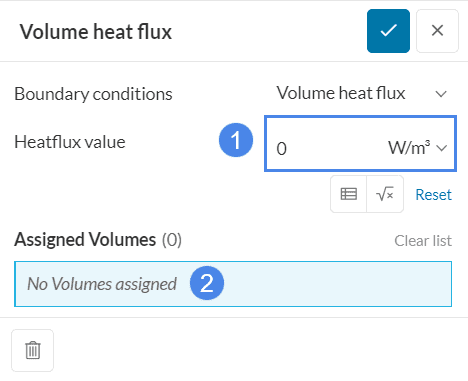
The parameters of the boundary condition are:
- Heat flux value: The value of the volume Heatflux variable to be applied, in units of \([W/m³]\) or \([\frac {Btu}{s.in^3}]\). The resulting heat flux will depend on the volume of the assignment.
- Assignment: Set of volumes on which the heat flux value will be applied.
Variable Heat Flux
Variable heat flux values can be specified with the use of the formula or table inputs. The allowed functions are:
- Time-dependent: The heat flux varies with respect to time (variable t) in a transient heat transfer, nonlinear static or dynamic thermomechanical simulation. This is useful, for instance, to ramp up the load from zero in nonlinear simulations, where a sudden application of load leads to numerical divergence, or to define power loading curves. This option is available for both formula and table inputs.
- Coordinate-dependent: The heat flux varies with respect to the position in space (variables X, Y, Z). This is useful for applying known power gradients on volumes. If the heat flux only depends on 1 variable, both the formula and table input can be used. For 2 or 3 coordinate dependency, only the definition by a formula is allowed.
Related Documentation
Important
The heat flux can be positive or negative. For a positive input, heat goes into the domain.
For a negative value, heat is removed from the volume.
Other Types of Heat Flux
In addition to volume heat flux, Simscale also offers surface heat flux and convective heat flux boundary conditions.
Last updated: February 13th, 2025
Did this article solve your issue?
How can we do better?
We appreciate and value your feedback.