Porous Media and Porosity Characteristics
Porous media is a bidirectional concept. Whether it is isotropic (3D) or 1D, bidirectional means the flow can pass through opposite directions.
A medium or a material that has voids or pores or is filled with solid particles which let fluid pass through is called a porous medium.
Consolidated medium: The solid body has internal pores. Fluid passes through the pores.
Unconsolidated medium: A pile of solid particles is packed inside a bed. Fluid flows around the particles.
Using porous media simplification reduces CAD and mesh complexity, and saves computational time and expenses.
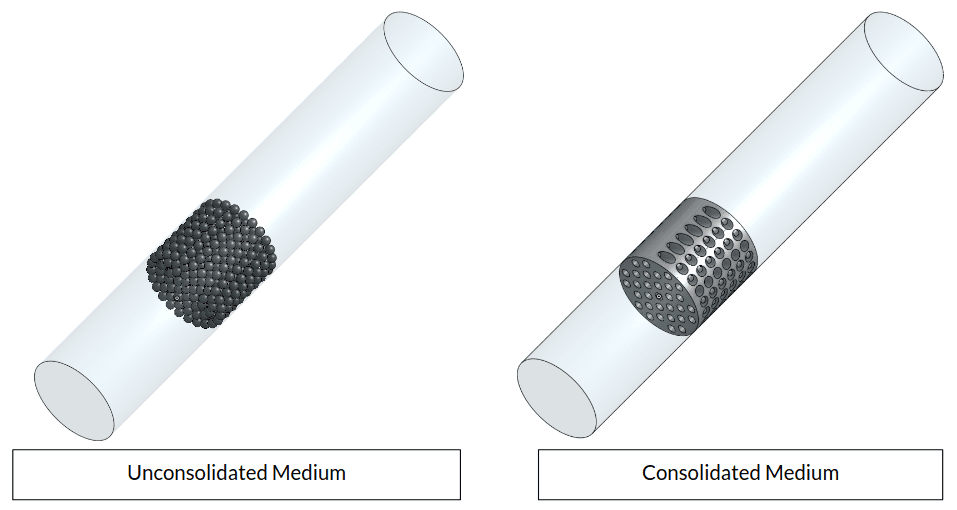
With the porous media feature, users can define porosity characteristics of volumes within the computational domain. Defining these porosity characteristics increases the accuracy of certain simulations. SimScale allows its users to model a porous entity inside the simulation domain in five different ways.
A porous media can be created under the Advanced Concepts tab in the simulation tree. The following models are available:
Darcy-Forchheimer Medium
This porosity model takes non-linear effects into account by adding inertial terms to the pressure-flux equation. The model requires both Darcy \(d\) and Forchheimer \(f\) coefficients to be supplied by the user. If the coefficient f is set to zero, the model degenerates into the Darcy equation.
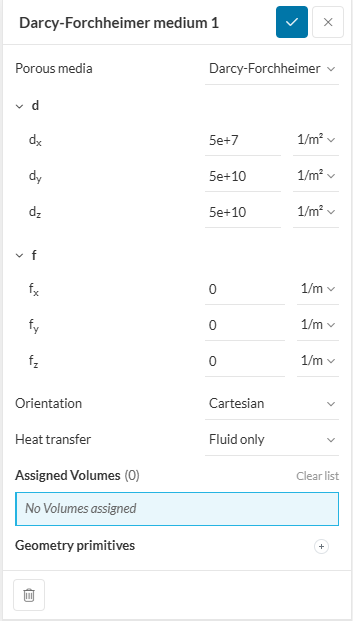
Furthermore, two-unit vectors for a local coordinate system have to be specified. A third vector is implicitly defined, such that (\(\vec{e_1} \vec{e_2} \vec{e_3}\)) is a right-handed coordinate system like (x y z). These three vectors should be the main directions of the porous zone resistance. Please note that the \(d\) and \(f\) coefficients are prescribed for each direction separately. It can be used for both anisotropic and isotropic medium.
The model leads to the following source term for the momentum equation:
$$S = – (\mu d + \frac{\rho |U|}{2} f) U$$
Where:
- \(S\) can be understood as a pressure gradient \([Pa/m]\);
- μ represents dynamic viscosity \([kg/m.s]\);
- ρ is the density of the fluid \([kg/m³]\);
- \(U\) is the velocity of the flow \([m/s]\).
The Darcy coefficient is the reciprocal of the permeability κ.
$$d = \frac{1}{\kappa}$$
Find an example on how to apply the Darcy-Forchheimer model, please check this page.
Fixed Coefficients Medium
This model requires \(\alpha\) and \(\beta\) to be supplied by the user. The corresponding source term is:
$$S = – \rho_{ref} (\alpha + \beta |U|) U$$
Where:
- \(S\) can be understood as a pressure gradient \([Pa/m]\);
- \(\rho_{ref}\) is the density of the fluid \([kg/m³]\). This value is only used for compressible and convective heat transfer simulations. Otherwise, the \(\rho\) value specified under materials is used;
- \(U\) is the velocity of the flow \([m/s]\).
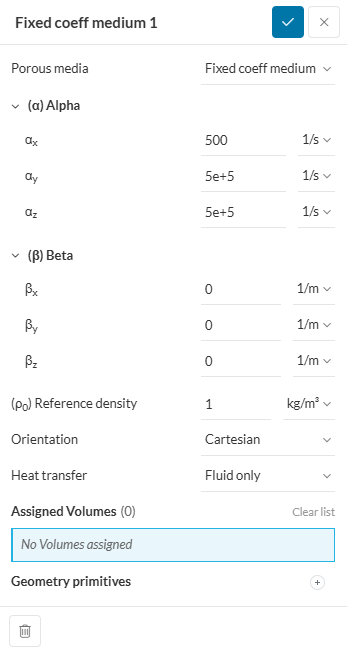
Similarly to the Darcy-Forchheimer model, the user has to specify two unit vectors for a local coordinate system. The \(\alpha\) and \(\beta\) coefficients are input based separately for each direction. Therefore, a fixed coefficients medium can be used to define isotropic and non-isotropic porosity.
Once the setup is complete, a porous region must be assigned. Such a region can be defined using geometry primitives or cell zones.
Important
Fixed coefficients, alongside with the pressure loss curve model, are the only two that can be used for compressible, convective heat transfer, and incompressible cases.
The Darcy-Forchheimer, Power Law, and Perforated Plate models should only be used for incompressible and convective heat transfer (with compressibility disabled).
Power Law Medium
In the power law formulation, the source term for the momentum equation is given by:
$$S = – \rho C_0 |U|^{(C_1)}$$
Where:
- \(S\) can be understood as a pressure gradient \([Pa/m]\);
- \(\rho\) is the density of the fluid \([kg/m³]\);
- \(C_0\) is the linear coefficient;
- \(C_1\) is the exponent coefficient;
- \(U\) is the velocity of the flow \([m/s]\).
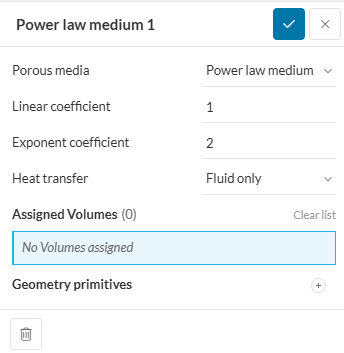
Note that a power law media will always be isotropic. Cell zones and geometry primitives can be used to assign a power law porous media.
For an example on how to apply the power law model, please check this page.
Pressure Loss Curve
The pressure loss curve is a simplified version of the Darcy-Forchheimer model.
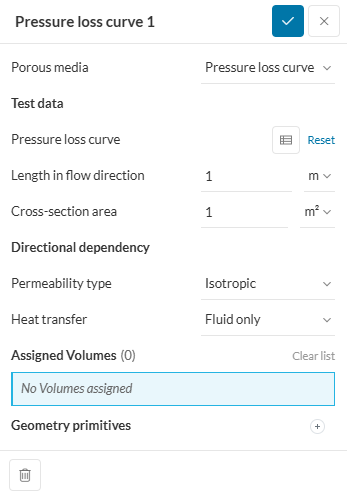
As input, the user has to provide the following information:
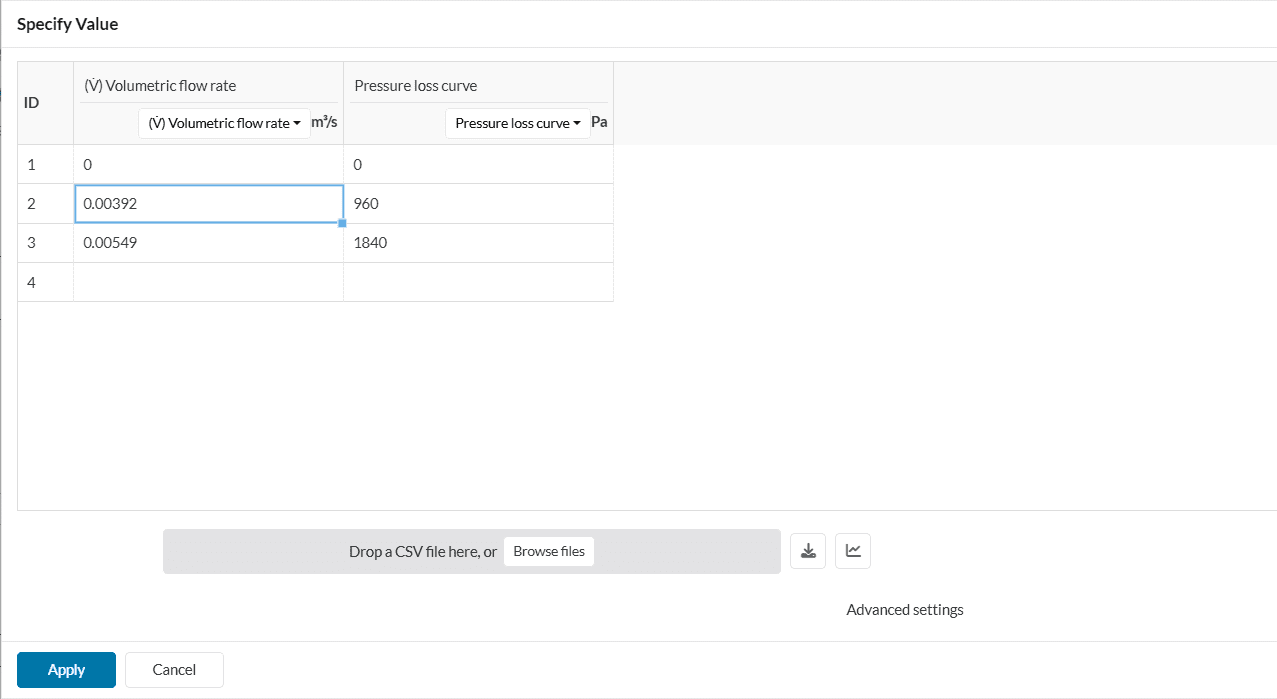
- A table of volumetric flux \([m³/s]\) versus \(\Delta P\ [Pa]\) for the geometry. A minimum of 3 data points have to be specified. Note: For better results, always start the table by defining a data point (0, 0) in the first line;
- Length of the porous media in the flow direction \([m]\);
- Cross-section area \([m²]\).
- Permeability type
Important
These inputs define the length of the porous media which was used to generate the curve and its cross-sectional area (normal to flow). They refer to the experimental model’s dimensions, and not to the CAD part that is being used to model the porous media.
Based on the input, a polynomial curve fit is performed and the Darcy-Forchheimer coefficients are automatically calculated. Therefore, the pressure loss curve formulation is a more convenient way of using the Darcy-Forchheimer model.
Important
Curve fitting methods work when a total of three or more data points are provided (including the first [0, 0] point). However, oftentimes, users only have a single non-zero data point for volumetric flux versus \(\Delta P\).
In case a single data point is available for your geometry, the approach described below can be used. This approximation is especially good for turbulent flow, providing satisfactory agreement:
1. Following the Darcy-Forchheimer model, assume that the Darcy coefficient is zero. Therefore, only the inertial term (Forchheimer) is considered;
2. Calculate f. Rearranging the Darcy-Forchheimer formulation, we have:
$$f = \frac {2\Delta P}{\rho U^2}$$
3. Extrapolate another data point, by choosing a different velocity (e.g. 2 times greater than the velocity from the first data point) and calculating the corresponding \(\Delta P\):
$$\Delta P = \frac {f\rho U^2}{2}$$
4. Calculate the corresponding flow rate for the velocity chosen in step 3;
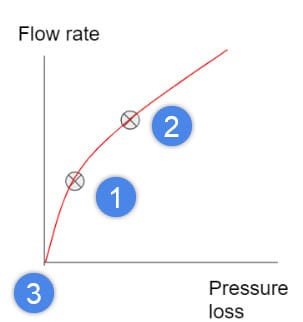
5. The picture below shows the resulting three points. [1] represents the initial data point. [2] is the point that is predicted and [3] is the (0, 0) data point;
6. Input the data points in the table, keeping in mind that the first point should be (0, 0).
7. The table values should have a consistently increasing trend from (0,0) to the maximum point. In addition, the table values should not be repeated.
Perforated Plate
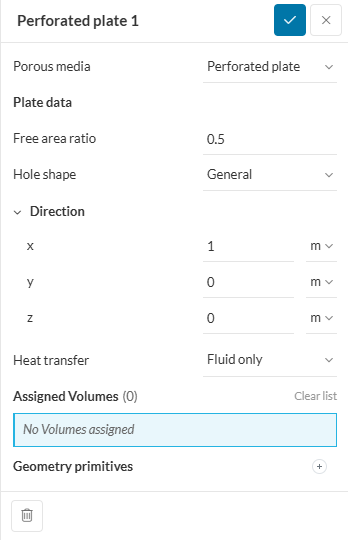
The perforated plate model estimates pressure loss based on geometrical parameters. As inputs, the user has to provide:
- Free area ratio: This is a ratio between the open area of the perforated plate (area covered by the holes) and the total area of the plate \(\left(\frac {A_h}{A}\right )\);
- The shape of the hole: Default is a general shape. A circular shape is also available. In case of a circular shape, the average hole diameter should be specified;
- Flow direction: With this input, the user can specify the principal flow direction within the medium. This direction is based on global coordinates.
The perforated plate model is based on the formulation presented in [1].
Important
For all porous media models, it’s important to refine the region around the porous media appropriately.
Make sure at least 5 mesh cells are placed across the porous media thickness.
Pressure Loss Function
The pressure loss function porous media is exclusive to the multi-purpose solver. Similarly to the pressure loss curve model, the user defines a volumetric flow rate versus delta pressure table by clicking on the table button:
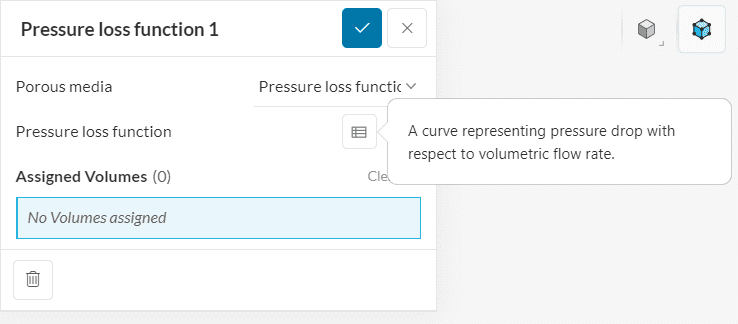
At least 3 data points are recommended for the table definition, with the first one being 0 flow rate and 0 pressure drop. With more points a better interpolation is obtained.
Note that this porous media model is always isotropic and the volume assignment needs to be done to a CAD volume since geometry primitives are not supported.
Darcy Law Medium
The Darcy Law medium is another porous media model exclusive to the multi-purpose solver. With the current implementation, this porous media model is always isotropic.
The Darcy Law medium in SimScale is based on the following formulation:
$$ dP = \frac{\mu L U}{K} + \frac{C_d \rho L U^2}{\sqrt{K}} $$
Where:
- \(dP\) is a pressure gradient \([Pa]\);
- \(\mu\) is the dynamic viscosity of the fluid \([kg/m.s]\);
- \(L\) is the length of the porous media in the flow direction;
- \(U\) is the velocity of the flow \([m/s]\);
- \(K\) is the permeability coefficient \([1/m^2]\);
- \(C_d\) is the drag coefficient;
- \(\rho\) is the density of the fluid \([kg/m³]\).
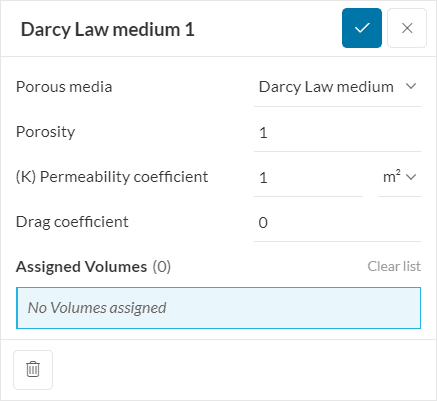
When inspecting the formulation that is used for the Darcy Law medium model, when the drag coefficient \(C_d\) term is not zero, both Darcy (linear) and Forchheimer (quadratic) terms will be present. This is usually the case for applications involving larger velocities since the quadratic term becomes more relevant as velocity increases.
On the other hand, when \(C_d\) is zero, this model is purely based on Darcy’s law.
Anisotropic Porous Media Definitions
From the porous media models outlined above, Power Law is the only one that does not support an anisotropic definition. Anisotropic definitions from the other porous media will be explored below.
Darcy-Forchheimer and Fixed Coefficient Mediums
For the Darcy-Forchheimer and Fixed Coefficient medium porous media models, the user gets to choose coefficients for each direction.
The Orientation may be Cartesian or Custom, where the user can define their own x and y unit vectors. The z unit vector is defined automatically, in such a way that it is perpendicular to both x and y unit vectors.
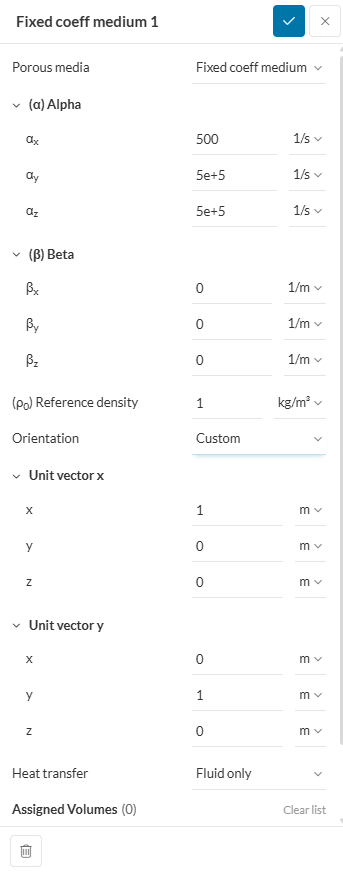
A common approach is to calculate the coefficients for the open direction and multiply those coefficients by 10-1000x for the blocked directions. The same workflow is also valid for Darcy-Forchheimer mediums.
Pressure Loss Curve and Perforated Plate
The perforated plate model is inherently directional, indicating the preferential direction of the perforations. Both the perforated plate and pressure loss curve support directional definitions based on cartesian coordinates.
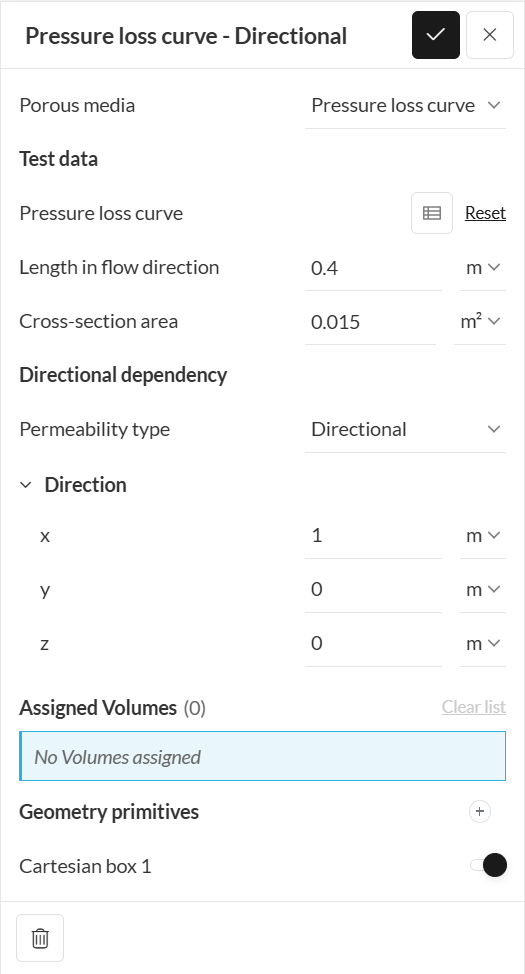
Darcy Law Medium and Pressure Loss Function
For both porous media models available in the multi-purpose solver, the porous media type may be Homogeneous or Directional. When choosing a directional definition, may use Custom or Cartesian orientations.
Furthermore, the porous media definition can be based on an Allowed Direction or a Blocked Direction.
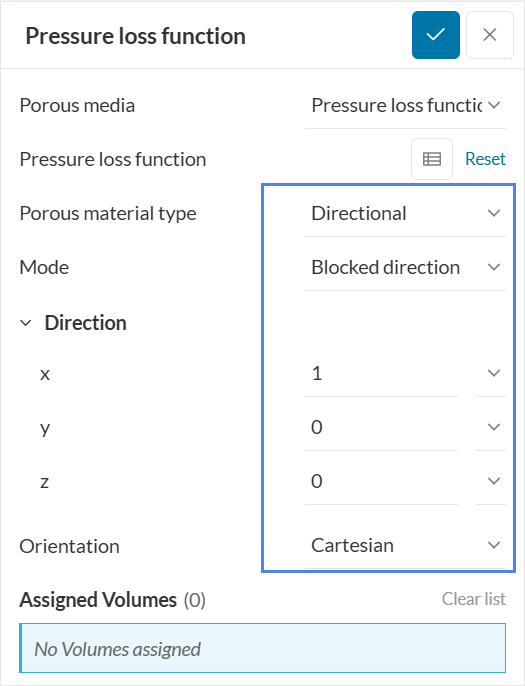
In the Blocked direction mode, the user defines the blocked flow Direction. Here, the 2 orthogonal directions will receive the fluid resistance as defined.
When using Allowed direction, the user informs which direction receives the fluid resistance, while the other 2 orthogonal directions will be blocked.
Effective Conductivity
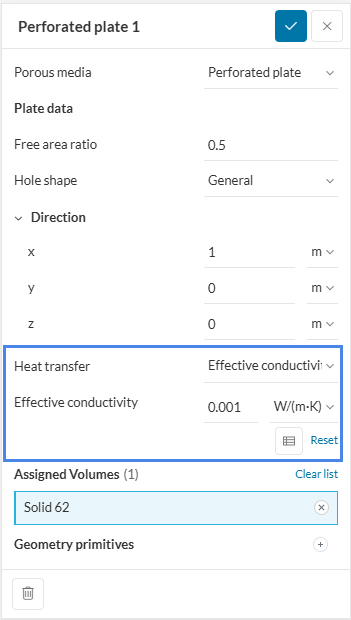
The Effective Conductivity option defines how heat conducts through the solid portion of the porous matrix. Instead of resolving fine structures such as fins or lattice elements in the mesh, a single representative thermal conductivity value, or a set of directional values, is assigned to the homogenized volume.
This option is particularly useful for:
- Fin arrays in heat exchangers, where the fins are too thin to mesh directly but contribute significantly to heat conduction.
- Metal foams and lattice structures, where the geometry is complex and periodic.
- Any porous region where the solid matrix conductivity differs from the bulk material conductivity due to the presence of voids.
Constant vs. Velocity-Dependent Input
For both isotropic and orthotropic modes, the effective conductivity can be specified in two ways:
- Constant: A single fixed value (or set of directional values for orthotropic). Use this when the thermal behavior of the porous matrix does not change significantly with flow velocity, for example, a metal foam at a fixed operating point.
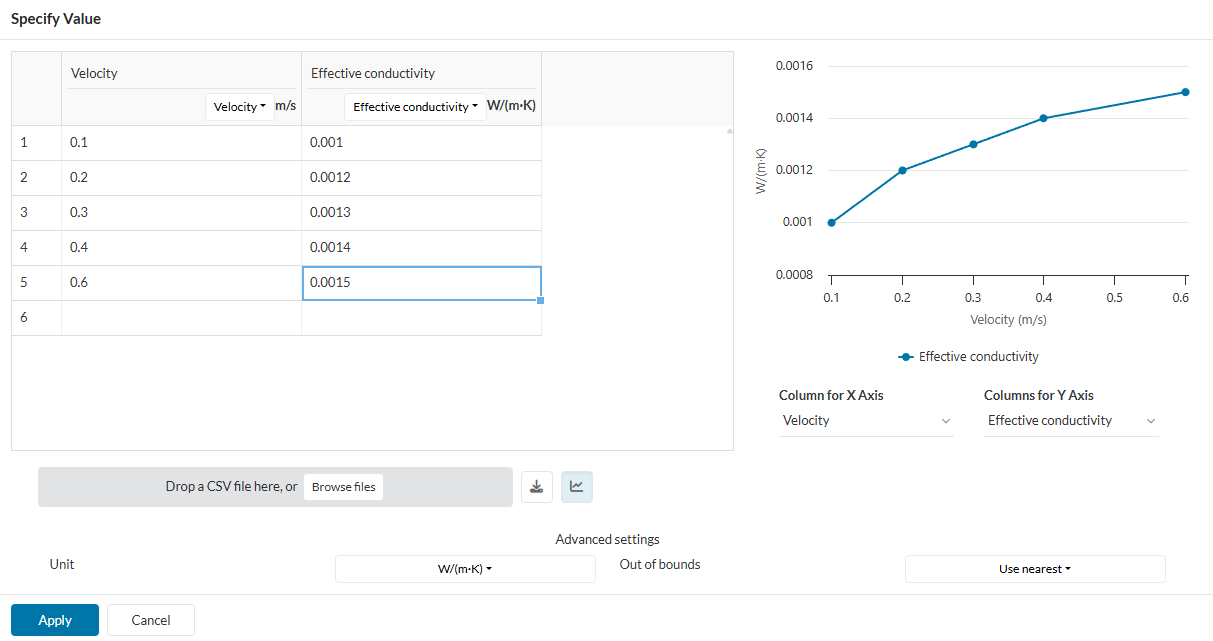
- Velocity-dependent table: A table of \((u, k_{eff})\) pairs, where \(u\) is the flow velocity magnitude. The solver interpolates between the entries at runtime. Use this when \(k_{eff}\) varies noticeably with velocity, which is typical for fin arrays and other geometries where the convective contribution to the effective conductivity changes with flow rate.
The velocity-dependent table values are best obtained from the Simulation-Based Approach described below: run the representative channel simulation at several inlet velocities and record the resulting \(k_{eff}\) at each point to populate the table.
Note
The effective conductivity represents the thermal conductivity of the solid matrix only, not the combined solid-fluid mixture. The solver accounts for the fluid contribution separately through the porosity value and the fluid material properties.
Estimating the Effective Conductivity
Three approaches are available for estimating the effective conductivity \(k_{eff}\) of a porous matrix, in increasing order of accuracy and effort. All three derive \(k_{eff}\) from the actual solid-phase volume fraction, using the bulk material conductivity directly will overestimate conduction whenever the matrix contains a significant fluid fraction.
Porosity-Based Bounds
Porosity-based formulas require only the solid and fluid conductivities and the porosity value \(\phi\) (the fluid volume fraction). They yield two bounding estimates without any geometry or simulation data.
The parallel arrangement (arithmetic mean) assumes solid and fluid conduct in parallel; all thermal resistance paths run side by side. This gives the upper bound on \(k_{eff}\):
$$k_{eff}^{max} = \phi \, k_f + (1 – \phi) \, k_s$$
The serial arrangement (harmonic mean) assumes solid and fluid conduct in series; each phase is a thermal resistance stacked in sequence. This gives the lower bound:
$$k_{eff}^{min} = \frac{1}{\dfrac{\phi}{k_f} + \dfrac{1-\phi}{k_s}}$$
where \(k_f\) is the fluid thermal conductivity, \(k_s\) is the solid thermal conductivity, and \(\phi\) is the porosity.
Note
These bounds are most reliable when the solid-to-fluid conductivity ratio is within approximately one order of magnitude. For highly conductive solids surrounded by a gas (e.g., aluminium fins in air), the bounds diverge significantly and a more accurate approach is recommended.
Correlation-Based Approach
For standard channel geometries, such as rectangular fin channels, circular tubes, or regular packed beds, published Nusselt number correlations provide an estimate of \(k_{eff}\) without the need to run a reference simulation. The general procedure is:
- Identify a Nusselt number correlation applicable to the channel geometry (e.g., Dittus-Boelter for turbulent pipe flow, Shah-London for laminar rectangular channels).
- Compute the average Nusselt number \(Nu_{L_{fc}}\) at the expected operating conditions, using the characteristic cross-sectional length \(L_{fc}\) of the channel as the reference length.
- Derive \(k_{eff}\) from \(Nu_{L_{fc}}\), the fluid thermal conductivity \(k_f\), and the channel geometry. The convective heat transfer coefficient \(h\) follows directly from the Nusselt number definition:
$$h = \frac{Nu_{L_{fc}} \cdot k_f}{L_{fc}}$$
where \(L_{fc}\) is the characteristic cross-sectional length of the channel. The effective conductivity \(k_{eff}\) is then obtained by equating the thermal resistance of the homogeneous porous channel to that of the resolved geometry using \(h\) and the channel dimensions.
This approach is faster than a reference simulation. Accuracy depends on how well the actual geometry matches the geometry assumed by the chosen correlation. It is best suited for well-characterized geometries at steady operating conditions.
Simulation-Based Approach (Recommended)
The simulation-based approach is the most general and accurate method. A small, geometrically resolved section of the porous matrix is simulated directly in a Conjugate Heat Transfer analysis, and the resulting average Nusselt number \(Nu_{L_{fc}}\) is used to derive \(k_{eff}\) for the equivalent homogeneous porous region. Follow these steps:
- Extract a representative unit section of the porous matrix geometry, for example, a single fin channel containing both the fluid volume and the solid fin.
- Set up a Conjugate Heat Transfer simulation on this section. Assign both fluid and solid materials. Define an inlet with a fixed velocity and temperature, fixed-temperature walls at the heated surfaces, and adiabatic slip walls on the cut faces.
- Add a Result Control for the area-average temperature at the outlet and a Field Calculation for the Nusselt number, using the inlet temperature \(T_i\) as the reference temperature and the characteristic cross-sectional dimension of the channel \(L_{fc}\) as the reference length.
- Run the simulation and extract the average Nusselt number \(Nu_{L_{fc}}\) from the results. The corresponding convective heat transfer coefficient is:
$$h = \frac{Nu_{L_{fc}} \cdot k_f}{L_{fc}}$$
- Use \(h\) together with the channel geometry and fluid properties to compute \(k_{eff}\). Repeat for several inlet velocities if the effective conductivity is expected to vary with flow speed, the resulting \(k_{eff}\) values can then be entered as a velocity-dependent table in SimScale.
Important
Using the bulk material conductivity directly as the effective conductivity will overestimate heat conduction through the matrix whenever the porous region contains a significant fluid fraction. Always account for the actual solid volume fraction when deriving or selecting the effective conductivity value.
Limitations
- The effective conductivity is a homogenized quantity. It cannot capture local temperature gradients that occur at the scale of individual fins or matrix ligaments.
- The porosity-based bounds diverge significantly for high solid-to-fluid conductivity ratios (greater than one order of magnitude). In these cases, use the correlation-based or simulation-based approach instead.
- The simulation-based workflow assumes that the length of the representative channel used for calibration matches the length of the modeled porous region. Significant length mismatches may introduce errors in the average Nusselt number.
- Specific heat capacity and density of the porous matrix are better estimated using porosity-weighted averages of the solid material properties, as these quantities are less sensitive to the local thermal non-equilibrium between solid and fluid phases.
References
- VDI Heat Atlas. Second Edition. Springer-Verlag Berlin Heidelberg 2010.
- Aichlmayr, H. T., and F. A. Kulacki, “The Effective Thermal Conductivity of Saturated Porous Media,” in J. P. Hartnett, A. Bar-Cohen, and Y. I Cho, Eds., Advances in Heat Transfer, Vol. 39, Academic Press, London, 2006. DOI: 10.1016/S0065-2717(06)39004-1
- Nield, D. A. and Bejan, A. (1999). ‘‘Convection in Porous Media’’, 2nd edn. Springer, New York.
Last updated: September 24th, 2026
Did this article solve your issue?
How can we do better?
We appreciate and value your feedback.
What's Next
Power Sourcepart of: Advanced Concepts