Documentation
Relaxation factors control the under-relaxation of the solution. This is a technique used for improving the stability of a calculation, especially in solving steady-state analysis, where the first iterations are critical.
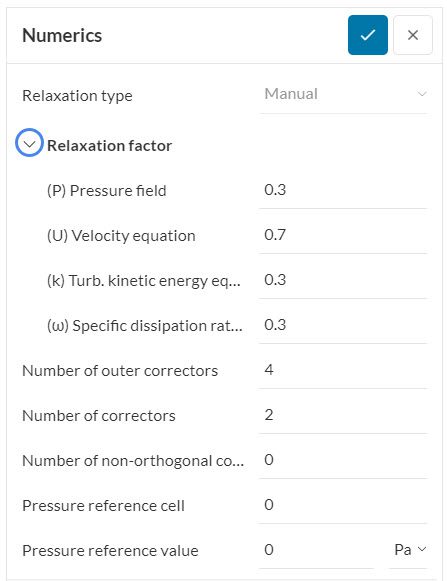
The best choice of the relaxation factor is one that is small enough to ensure stability but large enough to move the iterative process to convergence at a decent speed. For example, if \(α\) is the relaxation factor then a value of \(α\) that is:
In the case of manual relaxation, values between 0.3 < \(α\) < 0.7 are recommended.
The auto-relaxation feature is designed to dynamically change the factor \(α\) for the flow variables to speed up convergence while trying to keep the solution stable. In some cases, if this causes divergence, it is recommended to try with manual relaxation factors that are fixed over the iterations.
The method of under-relaxation is basically limiting the amount by which a variable changes from the previous iteration to the next one. Due to the nonlinearity in the equations, it is important to control the change of the variable.
Because of the non-linearities of the equations being solved, it is necessary to control the change of variable \(φ\). This is achieved by under-relaxation as follows:
$$ {φ_P}^n = {φ_P}^{n-1} + α \times\ ({{φ_P}^{n*}\ – {φ_P}^{n-1}}) $$
Where \(α\) is the factor that defines the relaxation such that:
And:
This means that the new value of the variable \(φ\) depends upon the old value, the computed change of \(φ\), and \(α\).
The under-relaxation factor \(α\), specifies the amount of under-relaxation, such that:
When applying the Multi-purpose solver, there are two different categories of relaxation factors in the Numerics tab that can be altered. The first type, depicted below, concerns the update of the corresponding variable involved during the iterative process.
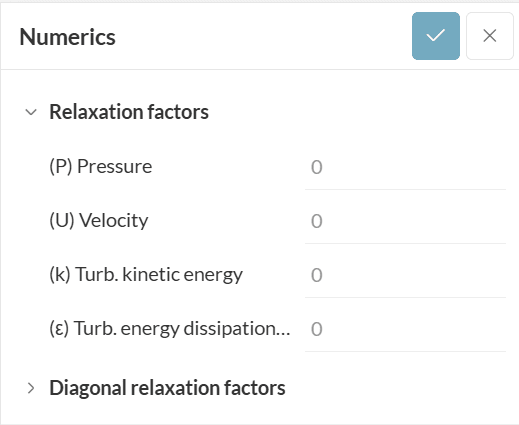
For this category the value set for \(α\) also ranges from 0<= \(α\)<=1, nonetheless it obeys the following rule:
On the other hand, the second category, “Diagonal Relaxation Factors”, influences the convergence of solutions from linear systems of equations associated with a specific variable, as shown below.
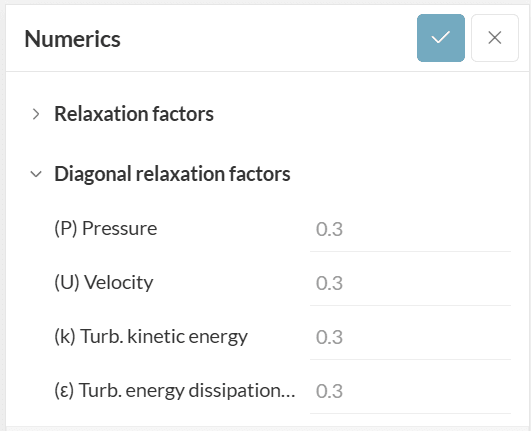
These factors aim to improve convergence and stability by modifying the diagonal terms of the coefficient matrix in the linear system of equations and obey the following rule:
The higher the value assigned to the \(α\), the more conservative is the correction procedure, requiring more iterations to reach desirable convergence
Last updated: September 2nd, 2025
We appreciate and value your feedback.
Sign up for SimScale
and start simulating now
