
An engineer might run three simulations at once. An agent might launch 300. That was how NVIDIA’s Todd McDevitt described the change, and nobody is going to read 300 result files line by line. The review has to move somewhere else.
That question ran through Agentic Unlocks, where NVIDIA, Siemens, Capgemini, CoLab, Thornton Tomasetti, Dolphin and others shared how they put AI agents to work on real engineering. Almost every speaker came back to it: if the model is probabilistic and the decision isn’t, where does the engineer step in?
Their answers were specific. Put the human at the irreversible step. Build the rest of the trust into the system the agent runs in. And only automate work you already know how to review.
What is human in the loop AI?
Human in the loop (HITL) AI is a system design where a person reviews, approves or corrects an AI system’s output at defined points before it’s acted on. The human owns specific decisions, and the system is built so those decisions can’t be skipped.
In engineering, that means an AI agent can set up, mesh, run and report a simulation on its own, while an engineer signs off on the result before it changes a design, a quote or a release. These review points are called gates.
Human in the loop vs human on the loop
The two terms are one word apart and describe different jobs. In the loop, the system stops and waits for a person to approve before it continues. On the loop, the system keeps running and a person supervises, stepping in when something looks wrong.
Most engineering AI workflows need both. The agent works on the loop for routine setup and solving, and in the loop at the steps where a wrong answer is expensive.
Why engineering AI needs a human in the loop
Large language models are probabilistic: ask the same question twice and you can get two different answers. Todd McDevitt put it plainly on the Agentic Unlocks panel. That’s acceptable for generative and early conceptual design, he said, but as you move through the engineering V, you need trust and determinism.
That’s the core of the probabilistic vs deterministic question. A deterministic system gives the same output for the same input, every time. A solver is deterministic. An LLM deciding which solver settings to use is not.
The bigger risk is how convincing the agent has become. Jack Sandiford of Ai Build noted that a year ago you could catch AI making things up. Now its outputs are so convincing that errors are much harder to spot.
Siemens’ Dirk Hartmann added the expertise problem. A structural engineer who asks an agent to run a CFD case gets a result easily, “but then you might be very easily fooled because you don’t get the basic CFD knowledge to get the right result.” The less you know about the physics, the less able you are to catch the agent’s mistake.
Humans have variance too
There’s a useful counterweight. Siemens’ Ian McGann described an internal study: “We gave five different engineers the same input CAD file, same load case, and we said solve it, and we came out with five different results.” The differences came from how each engineer applied the loads, meshed the part and followed the process.
So the realistic bar for an agent is a known, measured error that’s at least as good as the team’s own, with a human owning the decisions that matter.
Put the review gate at the irreversible step
If a human reviews everything, the human is the bottleneck again and nothing has changed. If nobody reviews anything, you get a well-documented, fully traceable wrong answer. The skill is choosing where the gates go.
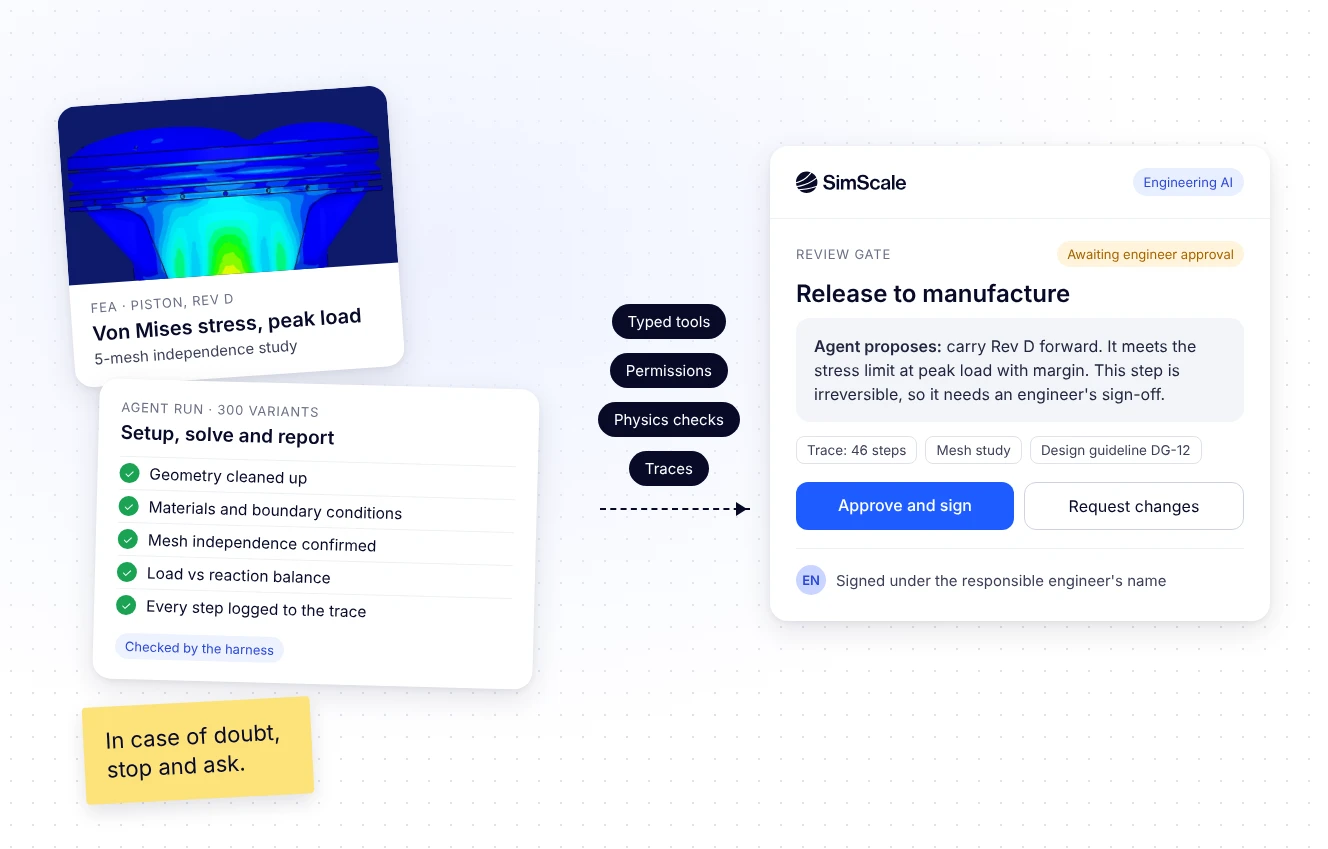
Jack Sandiford gave the clearest rule of the day: bring the human in “when the decision is irreversible. So release to manufacture, sign off, anything that spends money or cuts metal.” Everything upstream of that can run with lighter checks.
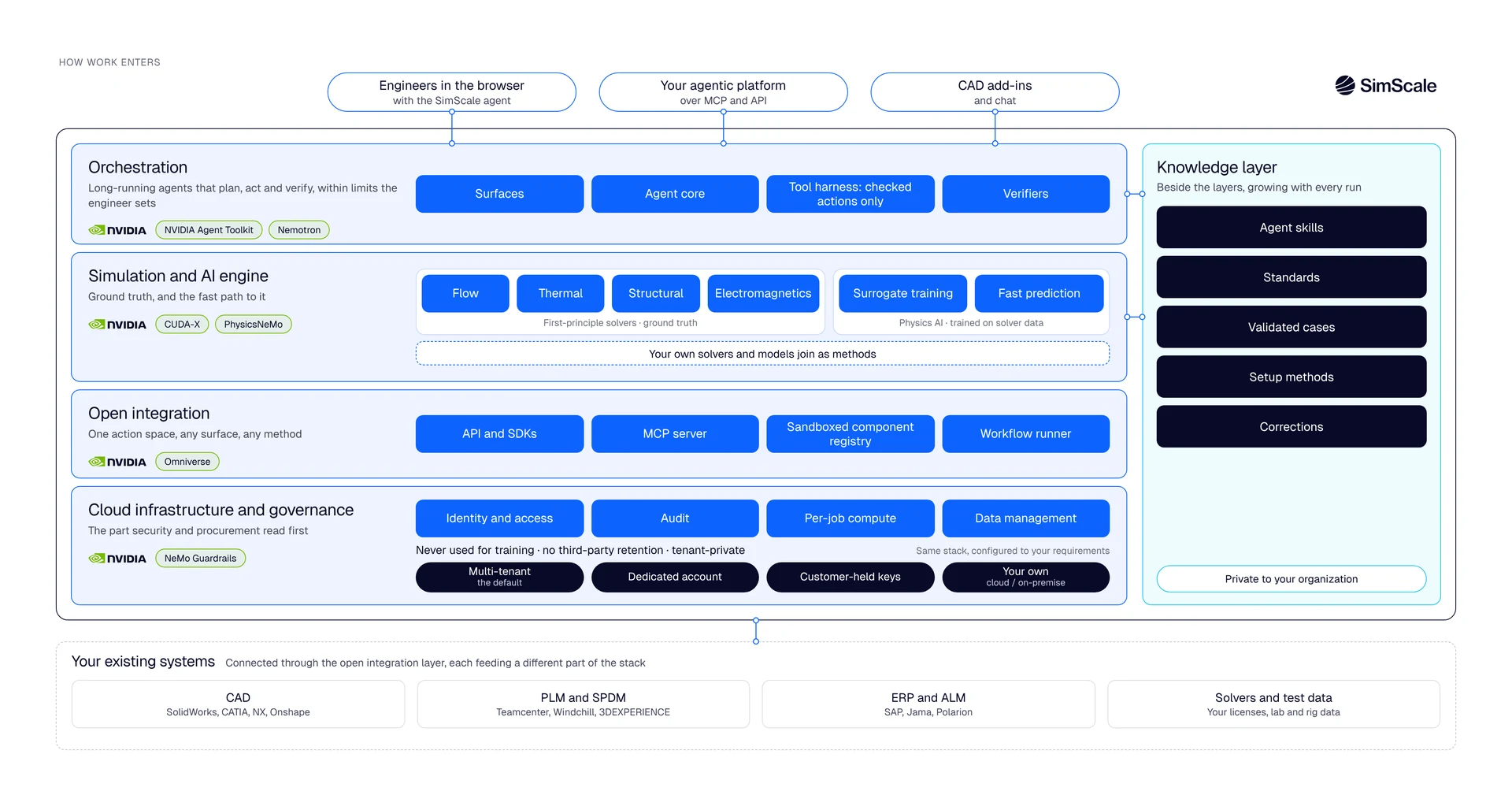
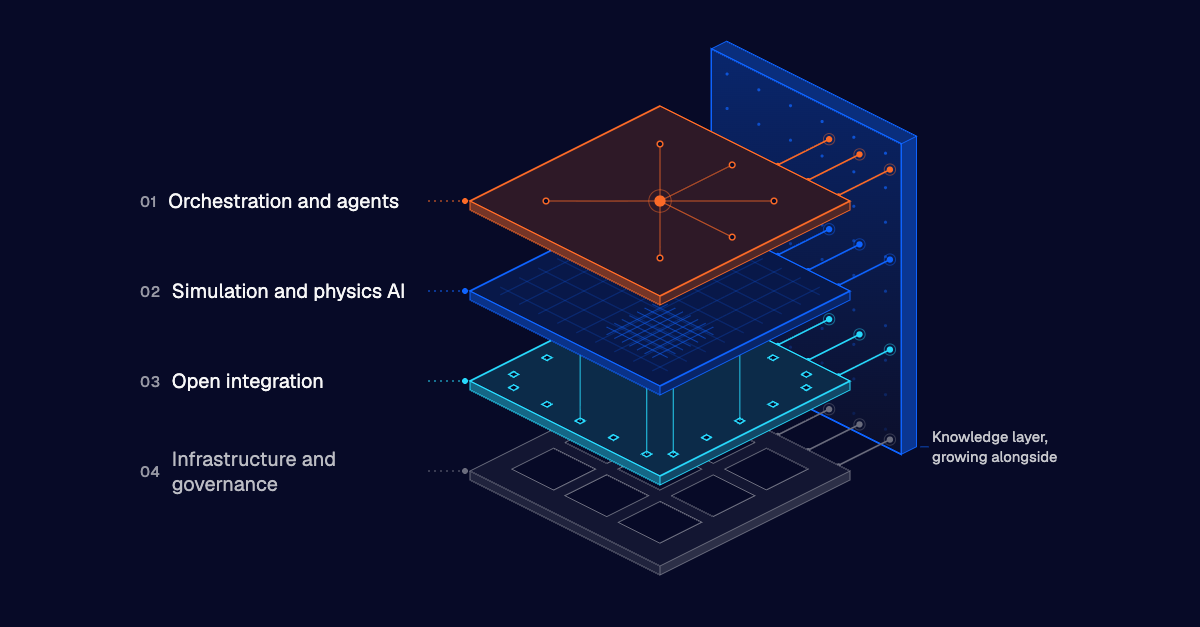
The Engineering AI Blueprint turns that rule into three zones, scoped by reversibility and consequence rather than by how hard the task is.
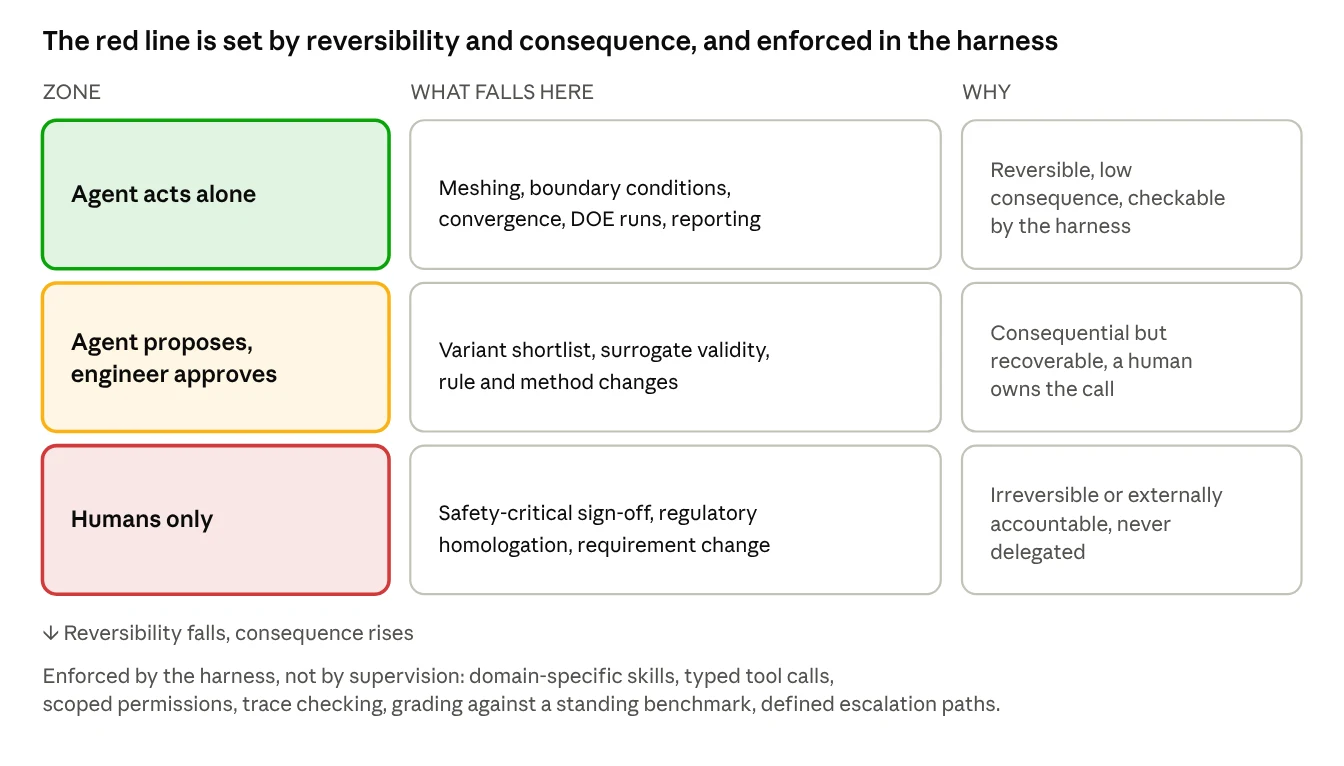
- Agent acts alone: reversible, low-consequence work the system can check, such as meshing, boundary conditions, convergence, DOE runs and reporting.
- Agent proposes, engineer approves: consequential but recoverable decisions where a human owns the call, such as which variants to carry forward, whether a surrogate model is valid in this operating range, and changes to a rule or method others will inherit.
- Humans only: irreversible or externally accountable decisions, such as safety-critical sign-off, regulatory homologation and changing a requirement.
The line moves. Each organization draws its own, and it shifts as evidence builds up. Regulation pulls in the same direction: Jack pointed to the EU AI Act, which sorts AI systems into risk tiers and requires human oversight for high-risk ones.
Engineer trust into the harness
Gates handle the big decisions. Everything between them needs a different kind of control, and Todd McDevitt’s answer was the harness: the software layer that decides what the agent is allowed to do, how it does it and when it has to stop.
He described what NVIDIA’s partners are building into it:
- Typed tool calls. The agent can only call operations that exist, with arguments that validate.
- Reasoning separated from authority. The LLM reasons. The harness decides which tools it can access, through explicit permissions.
- Physics and mesh checks. Automatic validation inside the harness, such as checking applied loads against reaction forces, or checking y+ values for the turbulence model.
- Trace review. Every step the agent takes is recorded so it can be inspected and improved.
The last point changes what you review. “We don’t want to trust the answer,” Todd said, “or look at the answer as the measure of trust, but really the process.” In the line that stuck with the audience: “It’s important to judge the system on its traces.”
A harness also gives the agent a way to stop. In a SimScale lightning demo, Ioannis Tsavlidis asked the Engineering AI agent to clean up a CAD model, apply boundary conditions and run a mesh independence study, then added one instruction: “in case of doubt, always stop and ask us for confirmation.” Escalation is a gate the agent triggers itself.
Physics is the other half. Physics AI returns performance predictions fast enough for an agent to check its own proposal before presenting it, and the full solver stays available when confidence drops.
Deterministic checks catch the errors a tired reviewer misses. The human gate covers the decisions no check can make.
6 review gates engineering teams use today
Here are the gates the speakers described, from simplest to most systematic.
1. A verify-and-certify gate in the redesigned workflow
Capgemini Engineering calls its approach augmented engineering: core engineering competence combined with AI tooling. Marco Morone said it “always needs some gate during the process where the results of AI will be verified and certified by engineer.” When Capgemini helps a client redesign a workflow for AI, it places that engineer-in-the-loop step at several stages, rather than bolting a review on at the end.
2. The engineer’s name on the finding
CoLab runs AI-based design-for-manufacturing checks grounded in a customer’s own design guidelines. When an engineer agrees with a finding, they triage it into a design review, where it appears under their name. “We want the engineers to validate things and actually put their name against them,” said co-founder Jeremy Andrews. Accountability stays with a person, and the AI’s output becomes a proposal that someone chose to stand behind. Read more about how CoLab and SimScale hand work between agents.
3. Re-run it yourself, twice
Thornton Tomasetti trains machine learning models on hundreds of thousands of structural analyses, then serves them as small web apps. Early on, engineers didn’t trust the predictions. “As an industry, we’re a dinosaur,” said Jeroen Janssen, speaking about architecture, engineering and construction.
So the team built a trust builder: engineers download the ML-predicted model, ready for FEA, run it themselves and see the utilization ratios match to within a few percent. After doing that twice, Jeroen said, they’re “off to the races.” This gate is designed to be passed a few times and then retired, once the evidence is in. See the Thornton Tomasetti story.
4. Every output traceable to its source
Dolphin has built heat transfer products for 40 years. Its roadmap for engineering AI runs capture, connect, reason, govern, and the last layer is the gate. “AI can recommend, reason and accelerate but human approves. Every output remains traceable,” said Group Chief Strategy Officer Padmanabh Nimbhorkar. Read how Dolphin adopted Physics AI and Engineering AI.
Traceability is what makes the human gate workable. Dolphin’s design head, Ahmed Ali, explained why: “It’s the nature of our engineers not to act on the answer we cannot check,” so every output parameter has to be linked to its process and its source.
5. AI reviews AI before the human does
Models tend to agree with whoever is asking. Jack Sandiford’s fix is an adversarial review: ask a second AI to review the first one’s work and look for problems. It sits in front of the human gate and filters out obvious errors, so the engineer’s review time goes on the judgment calls.
6. A pass rate against a benchmark
“Trust isn’t a good enough feeling,” Jack said. There needs to be a pass rate, measured against a golden example or benchmark. On the Siemens and NVIDIA panel, Dirk Hartmann gave the same advice: set up your own benchmarks and measure consistently. Todd McDevitt added that benchmarks are emerging in EDA and CAD, but CAE still lacks standard ones. A benchmark turns “do we trust it?” into a number you can track, and it’s how you decide when a gate can be relaxed.
How to design human in the loop review for an engineering AI workflow
Put together, the advice gives a practical sequence for any team rolling out AI agents.
- Pick a workflow you already know how to review. Laurence Cook of Generative Engineering said the difference between a demo and something that works in reality is “where is the human going to review and do they have the expertise and the tools to do it?” Geometry preparation is a good start: an engineer can see at a glance whether the right features were removed.
- Sort every step by reversibility and consequence. Use the three zones above. Most setup, meshing and solving lands in the first zone. Sign-off and release land in the last.
- Move checks into the harness. Anything that can be checked automatically, such as load balance, y+, convergence and mesh quality, should be, so the human gate only sees what needs judgment.
- Give reviewers context instead of confidence scores. Asked whether agents should report a confidence level, CoLab’s Jeremy Andrews called a score “somewhat contrived,” because an AI asked how confident it is will usually say very. CoLab shows the guideline and historical quality issues behind each finding instead, so the engineer can judge it.
- Measure a pass rate before you scale. Set a benchmark that reflects your own parts and methods, and track it as you widen the rollout.
- Feed corrections back. Every correction an engineer makes at a gate should become method the agent applies next time. Laurence Cook noted that an agent that doesn’t learn from your company’s data “stays in this demo feeling,” even on real projects.
Expect the gates to thin out over time. As the pass rate holds and the method captures more corrections, steps move from “engineer approves” to “agent acts alone.” The irreversible decisions stay with people.
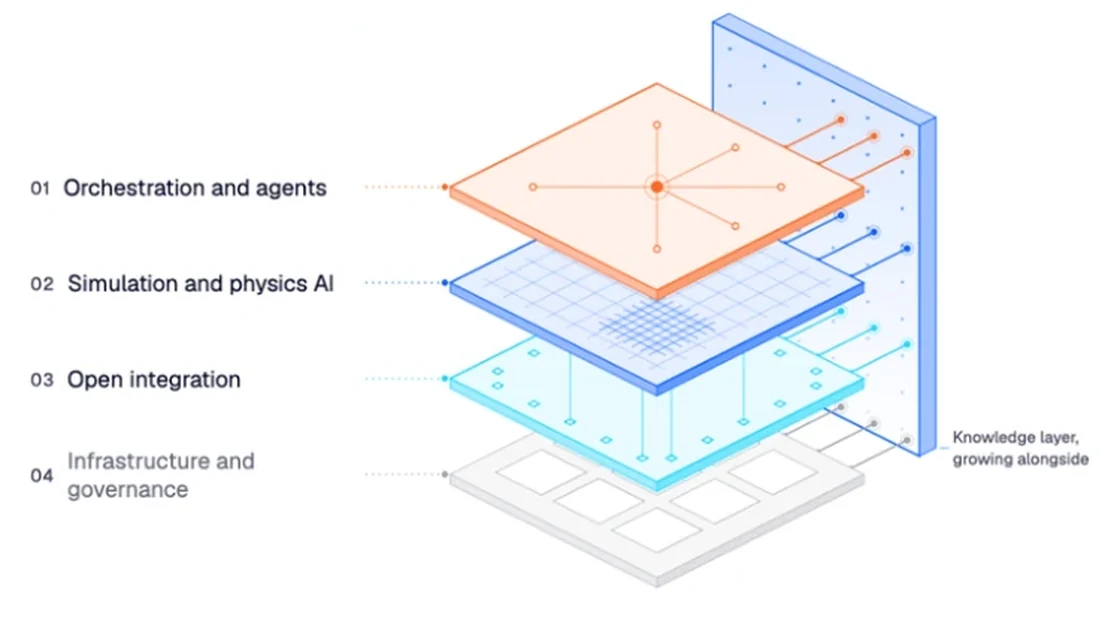
The Engineering AI Blueprint
The reference architecture for autonomous engineering workflows, including where the red line sits and how the harness enforces it.
Where engineers add the most value
The speakers at Agentic Unlocks saw human in the loop as a shift in where engineers spend their time.
Todd McDevitt expects engineering value to move to “the bookends”: upstream, defining the problem, the assumptions and the physics that matter; downstream, verification, sign-off and owning the decision. The middle, operating software and clicking through setup, is where agents do the work. As Ian McGann put it: “The job won’t change, but the role will change.”
Capgemini’s Matthieu Lebas summed it up in the Engineering AI Blueprint: “autonomy is not authority: agents execute and orchestrate, engineers stay accountable.”
Frequently Asked Questions
Human in the loop AI is a system design where a person reviews, approves or corrects AI output at defined points before it’s acted on. In engineering, an AI agent may set up and run simulations on its own, while an engineer approves results before they change a design, a quote or a release.
Human in the loop is a way of controlling agentic AI. An agentic system plans and carries out multi-step work on its own. Human in the loop adds review gates where the agent must stop for a person’s approval, usually before irreversible or high-consequence decisions.
A deterministic system always gives the same output for the same input, like a simulation solver. A probabilistic system, like a large language model, can give different outputs for the same input. Engineering AI combines both: the LLM plans the work, and deterministic tools and checks produce and verify the results.
At decisions that are irreversible or externally accountable, such as release to manufacture, safety-critical sign-off and requirement changes. Consequential but recoverable decisions, like which design variants to carry forward, suit an agent-proposes, engineer-approves gate. Routine, checkable steps like meshing and convergence can run without a gate.
Combine automatic checks with measured evidence. Constrain the agent with typed tool calls and permissions, run physics checks such as load vs reaction balance, review the agent’s traces, and track a pass rate against your own benchmark. Letting engineers re-run predictions in a full solver, as Thornton Tomasetti does, builds trust fastest.
Conclusion
Engineering AI needs a human at the right steps, and a system that makes the rest checkable. The teams at Agentic Unlocks put gates at irreversible decisions, built determinism into the harness, and judged their agents on traces and pass rates.
For the full architecture behind this, including where the red line sits and how the harness is enforced, read the Engineering AI Blueprint. To hear the speakers in their own words, watch Agentic Unlocks on demand or read the event recap.