Design Exploration
More options early. Fewer surprises late.
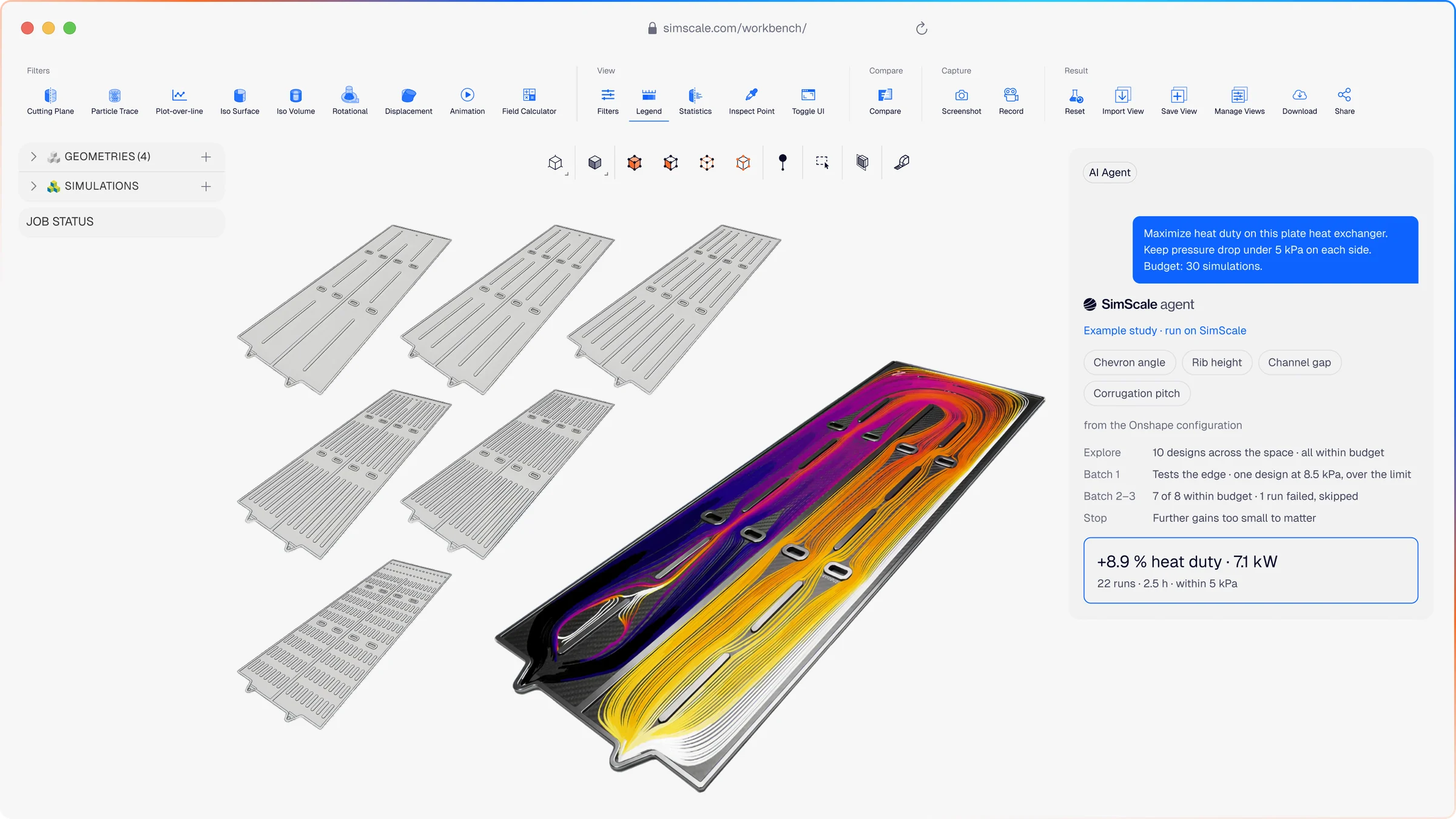
Give the agent your parametric CAD and the number you want to improve. It decides which designs are worth evaluating and runs them in parallel, so you find a strong design before changes get expensive.




Most of the design space never gets explored
A high-fidelity study can take days to set up and hours or days to run, and often needs a specialist to build the model and read the result. So teams simulate what they can afford, commit to a design, and spend the rest of the budget confirming it. Decisions stay conservative and better options go untested.
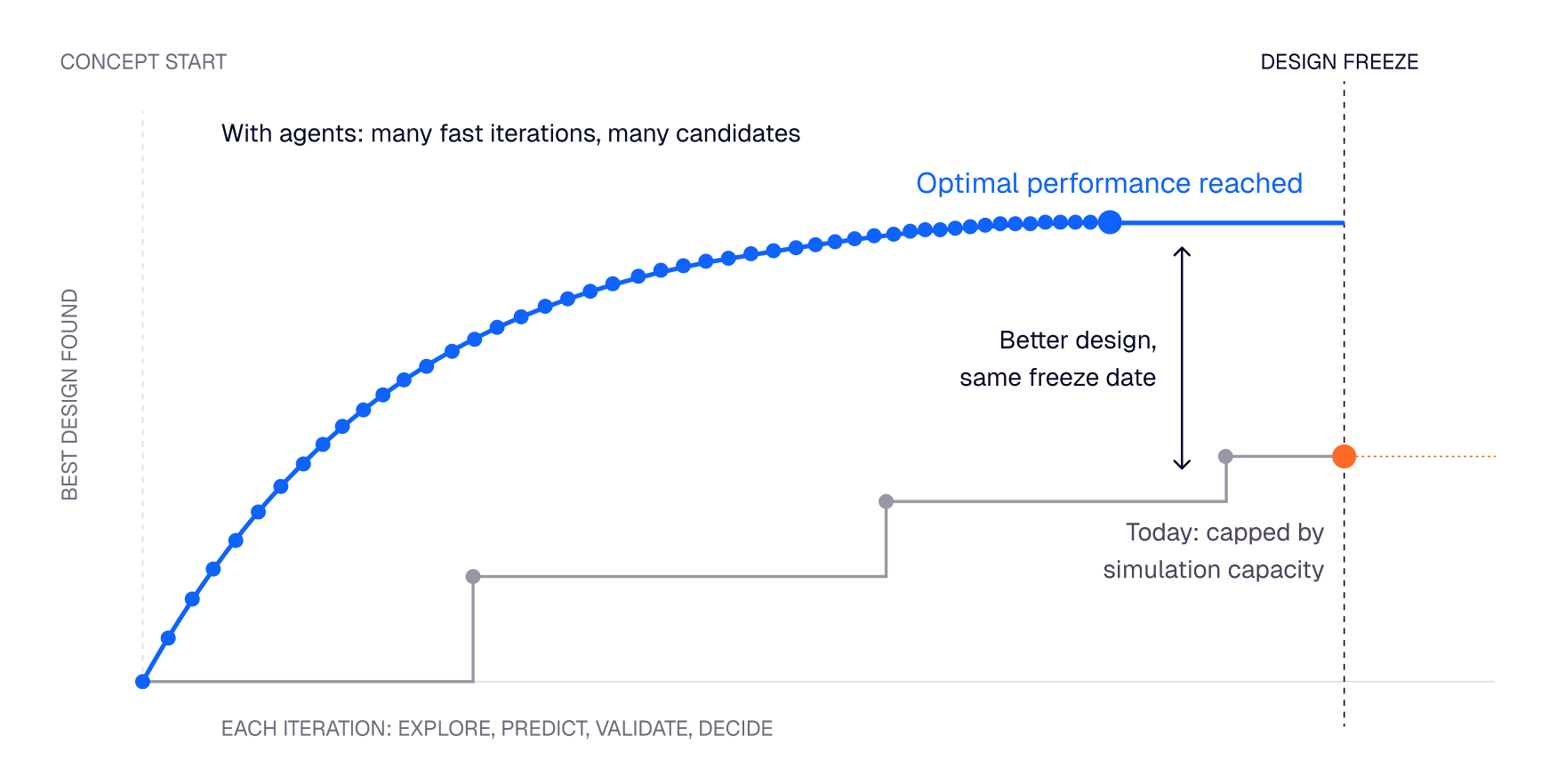
Design iterations before design freeze, today and with agents
Two ways to explore a design space
Use optimization to find the best design for one product. Train a Physics AI model when the same design space will be queried many times. Every answer traces back to validated physics.
Autonomous search
An optimization algorithm uses every result so far to decide which designs to simulate next. No training set up front.
- Run by SimScale’s agent, or by your own code through the API
- Your CAD tool in the loop
- Designs simulated in parallel in the cloud, with every result stored and comparable
Map the space, optimize in seconds
Train a model on tens to hundreds of simulations run in parallel. Then predict full results for any design in that space in seconds.
Which fits your study?
How long does one simulation take?
How often will you query this design space?
Design optimization
Let an optimization algorithm choose which designs to simulate, so every run counts. Run it with the agent or from your own code.
Optimization and Physics AI, side by side
Convion optimized a high-temperature gas recovery device for its solid oxide fuel cell and electrolyzer systems two ways: a full CFD optimization study, and a Physics AI model trained on hundreds of simulations run in parallel. Both reached the same design, with results within 5 % of each other.

“The real transformation comes from the reusability of the model.”
Armin Narimanzadeh
Manager, Thermofluids & Simulations
Months → under 1 hour
optimization cycles, across thousands of design variants
50 % less volume
for a design that met every performance target
Milliseconds
per prediction once the Physics AI model was trained
How an optimization study works
Each design is evaluated with Physics AI where a trained model covers it, or with a full simulation on SimScale’s solvers. An optimization algorithm, run by SimScale’s agent or by your own code through the API, decides which designs to evaluate next.
1 · Set up
Define the study
The parameters and ranges to vary, the metrics to improve and any limits.
2 · Generate
Build the variants
The agent or your code updates the parametric CAD for each design.
3 · Evaluate
Predict or solve
Physics AI predicts in seconds where a trained model covers the design. Otherwise a full solve runs, in parallel in the cloud.
4 · Choose
Pick the next designs
The optimization algorithm uses every result so far to decide what to try next.
5 · Decide
You review the best designs
Finalists are validated with a full solve. Compare them, with every design, result and decision recorded.
You provide
- Parametric CAD with the parameters and ranges to explore
- The metric to improve, and any limits
No simulation setup yet? SimScale’s agent can build it.
SimScale provides
- Hundreds of parallel cloud solves and Physics AI
- Every design and result stored and comparable
- API access for your own code
- A recorded study you can audit
FAQs about design optimization
No optimization method can guarantee it when every evaluation is an expensive simulation. What SimScale changes is how many designs you can evaluate: hundreds run in parallel in the cloud, with every result stored and comparable, so the search covers far more of the design space.
The failed run is recorded with its reason. SimScale’s agent can repair it or skip it and carry on. Your own code gets the same status through the API and can decide what to do.
Physics AI is a trained model that predicts results in seconds. It pays off when you’ll ask many questions about the same kind of design. Optimization is a search: it decides which designs to evaluate. They work together: an optimization can use Physics AI to screen designs and full simulations to confirm the best.
No. You can describe the study to SimScale’s agent in plain language. If you need a specific algorithm, or already have optimization code, drive SimScale through the REST API and SDKs instead.
Yes. Set limits on any result you track, such as a maximum pressure drop, and optimize for more than one objective when you need to.