The Challenge
- Architects and designers requested wind studies from simulation specialists and waited, which meant long iteration cycles and bottlenecks on experts, licenses and hardware.
- SimScale’s browser workbench made cloud wind studies fast, but they still ran outside Rhino and Grasshopper, where TT’s designers work.
- Decades of structural know-how sat with senior engineers instead of in tools that every engineer at the firm could use.
The Results & Next Steps
- Designers set up and run pedestrian wind comfort studies themselves from Rhino through the Digital Wind Tunnel app, including parallel studies with run time and cost estimates.
- Transient wind analyses run an order of magnitude faster than on traditional on-premises CFD.
- The same approach now powers TT’s machine learning apps, which size a braced steel frame in milliseconds instead of 2 to 3 hours.
- Next: a prototype AI wind tool that updates comfort results in 2 to 3 seconds, and Bender, an agent in Slack and Teams that designs from a prompt.
About Thornton Tomasetti
Thornton Tomasetti applies scientific and engineering principles to the design, construction and performance of buildings and infrastructure for clients across many industries. Its CORE Studio, the firm’s R&D and innovation team, builds the in-house design tools that around 2,000 engineers use.
Breaking the mold of the traditional simulation workflow
Many AEC firms follow a sequential model: architects and designers request simulation studies from analysts, then wait. That adds communication overhead and long iteration cycles, and it creates bottlenecks on specialists, on-premises licenses and hardware.
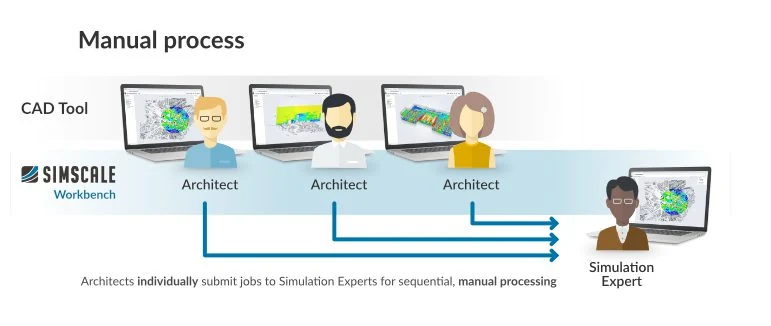
Thornton Tomasetti’s CORE Studio started changing that years ago by building in-house tools for architects and designers. The next step was CFD that’s easier to set up, more reliable and simpler to manage on compute and data.
Cloud wind analysis with the Pacefish® LBM solver
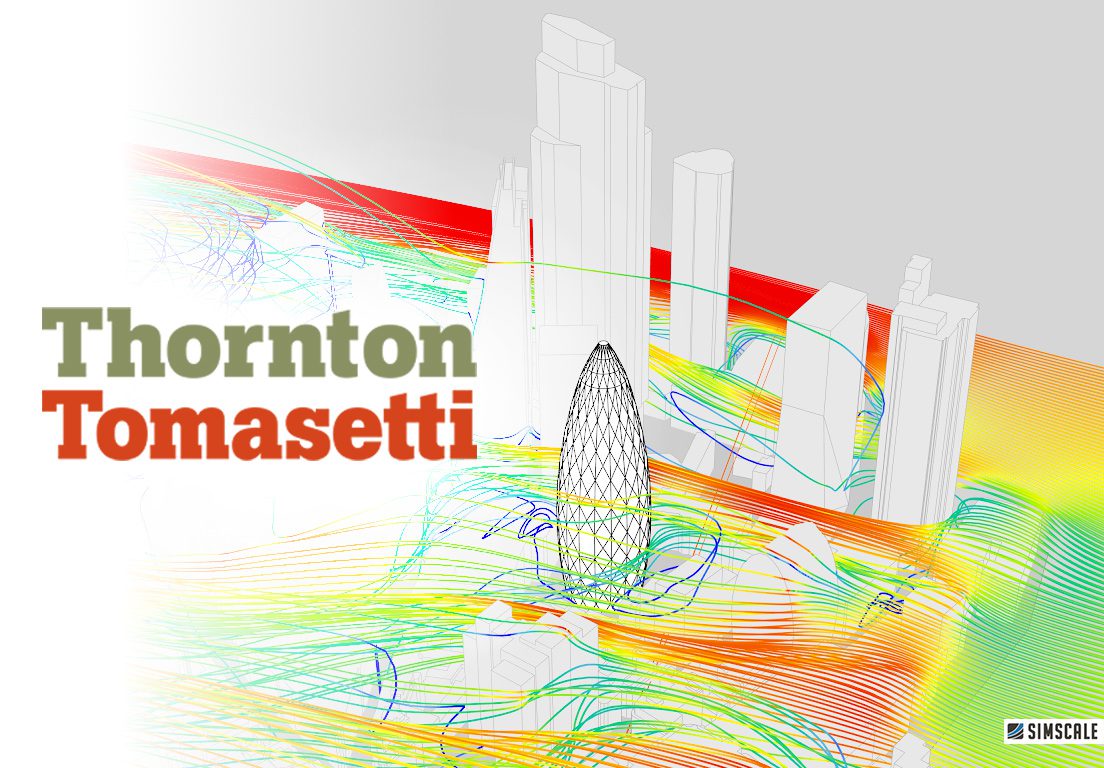
Thornton Tomasetti was an early adopter of the Pacefish® LBM solver that powers pedestrian wind comfort (PWC) analysis in SimScale’s browser-based workbench. The PWC tool evaluates the wind comfort and safety of a building or masterplan, and runs transient CFD an order of magnitude faster than traditional on-premises software. That let TT iterate on designs earlier.
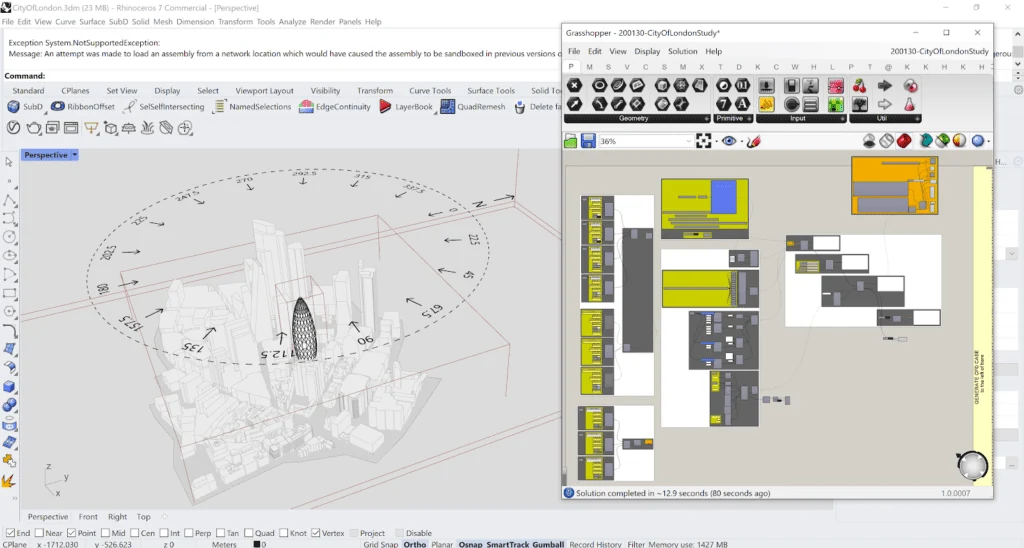
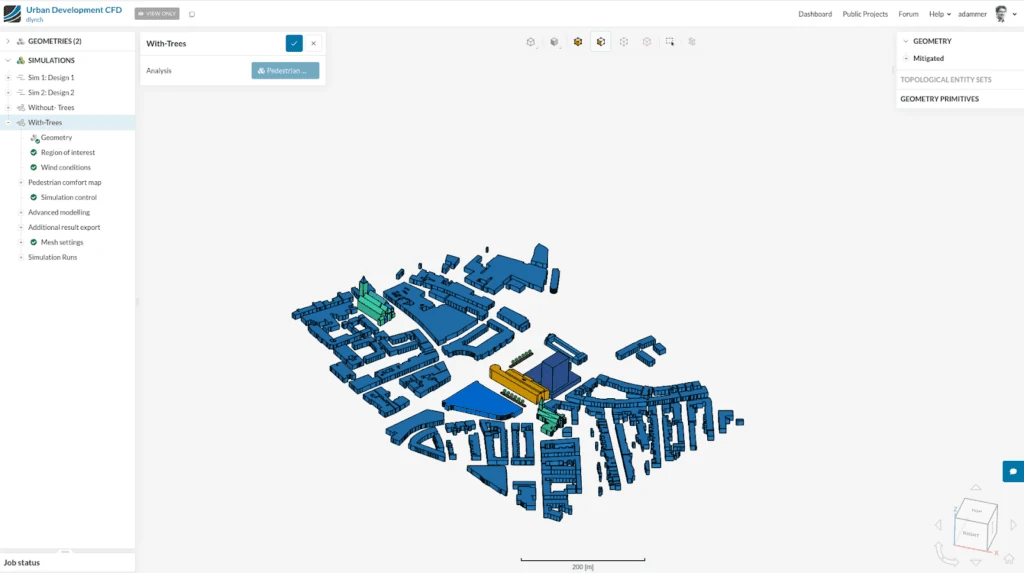
The workbench solved speed and compute. It didn’t yet connect to the tools TT’s architects already used every day, such as Rhino and Grasshopper.
The Digital Wind Tunnel app, built on the SimScale API
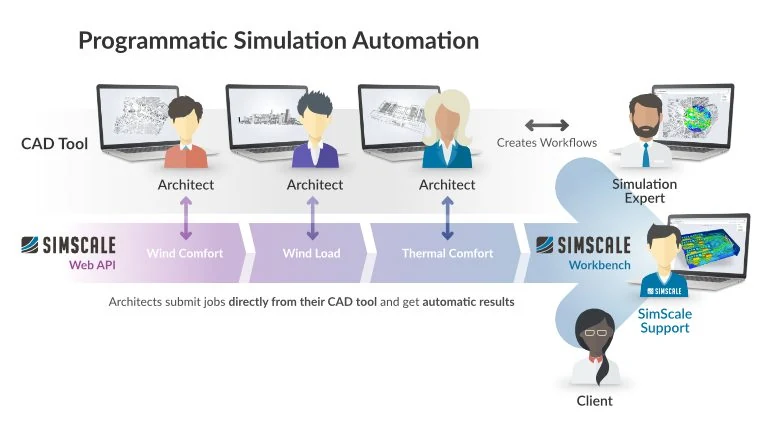
To close that gap, CORE Studio built on the SimScale API, which lets external software use SimScale’s geometry handling, meshing, simulation and result processing. With Rhino and Grasshopper on top, the team created the Digital Wind Tunnel app. Designers send geometry to SimScale, run the study in the cloud and get results back in their modeling environment.
Jeroen Janssen
Associate Director, Thornton Tomasetti

“The digital wind tunnel app created by the CORE Studio Group is a CFD app using wind simulations for urban developments and looking particularly at PWC, structural wind loading, facade pressures, and integrating these analysis types into our digital design workflows. The app is really for the larger pool of engineers who might not be CFD experts but can run a quick simulation without leaving the rhino design environment.”
A designer or architect can now set up wind studies alone, including parallel studies, with run time and cost estimates just as in the workbench. Collaboration and admin features let expert users manage and quality-check the process, with no CFD software or hardware to maintain.
Jeroen Janssen
Associate Director, Thornton Tomasetti
“We wanted to develop and distribute an app within our office, powered by the SimScale API, so more of our users could run a simulation, especially at the earlier design stages. For example, we can look at very tall buildings and use CFD early on to get an understanding of wind loading, then use this in design, go through multiple iterations and feed those results back into the structural analysis.”
From wind studies to machine learning design apps
The wind app proved a pattern: put analysis inside the tools designers already use, and it spreads beyond the specialists. CORE Studio has since applied the same pattern to AI in structural engineering. The goal, as Jeroen put it at Agentic Unlocks, is to:
Jeroen Janssen
Associate Director and CORE Studio UK Lead, Thornton Tomasetti
“give all of the firm knowledge, all of the 70 or so years that the firm’s been operating into the hands of basically any colleague, anyone that comes through the door”
Data, machine learning and MLOps
TT’s approach has 3 parts. The data comes from analysis sets of simple structural members, such as steel columns, timber columns and concrete beams. Machine learning models train on hundreds of thousands of those analyses, and the small models combine into larger, more complex systems.
The third part is MLOps. TT built its own platform, Cortex, to store trained models and issue internal API tokens. Engineers call the models from Python scripts, Rhino, Grasshopper and web tools without being machine learning experts themselves.
The speed difference is large. Sizing a braced steel frame by conventional calculation can take 2 to 3 hours; a micro-app built on the trained models returns it in milliseconds. Where a project team would once check tens of options, it can now check hundreds or thousands.
From Asterisk to Asterisk 2.0
TT’s first tool, Asterisk, launched in 2018 in Rhino. It was well used, mostly on competition-style projects, but engineers found it hard to trust because it worked like a big black box.
So the team broke the problem down into micro-apps that each answer one question, such as sizing a truss, a timber column stack or a steel bay. Asterisk 2.0 combines 30 to 40 of them to scheme a whole building and compare options on steel tonnage and embodied carbon at concept stage, when changing the structural system is still cheap.
How engineers learned to trust the predictions
Trust was the main barrier, and TT built a check into the workflow. From the web app, an engineer downloads the ML-predicted model already set up for FEA in SAP2000, runs it and compares. Utilization ratios match the prediction within a few percent.
Jeroen Janssen
Associate Director and CORE Studio UK Lead, Thornton Tomasetti
“They actually match to a few percent and I’m happy with that. They do that two times and then they’re off to the races and actually use the tools.”
AI wind comfort in seconds
Wind is following the same path. Next to the Digital Wind Tunnel app, TT has a prototype AI wind tool trained on a few hundred to a few thousand wind analyses. It updates the pedestrian wind comfort picture in 2 to 3 seconds as the massing changes, so designers can test options live.
Bender: a steel building from a prompt
TT is now bringing these tools into Slack and Microsoft Teams. In the session, an engineer asked Bender, TT’s agent, to design a 3-by-3-bay, 3-story steel building in New York. Bender is still emerging, and it follows the same rule as everything before it: meet engineers where they already work.
3 lessons from Thornton Tomasetti for AI in AEC
- Build trust first. Give engineers a way to check predictions against a tool they already trust, such as a full FE run in SAP2000.
- Take small steps that don’t disrupt current work. Micro-apps that answer one question got adopted where one large black box didn’t.
- Serve engineers in the tools they already use. Rhino, Grasshopper, Python, Slack and Teams, for wind and structure alike.
SimScale builds on the same thinking. Engineering AI automates simulation setup and workflows, and Physics AI trains on your own simulation results to predict new designs in seconds. See how AEC teams use wind simulation, urban microclimate simulation and simulation for architecture, engineering and construction.
Frequently Asked Questions
Thornton Tomasetti runs cloud CFD wind studies, including pedestrian wind comfort, through the SimScale API. Its Digital Wind Tunnel app sends geometry from Rhino and Grasshopper to SimScale and brings the results back into the modeling environment.
It’s an in-house Rhino and Grasshopper app built by Thornton Tomasetti’s CORE Studio on the SimScale API. Designers who aren’t CFD experts use it to run pedestrian wind comfort, wind loading and facade pressure studies, including parallel studies with run time and cost estimates.
Machine learning models trained on hundreds of thousands of analyses size structural members and systems in milliseconds. Engineers call them through TT’s Cortex platform from Rhino, Grasshopper, Python and web tools, and compare schemes on tonnage and embodied carbon in Asterisk 2.0.
At Thornton Tomasetti, engineers download the ML-predicted model already set up for FEA in SAP2000, run it and compare. Utilization ratios match the prediction within a few percent.