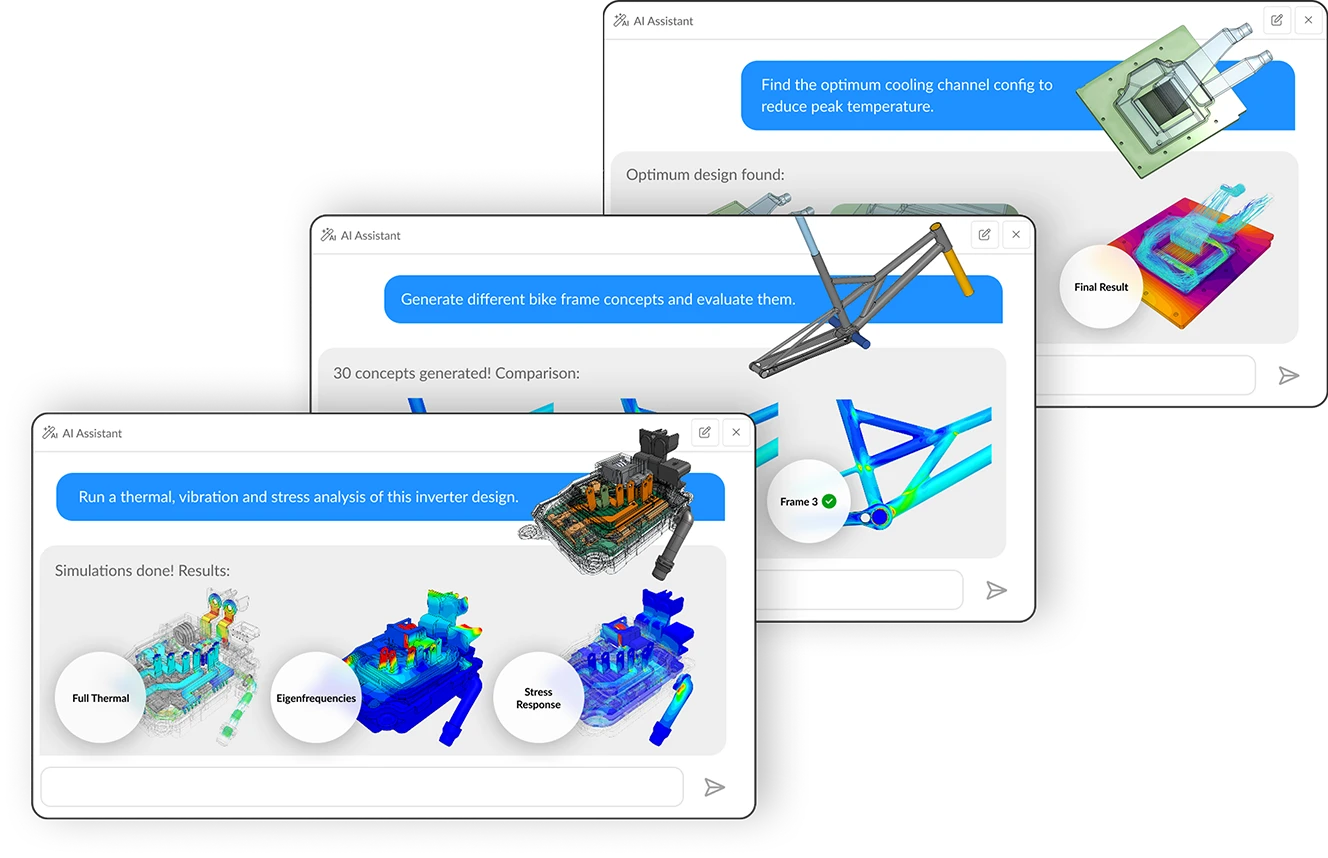

What happens when a design review agent and a simulation agent can actually coordinate across platforms? That’s what Jon Wilde, VP of Product at SimScale, and Jeremy Andrews, Co-Founder and CTO of CoLab, demonstrated live at Design & Simulation Week 2026, hosted by engineering.com.
Between them, they covered why AI has transformed software engineering but stalled in hardware, where simulation time actually gets lost, and what a working proof of concept of two AI agents talking to each other looks like in practice.
Here are the five things that stuck.
Watch On Demand
Watch the full webinar, part of engineering.com’s Design & Simulation Week 2026.
1. The real time sink is everything around the simulation
Jon opened with a distinction that’s easy to miss. Simulation cycle time — mesh, solve, post-process — and simulation lead time, everything that happens before and after, are two separate problems. The industry has mostly been optimising the first one.
Cycle time gains are real but limited. GPU acceleration delivers a few multiples. Physics AI can compress solve time to near-zero, but only after you’ve trained the model. And simulation is already fairly democratised: what a designer could be doing upstream, they mostly are.
Lead time is where the hours actually go. Jon cited a company currently waiting 18 months between handing off a design and receiving simulation results. The solver isn’t the bottleneck. Communication overhead is — unclear briefs, context lost between the designer and simulation engineer, weeks spent figuring out what to simulate and how to describe it.
Engineering AI targets that gap.
2. Physics AI and Engineering AI work as a loop, not alternatives
One of the clearest contributions of the session was Jon’s framing of the two AI types as complementary.
Physics AI is about prediction speed. Train a model on enough simulation data and it replaces the solver, returning results in seconds with no mesh, no CAD cleanup, and accuracy within 5% of a full run. It requires upfront training data investment.
Engineering AI handles orchestration. It reads your intent, builds a plan, sets up simulation conditions, handles uncertainty when something goes wrong, and interprets results. No pre-trained data needed — just context, provided the way you’d brief a new engineer.
The combination is where the real compression happens. Engineering AI can call Physics AI in a tight loop, running thousands of design evaluations in the time a single traditional simulation would take. Jon demonstrated this live with a server rack thermal optimisation: the agent explored a parameterised design space using Physics AI predictions, then ran a full simulation on the best candidate to validate.
3. Building an agent looks more like training a person than writing a script
Jon spent time on something most demos skip: how you actually build one of these agents.
You identify a workflow that’s high-impact and repeatable, then write down how you’d explain it to someone new — the assumptions you make, the steps that feel obvious, what would go wrong if a detail got missed. For the drop test agent, that meant explaining that you don’t simulate the full meter of fall. You place the object 1 cm from the floor and assign an initial velocity equivalent to free-fall from 1 m. It’s the sort of thing you probably realised on day one of running drop test simulations but you probably have not written down before, but crucial context for an agent.
From there, the agent can apply the same logic to any model it’s never seen before, reason through contact pairs, and set up the simulation without being walked through it again. That context can then be handed to a colleague with no further training required on their end.
4. Design review is where the engineering insights are needed
As AI makes it faster to generate candidate designs and simulation results, design review becomes the primary activity engineers spend time on — and from Jeremy’s point of view, a natural place to trigger everything else in the process.
CoLab’s current position is digitising design review: consolidating what used to live across emails, slide decks, and disconnected meetings into a single web environment where 3D models, drawings, and feedback sit together. A side effect of that digitisation is data — not just what changed in a design, but why. That record of engineering reasoning is what powers Auto Review and Operator, CoLab’s tools for automated feedback and conversational search across review history.
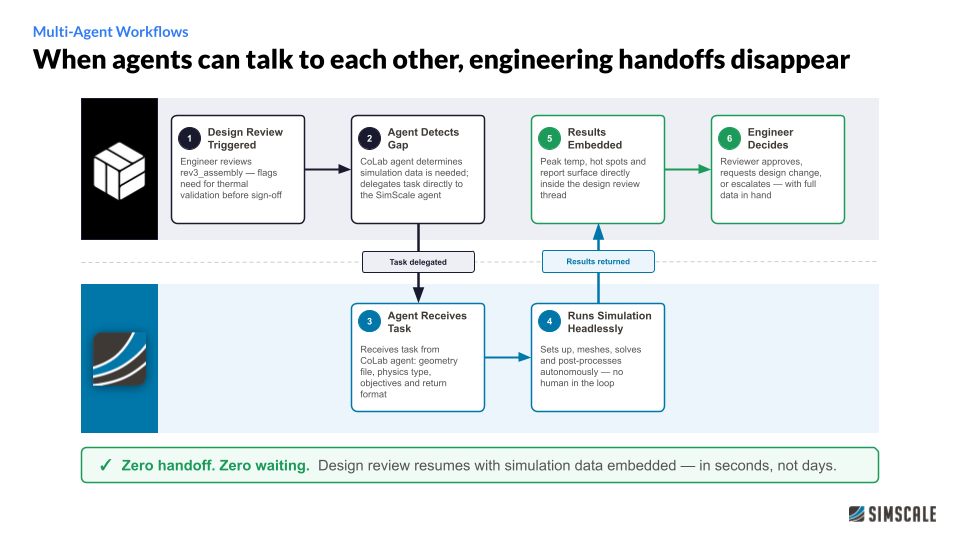
The longer play is using design review as the trigger point for downstream work. If a question surfaces mid-review — what happens to simulation results if this feature changes — the current answer is an async loop that takes a week.
In the world Jeremy described, the design review agent asks the simulation agent, gets a result, and brings it back into the review before the meeting ends.
5. The proof of concept is already running
That scenario is already working. Earlier this year, CoLab and SimScale engineers worked together to build a live integration: enabling the CoLab AI agent to request a simulation on a design file, hand it to the SimScale Engineering AI agent, set up and run it autonomously, then pipe results — including clarifying questions for the user — back into CoLab’s review interface.
The human stays in the loop throughout. The agent pauses, checks its setup, and surfaces questions to the right person at the right moment. Results come back as 3D visualisations and tabular data, directly inside the review. Engineers can annotate, pin feedback, and reach a decision without leaving the environment or waiting a week.
Jon shared the data behind why this matters. Companies using agentic workflows are exploring at least three times more design variants before finalising, turning around RFQ responses three times faster, and in close to 90% of cases letting agents make routine decisions autonomously.
As Jeremy put it, the goal right now is getting to the right answer faster, not bypassing validation entirely. Checks still happen — at the end of a much shorter loop.