
Almost every engineering team is now experimenting with AI. Very few have it running in production. Capgemini Engineering, which helps R&D organizations across automotive, aerospace, rail and energy bring AI into product development, puts the share of its clients who feel they’ve scaled AI at fewer than 10%.
SimScale’s own numbers tell the same story. In our yearly survey of engineering leaders, the share of teams experimenting with AI jumped between 2025 and 2026. The share running mature, trusted AI programs in production barely moved. When we polled the audience of our Engineering AI Blueprint webinar in November, 8% were in production and 10% had scaled.
So the hard part of AI implementation in engineering is getting a pilot into the way your team designs, simulates and signs off products. This guide pulls together what practitioners from Capgemini, Siemens, NVIDIA, Dolphin, Generative Engineering and Aibuild shared at Agentic Unlocks 2026 into a 6-step roadmap.
The Engineering AI Blueprint
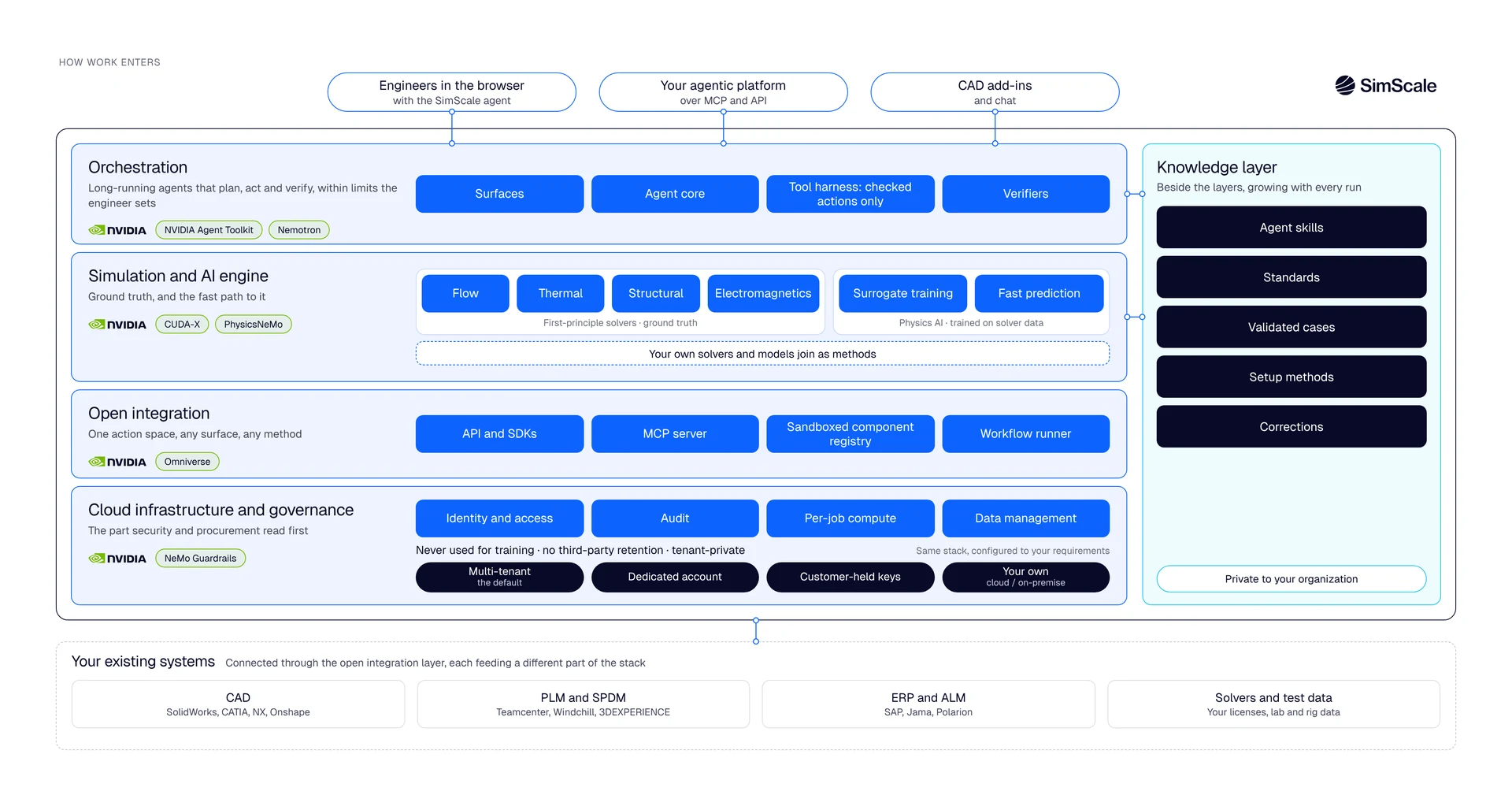
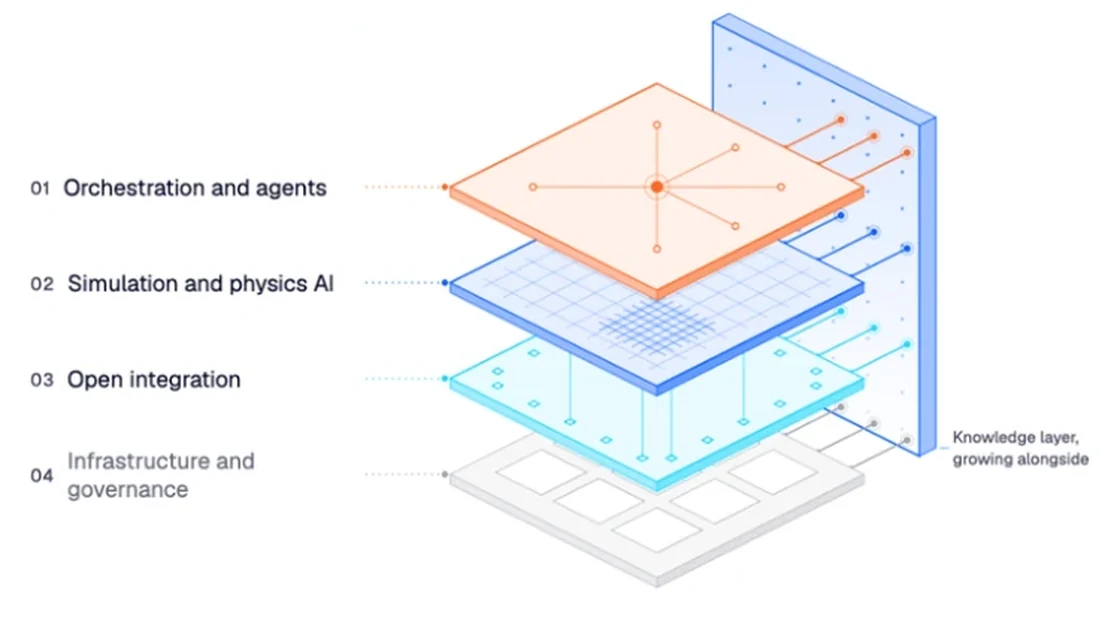
The reference architecture for autonomous engineering workflows: what changes when agents run for hours, the stack they need underneath, and where the autonomy red line sits.
Why AI pilots stall before production
An AI pilot stalls when it proves value on its own but never becomes part of the development process. Marco Morone of Capgemini Engineering called this the main challenge for clients today: many have pilots that show significant value, and those pilots still sit outside the current development process.
Three things keep them there, according to Capgemini’s customers:
- Cost. Pilots are already expensive. At scale, token costs come on top of compute and software licenses.
- Reliability. Engineering can’t accept a made-up result, so the system has to be grounded in the right tools and data.
- People. Engineers who’ve followed the same methods for 20 or 30 years need training and support to work with agents.
Hardware adds its own friction. As SimScale CEO David Heiny put it when he opened Agentic Unlocks, releasing a physical product takes many experts, many tools and many data formats. No frontier model can take on that whole chain out of the box yet.
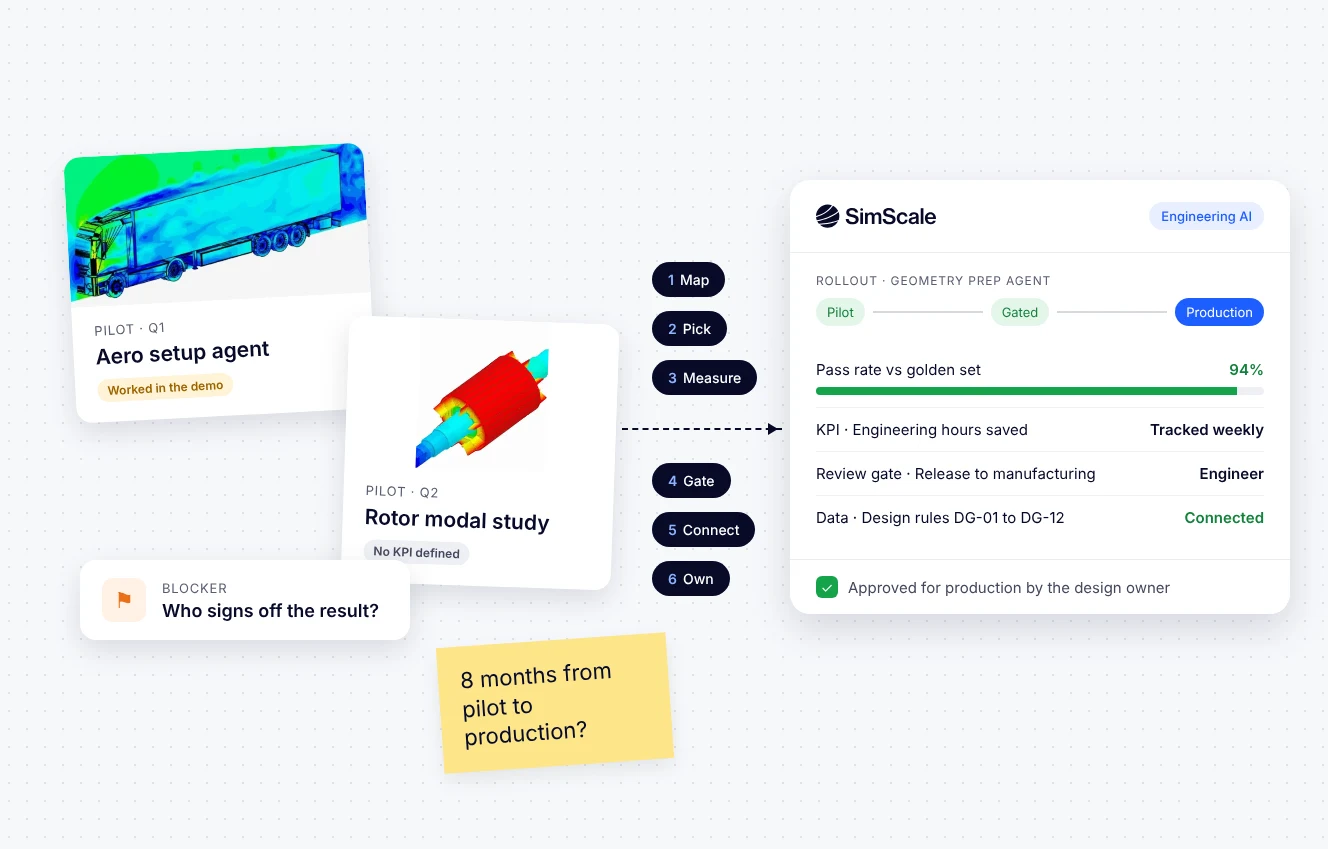
The State of Engineering AI 2026 report puts the average time from pilot start to first production deployment at around eight months. The steps below are how teams shorten it.
A 6-step AI implementation roadmap for engineering teams
1. Map the workflow before you choose a tool
Start with how your team works today. Capgemini begins every large rollout with a process and workflow assessment: where the bottlenecks are, which tasks eat time, and which problems engineers and the business already point to.
Then think about the whole development flow instead of one task at a time. “It’s not just like AI is an add-on,” said Matthieu Lebas of Capgemini Engineering. Adding AI changes the way of working, so the workflow has to be redesigned around it.
Dolphin, which has 40 years of heat exchanger and cooling system designs behind it, reached the same conclusion from the customer side. Executive Director Mohammed N.J. told the audience: “Do not start at the tool. Start with a record that you already own. Prove one pathway with it and build a capability to own the rest.” Dolphin’s first pathway runs from the customer’s RFQ to a validated design, which we cover in RFQ automation for engineer-to-order teams.
2. Pick one workflow you can check
“Think big, start small” was the first piece of advice from the Siemens and NVIDIA panel: pick one workflow and start now.
The closing panel added what makes a workflow a good first pick:
- You already know how a human will review the result. Laurence Cook, co-founder and CPO at Generative Engineering, uses geometry preparation as the example. An engineer can see straight away whether the agent removed the right features and tagged the right faces. An open-ended task that returns a long PDF is far harder to judge.
- It runs weekly or daily. Jack Sandiford, product leader at Aibuild, pointed to routine work such as CAD edits, drawing checks and design reviews. A task you do twice a year never builds up enough examples to learn from.
- You can compare it with an engineer. Give the agent and one of your engineers the same job and see whether the outputs match.
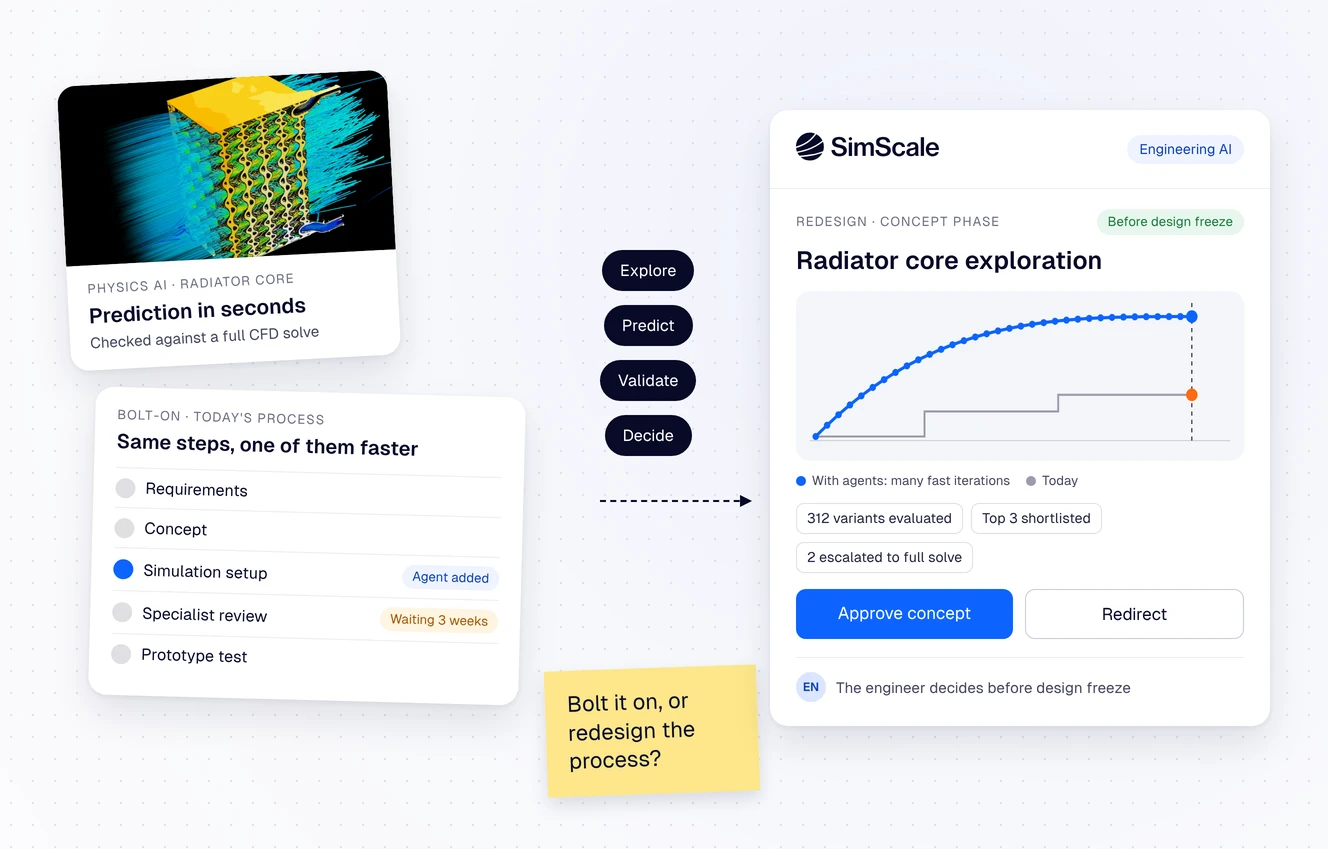
To rank candidates, David Heiny uses the RICE score SimScale applies to its own product priorities: reach times impact times confidence, divided by effort. Use cases that hinge on efficiency alone, with no business metric behind them, tend to lose their budget.
3. Set economic and technical KPIs before the pilot starts
Capgemini writes economic and technical KPIs into the redesigned workflow from day one, so management can see where AI pays back and where it doesn’t. Most teams skip this. In the Agentic Unlocks live poll, more than 1 in 5 teams hadn’t defined any AI KPIs at all.
Plan for three cost lines. Todd McDevitt, who manages developer relations for CAE at NVIDIA, listed them as the LLM, the license for the engineering software the agent calls, and the compute. Agents change the license math: an engineer might run 3 simulations at once, while an agent can start 300.
Benchmarks keep model choices honest. The Siemens panelists recommended preparing a set of benchmark tasks and re-running them as new models arrive, so decisions rest on measured results instead of gut feel or price alone.
4. Build trust into the harness and the gates
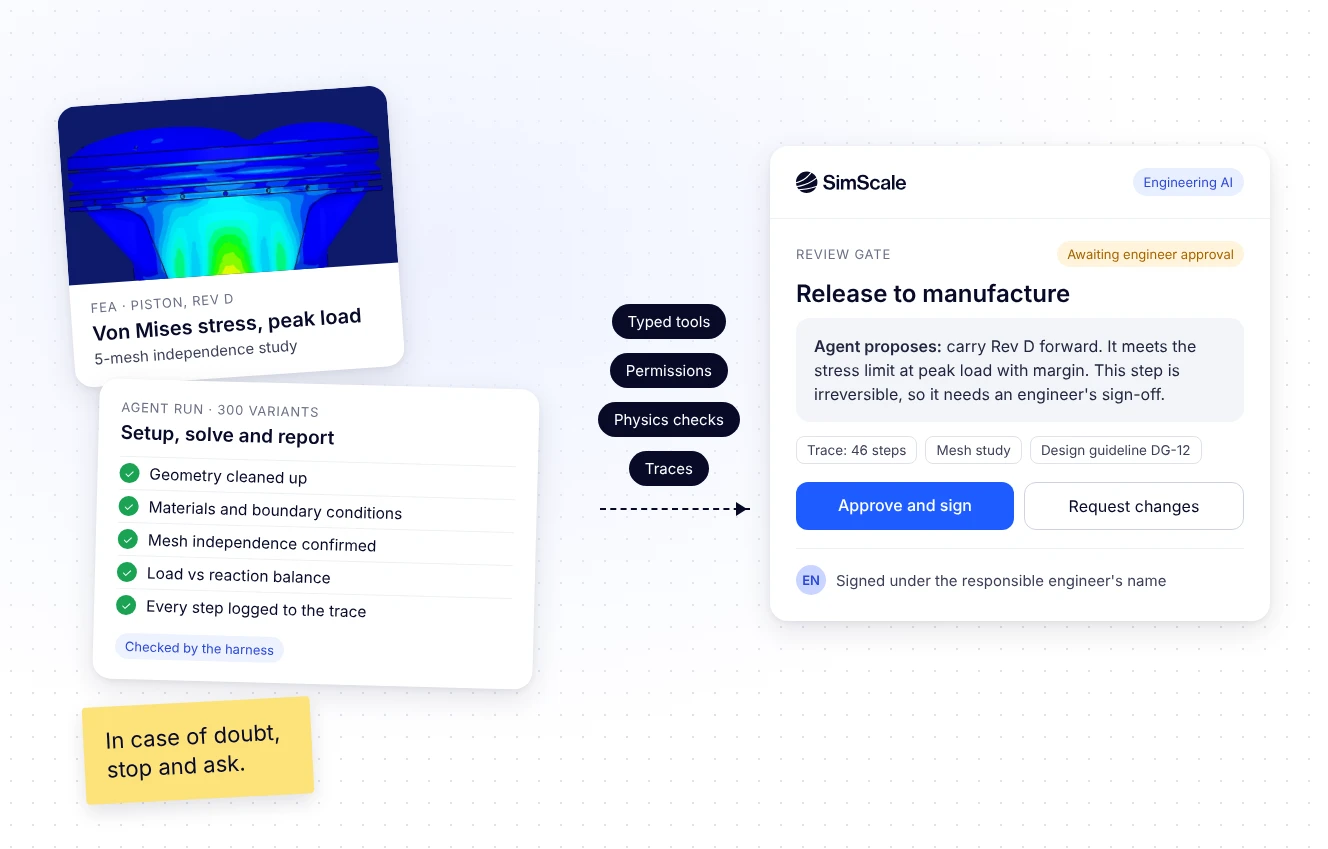
A language model is probabilistic. Engineers won’t act on a result they can’t check, so trust has to come from the system around the model. Todd McDevitt described how teams build that harness: typed tool calls, explicit permissions on which tools an agent can use, and physics checks such as mesh quality, y+ and loads versus reaction forces. “It’s important to judge the system on its traces,” he said, meaning the steps the agent took to reach its answer.
Capgemini places engineer-in-the-loop gates at several stages of every redesigned workflow, where engineers verify and certify the AI’s results before work moves on. Jack Sandiford’s rule for where those gates must sit: at any decision you can’t reverse, such as release to manufacturing or anything that spends money or cuts metal.
Before scaling, Jack wants a measured pass rate against a golden example or benchmark. Trust needs a number behind it.
5. Connect your toolchain and your company data
AI agents need data to move between engineering tools without manual handoffs. Capgemini calls this digital continuity: connecting CAD, simulation and other engineering software through APIs into one framework so an agent can work across them.
Company data is what separates a pilot from production. “One of the main differences of going from pilot to real thing is like hooking into real company data and like your own design practices,” said Laurence Cook. An agent that applies your design rules and learns from every project improves over time. One that doesn’t stays a demo, even on real work.
You don’t need perfect data to start. Jack Sandiford suggests capturing what lives in senior engineers’ heads now, before the platform decision. Our guide to capturing tribal knowledge covers how.
6. Build hybrid skills and decide what to own
Engineers who combine core engineering with agentic AI skills are hard to hire. Matthieu Lebas called the profile “the sheep with five legs,” a French saying for someone who has everything. Capgemini’s answer is small pod teams that put domain experts, discipline engineers and AI engineers together, plus training programs that build hybrid skills in existing staff.
On make or buy, Capgemini expects customers to keep ownership of their most core activities to protect IP and sensitive data, and to bring in engineering partners elsewhere to move faster. Dolphin is doing both: it runs simulation and agentic design with SimScale and builds its next two pathways in its own AI department.
What a scaled rollout looks like
Capgemini’s work with a German automotive OEM shows the structured version. It follows what is now Capgemini’s standard five-step approach for rolling AI out across an R&D department. Each use case it deploys also builds the shared foundation, toward a platform that orchestrates workflows across engineering departments. Off-the-shelf “assets” for known tasks are customized and deployed in the customer’s own environment.
Two results show what’s possible once a workflow is redesigned around AI:
- Aerospace: an agentic drawing checker cut drawing review time by 50 to 55% and improved review quality.
- Rail: agents analyzed mixed documentation (drawings, specifications, 3D models and spreadsheets) for a rolling stock system engineering team, cutting the time to generate and analyze requirements.
When Capgemini asked its customers where to start, documentation, requirements traceability and drawing comparison came up most. All three are low-risk, high-volume tasks.
How to measure AI ROI in engineering
Measuring AI ROI in engineering starts with the cost side, which is the easy part. Value is harder. Capgemini measures it through engineer productivity, cycle time reduction and quality improvement, and Matthieu Lebas expects it to show up in revenue in the end.
The Agentic Unlocks poll shows where engineering leaders put their own measures. Engineering hours saved came top at 31%, ahead of product or design performance (22%) and faster time to market (17%). Cost reduction barely registered.
Speed is the easiest gain to see early. Convion trained a Physics AI model on a design of experiments run in parallel on SimScale and cut a fuel cell ejector’s design loop from months to under an hour. The design it found takes up 50% less physical volume.
Off-the-shelf agent or build your own?
Your first move depends on whether you’re buying or building. If you’re using an engineering agent from a provider, Laurence Cook’s advice is to throw a hard problem at it. Capability has moved fast, and a skeptic from two years ago may be surprised. If you’re building your own, start small: agents are powerful but fickle, so begin with one workflow you can automate and a clear goal.
Either way, get hands-on. David Heiny’s advice to engineering leaders was to use AI systems for real engineering work, one step beyond office tasks, to understand what they can and can’t do. The Siemens and NVIDIA panel said the same: pick a workflow you understand, connect a coding harness to an LLM and start working with it.
For a broader view of where engineering teams sit today, read what the Agentic Unlocks audience told us about AI adoption and our earlier webinar with Accenture on escaping AI pilot purgatory.
Frequently asked questions
AI implementation in engineering is the process of moving AI from experiments into everyday product development work, such as CAD preparation, simulation, design review and documentation. It covers redesigning the workflow, connecting tools and data, setting KPIs, and putting engineer review gates where decisions can’t be reversed.
Most pilots prove value in isolation but never become part of the development process. Capgemini’s customers name cost, reliability and people as the three main blockers. Missing KPIs and disconnected engineering tools make the gap wider.
SimScale’s State of Engineering AI 2026 report puts the average at around eight months from pilot start to the first production deployment. Picking a routine, checkable workflow and setting KPIs up front shortens it.
It should show a measured pass rate against a benchmark or golden example, a clear way for engineers to review its output, and progress on the economic and technical KPIs you set at the start.
Most do both. Teams keep ownership of core activities that hold IP and sensitive data, and use partners and off-the-shelf agents elsewhere to move faster. If you buy, test the agent on a hard problem. If you build, start with one small workflow.
Start with one workflow
Pick a simulation your team repeats every week and try the SimScale agent on it. Explore Engineering AI, or read the Engineering AI Blueprint to see how agents, Physics AI and your existing tools fit together.
Move your first engineering workflow to production
Talk to our team about where agents fit in your design and simulation process.