
Most engineering teams have started with AI. Very few have scaled it. When we polled the audience at Agentic Unlocks live, just 1 in 20 said they’re moving AI from pilot into standard workflows.
More than 1,000 engineers and engineering leaders registered for the event in September. Between sessions, we asked them four questions: where their team is with AI, whether they’re on track, how they measure success, and where they see value today. Here’s what they said, along with some insights from speakers at the event who have already crossed this gap themselves.
Engineering AI adoption: 7 in 10 haven’t moved past experiments
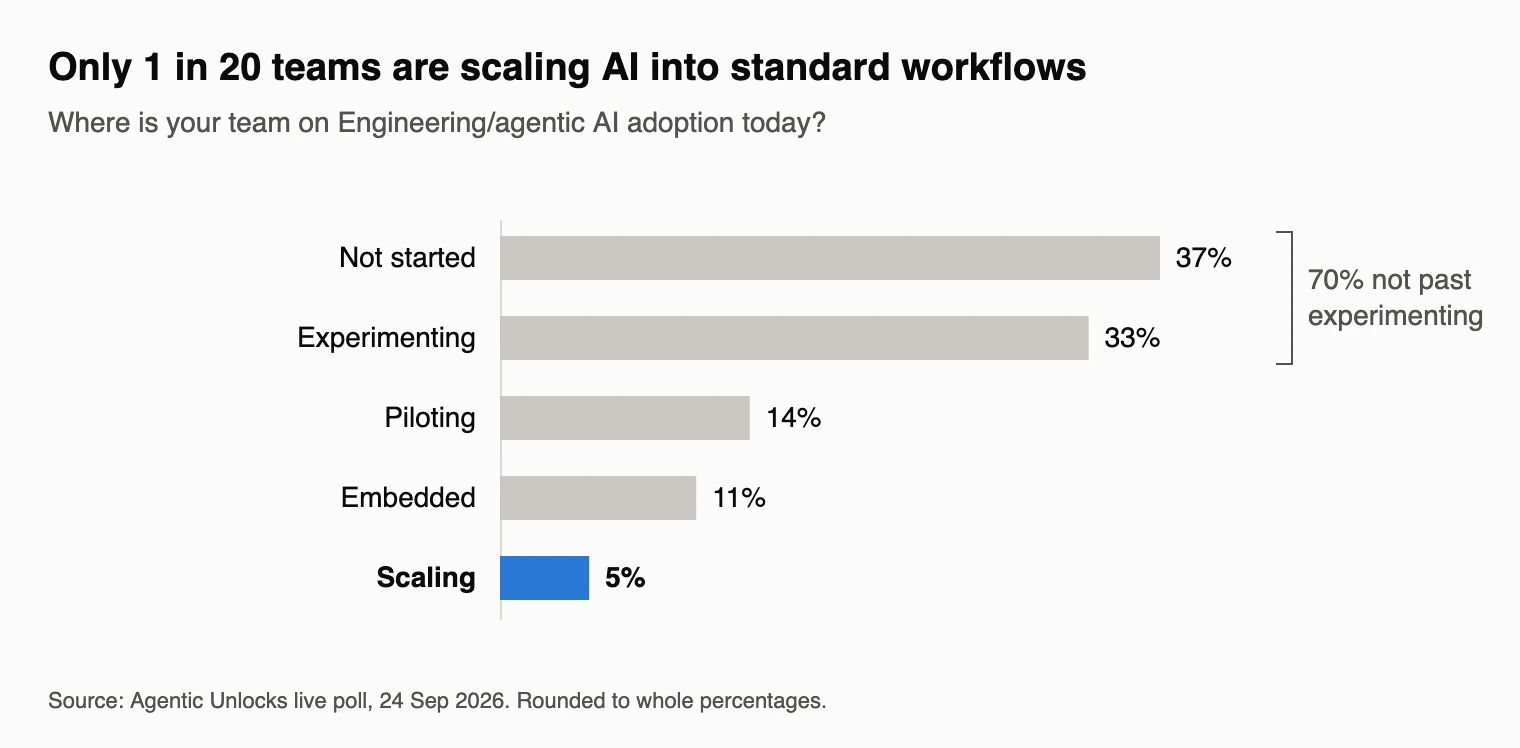
Seven in ten teams (70%) haven’t moved past informal experiments, and 37% haven’t started at all. Only 16% have AI embedded in day-to-day work or are scaling it.
That lines up with the bigger picture. Our State of Engineering AI 2026 survey of 350 engineering leaders at companies with more than 1,000 employees found pilots had nearly doubled year on year, while mature, scaled programs were still the exception. Capgemini’s Matthieu Lebas told the Agentic Unlocks audience the same thing from the consulting side: fewer than 10% of its clients think they’ve scaled AI.
AI pilot to production: more teams are behind plan than ahead
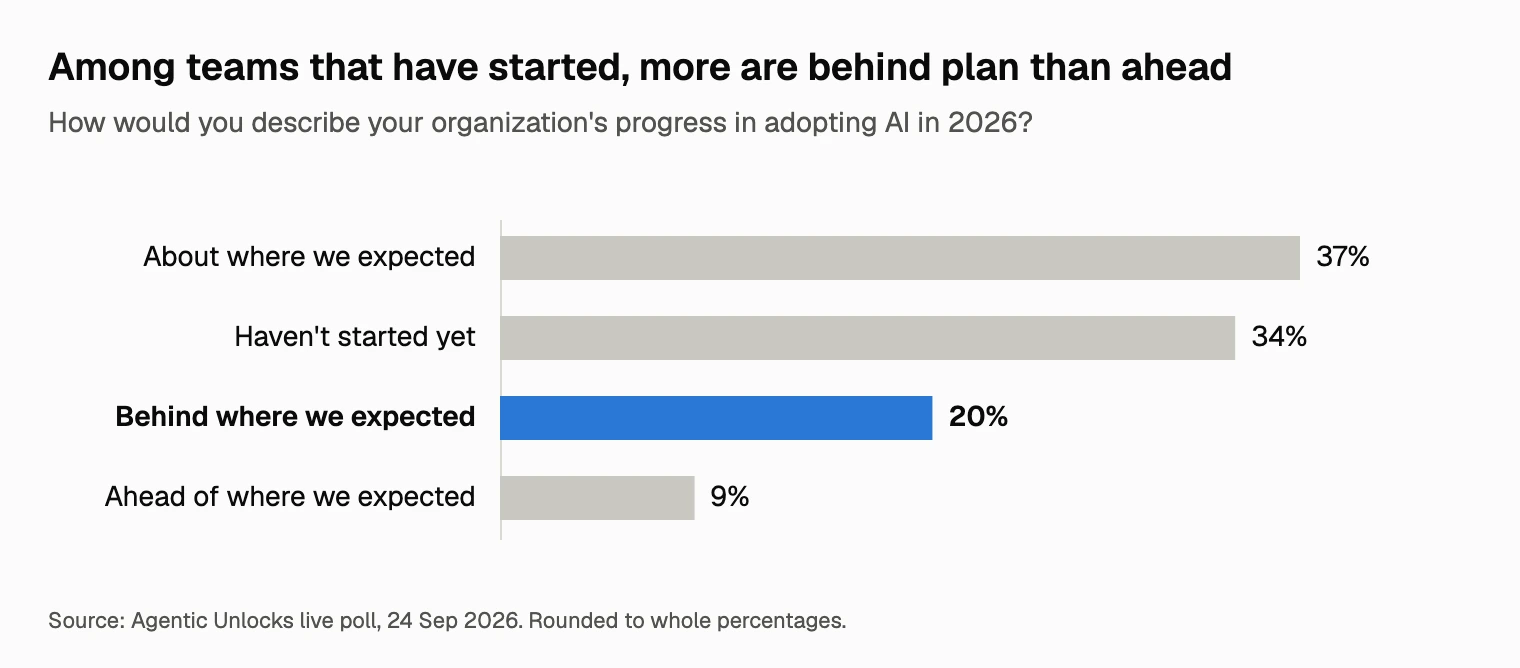
We asked how each organization’s AI progress in 2026 compared with what it expected. More than a third (37%) said they’re on track. Another 34% haven’t started.
Among teams that have started, the split is lopsided. More than twice as many are behind plan as ahead of it (20% behind, 9% ahead).
That’s the pilot gap in one number. Getting a pilot running is now routine; getting it into the everyday development process is where teams stall. Capgemini’s Marco Morone called this the main challenge for clients today: pilots that prove significant value but never become part of how the team works.
The 2026 State of Engineering AI report finds it takes around eight months, on average, to get from pilot start to the first production deployment.
How engineering teams measure AI success: hours saved, rarely cost
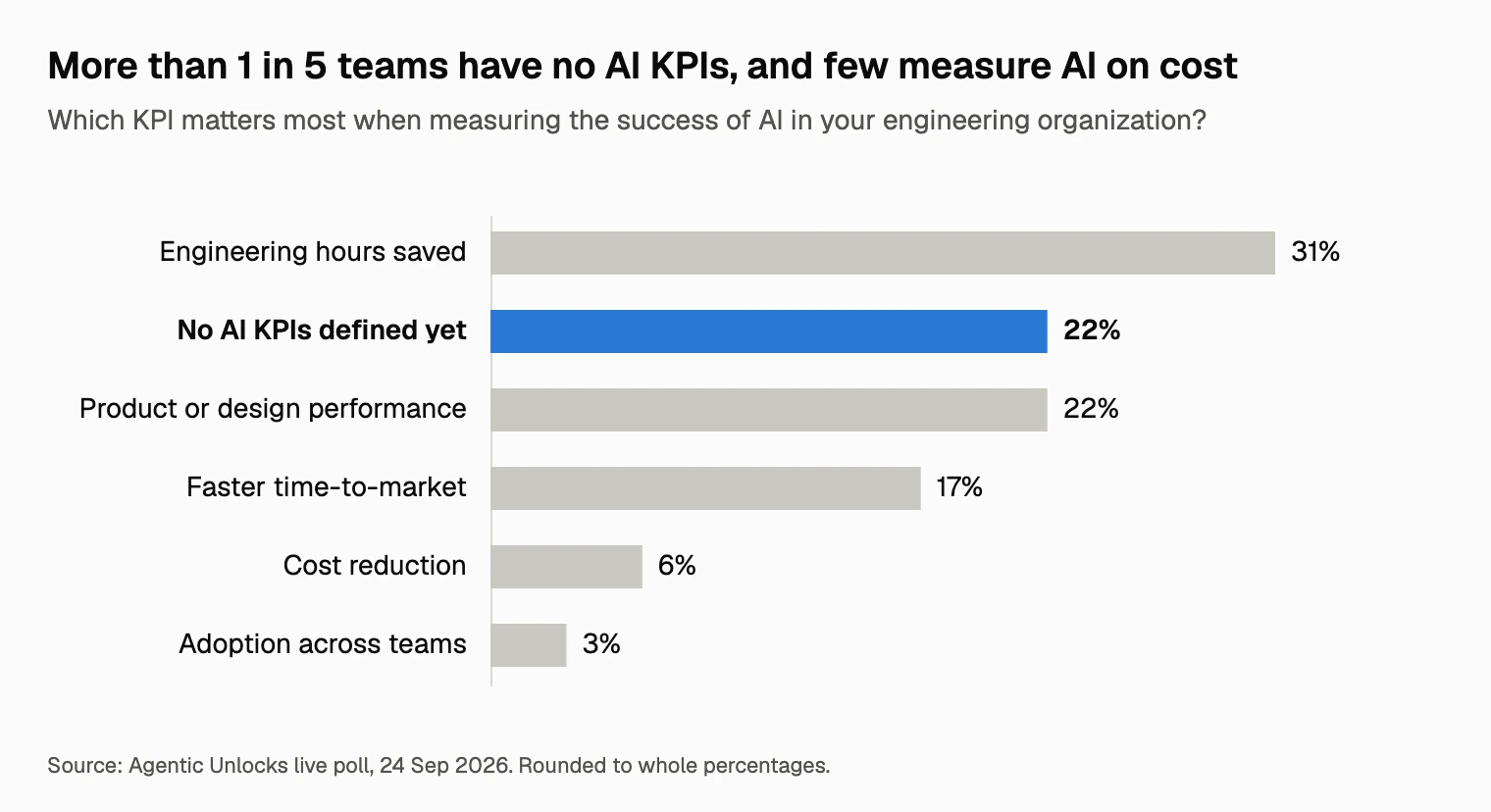
When we asked which KPI matters most for AI in engineering, engineering hours saved came top at 31%. Product or design performance (22%) and faster time-to-market (17%) followed. Two findings stand out. Cost reduction barely registers, which matches our 2025 survey, where reduced costs ranked lowest of all expected AI benefits. Engineering leaders want more design exploration and faster cycles, and they expect AI to pay back through better products.
The second finding is the risk. More than 1 in 5 teams haven’t defined any AI KPIs at all. Without a measure, a successful pilot is hard to defend and harder to scale.
Where engineering teams already see value from AI
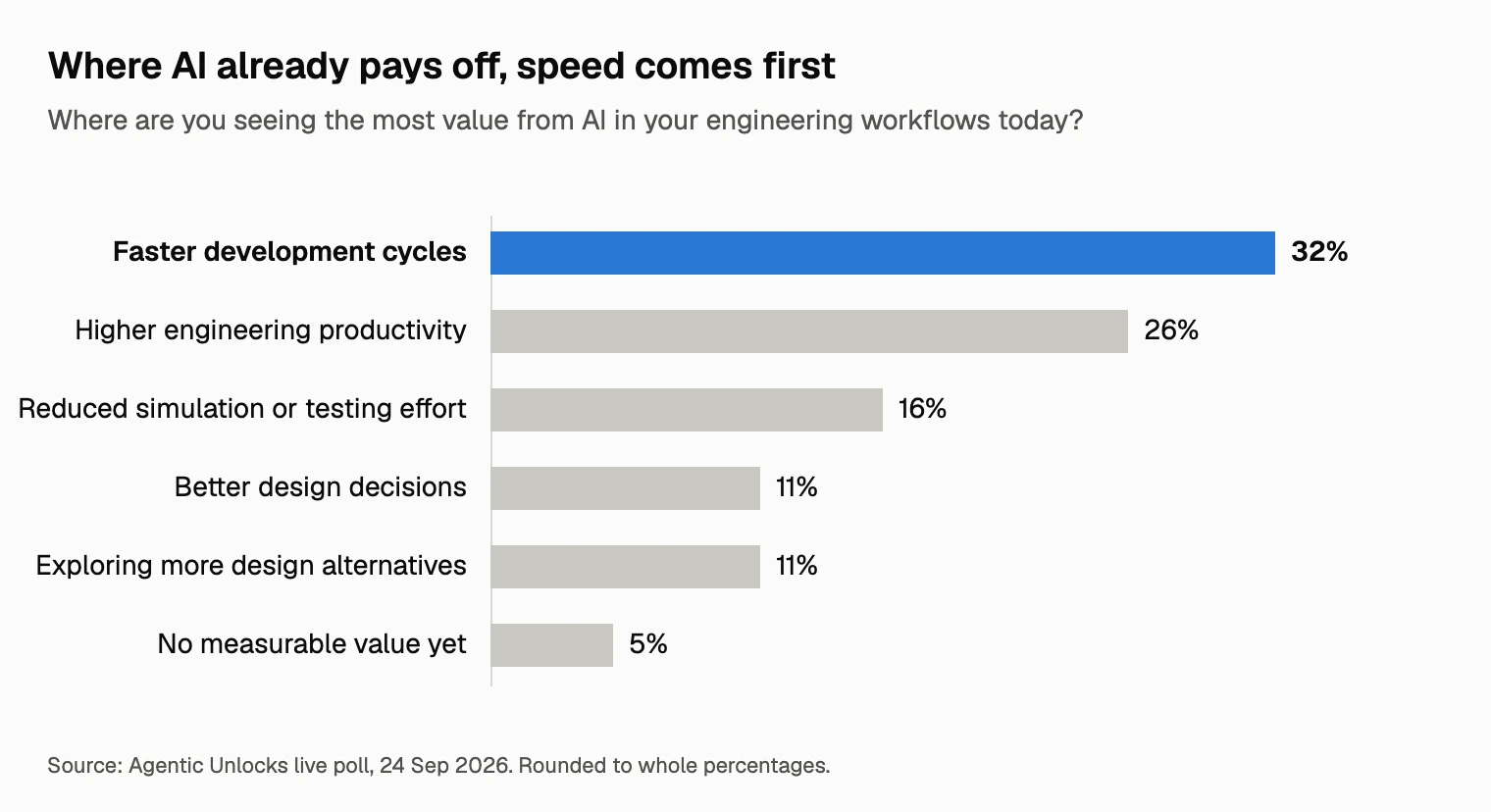
Later in the afternoon, we asked where teams are seeing the most value from AI today. Almost everyone who answered (95%) named at least one area of measurable value. Faster development cycles came top at 32%, followed by higher engineering productivity at 26%.
Speed comes first, and the customer stories at the event back that order. Convion used a design of experiments run in parallel on SimScale to train a Physics AI model, compressing its design loop from months to under one hour, with predictions within 5% of high-fidelity CFD. The design it found takes up 50% less physical volume.
How to move from AI pilot to scale: advice for each stage
The poll shows where teams get stuck. The sessions showed how teams got moving. Here’s the most practical advice from the day, matched to each stage.
Not started: pick the job your engineers hate most
Calum MacDougall of Dexory called it the “blank sheet problem”: “No one really knows where this technology sits very clearly.” His team started with repetitive setup. Each section of Dexory’s robot tower has 198 contacts and 192 bolted connectors, and the SimScale agent now sets them up consistently across sections, so results can be compared with physical tests.
Experimenting: start from data you already own
Dolphin spent time asking which tool to buy before changing the question. Executive Director Mohammed N.J. told the audience: “Do not start at the tool. Start with a record that you already own.” Dolphin is piloting Engineering AI and Physics AI on four decades of heat exchanger designs, targeting quote turnaround of 1 to 2 days, down from 3 to 15.
Piloting: set the KPIs before you scale
Capgemini’s advice to clients moving from pilot to production is to redesign the workflow around AI and set economic and technical KPIs up front, so management can see where AI pays back. With 22% of our respondents yet to define any AI KPIs, this is the step most teams can take next.
Embedded and scaling: make results checkable
At scale, engineers have to trust results they didn’t set up themselves. Thornton Tomasetti lets engineers download an ML-predicted structural model and run the FEA themselves. After doing that twice, Jeroen Janssen said, engineers “are off to the races.” NVIDIA’s Todd McDevitt argued for building determinism into the agent harness with typed tool calls, explicit permissions and physics checks: “It’s important to judge the system on its traces.”
Watch all 13 Agentic Unlocks sessions on demand
Real stories from Convion, Dolphin, Dexory, Thornton Tomasetti and more, plus live demos of the SimScale agent and Physics AI.

Conclusion
The gap between piloting AI and scaling it is where most engineering teams now sit. The teams that crossed it picked a first job with a clear payoff, built on their own engineering record, and gave engineers a way to check the results.
For the full sessions, watch Agentic Unlocks on demand or read our event recap. To see agentic simulation on your own models, explore Engineering AI.
Frequently asked questions
Very few. In the Agentic Unlocks live poll, 5% of respondents said they’re scaling AI into standard workflows and 11% have it embedded in day-to-day work. Capgemini puts the share of its clients who think they’ve scaled AI at under 10%.
The State of Engineering AI 2026 report puts the average at around eight months from pilot start to the first production deployment. Teams with mature AI programs get there in three to six months.
Engineering hours saved was the top choice in our poll (31%), followed by product or design performance (22%) and faster time-to-market (17%). Only 6% chose cost reduction. Whichever you choose, define it before the pilot so you can prove the result.
Pilots often prove value but never become part of the everyday development process. Speakers at Agentic Unlocks pointed to three fixes: start with a clear first job, build on engineering data you already own, and make AI results checkable so engineers trust them.