NEN 8100 grades a location by one number: the percentage of hours in a year that the hourly mean wind speed at 1.75 m above ground exceeds 5 m/s. That single threshold, applied to every activity, is what separates it from Lawson and Davenport, which set a different threshold speed for each activity. The result is five quality classes, A to E, and a separate danger check at 15 m/s.
It is the standard Dutch municipalities work from when they assess high-rise plans. Rotterdam, Amsterdam, Eindhoven and Tilburg each attach their own rules to it, and the standard’s own decision model calls for a wind study on any building over 30 m.
Download our ‘Wind Engineering’ white paper to learn about building design, wind loading implications, pedestrian wind comfort, natural and mechanical ventilation, pollution mitigation, and more. Download the white paper.
What is NEN 8100?
NEN 8100 is the Dutch standard for wind comfort and wind danger in the built environment, published by NEN, the Netherlands Standardization Institute, in February 2006. The most recent of the three main pedestrian comfort standards is the Dutch wind nuisance standard (NEN 8100), and it applies a discomfort threshold for the hourly mean wind speed of 5 m/s for all types of activities.
Depending on the exceedance probability of the threshold wind speed, the code defines five quality classes of wind comfort A to E. This standard also advises on dangers caused by wind.
The standard consolidated three decades of Dutch wind tunnel practice at TNO, which until then had scored comfort against Lawson and Penwarden thresholds, into one national criterion, and it replaced the inconsistent rules individual municipalities had been applying. It has not been revised since. NEN 8100:2006 is still the current edition, and the Netherlands is, as Blocken and other wind engineering researchers note, still the only country with a national wind comfort standard. Its companion document, NPR 6097:2006, supplies the wind statistics the assessment runs on.
Wind nuisance, or unfavorable wind conditions, are becoming more important as a factor to consider for both zoning and construction plans, as new high-rise buildings can create higher wind speeds and stronger gusts at the pedestrian level.
Reference height and averaging
NEN 8100 assesses the hourly mean wind speed at 1.75 m above ground, with no gust correction. The Lawson criteria are evaluated at 1.5 m to 1.75 m depending on the authority, and some Lawson variants use a gust-equivalent mean. Some third-party summaries of NEN 8100 get this wrong: they quote 1.5 m, or list “gust peak” thresholds of 2 m/s that do not exist in the standard.
NEN 8100 wind comfort classes A to E
Five classes, set by how often the hourly mean wind speed exceeds 5 m/s. Class A is exceeded less than 2.5% of the year. Class E is exceeded more than 20% of the year.
| Class | Hours above 5 m/s per year | Traversing (doorlopen) | Strolling (slenteren) | Sitting, long periods (langdurig zitten) |
|---|---|---|---|---|
| A | under 2.5% (under 219 h) | Good | Good | Good |
| B | 2.5% to 5% (219 to 438 h) | Good | Good | Moderate |
| C | 5% to 10% (438 to 876 h) | Good | Moderate | Poor |
| D | 10% to 20% (876 to 1,752 h) | Moderate | Poor | Poor |
| E | over 20% (over 1,752 h) | Poor | Poor | Poor |
Municipal policy compares the activity rating with the intended use of the space. A class C location is rated good for traversing and poor for sitting. The three activities are the standard’s own. Activity class I, traversing, covers sidewalks, cycle paths and parking lots. Class II, strolling, covers shopping streets and park paths. Class III, sitting for long periods, covers terraces, outdoor cafes and park benches.
Municipal policies set the required rating per activity. The Hague’s 2009 high-rise policy requires at least “moderate” for the intended activity. Eindhoven’s 2020 policy rule requires “good” for seating areas and building entrances and prohibits “poor” anywhere in a plan.
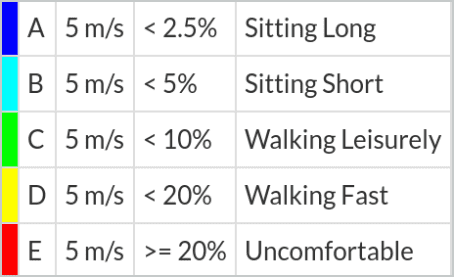
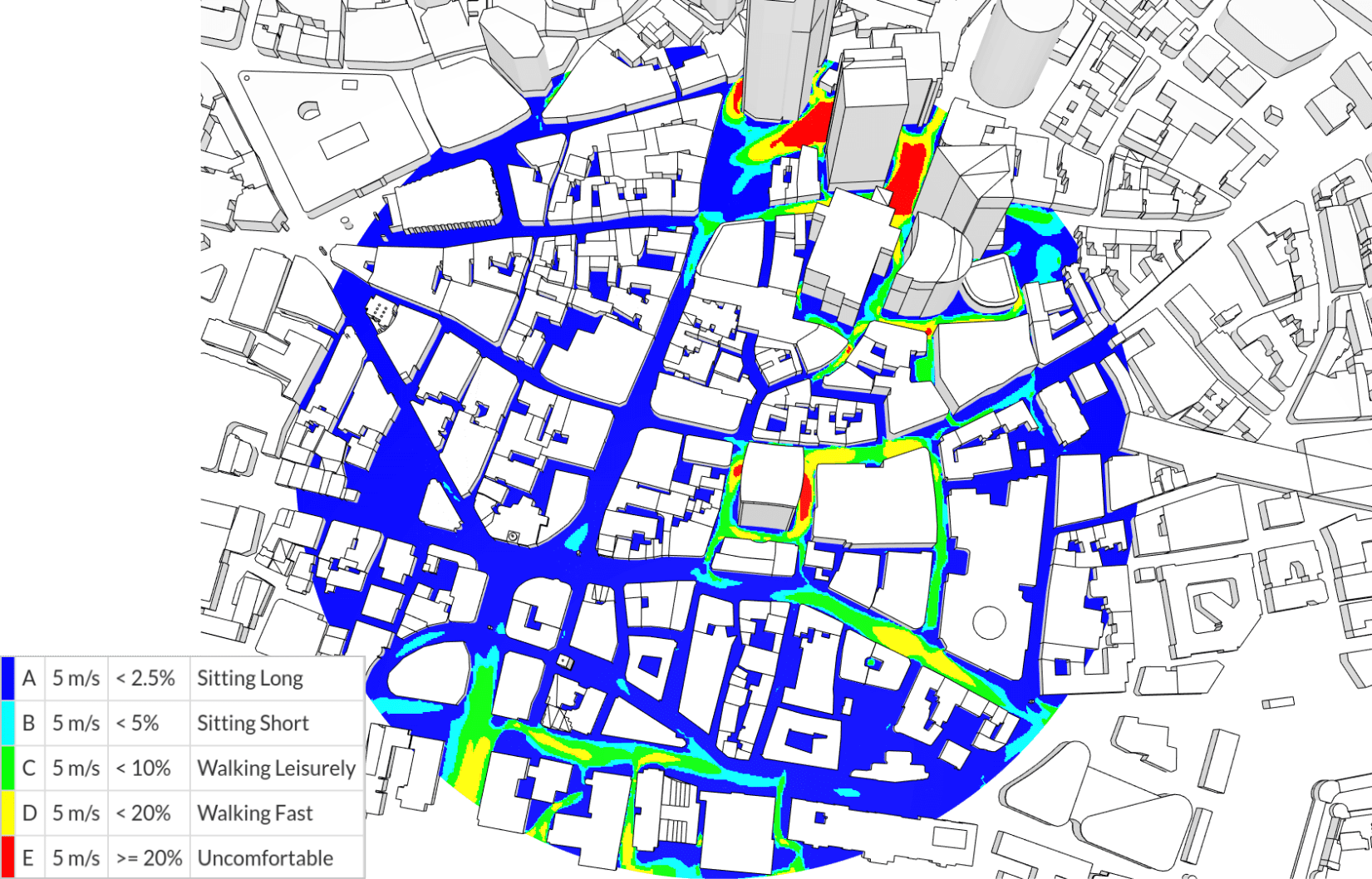
SimScale’s class labels. The platform’s NEN 8100 comfort map labels the classes Sitting Long (A), Sitting Short (B), Walking Leisurely (C), Walking Fast (D) and Uncomfortable (E). The class boundaries are the standard’s. The labels are the platform’s shorthand for the most demanding use each class suits. When a municipal requirement names an activity rating, read the class letter against the table above.
The NEN 8100 wind danger criterion
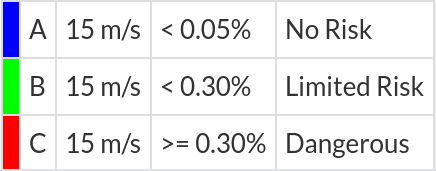
Danger is assessed separately from comfort, against a 15 m/s hourly mean wind speed. Exceeded less than 0.05% of the year, about 4 hours, there is no risk. Between 0.05% and 0.3%, 4 to 26 hours, the risk is limited. At 0.3% or more the location is dangerous.
| Rating | Exceedance of 15 m/s | Hours per year | Acceptable for |
|---|---|---|---|
| No risk | under 0.05% | under 4 h | all activities |
| Limited risk | 0.05% to 0.3% | 4 to 26 h | traversing only |
| Dangerous | 0.3% or more | over 26 h | nothing; the design has to change |
Limited risk is only acceptable where people pass through, activity class I. Strolling and sitting areas need the no-risk rating, and a dangerous rating is never permitted. Comfort and danger are two separate passes on the same wind data. A site can score class A on comfort and still exceed the danger criterion for one wind direction, so both maps are checked before a layout is approved.
How the exceedance probability is calculated
In order to evaluate the pedestrian wind comfort in a particular location for a current or future structure, three elements need to be determined and then combined:
- Historical meteorological data: Close to the location of the building to capture representative/typical wind conditions.
- Local wind conditions: Influenced by the building and its surroundings.
- Specific comfort criteria: Relate local wind speeds to actual subjective “wind comfort” felt by pedestrians.
In order to evaluate the pedestrian comfort, the local wind velocity needs to be related to the weather station data in order to obtain the probability of the local wind speed exceeding the threshold wind speeds defined by the comfort criterion.
Under NEN 8100 all three elements are fixed by the standard.
The meteorological data comes from NPR 6097:2006, which converts KNMI weather station records into hourly mean wind statistics at 60 m height for any site in the Netherlands, in 12 wind directions, already corrected for the terrain roughness around the site. This is why a NEN 8100 assessment runs 12 directions, where a planning submission under Lawson typically runs 16 or 36.
The local wind conditions come from a wind tunnel test or a CFD simulation. The standard accepts either. Each run gives, per direction and per point, the ratio of the wind speed at pedestrian height to the 60 m reference speed, the amplification factor.
The criterion is the 5 m/s threshold. For each point and each direction, the amplification factor converts 5 m/s at 1.75 m into the 60 m speed that would produce it. The NPR 6097 statistics give how often that 60 m speed is exceeded from that direction. Summing over the 12 directions gives the exceedance percentage, and the percentage gives the class. The danger map repeats the same calculation with a 15 m/s threshold.
The NPR 6097 wind statistics set the exceedance probability. The CFD run supplies the amplification factors.
When NEN 8100 requires a wind study
Over 30 m, a wind tunnel or CFD study is required. Between 15 m and 30 m in a sheltered setting, or under 30 m in an unsheltered one, a wind expert decides whether a study is needed. Under 15 m in a sheltered setting, no assessment is required. The decision model turns on building height and how sheltered the site is.
| Building height | Sheltered surroundings | Unsheltered surroundings |
|---|---|---|
| Under 15 m | No assessment | Expert judgment |
| 15 m to 30 m | Expert judgment | Expert judgment |
| Over 30 m | Wind study required | Wind study required |
Sheltered means that obstacles cover at least 20% of the area within 300 m of the building, the building is no more than 150% of the average height of those obstacles, and the distance to them is no more than 10 times their average height.
Municipal rules sit on top of the standard. NEN 8100 is not statutory. Municipalities apply it through their high-rise policies and planning decisions, and the Dutch Council of State has accepted it as the assessment framework in planning appeals. Rotterdam’s high-rise policy makes a wind study mandatory from 70 m, and lower for buildings more than twice the height of their surroundings or on exposed sites, and sets a target class per zone on a wind quality map. Eindhoven’s 2020 policy rule names NEN 8100:2006 explicitly. Amsterdam requires a high-rise effects report, which covers wind, from 30 m in designated zones and from 60 m everywhere. Tilburg requires a wind tunnel test before design approval. Running CFD on the massing model first allows changes to building position and height; a wind tunnel test at the end of design leaves only landscape changes.
NEN 8100 vs Lawson vs Davenport
There are many criteria and standards existing today to help assess the expected wind climate in the design stage, by providing parameters of what should be achieved to stay within favorable conditions. Lawson, Davenport and NEN 8100 are considered comprehensive or complete, as they address a wide range of activities, including “sitting/standing long”, “sitting short” and “strolling”. All three criteria consist of a threshold value of the wind speed and a maximum allowable exceedance probability of this threshold value.
Where they differ:
| Criterion | NEN 8100 | Lawson LDDC | Davenport |
|---|---|---|---|
| Threshold speed | 5 m/s for every activity | 2.5, 4, 6 and 8 m/s by activity | Beaufort bands by activity |
| Averaging | Hourly mean, no gust factor | Mean; gust-equivalent in some variants | Mean (Beaufort) |
| Reference height | 1.75 m | 1.5 m to 1.75 m | Pedestrian level |
| Exceedance | Five bands, 2.5% to 20% | 5% | About 1.5% (once a week) |
| Danger criterion | 15 m/s at 0.05% and 0.3% | 15 m/s at 0.022% | None |
| Where required | Netherlands | UK planning, City of London | Reference criterion, rarely mandated |
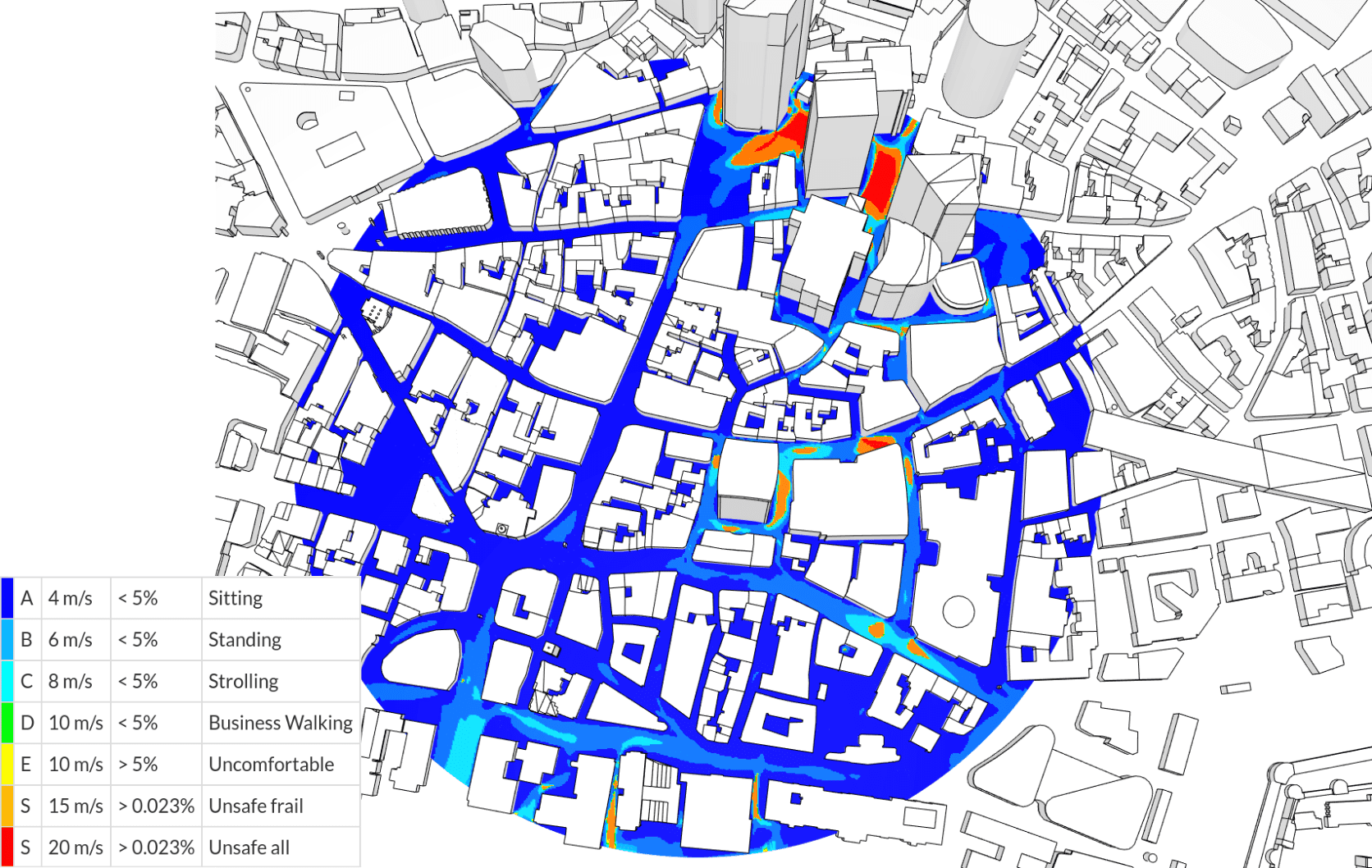
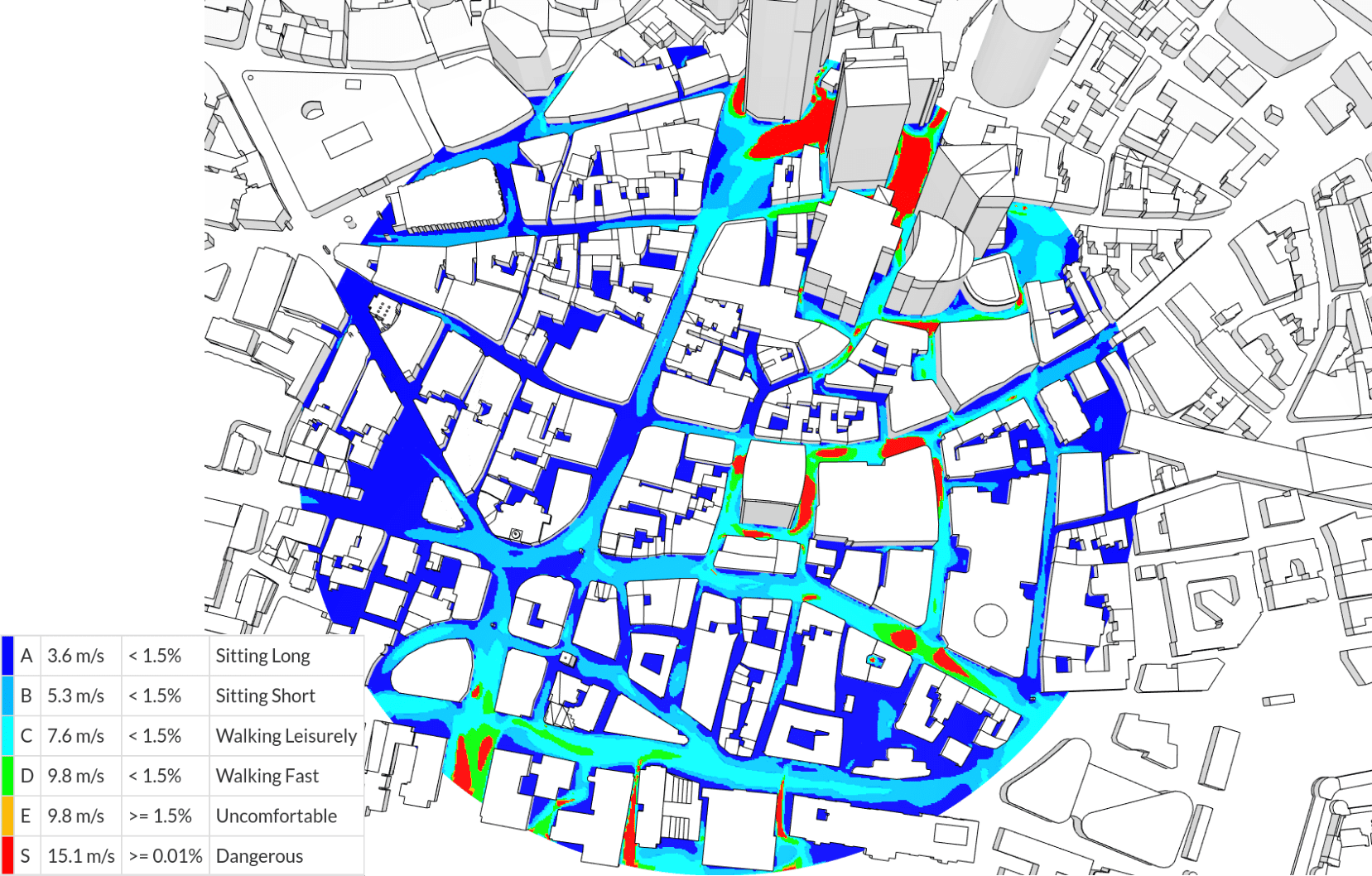
Lawson grades by speed and NEN 8100 grades by frequency. Under Lawson LDDC, a seating area passes if the wind stays under 2.5 m/s for 95% of the year. Under NEN 8100, it passes if the wind stays under 5 m/s for 97.5% of the year. Those are different tests, and a plaza can be class A on one and category C on the other.
However, despite standardizations being put in place, they can all lead to very different conclusions about wind comfort.
The three maps below show the same site, Central London around 20 Fenchurch Street, scored against each criterion from one set of CFD results.
Running NEN 8100 in SimScale
SimScale evaluates all of these criteria in parallel. Our multi-directional wind analysis feature greatly improves time to project completion, by supporting up to 36 wind rose-driven directions to be concurrently simulated and automatically calculating the Lawson, Davenport, and NEN 8100 wind comfort criteria.
For NEN 8100 the setup follows the standard. Select NEN 8100 as the wind engineering standard, upload the NPR 6097 output file for the site (12 directions, already roughness-corrected, so no exposure correction is applied), set the pedestrian height to 1.75 m, and run. SimScale rescales the 60 m NPR 6097 speeds to its 10 m reference internally. The results include a NEN 8100 comfort map, classes A to E, and a NEN 8100 danger map as separate outputs, and the same solved simulation can be read against Lawson and Davenport without re-running the CFD.
LEVS architecten used this on Koningswei, a mixed-use development in Tilburg where the city requires a wind tunnel test before approval. They ran NEN 8100 comfort studies on the massing model during concept design, adjusted building positions and heights from the results, and resolved over 99% of potential comfort issues before the official test. The wind tunnel study asked for one landscape change: moving a few bushes. LEVS reports up to 10x faster design iteration cycles across the projects that followed.

Reinoud van der Zijde
Senior Architect, LEVS architecten

“It is particularly effective during the urban planning phase, where we can quickly test multiple design options and obtain results within an hour.”
Assess NEN 8100 wind comfort in the browser
Run a NEN 8100 wind comfort simulation on the cloud-native SimScale platform. No installation, special hardware or credit card required.
Frequently asked questions
NEN 8100 is the Dutch standard for wind comfort and wind danger in the built environment, published by NEN in 2006. It grades a location by how often the hourly mean wind speed at 1.75 m exceeds 5 m/s, in five classes from A (under 2.5% of the year) to E (over 20%), and applies a separate danger criterion at 15 m/s.
Class A: wind exceeds 5 m/s less than 2.5% of the year, good for sitting, strolling and walking through. Class B: 2.5% to 5%, moderate for sitting. Class C: 5% to 10%, moderate for strolling, poor for sitting. Class D: 10% to 20%, moderate for walking through only. Class E: over 20%, poor for every activity.
One threshold: 5 m/s hourly mean wind speed at 1.75 m above ground, for all activities. Comfort is decided by how often that speed is exceeded. The danger criterion uses 15 m/s.
An hourly mean wind speed of 15 m/s. If it is exceeded less than 0.05% of the year (about 4 hours) there is no risk. Between 0.05% and 0.3% (4 to 26 hours) the risk is limited, which is acceptable only where people pass through. At 0.3% or more the location is dangerous and the design has to change.
For any building over 30 m, a wind tunnel or CFD study is required. Between 15 m and 30 m in a sheltered setting, or under 30 m in an unsheltered one, a wind expert decides. Under 15 m in a sheltered setting no assessment is needed. Municipalities add their own thresholds; Rotterdam requires a study from 70 m and Amsterdam requires a high-rise effects report from 30 m in designated zones.
No. NEN 8100 is not statutory. Municipalities apply it through high-rise policies and planning decisions, and the Council of State has accepted it as the assessment framework in appeals. Rotterdam requires a wind study from 70 m, Amsterdam a high-rise effects report from 30 m in designated zones, Eindhoven names NEN 8100:2006 in its policy rule, and Tilburg requires a wind tunnel test before approval.
NEN 8100 uses a single 5 m/s threshold and grades by how often it is exceeded (2.5% to 20%). Lawson uses a different threshold per activity (2.5 m/s to 8 m/s under LDDC) at a fixed 5% exceedance. NEN 8100 uses the hourly mean at 1.75 m with no gust factor; Lawson variants are evaluated at 1.5 m to 1.75 m and some use a gust-equivalent mean. NEN 8100 applies in the Netherlands, Lawson in UK planning.
Yes. The standard accepts a wind tunnel test or a CFD simulation for the local wind conditions. Tilburg still requires a wind tunnel test for the formal approval. CFD can be run earlier in design; the wind tunnel test confirms the result.
More wind comfort resources from SimScale
- Lawson wind comfort criteria: LDDC, 2001, and the original compared
- How to Analyze Pedestrian Wind Comfort with SimScale
- SimScale Feature Release: Multi-Direction Pedestrian Wind Comfort Analysis
- How to Assess Pedestrian Wind Comfort in 2019
- Boston Waterfront Weather & Pedestrian Wind Comfort
- Sustainable Wind Engineering: The Stockholm Royal Seaport Project
- Designing Livable Urban Spaces with Early-Stage Wind Comfort Analysis (LEVS architecten)