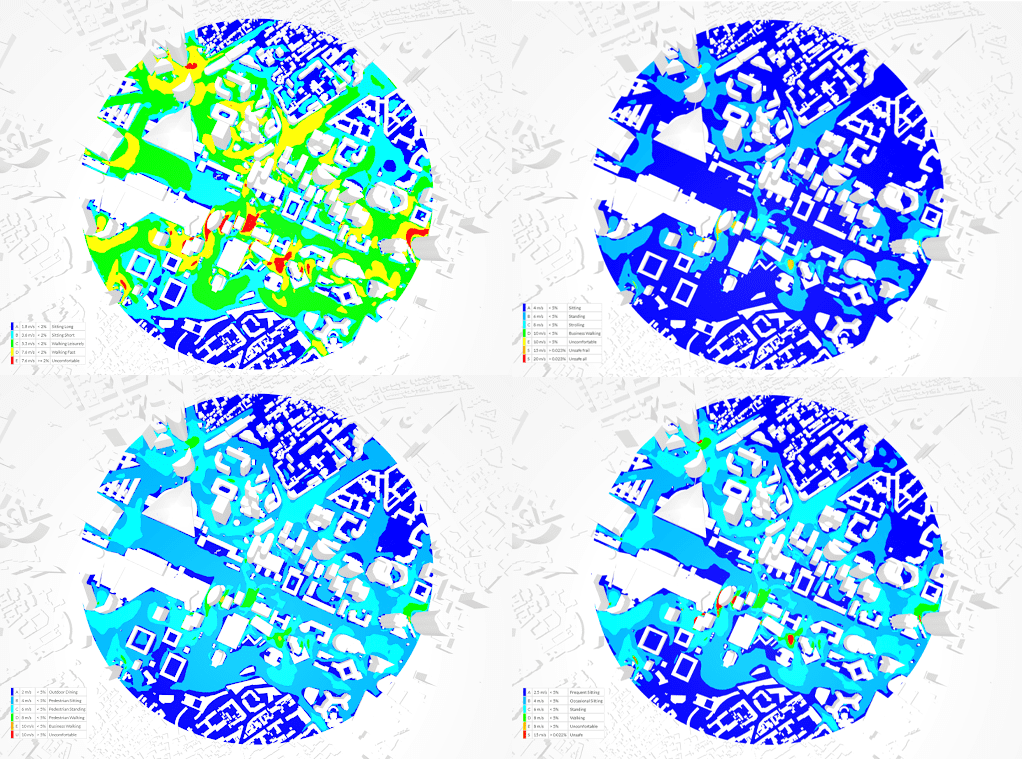

Three threshold sets share the Lawson name: the original Lawson criteria, Lawson LDDC, and Lawson 2001. They assign different wind speeds to the same activity, and they judge those speeds at different exceedance probabilities. The same CFD results, scored against the original criteria at 2% and against LDDC at 5%, can put the same plaza in two different comfort categories.
Which set applies is usually decided by the local authority, not by the engineer. But the difference is large enough to matter at concept stage, when a 2.5 m/s seating threshold and a 4 m/s seating threshold lead to different building massing.
Below are the full category tables for all three, the calculation that sits behind the exceedance probability, and the rule for picking a variant when the authority has not named one.
Our whitepaper covers pedestrian wind comfort from origin and definition through analysis, criteria and case studies. Download the whitepaper.
What are the Lawson wind comfort criteria?
The Lawson criteria classify a location by the probability that wind speed there exceeds a threshold. Each category pairs a threshold speed with an exceedance probability, and each pairing corresponds to an activity a pedestrian could reasonably do: sitting, standing, walking. Speeds are evaluated at pedestrian height, between 1.5 m and 1.75 m depending on the local authority.
A location is assigned the most permissive category it satisfies. The calculation starts at the highest threshold speed, the unsafe or uncomfortable condition, and works down. If the probability of exceeding a threshold is below the value the category allows, that category is met and the calculation moves to the next one down. It stops at the first category the location fails. That last satisfied category is the location’s rating.
This runs for every point in the domain and for every wind direction, typically 4 to 36 directions.
Where the probability comes from
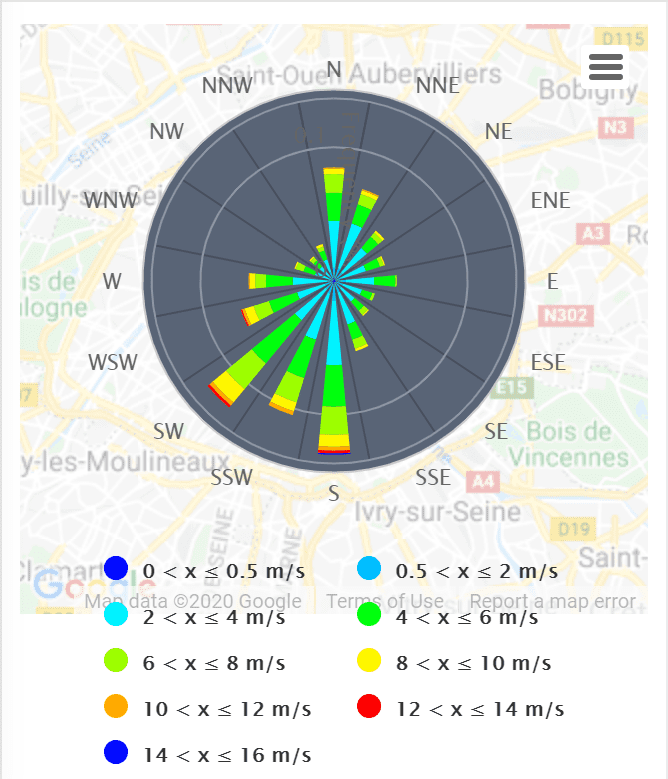
The probability comes from statistical weather data, not from the CFD run. A year-round wind rose for the site gives the frequency and speed distribution for each direction. The CFD run gives an amplification factor for each point: how much faster or slower the wind is at that point than at the reference met station, for that direction.
Multiply the two and you get the local speed distribution, which is what the threshold is tested against. The met data also carries a terrain factor per direction, accounting for how much buildings, trees and open ground upwind slow the flow before it reaches the site.
Why there are three variants
The variants exist because comfort is judged locally. Wind speeds that read as normal in a coastal city read as unacceptable inland, and planning authorities set thresholds their residents will accept. The subtypes (LDDC, 2001, and the original) differ in both the threshold speeds and the probability values, so a variant is a complete scoring system rather than a tweak to one number.
General Lawson criteria
The original Lawson criteria use five categories at a 2% exceedance probability, with thresholds from 1.8 m/s to 7.6 m/s. There is no safety category.
| Category | Threshold | Exceedance | Activity |
|---|---|---|---|
| A | > 1.8 m/s | < 2% | Sitting long |
| B | > 3.6 m/s | < 2% | Sitting short |
| C | > 5.3 m/s | < 2% | Walking leisurely |
| D | > 7.6 m/s | < 2% | Walking fast |
| E | > 7.6 m/s | ≥ 2% | Uncomfortable |
Category E is the failure state. Wind exceeds 7.6 m/s more than 2% of the year, roughly 175 hours. E zones are rare on a typical comfort map, and where they overlap a pedestrian or cycle route they need mitigation.
Category D is the one that catches people out. The wind requirements are met, but only for fast walking. An outdoor dining terrace placed in a D zone will not work. Most authorities apply a three-step judgment on top of the category: the intended use is “good quality” if its category is met, “acceptable” one category worse, and “unacceptable” two or more categories worse.
Lawson LDDC criteria
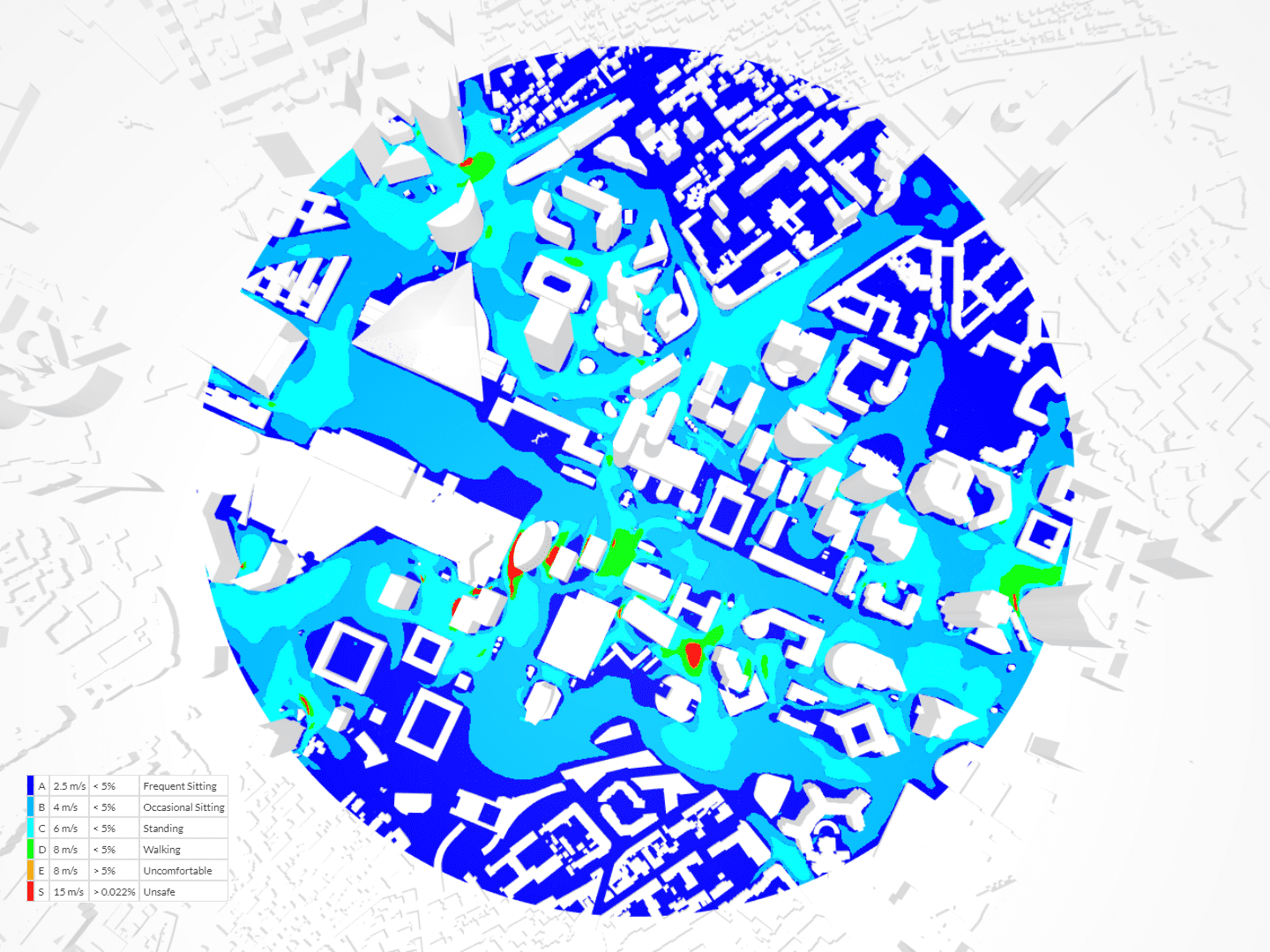
Lawson LDDC uses six categories at a 5% exceedance probability for the five comfort categories, and adds a safety category at 15 m/s. The thresholds run from 2.5 m/s to 8 m/s.
| Category | Threshold | Exceedance | Activity |
|---|---|---|---|
| A | > 2.5 m/s | < 5% | Frequent sitting |
| B | > 4 m/s | < 5% | Occasional sitting |
| C | > 6 m/s | < 5% | Standing |
| D | > 8 m/s | < 5% | Walking |
| E | > 8 m/s | > 5% | Uncomfortable |
| S | > 15 m/s | > 0.022% | Unsafe |
LDDC comes from the London Docklands redevelopment of the 1980s, which is where the name comes from: London Docklands Development Corporation. It is the most widely applied Lawson variant in UK planning.
The S category is a distress criterion rather than a comfort one. 0.022% of a year is about 2 hours. A location where wind exceeds 15 m/s for more than 2 hours a year is unsafe regardless of how it scores on comfort, and a passage zone classified S needs a physical mitigation, not a change of use.
The City of London variant
The City of London Wind Microclimate Guidelines use a modified LDDC, which SimScale lists as “London LDDC Comfort”. Comfort thresholds and the 5% exceedance are the same as standard LDDC. The distress criterion is stated as mean and gust equivalent mean speed at or above 15 m/s reaching 0.022% exceedance from any single wind direction.
The per-direction wording matters. A site can pass on a direction-weighted average and fail on one dominant direction, so the assessment has to be run and reported per direction. Running 36 directions rather than 8 or 16 resolves that properly.
Lawson 2001 criteria
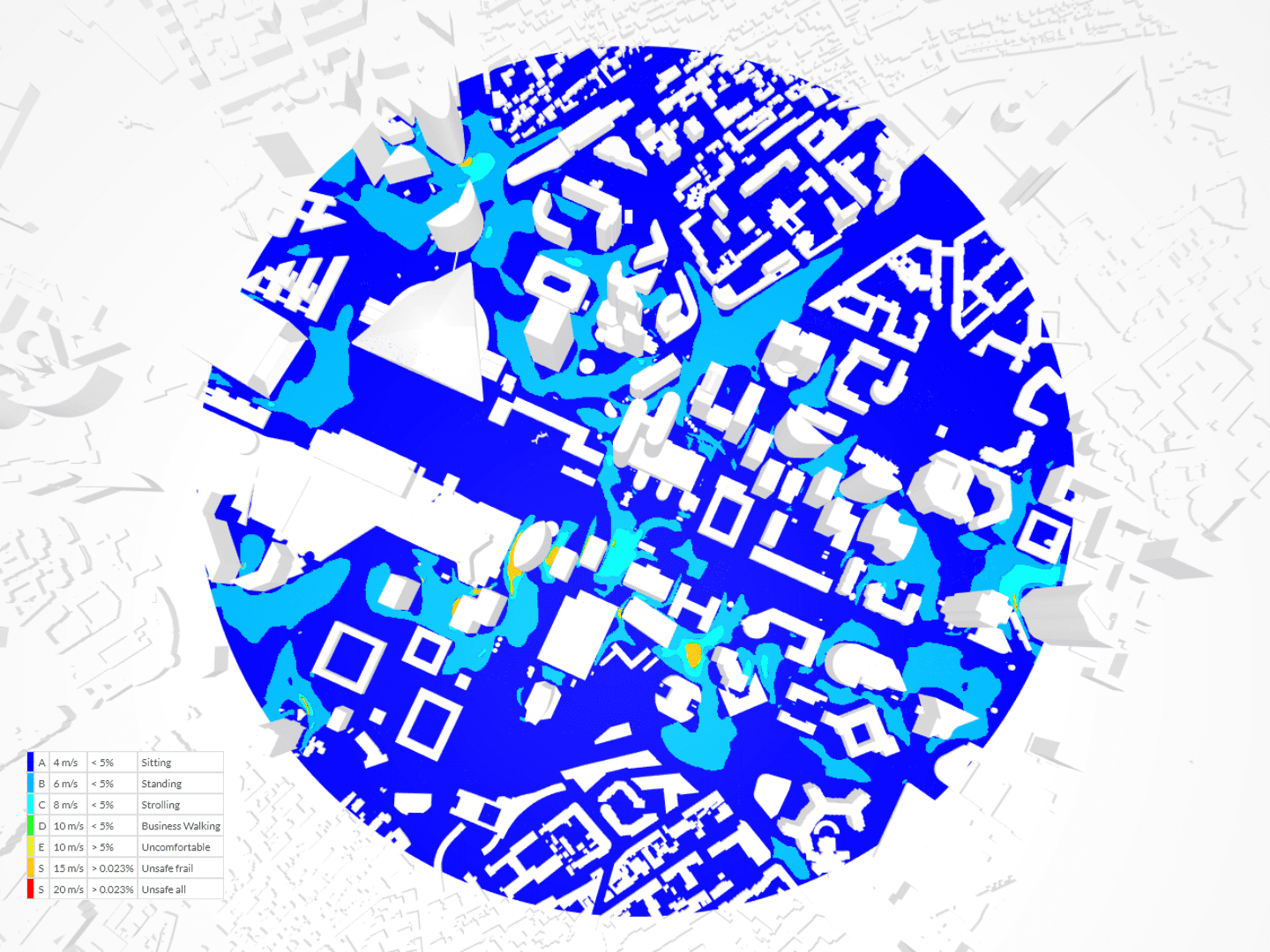
Lawson 2001 uses five comfort categories at 5% exceedance and two safety categories, at 15 m/s and 20 m/s. Its comfort thresholds run from 4 m/s to 10 m/s, higher than both other variants at every equivalent activity.
| Category | Threshold | Exceedance | Activity |
|---|---|---|---|
| A | > 4 m/s | < 5% | Sitting |
| B | > 6 m/s | < 5% | Standing |
| C | > 8 m/s | < 5% | Strolling |
| D | > 10 m/s | < 5% | Business walking |
| E | > 10 m/s | > 5% | Uncomfortable |
| S15 | > 15 m/s | > 0.023% | Unsafe frail |
| S20 | > 20 m/s | > 0.023% | Unsafe all |
The two-level safety split is what separates Lawson 2001 from LDDC. S15 flags conditions unsafe for frail pedestrians, children and cyclists. S20 flags conditions unsafe for anyone. A site can clear S20 and still fail S15, which is the case that matters for a hospital entrance, a school route or a care home approach.
Which Lawson variant applies to your site
If the local authority names a variant, use it. In UK planning that is usually Lawson LDDC or the City of London modification. Where no variant is specified, the practical rule is to assess against the strictest set the site’s intended use can justify, because a scheme that passes a 2% criterion passes a 5% one.
The three sets side by side, aligned by activity:
| Activity | General Lawson (2%) | Lawson LDDC (5%) | Lawson 2001 (5%) |
|---|---|---|---|
| Sitting, long periods | 1.8 m/s | 2.5 m/s | 4 m/s |
| Sitting, short periods | 3.6 m/s | 4 m/s | covered by Sitting |
| Standing | not separated | 6 m/s | 6 m/s |
| Walking, leisurely | 5.3 m/s | covered by Walking | 8 m/s |
| Walking, business | not separated | 8 m/s | 10 m/s |
| Walking fast | 7.6 m/s | covered by Walking | covered by Business walking |
| Uncomfortable above | 7.6 m/s at ≥ 2% | 8 m/s at > 5% | 10 m/s at > 5% |
| Safety | none | 15 m/s at > 0.022% | 15 and 20 m/s at > 0.023% |
Two things fall out of that table.
The original Lawson criteria are the strictest by a wide margin. A seating area needs 1.8 m/s at 2% exceedance, against 4 m/s at 5% under Lawson 2001. That is more than double the speed at more than double the allowed frequency.
Lawson 2001 is the only variant with a graded safety criterion. If the scheme includes a route used by elderly or vulnerable pedestrians, the S15 category is the reason to choose it over LDDC even where the authority accepts either.
What the threshold speeds actually feel like
The Lawson thresholds are not arbitrary. Each one is the speed at which a specific activity stops being pleasant.
| Speed | Effect at pedestrian height |
|---|---|
| 1.8 m/s | Barely perceptible. Reading a newspaper outdoors is comfortable. |
| 2.5 m/s | Light air movement. Long periods of sitting are still comfortable. |
| 4 m/s | Hair is disturbed, loose paper moves. Short sits are fine, long ones are not. |
| 6 m/s | Dust and paper are raised, hair is disarranged. Standing is acceptable, sitting is not. |
| 8 m/s | Force felt on the body. Walking is fine, standing still is unpleasant. |
| 10 m/s | Umbrellas are hard to use, difficulty with balance in gusts. |
| 15 m/s | Progress on foot is impeded. Unsafe for frail pedestrians and cyclists. |
| 20 m/s | Walking is dangerous for anyone. People are blown over in gusts. |
A useful reference point for a comfort target: 4 m/s to 6 m/s is the band where most outdoor seating stops working, which is why every Lawson variant places a category boundary inside it.
Reading a Lawson comfort map
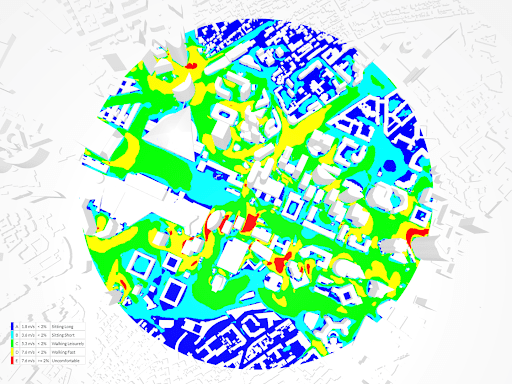
The maps in this article show the same district, La Defense in Paris, scored against all three variants. Comparing them shows how much the variant choice moves the result on identical CFD data.
Three things to check on any comfort map before drawing conclusions from it:
- The variant, stated on the legend. A map with no variant named is not interpretable.
- Whether the safety criterion was run. Comfort and safety are separate passes. A map showing only comfort categories says nothing about distress conditions, and a site can be comfortable on average and unsafe in a storm direction.
- The number of wind directions. Eight directions will miss a channeling effect that 36 directions catch. For a site with a dominant wind direction or a tight street canyon, direction count changes the answer.
Running Lawson criteria in SimScale
SimScale’s pedestrian wind comfort analysis supports the general Lawson criteria, Lawson LDDC, London LDDC Comfort and Lawson 2001, alongside Davenport, NEN 8100 and the AIJ criteria. The criterion is a post-processing selection, so one solved simulation can be scored against several variants without re-running the CFD.
That matters most at concept stage, when the authority’s requirement may not be confirmed. Solve once, score against LDDC and against the original criteria, and the massing decision is made with both answers in hand.
Assess pedestrian wind comfort in the browser
Set up a wind comfort simulation on the cloud-based SimScale platform. No installation, special hardware or credit card required.
Frequently asked questions
Lawson 2001 uses higher comfort thresholds and adds a second safety category. LDDC sets sitting at 2.5 m/s and walking at 8 m/s, with one unsafe category at 15 m/s. Lawson 2001 sets sitting at 4 m/s and business walking at 10 m/s, with unsafe categories at 15 m/s (frail pedestrians) and 20 m/s (all pedestrians). Both use 5% exceedance for comfort.
The Lawson criteria classify a location by how often wind exceeds a threshold speed at pedestrian height. Under Lawson LDDC the thresholds are 2.5 m/s for frequent sitting, 4 m/s for occasional sitting, 6 m/s for standing and 8 m/s for walking, each at 5% exceedance. Above 8 m/s at more than 5% the location is uncomfortable, and above 15 m/s at more than 0.022% it is unsafe.
Between 1.8 m/s and 4 m/s, depending on the criteria applied and how long people sit. The original Lawson criteria require 1.8 m/s at 2% exceedance for long periods of sitting. Lawson LDDC requires 2.5 m/s at 5%. Lawson 2001 requires 4 m/s at 5%.
The wind speed exceeds the category threshold no more than 5% of the time across a full year, roughly 438 hours. The percentage is calculated from year-round wind rose data for the site, not from the CFD run.
15 m/s exceeded more than 0.022% of the year, about 2 hours, under Lawson LDDC. Lawson 2001 uses 0.023% and splits the classification: above 15 m/s the location is unsafe for frail pedestrians and cyclists, above 20 m/s it is unsafe for everyone.
Comfort criteria test whether an activity is pleasant, at exceedance probabilities of 2% or 5%. Safety, also called distress, tests whether wind is strong enough to injure, at an exceedance probability near 0.022%. They are separate passes and a location can pass one and fail the other.
A modified Lawson LDDC, set out in the City of London Wind Microclimate Guidelines. Comfort thresholds match standard LDDC at 5% exceedance. The distress criterion is mean and gust equivalent mean speed at or above 15 m/s reaching 0.022% exceedance from any single wind direction.