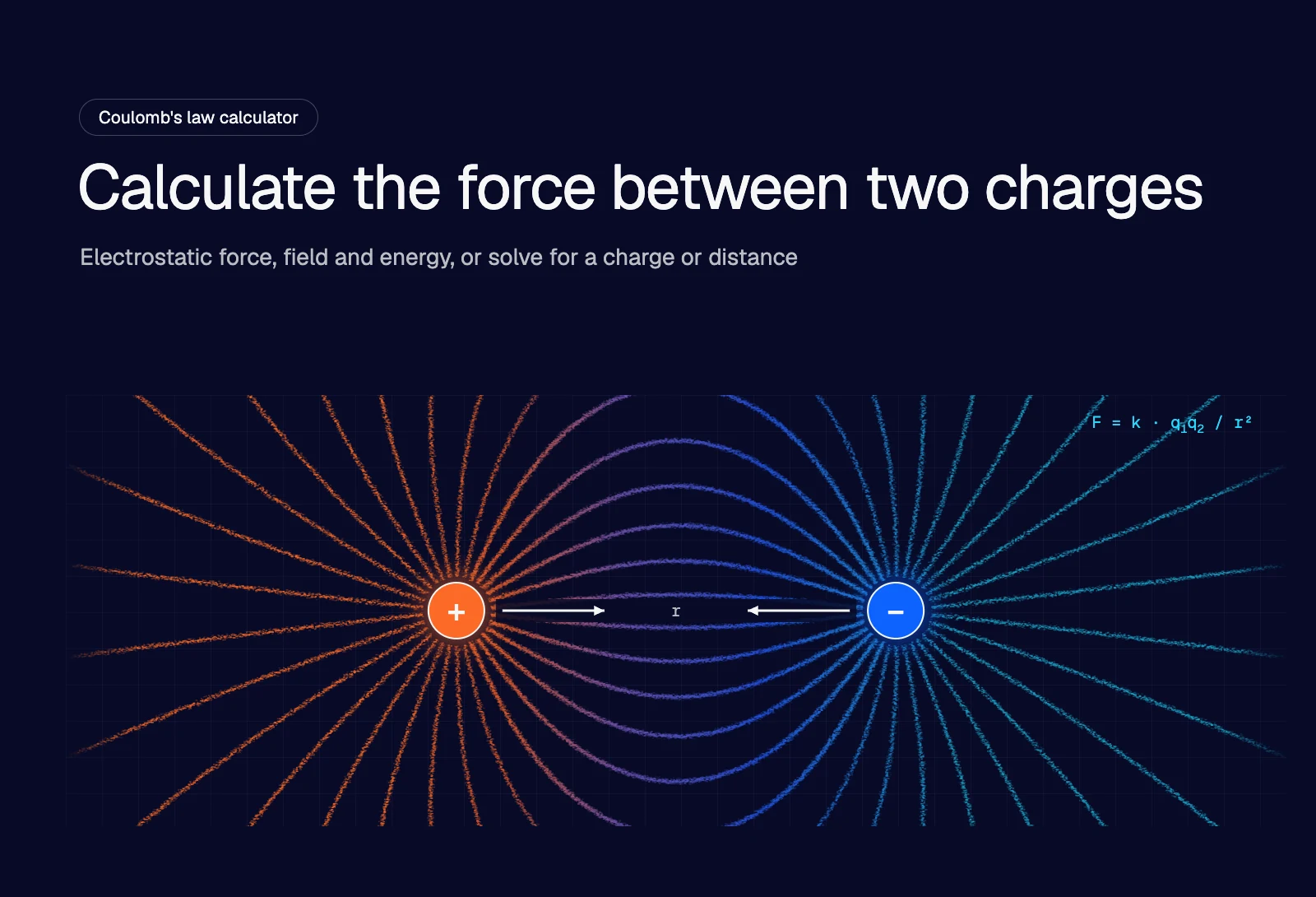

Electrostatic force grows with the inverse square of distance. Halve the gap between two charged parts and the force between them goes up four times, which is why a clearance that looked generous on a drawing can still end in a spark, a stuck particle or a disturbed sensor.
This Coulomb’s law calculator gives the force between two point charges from their size, their separation and the material between them. Switch modes to work backward: find the charge that produces a known force, or the distance at which two charges reach it.
Coulomb’s Law Calculator
Get the electrostatic force between two point charges, or solve for a charge or a distance.
How to use the Coulomb's law calculator
- Pick what to solve for. Use Force to get the electrostatic force from two charges, Charge to find the second charge from a known force, or Distance to find the separation.
- Enter the charges with their sign. Like signs repel and opposite signs attract. Units run from coulombs down to picocoulombs and the elementary charge \( e \).
- Enter the distance between the charge centers, or the force for the Charge and Distance modes.
- Choose the medium. Vacuum and air give almost the same answer. A dielectric such as oil or water reduces the force by its relative permittivity.
- Click Calculate. The results show the force, the electric field of the first charge at the second charge and the electric potential energy of the pair.
Every input is converted to SI units before the calculation, so you can mix units freely, for example µC with mm.
Coulomb's law formula
Coulomb's law states that the force between two point charges is proportional to the product of the charges and inversely proportional to the square of the distance between them:
$$ F = k_e \frac{|q_1 \, q_2|}{\varepsilon_r \, r^2} = \frac{1}{4 \pi \varepsilon_0 \varepsilon_r} \frac{|q_1 \, q_2|}{r^2} $$
Where:
- \( F \) is the magnitude of the electrostatic force in N, acting along the line between the charges
- \( q_1 \) and \( q_2 \) are the charges in coulombs (C)
- \( r \) is the distance between the charge centers in m
- \( k_e \) is Coulomb's constant, \( 8.9875 \times 10^{9} \text{ N m}^2/\text{C}^2 \)
- \( \varepsilon_0 \) is the vacuum permittivity, \( 8.8542 \times 10^{-12} \text{ F/m} \)
- \( \varepsilon_r \) is the relative permittivity of the medium, 1 for vacuum
The sign of \( q_1 q_2 \) gives the direction. A positive product means the charges repel, and a negative product means they attract.
Coulomb's constant
Coulomb's constant is \( k_e = 1 / (4 \pi \varepsilon_0) \approx 8.9875517923 \times 10^{9} \text{ N m}^2/\text{C}^2 \). For quick hand checks, \( 9 \times 10^{9} \) is within 0.2%. The calculator uses the full value.
Worked example: two small charges in vacuum
A charge of +2 µC sits 5 cm from a charge of -3 µC in vacuum.
- Convert to SI: \( q_1 = 2 \times 10^{-6} \text{ C} \), \( q_2 = -3 \times 10^{-6} \text{ C} \), \( r = 0.05 \text{ m} \)
- Product of the charges: \( |q_1 q_2| = 6 \times 10^{-12} \text{ C}^2 \)
- Force: \( F = 8.9875 \times 10^{9} \times \frac{6 \times 10^{-12}}{0.05^2} = 21.57 \text{ N} \)
- Direction: the charges have opposite signs, so the force is attractive.
That's about 4.85 lbf from two charges smaller than a static shock. These are the calculator's default inputs, so you can check the result above.
Finding the distance for a given force
Rearrange the formula to find the separation at which two charges reach a target force:
$$ r = \sqrt{\frac{k_e \, |q_1 \, q_2|}{\varepsilon_r \, F}} $$
Two charges of 1 nC each, in air (\( \varepsilon_r = 1.0006 \)), reach a force of 1 mN at a distance of about 3.0 mm. Move them to 6 mm and the force drops to a quarter, about 0.25 mN.
Charges at atomic scale
The same law holds for the proton and electron in a hydrogen atom. With a charge of \( e = 1.602 \times 10^{-19} \text{ C} \) each and a separation of \( 5.29 \times 10^{-11} \text{ m} \), the attractive force is about \( 8.24 \times 10^{-8} \text{ N} \). Pick e as the charge unit and pm as the distance unit to try it.
Electric field and potential energy
The calculator also reports two values that come from the same terms.
Electric field. The field that \( q_1 \) creates at the position of \( q_2 \) is \( E = k_e |q_1| / (\varepsilon_r r^2) \), in V/m or N/C. Multiply it by \( q_2 \) and you get the force back. Compare the field with the dielectric strength of the medium: dry air breaks down at about 3 MV/m in a uniform field.
Potential energy. The electric potential energy of the pair is \( U = k_e q_1 q_2 / (\varepsilon_r r) \), in joules. A negative value means the charges attract, and it takes that much work to pull them infinitely far apart.
Relative permittivity of common materials
A uniform dielectric around both charges divides the force by its relative permittivity \( \varepsilon_r \). Typical room-temperature values:
| Medium | Relative permittivity εr |
|---|---|
| Vacuum | 1 (exact) |
| Air (dry, sea level) | 1.0006 |
| PTFE | 2.1 |
| Transformer oil | 2.2 |
| Polyethylene | 2.25 |
| FR-4 (PCB laminate) | 4.4 |
| Water (20 °C) | 80 |
Permittivity changes with frequency, temperature and moisture, so check the datasheet for design work. Every medium in this table is a preset in the calculator, and you can enter a custom value.
When Coulomb's law is not enough
\( F = k_e q_1 q_2 / r^2 \) is exact for two point charges at rest. Real parts break those assumptions in a few common ways:
- Charged bodies with size. The law holds for spheres with uniform charge measured center to center, and for parts far apart compared with their size. Close conductors redistribute their charge, so the force differs from the point-charge value.
- Many charges. Forces from several charges add as vectors. Sum each pair's force along its own line, or use a field solver for real charge distributions.
- Mixed materials. Dividing by \( \varepsilon_r \) only works when one uniform dielectric fills all the space around the charges. Insulation, air gaps and PCB laminates together need a field solution.
- Moving charges. Currents and moving charges add magnetic forces. Coulomb's law covers electrostatics only.
For conductors held at a voltage, think in terms of potential and capacitance instead of fixed charges. The charge on each conductor depends on the geometry and on every other conductor nearby.
From Coulomb's law to electrostatics simulation
The calculator handles two point charges. For a high voltage cable, a busbar, a connector or a sensor electrode, you need the electric field across the real geometry, and that comes from a field solver.
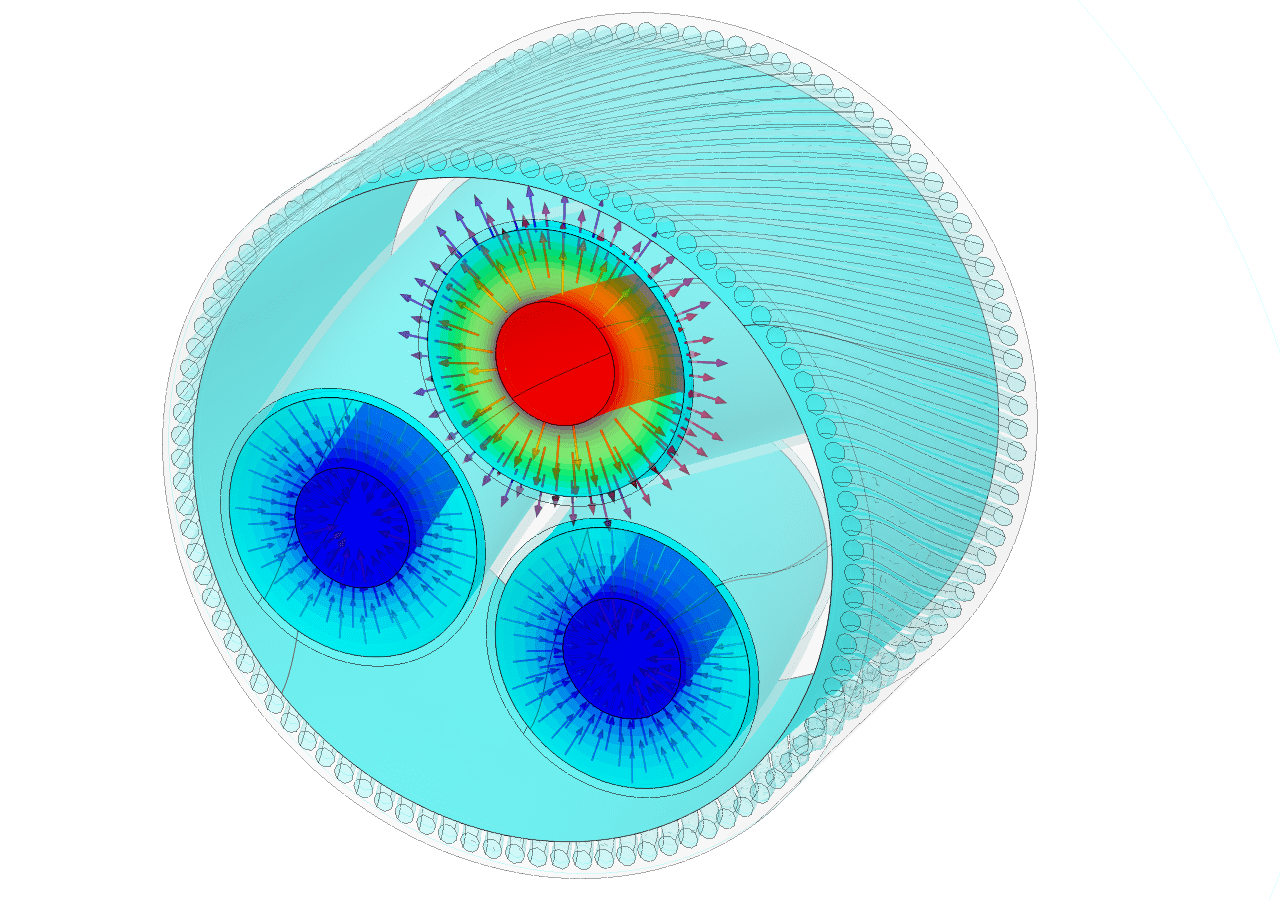
SimScale's electrostatics analysis solves for electric fields, charges and their forces in electrostatic equilibrium, and calculates the capacitance matrix between conductors. You assign a relative permittivity to each body and apply fixed potential, floating potential, charge density or total charge conditions. The high voltage power cable tutorial walks through a full setup, from materials to electric field magnitude and capacitance results.
Electromagnetic simulation runs in the same browser-based platform as CFD, FEA and thermal, with no install and no HPC to manage. Find field peaks before you set clearances, compare insulation designs side by side, and move to low-frequency electromagnetics for magnets, coils and motors.
Simulate electric fields on your design
Get the electric field, forces and capacitance for real geometry, straight from your browser.
Frequently asked questions
Coulomb's law gives the electrostatic force between two point charges. The force is proportional to the product of the charges and inversely proportional to the square of the distance between them. Like charges repel and opposite charges attract.
Coulomb's constant is \( k_e = 1/(4 \pi \varepsilon_0) \), about \( 8.9875 \times 10^{9} \text{ N m}^2/\text{C}^2 \). Many hand calculations round it to \( 9 \times 10^{9} \), which is within 0.2%.
In SI units, charge is in coulombs, distance in meters and force in newtons. Small charges are usually given in µC, nC or pC, and atomic charges as multiples of the elementary charge, \( 1.602 \times 10^{-19} \text{ C} \).
The force follows an inverse square law. Doubling the distance cuts the force to a quarter, and halving it makes the force four times larger.
A uniform dielectric around both charges divides the force by its relative permittivity. In water, with a relative permittivity of about 80, the force between two ions is about 80 times weaker than in vacuum.
More free engineering tools: y+ calculator, Reynolds number calculator, lift coefficient calculator, pipe flow rate calculator and the NACA airfoil generator.