Challenges
- A typical design cycle allowed for 10 to 15 manual iterations linked by handoffs between tools.
- Each design iteration took one to five days, stretching a design phase to 6 weeks or more.
- Simulation licenses shared across a global team meant runs queued one after another.
- Finding small performance gains and optimizations requires fast and accurate predictions.
Results
- One-click workflow using autonomous multi-objective optimization, powered by Physics AI and CFD.
- The design phase is compressed to under a week, with a 75-iteration optimization loop completing in around three hours.
- Cloud-native compute runs 10-15x more analyses simultaneously.
- CFD matched lab results to within 5%, and Physics AI averages under 3.5% against CFD simulation on designs it has never seen.
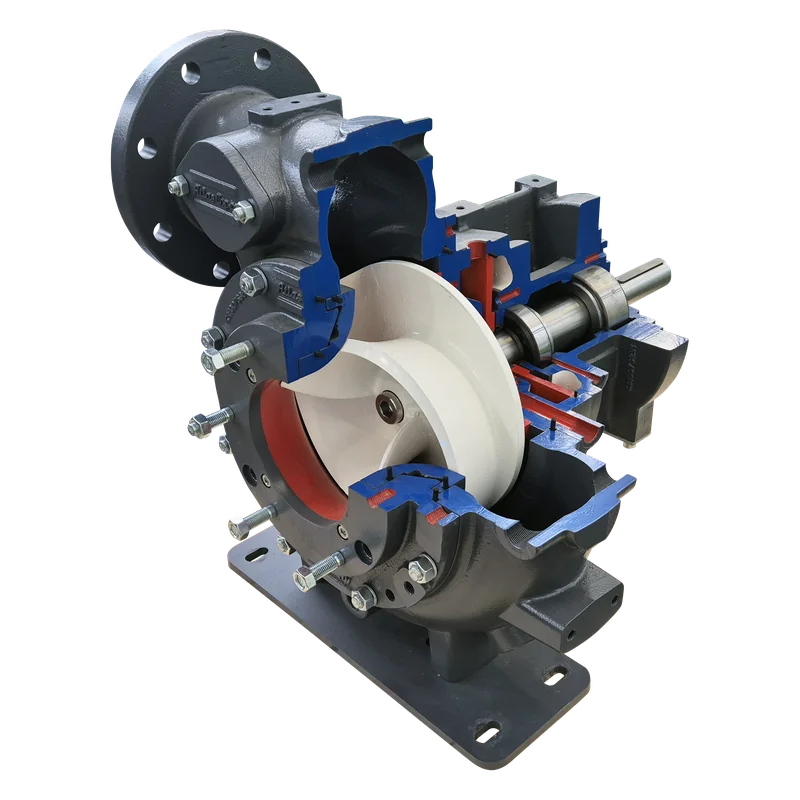
Varisco has designed and built pumps in Padua, Italy, since 1932, producing its first self-priming centrifugal pump in 1948. Today it specializes in heavy-duty industrial pumping equipment: self-priming centrifugal pumps with semi-open impellers for drainage, dewatering, and industrial liquid transfer, alongside volumetric pumps for high-viscosity fluids. Varisco joined the Atlas Copco Group in 2016.
Giulio Ferrarese is R&D Manager in Varisco, where he leads the team responsible for the hydraulic development of the company’s pump ranges, from initial impeller concept through performance validation.

Giulio Ferrarese
R&D Manager IFD, Varisco S.r.l., part of Atlas Copco Group
“For us, simulation and performance optimization is an essential step of the design process, so that we can be sure we are bringing the very best products to market.”
From Experience-Led Iteration to Physics AI Optimization: Varisco’s Adoption of SimScale
Varisco’s design process is built on deep engineering experience. The team designs impellers in CFturbo, assembles the surrounding geometry in CAD, and passes each variant to CFD analysis, with results feeding the next change. Using on-premises CFD software, a typical design loops over 10 to 15 cycles of this process. With simulation licenses shared across a global Atlas Copco team, each iteration could take one to five days depending on the queue, and a full design phase ran to three to five weeks.
For a new product development program, Giulio and his team wanted to mechanize this process by moving to closed-loop algorithm-driven optimization, leveraging machine learning surrogate models to accelerate optimization runs. That meant generating synthetic training data at scale to map out a design space, and using that data to train a machine learning model. It was clear that this could only work with a fully automated CFD analysis and Physics AI inference pipeline, something that the team’s existing manual, on-premises solution could not deliver.
Giulio selected SimScale as a platform that could deliver highly scalable simulation and Physics AI in an integrated environment. SimScale’s cloud-native CFD runs every simulation on elastic cloud compute, able to handle the hundreds of simulation runs needed and immediately increasing their simulation throughput by 10-15x with no licensing or compute bottlenecks. Once the training runs were complete, the team could directly train and inference Physics AI models, enabling optimization loops in a fraction of the time. As Giulio puts it, “In the time it used to take us to complete one design iteration, we can now evaluate an entire design space using SimScale and Physics AI to surface the optimal configuration.”
Over roughly five months, Varisco and SimScale’s applications engineering team built a dedicated application that combines SimScale’s simulation, Physics AI, and automation with Varisco’s existing design tools.
“What SimScale’s team delivered was not a standard CAE tool. It was a solution built around how our engineers actually work.”
CFD Benchmarking Against the Test Rig
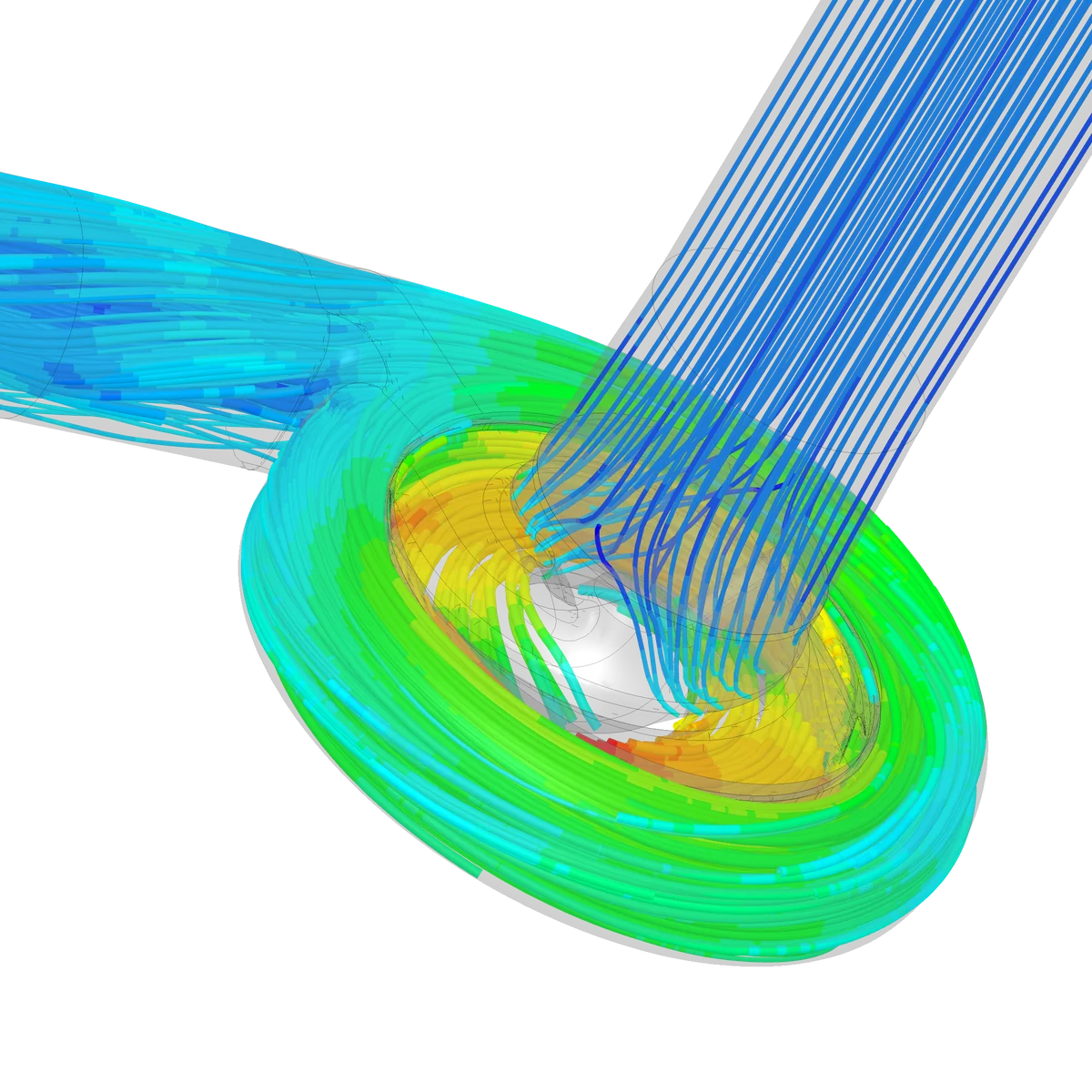
The first step was to prove the underlying technologies, before building layers of automation and process integration on top. Varisco began by validating the solver on a set of existing pump models, each modeled to match the physical test setup, using SimScale’s Multi-purpose solver and run across a series of flow rates to reconstruct the full pump curve. Results fell within 5% of lab measurements, and NPSH predictions correlated closely with test data.
Running the cases in parallel in the cloud completed the validation campaign in around a month. “Starting from our own test data meant the Physics AI model would inherit a level of accuracy we had already verified,” Giulio explains.
Physics AI: One-Click Impeller Optimization
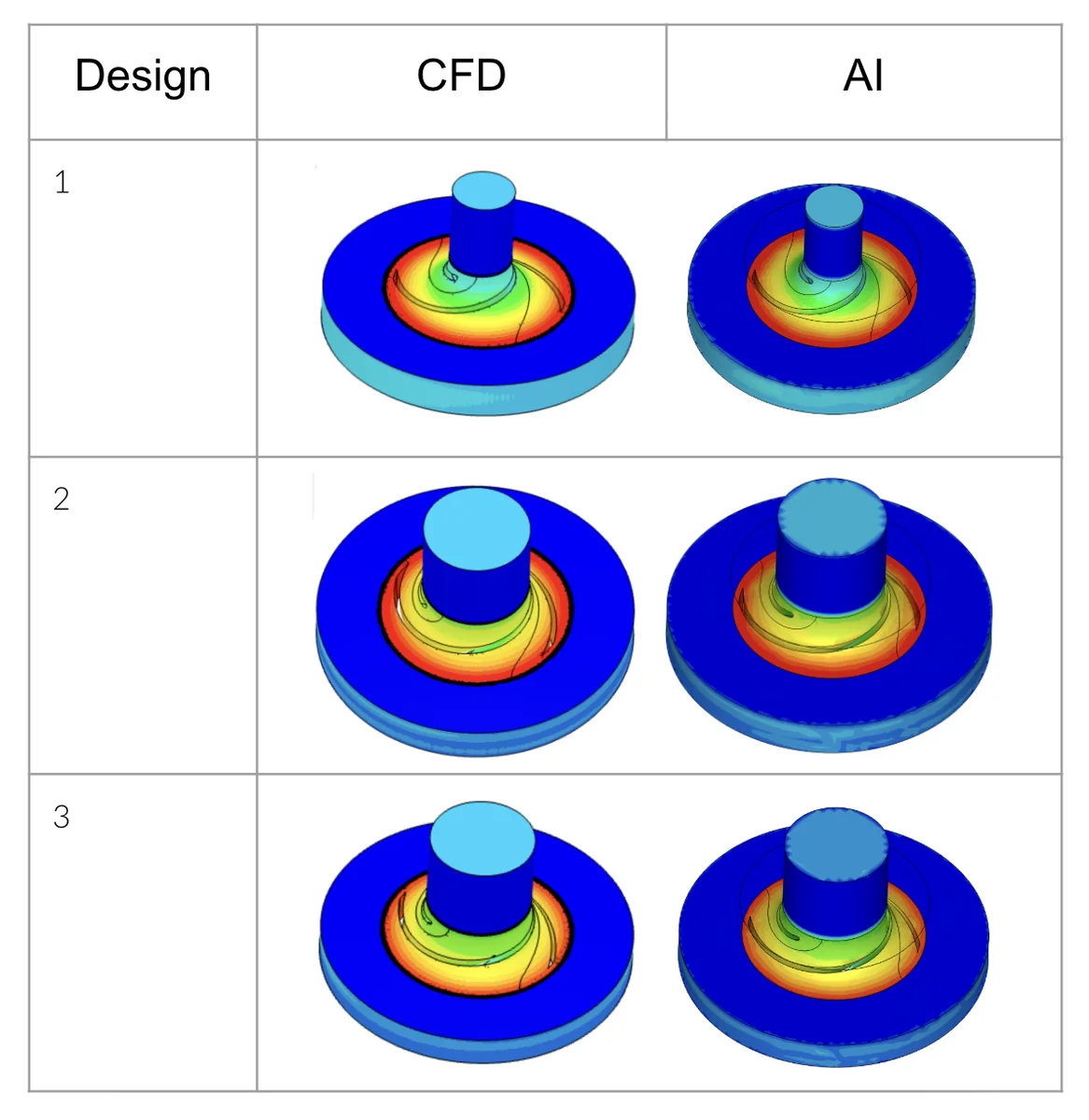
Once the team had established the solver’s accuracy, the next step was to expand the dataset parameter space synthetically, building up a dataset on which to train a Physics AI model. A structured sampling plan of 128 to 150 configurations per pump family produced a training set of around 600 CFD simulations. Tested on new, unseen designs, and compared against CFD simulation data, the Physics AI model averaged 3.3% error on pressure rise and 2.5% on shaft power, with R² values of 0.98 to 0.99.
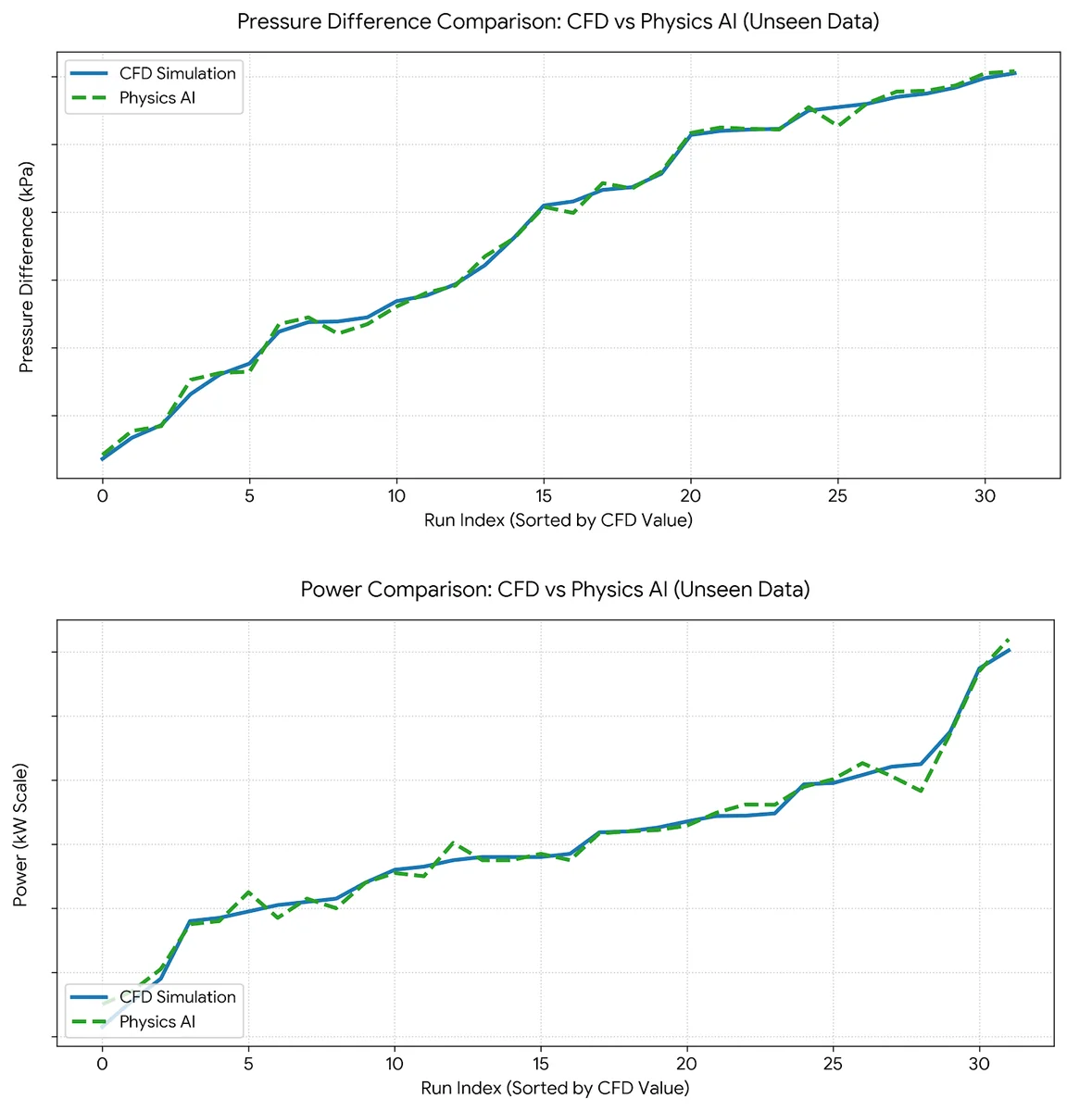
Having proven the strategy using experimental data and on a known design space, Varisco worked with SimScale’s solution engineering team to build an impeller optimization application that runs in four stages. Starting from baseline design files and parameter ranges, the application generates each candidate impeller variant in CFturbo and sets it up in SimScale; the optimizer searches the design space using Physics AI inference to maximize pressure rise while minimizing shaft power, selecting the best balanced design at each operating point from a Pareto front. Finally, a report delivers optimized performance curves, cost predictions, and design files.
Each evaluation takes around two minutes, including geometry generation, import and Physics AI prediction, so a complete optimization loop runs in a matter of hours, depending on the scope. When the Physics AI model confidence drops (if the design parameters or operating point deviate too far from the training data), the workflow falls back to full CFD, keeping an audit trail so engineers can review or intervene at any stage.
For Giulio and the team, the Physics AI-powered process has transformed the way they approach design and simulation. He summarizes, “For us the big unlock is that once we have trained the model, the number of ideas we can test and designs we can optimize is practically unlimited.”
Looking Ahead
Varisco has encoded decades of hydraulic expertise into an AI-driven workflow without compromising on rigor: validating CFD against its own lab data first, then training Physics AI on a design space its engineers defined. Design decisions that once depended on how many iterations the schedule could accommodate can now benefit from comprehensive design space exploration, in the space of days rather than weeks.
The Varisco team are now using the process in live design projects. With parallel pilots running at sister companies, there is interest in extending Physics AI-driven design automation to additional product lines across the Group.
“What SimScale’s team delivered for us was not a standard CAE tool — it was a solution built around how our engineers actually work. In the time it used to take us to complete one design iteration, we can now evaluate an entire design space and surface the optimal configuration. We’re already looking at how we extend this across our product lines.”