Challenges
- Each airflow simulation took 6 to 20 hours to solve on local workstations, limiting the team to about one study a day.
- A growing backlog meant only priority projects got a simulation, and waiting for results slowed down the sales cycle.
- Proposals with several fan layout options took up to a week to simulate, or had to be cut to one option.
- Running simulations and building reports took up a designer’s full working time.
- Keeping up required two workstation licenses and dedicated hardware.
Results
- Cloud-native CFD solves the same simulations in 10 to 30 minutes, more than 90% faster.
- The backlog is clear and every project gets a simulation, with more than 130 reports delivered in a few months.
- All layout options for a proposal run in parallel and come back in about three hours.
- Engineering AI handles 85–90% of the workflow, from setup to finished report, returning half of that time to product design.
- Simulation spend is a third lower than before, with no simulation hardware to maintain.
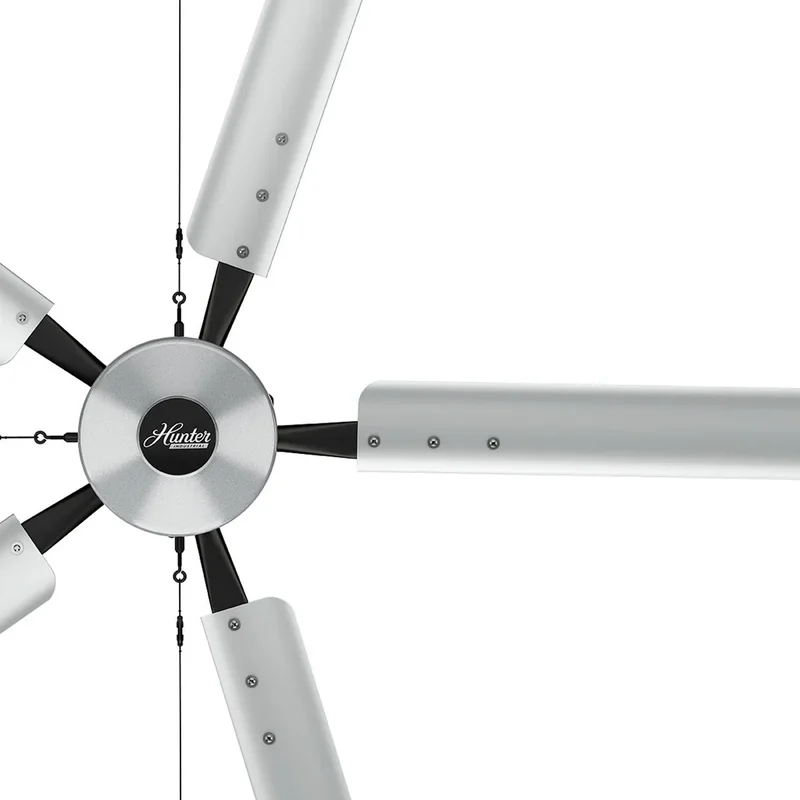
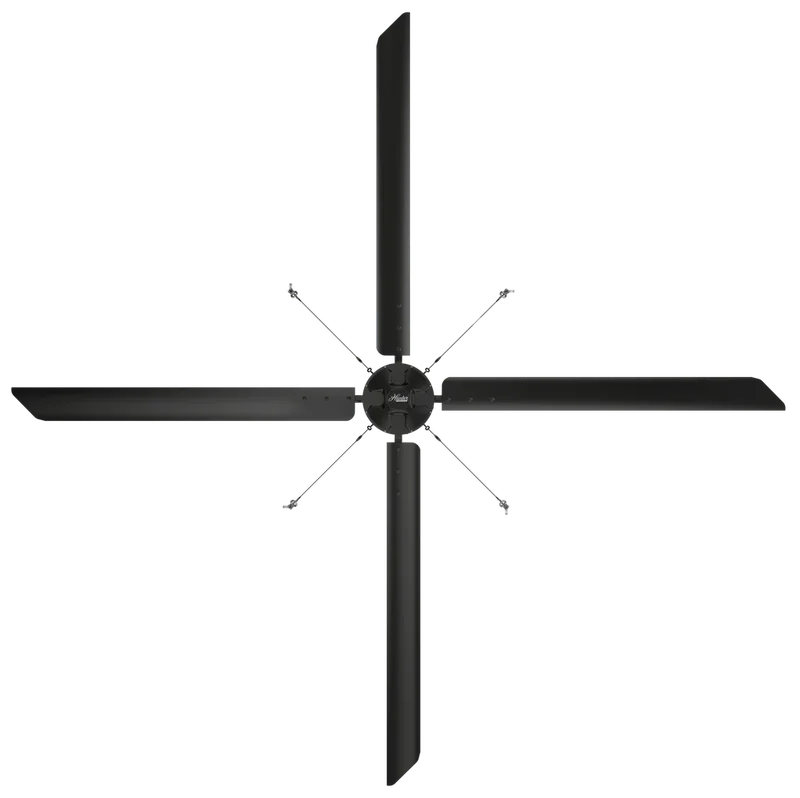
Hunter Fan Company has been making fans since 1886 and is one of the best-known names in residential ceiling fans in the United States. Hunter Industrial is its commercial and industrial business, designing and building high-volume, low-speed (HVLS) fans for warehouses, factories, distribution centers, and other large commercial spaces.
HVLS fans move large volumes of air at low speed to create the floor-level air movement that keeps people cool. For each customer site, Hunter Industrial’s seven-person engineering team helps customers answer the practical questions: how many fans, what size, and where to hang them.
Michael Mulcahy, Senior Engineering Manager, leads a team that includes a lead designer and a simulation engineer who together design bespoke fan layouts for each customer site as part of the bidding process, using airflow simulation to show how each layout will perform. He spearheaded the transition to SimScale and the adoption of AI-driven workflows.

Michael Mulcahy
Senior Engineering Manager, Hunter Industrial

“SimScale has helped to cut the cord on a boat anchor that was restricting our ability to do more with our resources.”
From Overnight Runs to Same-Day Reports: Hunter Industrial’s Adoption of SimScale
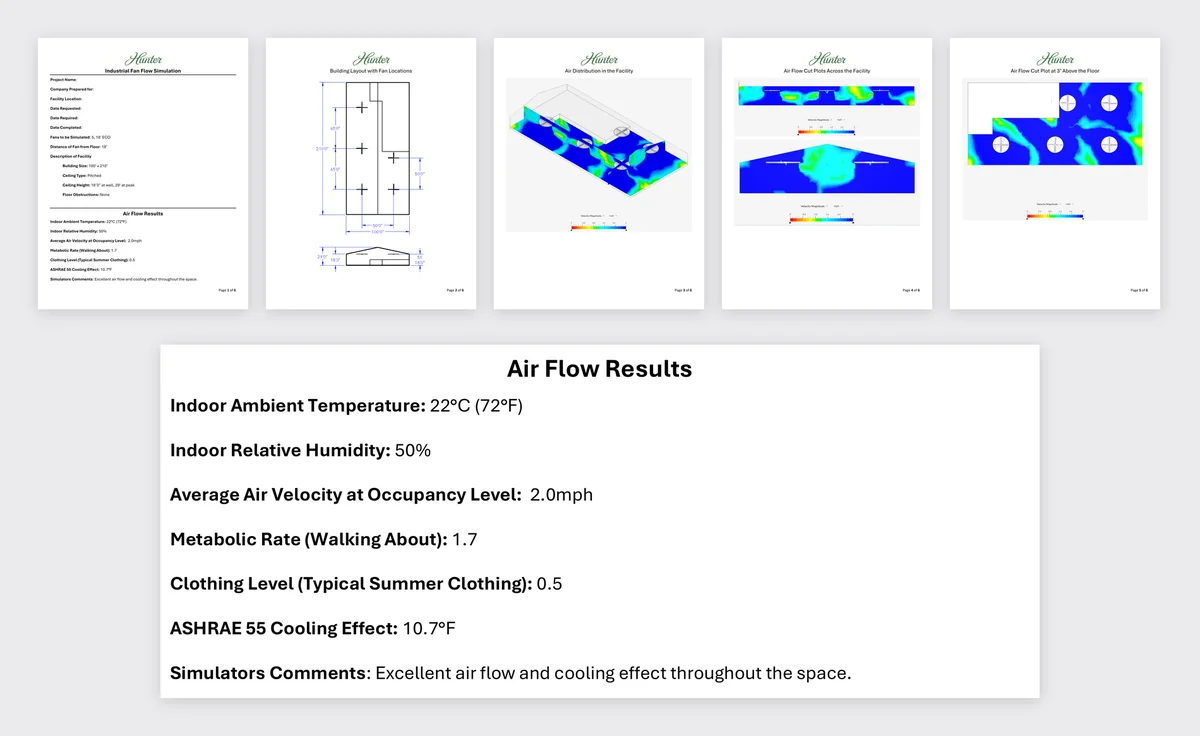
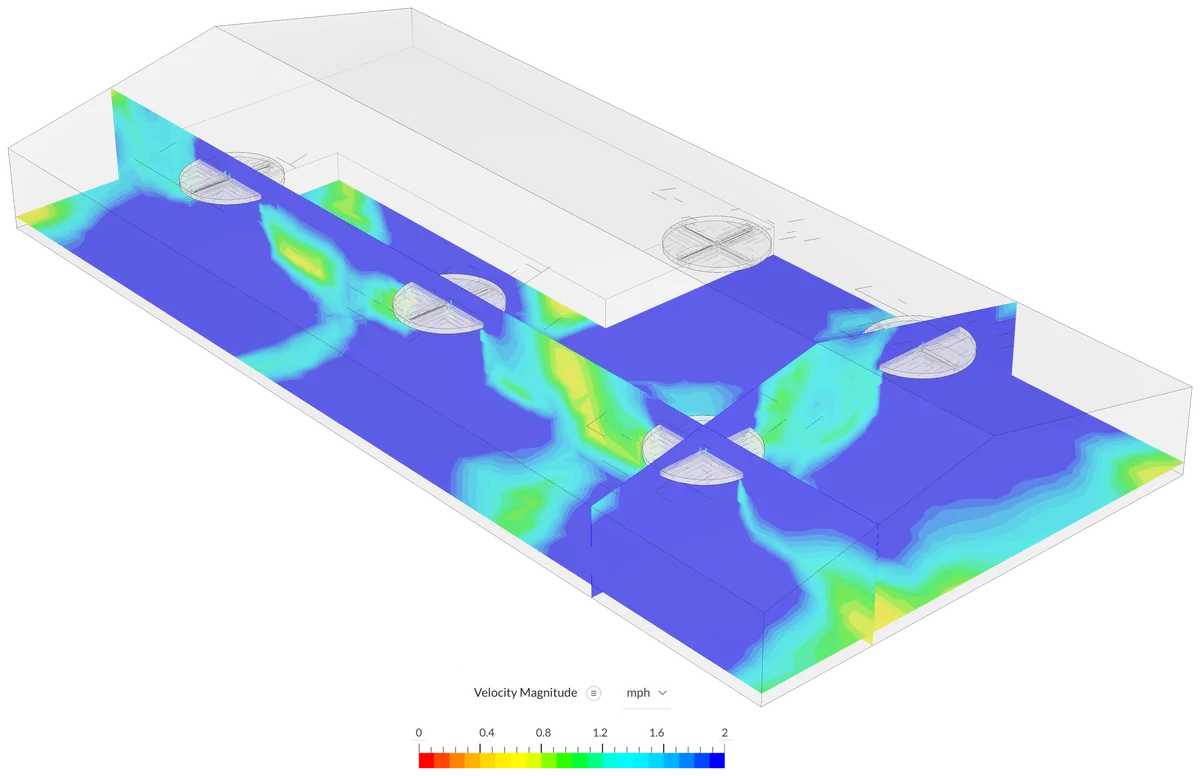
To show customers how different fan configurations will perform in their facility, the team models each site and produces a short report showing air distribution through the space, velocity cut plots at 3 ft above the floor, and the resulting ASHRAE 55 cooling effect. As Michael puts it, “It’s a service engineering provides to say we can make sure every area of your building has airflow going through it, and here is a simulation of what that airflow looks like.”
The team previously used the CFD add-on of a desktop CAD tool, where each simulation took between 6 and 20 hours to solve. With runs going overnight across two workstations, the team managed about one study a day, and as the business grew, so did the queue. Smaller jobs often went without a simulation, and in a sales cycle that can move quickly, insights had to reach customers while they were still weighing their options.
After reviewing alternatives, Hunter Industrial chose SimScale for the quality of its visual output, for multicore processing in the cloud, and for the scope to automate simulation workflows with AI agents. On SimScale’s cloud-native platform, the same simulations solve in 10 to 30 minutes, more than 90% faster, and several can run at once without waiting for a free workstation. The complete turnaround, including manual CAD preparation and report compilation, fell from one to two days to three to four hours.
Michael also credits SimScale’s support for how quickly the team scaled up, singling out Ricardo, their application engineer, who guided the team through onboarding and helped them learn the platform, and David from the account team, who checked in regularly throughout. “It wasn’t just training on the software itself. Ricardo shared a lot of specialist knowledge as well, and he educates you on the why,” he says. “That was so pivotal for us to be able to adopt it quickly and then scale it.”
“The product itself is great. It does exactly what SimScale said it would do. But the execution side of it, and having that support, is really what made it a win for us.”
CFD: Simulating Every Fan Layout a Customer Wants to Compare
Each study models the facility in 3D with the fans in position, solved as steady-state CFD using the Multi-Purpose solver in SimScale. The team converts air velocity at occupant level into the ASHRAE 55 cooling effect, the drop in perceived temperature that air movement gives occupants, and repositions fans wherever part of the floor gets too little airflow.
Customers often want to compare fan sizes, models or layouts, so a project can carry two or three options. Before SimScale, that meant asking the customer to pick one or spending up to a week on processing. “With SimScale we upload it once, we put our fans in, and in three hours we’ve got all the scenarios finished,” Michael says. Customers can compare the results while they are still making their decision.
In one recent project, the team simulated five 18 ft fans in a 100 by 210 ft production facility with a pitched roof rising to 29 ft. The report showed an average air velocity of 2.0 mph at occupancy level and an ASHRAE 55 cooling effect of 10.7°F, with strong airflow throughout the space, and was completed the day after it was requested.
Engineering AI: From CAD to Finished Report
With cloud computing removing the solve bottleneck, the remaining time sat in the steps around it: setting up each simulation and assembling the customer report, which alone took about an hour per project. Michael saw an opportunity to automate that process with AI. Using SimScale’s Engineering AI, the team built an agent-driven workflow that takes over once the 3D model of the facility is ready. The agent sets up and runs the simulation, then generates the finished report as soon as processing completes.
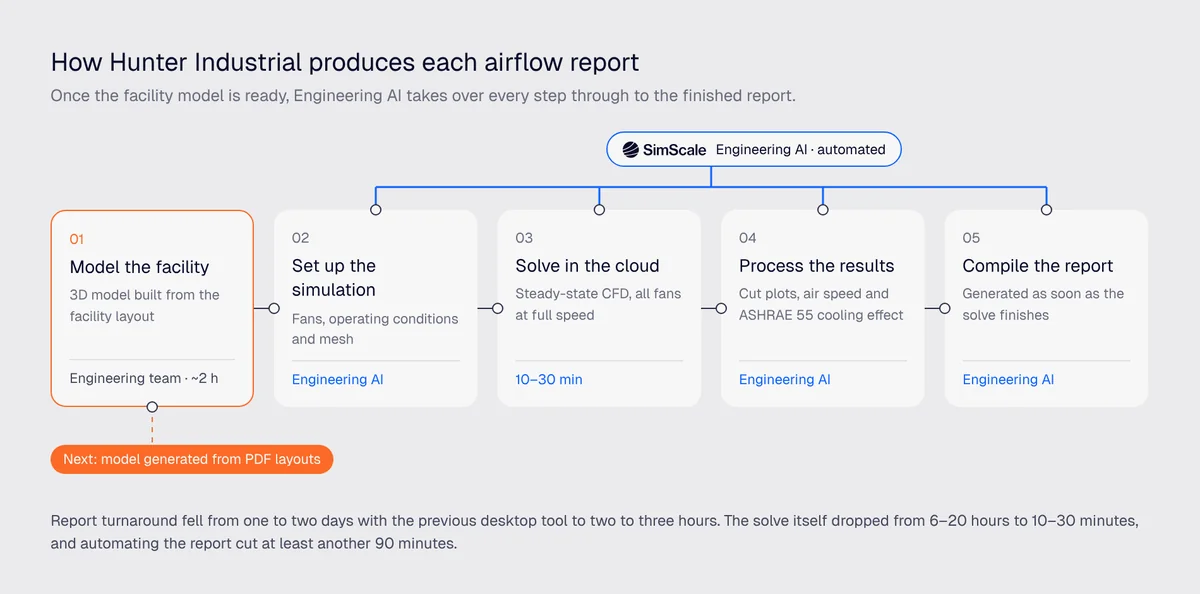
“We still prepare the model, but the AI now handles everything after that,” Michael explains. “As soon as a simulation finishes processing, the report generates automatically and we end up with a finished project.” Report automation cut at least another 90 minutes from every project, bringing turnaround to two to three hours, and Michael estimates the agent now handles 85–90% of the work. The workflow is standardized enough to share across the team. “Anyone who has access to a CAD model and SimScale can run the AI agent,” he says.
Hunter Industrial now delivers at least twice as many simulation reports as before, more than 130 in a few months, while the lead designer’s time on simulation has fallen from all of it to about half. “Now we don’t have to prioritize. We can do all of them,” Michael says. Faster turnaround has also raised demand, with a simulation now requested for almost every potential project, and the team absorbs that volume at a third lower simulation cost.
Towards a frictionless process
Hunter Industrial’s experience shows what happens when simulation keeps pace with the sales cycle. Cloud-native CFD removed the hardware constraint, and Engineering AI removed most of the manual work around each run, turning a specialist bottleneck into a standardized service that supports every proposal.
The next step is the input. Hunter Industrial is standardizing what sales reps submit, with fully dimensioned sketches for every request, so that facility geometry can eventually be generated automatically from a PDF layout and the workflow can run end to end. “This will allow us to drive the report turnaround time down even further so it is completely frictionless for our sales team and customers”, Mike concludes.
“We’ve doubled our output. We’ve freed up a designer from 100% to maybe 50%. And we’ve cut our cost by a third. That’s really the bottom line.”