Industrial & Commercial Fans simulation software
Design, validate, and optimize industrial fans in the cloud.
Run full-physics CFD and FEA on fan and blower designs in parallel. Sweep mass flow to derive complete P-Q and efficiency curves, find the Best Efficiency Point, and prove blade assemblies hold at full rotational speed without queuing for HPC or buying a workstation per engineer.
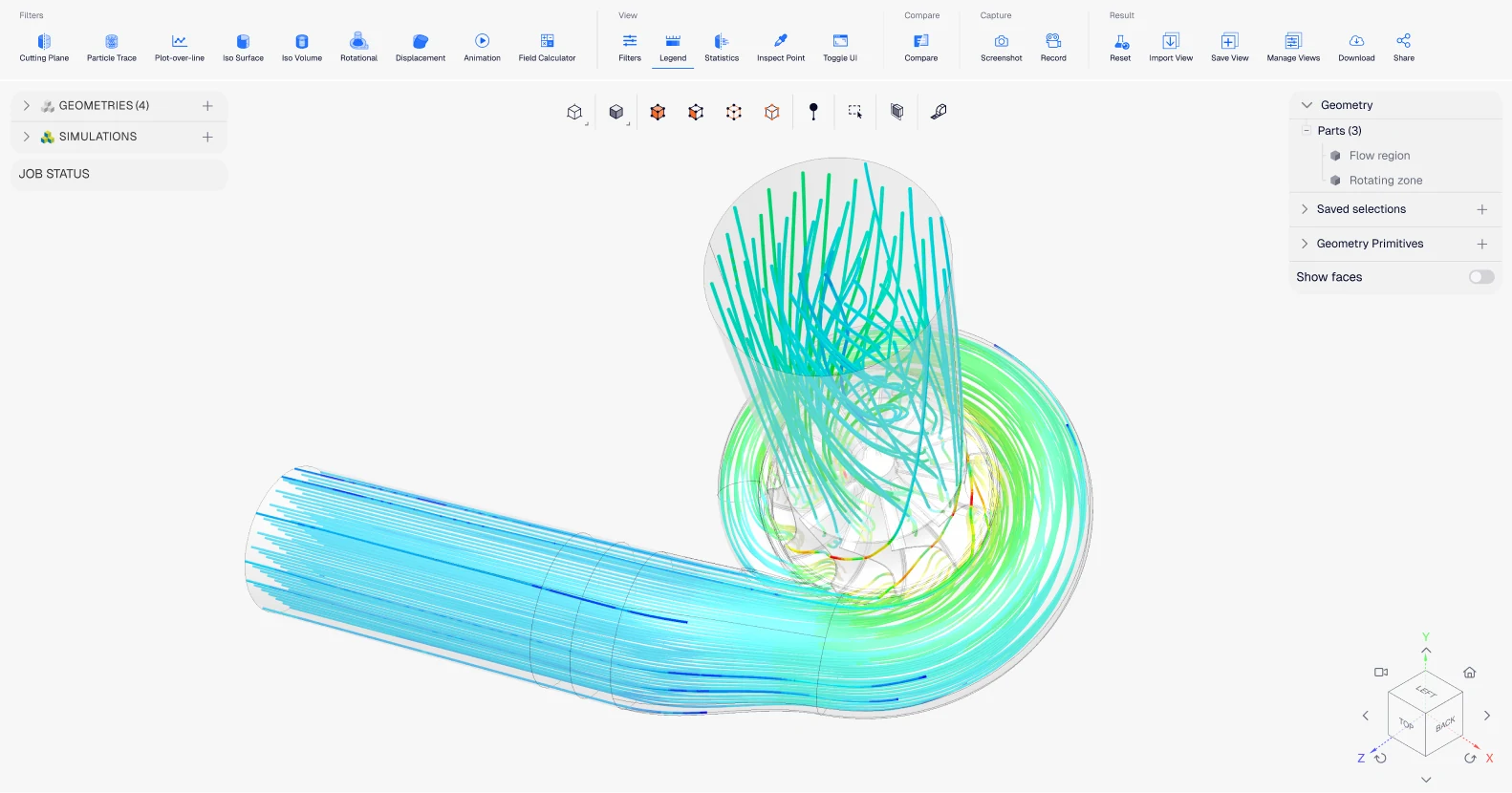












Siloed tools and physical prototypes slow fan design when duty point, efficiency, and blade integrity all need proving at once. SimScale runs CFD and FEA in parallel on one cloud platform. Compare impeller geometries, derive fan curves, and validate blade assemblies in hours, not days.
Valve simulation that covers your full design challenge
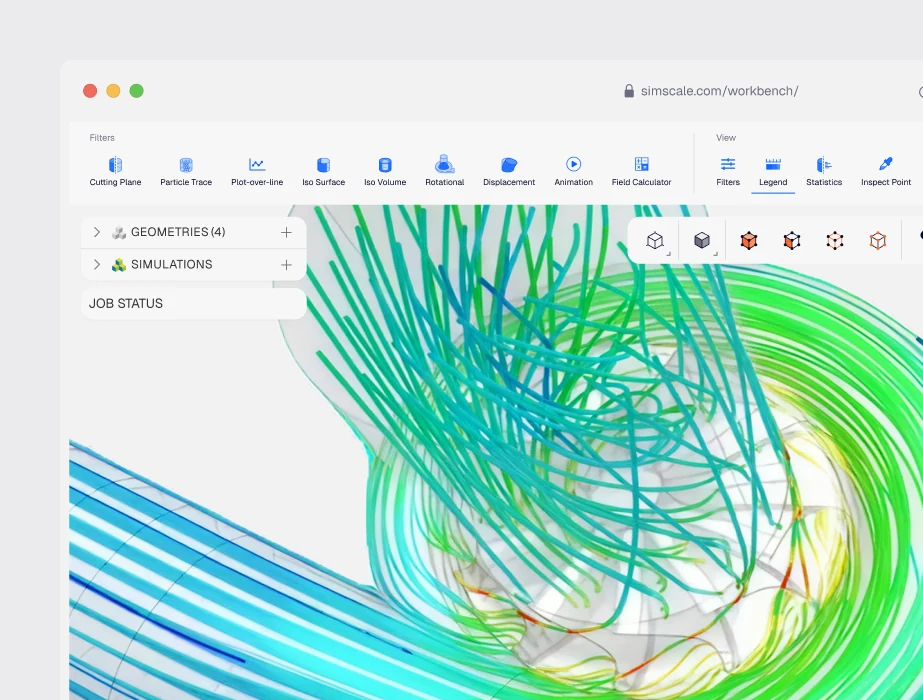
All the physics valve engineers need
Simulate internal flow, structural integrity, and thermal behavior for any valve type, ball, gate, globe, butterfly, or control. Quantify pressure drop, plot Cv curves, identify cavitation risk, and validate structural ratings from one CAD model.
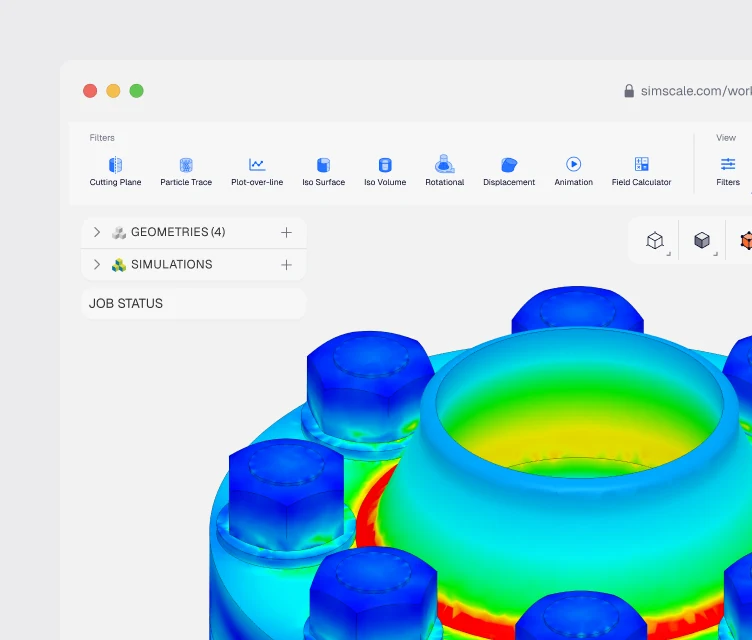
AI-native valve design optimization
Physics AI predicts flow performance in seconds across dozens of valve geometries before committing to full CFD. Engineering AI automates meshing for complex internal flow geometries, compressing the design cycle from weeks to days.
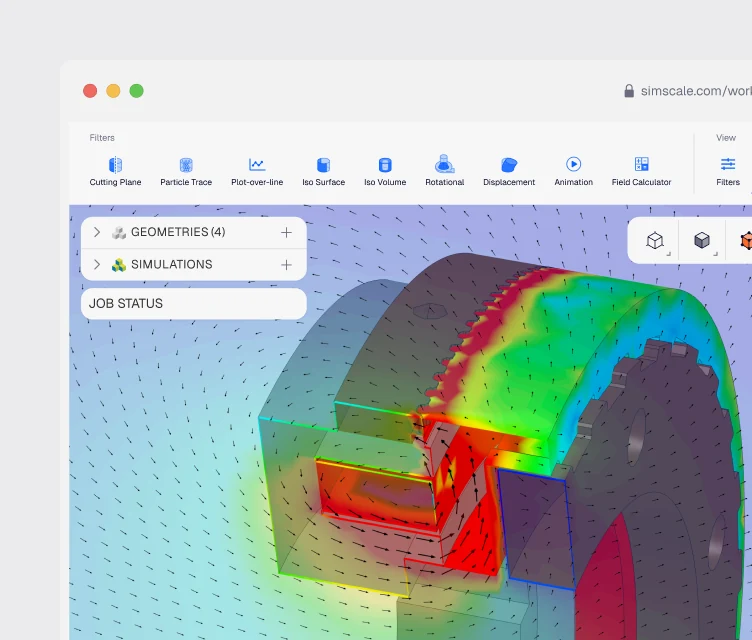
Cloud benefits - more variants, faster
Import from any standard CAD format and run full Cv curve sweeps across multiple valve positions simultaneously. Batch-test a complete valve family in a single session and share results with your team in real time.
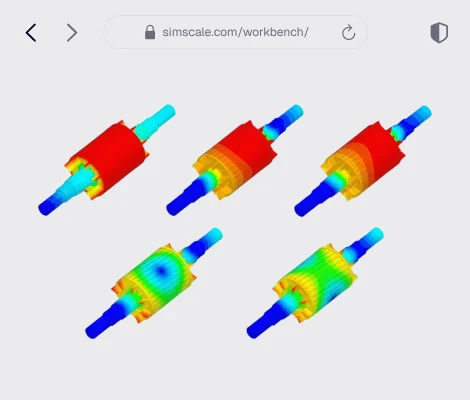
Pressure drop & Cv curves
Run multiple opening positions in parallel to automatically generate full valve performance curves. Quantify pressure drop and flow coefficient across the complete operating range in minutes.
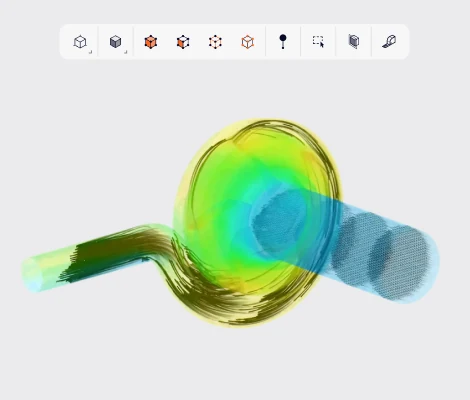
Cavitation risk prediction
Identify high-velocity, low-pressure zones where cavitation will occur before it damages hardware. Optimize trim geometry and flow path to eliminate risk and extend valve service life.
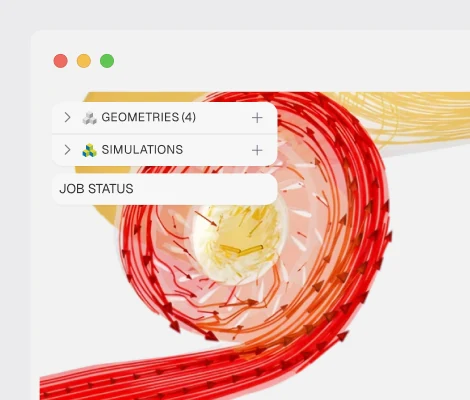
Water hammer & transient analysis
Simulate sudden valve closure and transient pressure waves to quantify water hammer risk. Optimize actuation speed and geometry to protect downstream equipment and ensure system stability.

Replacing an impeller and inlet cone to hit a 310 kW** power ceiling
CASE STUDY
“The geometry requirements and speed of SimScale's incompressible analyses are fantastic. I simply could not do these comparisons using TCFD on my AMD Ryzen Threadripper PRO 3975WX in an acceptable time. The difference would be many days instead of hours for SimScale.”
— Owner of FanMechanics
Weight-optimized turbomachinery blade assembly validated at 50,000 rpm**
CASE STUDY
“We now have an AI model that can generate a new optimized design in under an hour, and I have complete confidence in the results.”
Relume
1 hour
Thousands of design variants explored
“We now have an AI model that can generate a new optimized design in under an hour, and I have complete confidence in the results.”
Relume
Related resources

Alex Graham
June 16, 2026
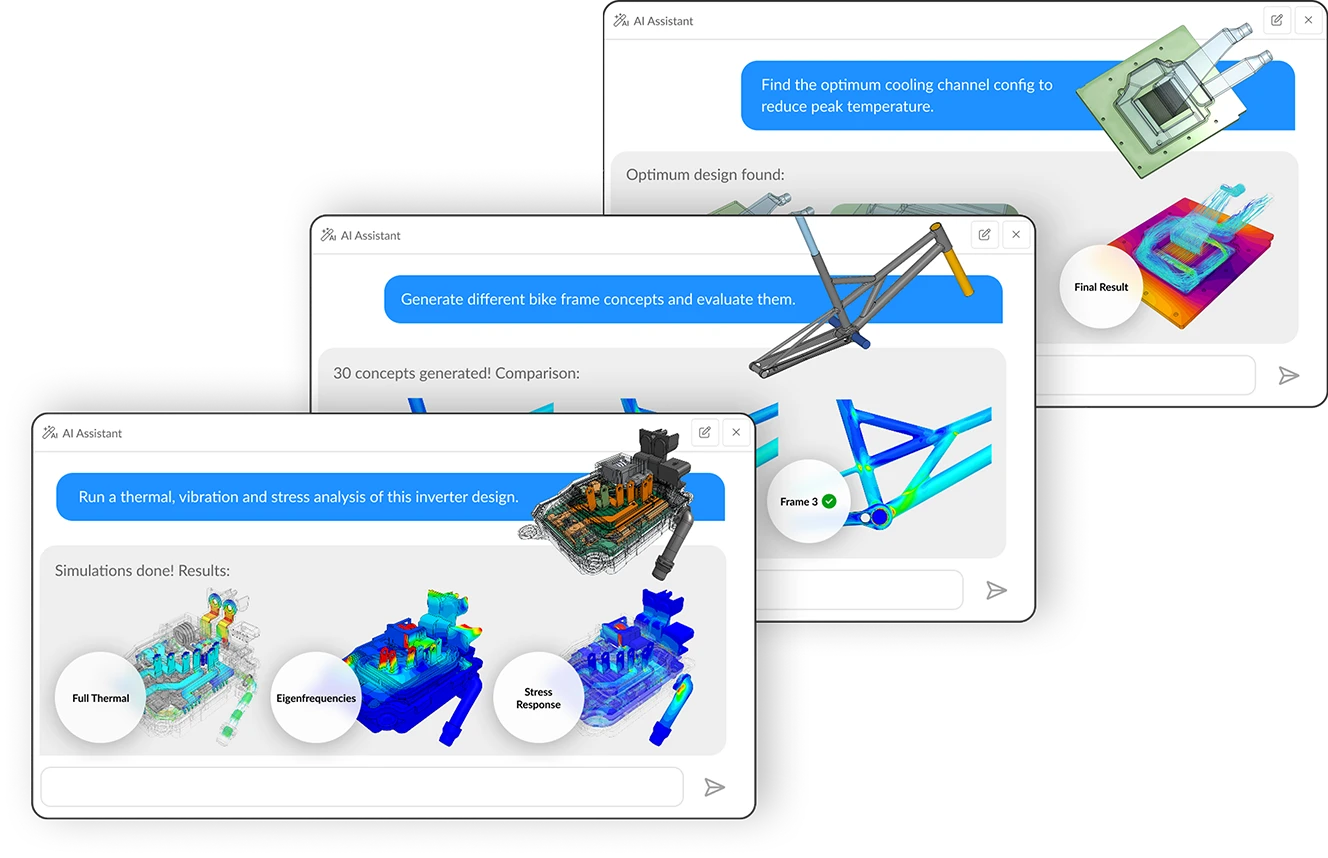
Multi-agent workflows: key takeaways from Design & Simulation Week 2026
SimScale and CoLab demonstrated live AI agent collaboration at Design & Simulation Week 2026, cutting engineering review and simulation lead times dramatically.
Alex Graham
June 12, 2026

SimScale Workflows: Why we are opening up the platform (& why you should care)
SimScale Workflows opens its platform to custom solvers and tools, enabling automated, AI-driven multi-step engineering simulation pipelines for any organization.
Alex Graham
May 29, 2026



Luis Goncaves
June 18, 2026
Luis Goncaves
January 27, 2026

Paras Ghumare
December 4, 2025


Jon Wilde
June 16, 2026


David Heiny
June 15, 2026
Jon Wilde
June 3, 2026

Peter Selmeczy
March 24, 2026

Peter Selmeczy
September 10, 2025
Peter Selmeczy
June 25, 2025
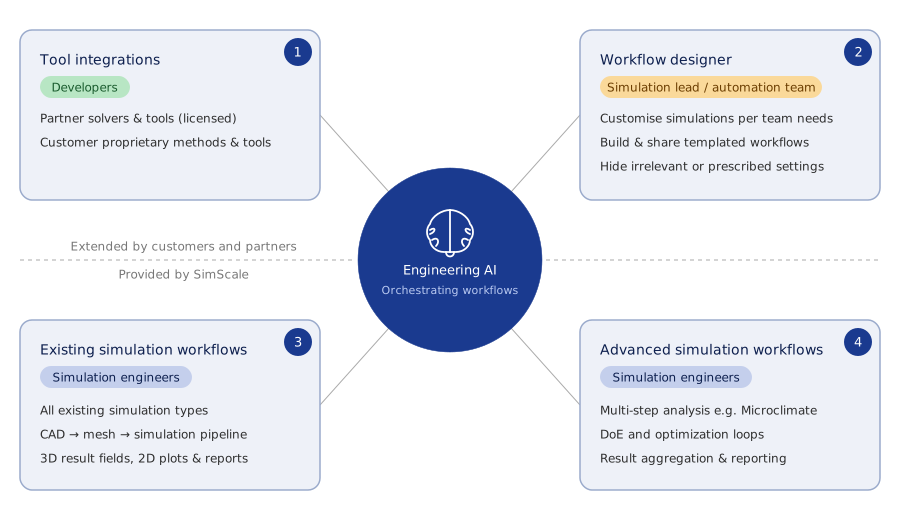
Peter Selmeczy
May 29, 2026
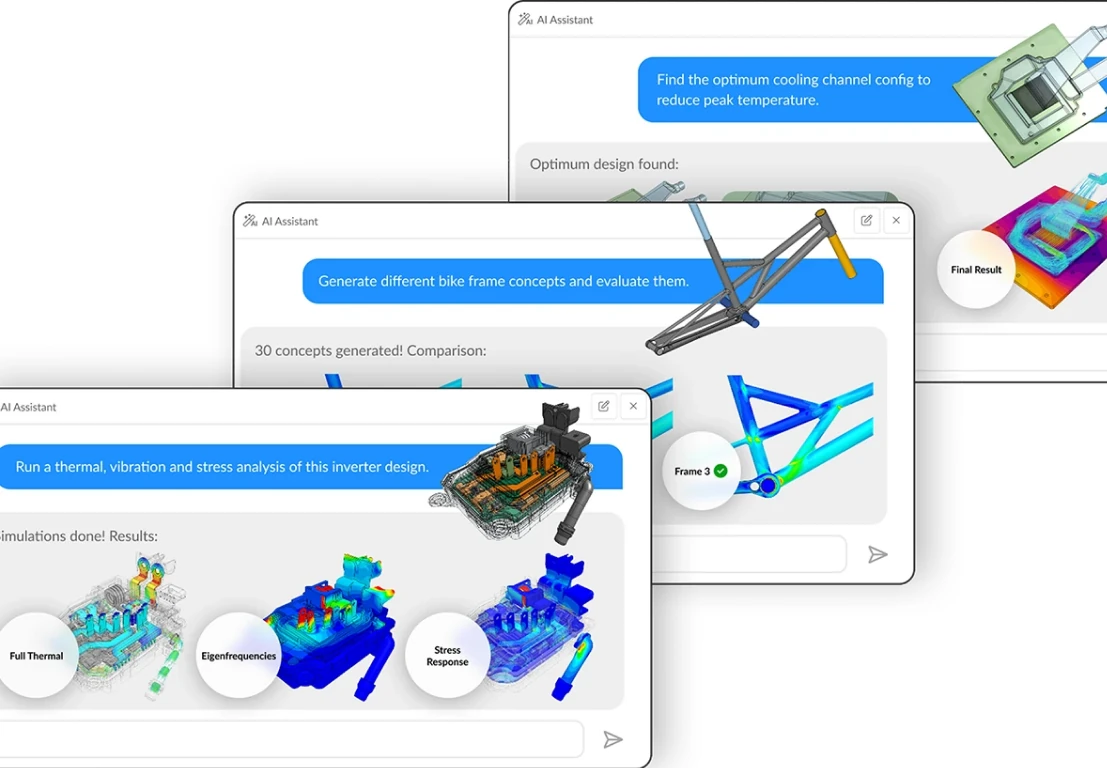
SimScale supports laminar and turbulent flows, incompressible and compressible flows, multiphase flows using the volume of fluid (VoF) method, passive scalar and species transport, and conjugate heat transfer.
SimScale uses multiple solvers depending on the analysis type. For multiphase flow, it uses OpenFOAM's interFoam solver. For high-speed transient simulations, it offers a GPU-accelerated Lattice Boltzmann Method (LBM) solver.
The Lattice Boltzmann Method solver runs on multiple GPUs in parallel, delivering turnaround times 20–30 times shorter than standard CFD methods. Transient simulations that once took days now complete in hours.
SimScale supports several turbulence models including k-omega SST, k-epsilon, Smagorinsky, SST-DDES, and Hybrid SST-IDDES. The LBM solver in particular supports scale-resolving turbulence models for high-fidelity transient analysis.
Yes. SimScale includes conjugate heat transfer (CHT) and convective heat transfer analysis, enabling thermal modeling of conduction and convection together with the flow field in a single coupled simulation.