Indoor Environment simulation software
Design indoor spaces that perform exactly as drawn — for comfort, air quality, and energy.
Map temperature, airflow, and contaminant transport inside any conditioned space with cloud-native CFD. Validate natural and mechanical ventilation, run PMV/PPD against ASHRAE 55, simulate fume extraction systems, and confirm IAQ across every zone — all in a browser, before construction starts.
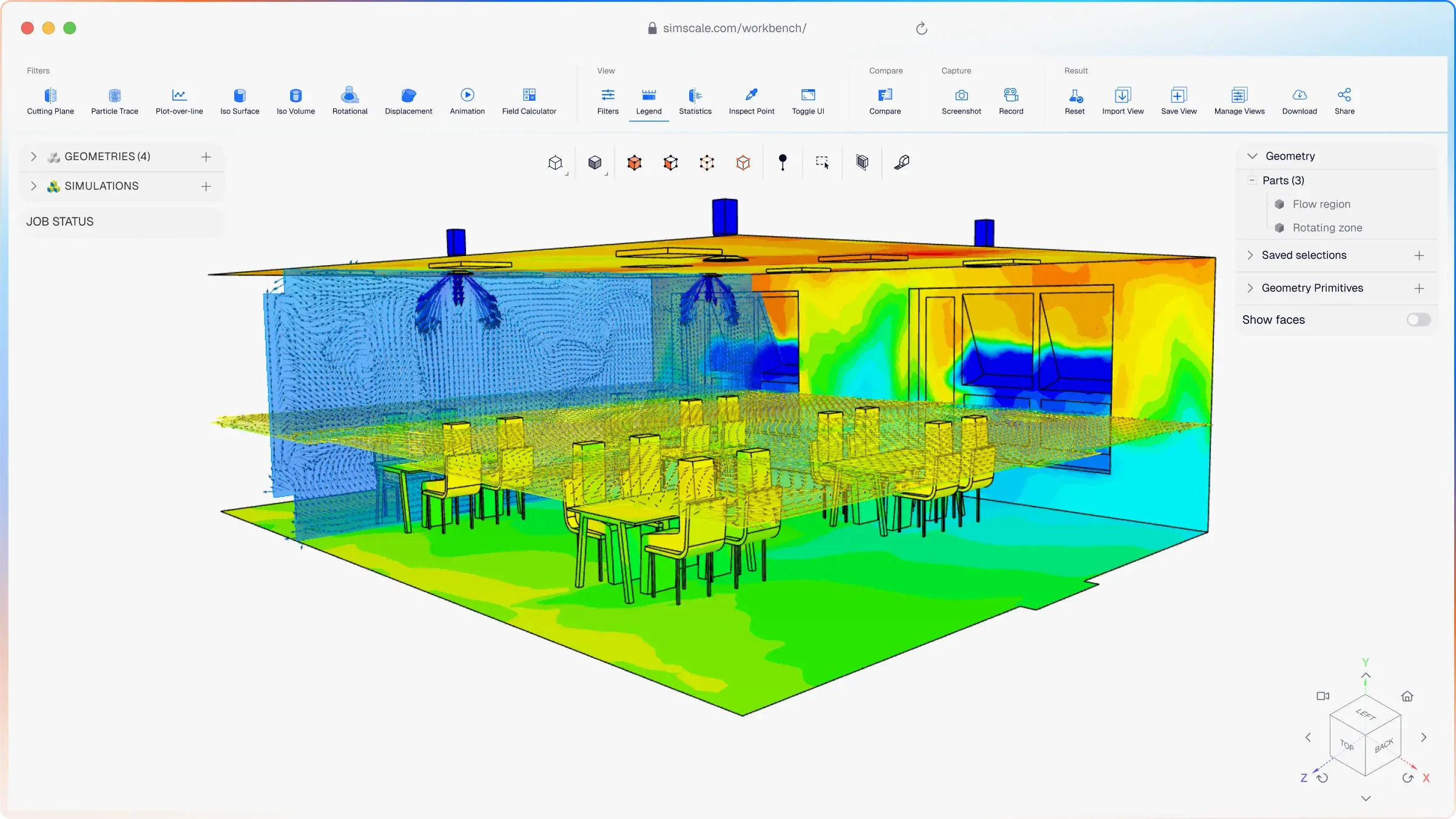












Thermal comfort, fresh-air delivery, fume extraction, and energy load all interact across a single occupied volume. SimScale runs full CFD in the cloud, in parallel, so MEP engineers and architects can test ventilation strategies, comfort metrics, and air quality outcomes early enough to shape the design.
One platform for thermal comfort, ventilation, and fume extraction
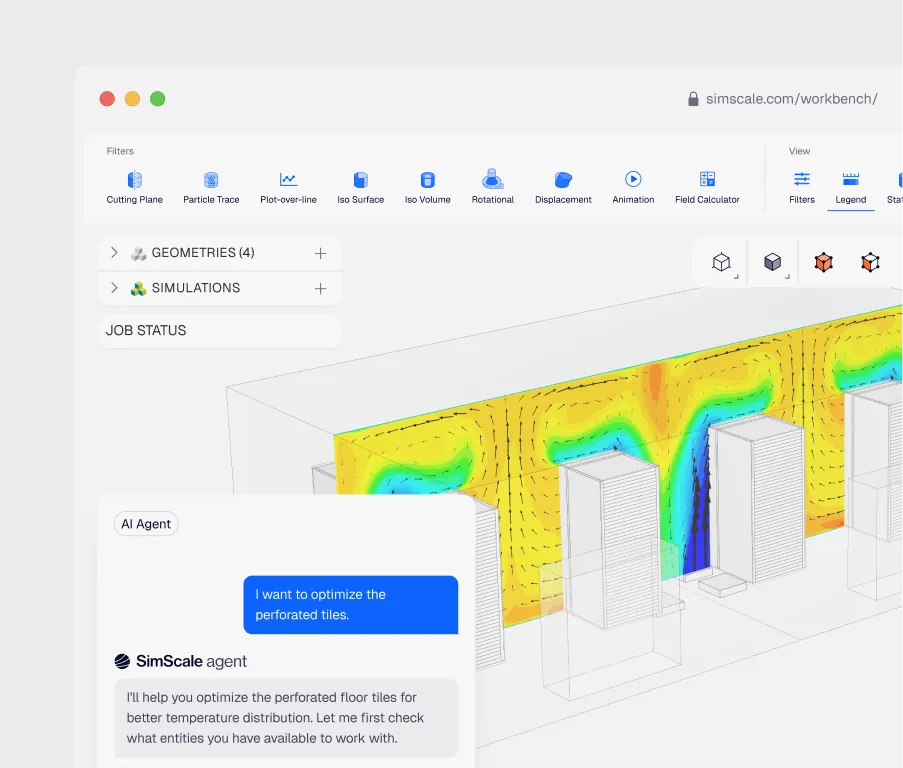
Engineering AI — from geometry to result in hours, not weeks
SimScale's Engineering AI automates geometry cleanup, meshing, and boundary condition setup. Physics AI delivers near-instant predictions on ventilation configurations, diffuser placements, and hood geometries — so engineers can explore far more of the design space before committing to equipment or drawings.
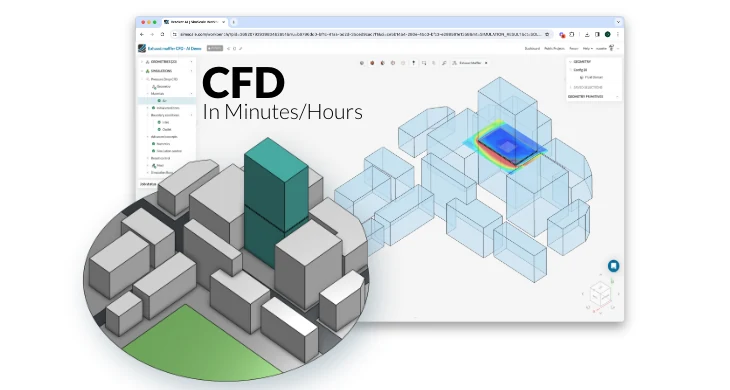
Cloud — every variant running simultaneously
No on-premise HPC, no queue. Run dozens of ventilation strategies, diffuser layouts, or fume extraction configurations at the same time, share live results in a browser, and shorten feedback loops by 50–70%.
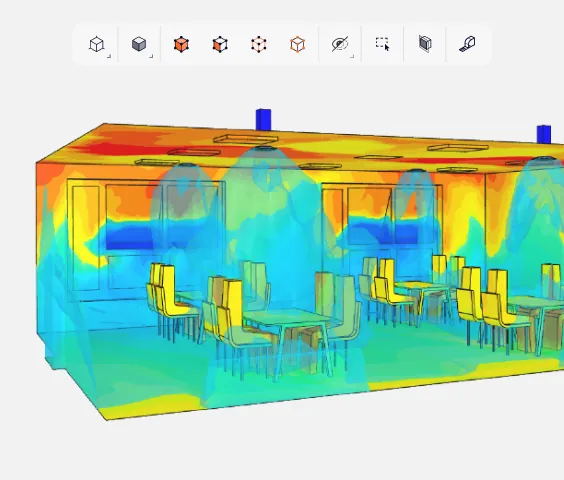
Thermal comfort and IAQ — PMV/PPD, CO₂, and mean age of air
Map predicted mean vote and predicted percentage dissatisfied across the full occupant zone against ASHRAE 55. Simulate CO₂ build-up, mean age of air, and contaminant transport using passive scalars to validate fresh-air delivery for classrooms, offices, and healthcare spaces. Compare displacement, UFAD, and mixing strategies to quantify the trade-off between ventilation effectiveness and energy use.
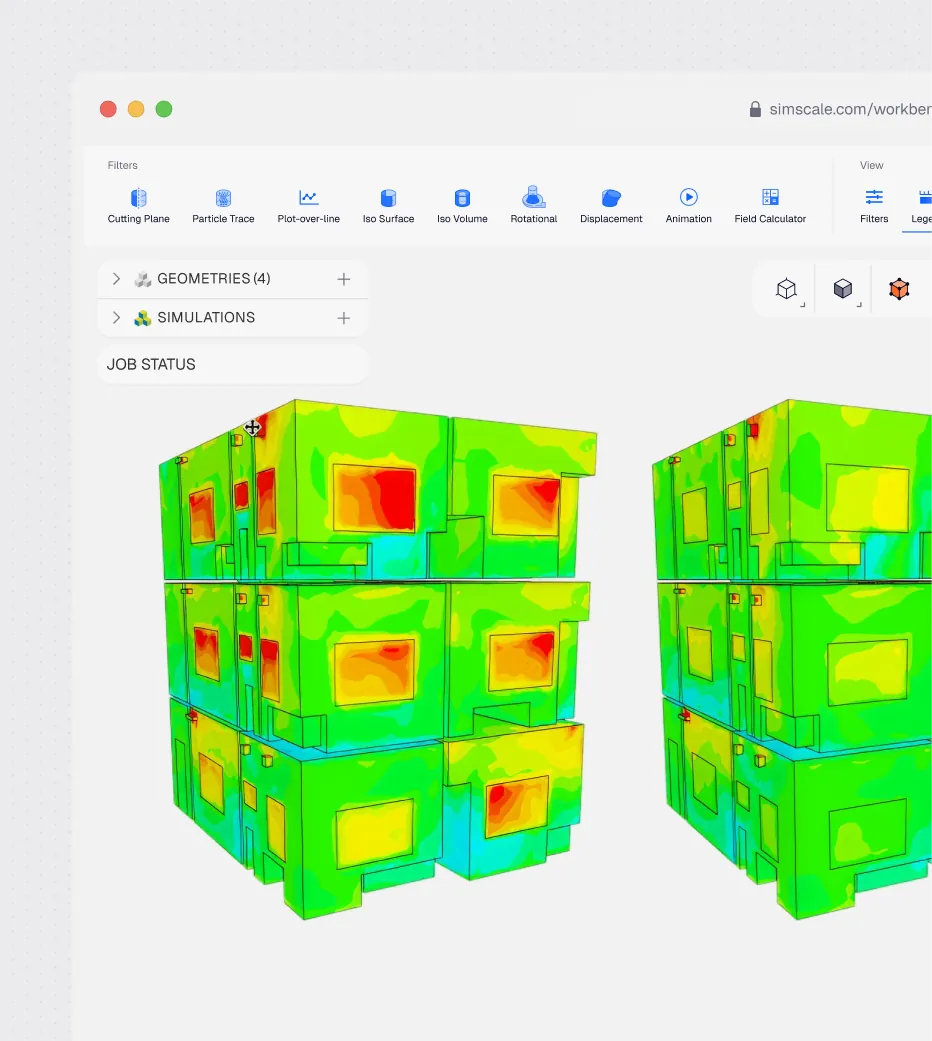
Natural ventilation — wind-driven, stack effect, and Cp export
SimScale's incompressible solver and Lattice Boltzmann method (LBM) model buoyancy-driven stack effect through atria and shafts, wind-driven cross ventilation across operable façades, and façade-detail studies of louvres and operable window angles — including mixed-mode switchover strategies. A 16-direction wind rose runs in parallel and exports calibrated Cp values to IES VE, EnergyPlus, and DesignBuilder, replacing default values that can differ from site-specific reality by up to 100% in magnitude.
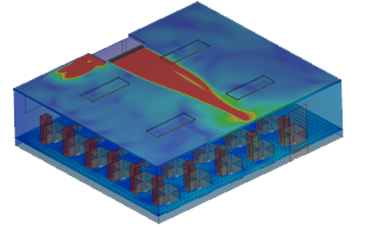
Mechanical ventilation — supply, exhaust, MVHR, and re-entrainment
Simulate the full mechanical ventilation system from diffusers and ducts to AHU intakes and exhaust stacks. Validate supply, exhaust, and balanced MVHR systems against ASHRAE 62.1, 62.2, Passivhaus, and healthcare codes. Optimise diffuser and louvre geometries against pressure drop and draft risk, and assess exhaust re-entrainment using CHT with passive scalar transport.
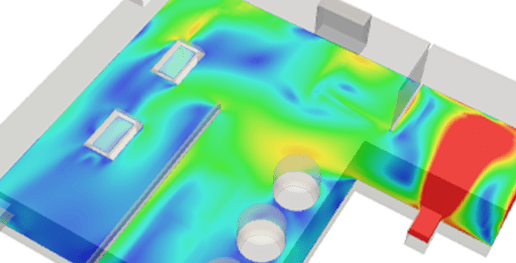
Fume extraction — welding, chemical, CNC plasma, and lab hoods
Run CFD, passive-scalar smoke transport, and conjugate heat transfer on the full extraction system — from hood geometry and source-capture distance through ductwork pressure drop to fan sizing. Validate the 0.5–1.0 m/s capture velocity standard for welding hoods, the 80–120 fpm face velocity for chemical fume hoods (ASHRAE 110), and air-change rates for school chemistry labs.

Huge
climate-responsive design for large, acoustically sensitive spaces
“The main benefit of using SimScale is the ability to link advanced computational fluid dynamics in the cloud to energy savings from our thermal modeling and analysis. Optimizing for comfort in sensitive spaces like large theaters with significant structural and acoustic constraints is a difficult task, and having access to the right tools at the right time is critical to ensure building performance.”
Madhav Munshi - Mechanical Engineer at Kohler Ronan

16
wind directions simulated in parallel
“With the application of SimScale, we are able to simulate the effect of natural ventilation throughout a building far more accurately, by comparison to the use of default Cp settings. This can have a noticeable impact when simulating naturally ventilated buildings on parameters such as summertime internal temperatures, CO2 concentrations, and wintertime space heating loads. Our experience to date is that SimScale offers more favourable simulation outcomes in the case of CIBSE TM59 simulations, for instance, which can return project cost savings without compromising the risk of overheating.”
Richard Tibbenham - Greenlite Building Physics

50-70%
shorter MEP feedback loops due to cloud CFD
“SimScale allows us to embed simulation insight at the moment when decisions are being made, not after drawings are complete.”
Mark Hahn - Mechanical Engineer, DLR Group
Related resources

Alex Graham
June 16, 2026
Multi-agent workflows: key takeaways from Design & Simulation Week 2026
SimScale and CoLab demonstrated live AI agent collaboration at Design & Simulation Week 2026, cutting engineering review and simulation lead times dramatically.
Alex Graham
June 12, 2026

SimScale Workflows: Why we are opening up the platform (& why you should care)
SimScale Workflows opens its platform to custom solvers and tools, enabling automated, AI-driven multi-step engineering simulation pipelines for any organization.
Alex Graham
May 29, 2026



Luis Goncaves
June 18, 2026
Luis Goncaves
January 27, 2026

Paras Ghumare
December 4, 2025


Jon Wilde
June 16, 2026


David Heiny
June 15, 2026
Jon Wilde
June 3, 2026

Peter Selmeczy
March 24, 2026
Peter Selmeczy
September 10, 2025
Peter Selmeczy
June 25, 2025
Peter Selmeczy
May 29, 2026
SimScale handles the full range of indoor environment physics: thermal comfort (PMV/PPD against ASHRAE 55), indoor air quality (CO₂, mean age of air, contaminant transport), natural ventilation (wind-driven and stack effect), mechanical ventilation (supply/exhaust/MVHR and ASHRAE 62.1/62.2 compliance), fume extraction (welding source-capture hoods, CNC plasma downdraft tables, chemical fume hoods, lab fume hood arrays), large-volume stratification in halls and atria, and condensation risk on cold surfaces — all in a single cloud-native CFD platform.
Whole-building energy models give annual energy demand and zonal averages — they cannot resolve sub-zonal physics. Use CFD when you need local PMV/PPD mapping across an occupant zone; spatial answers on where CO₂ accumulates or where a supply jet fails to mix; site-specific wind pressure coefficients for natural ventilation modelling (default tool values can differ from actual by up to 100% in magnitude); exhaust re-entrainment risk across a building envelope; or capture velocity validation for fume extraction systems.
SimScale produces full PMV/PPD contour plots across the occupant zone, accounting for air temperature, mean radiant temperature, relative humidity, air speed, metabolic rate, and clothing insulation. ASHRAE 55 requires at least 80% occupant satisfaction (PMV within ±0.5) — CFD lets you map where local discomfort exists and tune supply conditions to close those gaps.
SimScale's incompressible CFD and Lattice Boltzmann (LBM) solvers cover wind-driven cross ventilation through operable windows and façade openings; buoyancy-driven (stack effect) flow through atria, shafts, and chimneys; combined wind-and-buoyancy interaction with realistic Atmospheric Boundary Layer profiles; mixed-mode strategies; and façade-detail studies of perforated screens, louvres, and operable window angles. A 16-direction wind rose study runs in parallel on the cloud and exports calibrated wind pressure coefficients to downstream thermal modelling tools.
SimScale handles supply-only, exhaust-only, and balanced (with or without MVHR / heat recovery) systems across residential, commercial, institutional, and healthcare buildings. Workflows cover diffuser and louvre optimisation, duct and AHU sizing, room-level airflow and thermal comfort, exhaust re-entrainment analysis, and code-compliance against ASHRAE 62.1, 62.2, Passivhaus, and healthcare ventilation standards.