SimScale empowers engineers and designers to swiftly simulate and optimize turbomachinery designs, transforming your workflow.
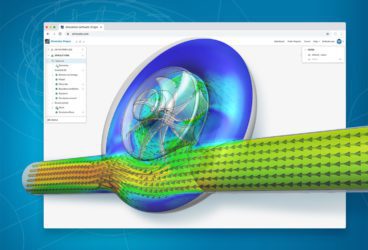
The SimScale Multi-purpose CFD solver is a versatile analysis type specifically designed for turbomachinery, propellers, and more generally anything that rotates within a fluid. It includes a robust meshing strategy, based on a binary tree based meshing technique, that produces an automated body-fitted mesh. The Finite Volume based solver is optimized to handle a wide range of flow regimes including:
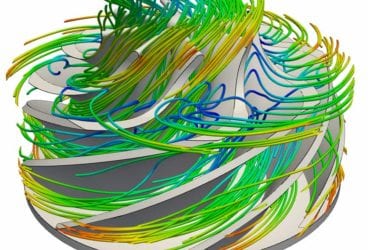
It can simulate both incompressible and compressible flow, either laminar or turbulent in a single framework. Turbulence is modeled using the RANS equations with the k-epsilon turbulence model for closure and proprietary wall functions for near-wall treatment that allow higher flexibility in creating the mesh near wall regions. Multi-purpose supports a Moving Reference Frame (MRF) rotor formulation in the steady-state as well as a full sliding mesh approach for transient analysis of rotating components.
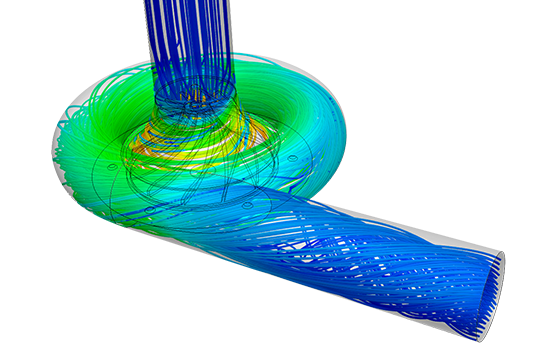
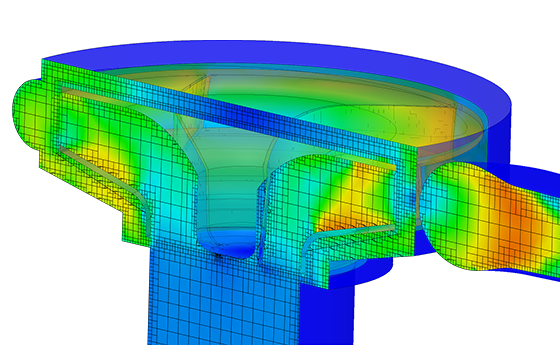
The Multi-purpose analysis type provides a very robust, automated binary-tree-based meshing algorithm producing hexahedral cells suitable for the underlying Finite Volume-based CFD solver. The meshing algorithm is highly parallelized for multiple CPU cores, reducing high-quality mesh generation times by considerable margins, and requires fewer cells to achieve the same level of accuracy and rapid solver convergence. Another feature is the automatic generation of optimal mesh interfaces between the rotating and stationary components of the system being simulated.
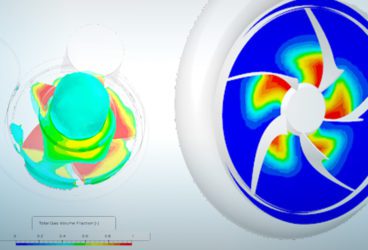
SimScale factors caviation into the CFD simulation of pumps, water turbines, and marine propellers, or any machine immersed in a fluid. The SimScale Multi-purpose CFD solver computes the space occupied (volume fraction) by the liquid and its vapour and cavitation results are shown as the volume fraction of gas present in the liquid. Robust convergence and fast simulation turnaround with the Cavitation model enable SimScale users to conduct NPSHr studies for a pump within a day.
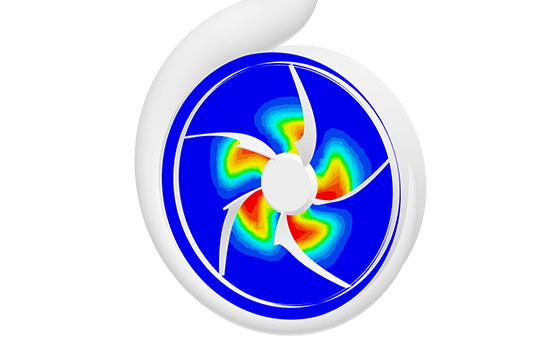
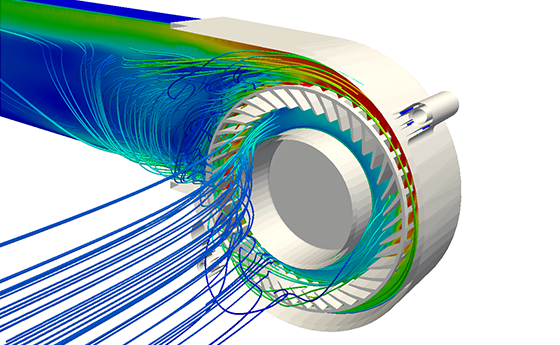
When designing new pumps, fans, and blowers, SimScale can calculate the system performance curve by running parametric studies that solve for a range of pressure drop – flow rate scenarios of the design. The highly parallelized and cloud-optimized algorithms allow a parametric study to run in nearly the same time as a single data point run!
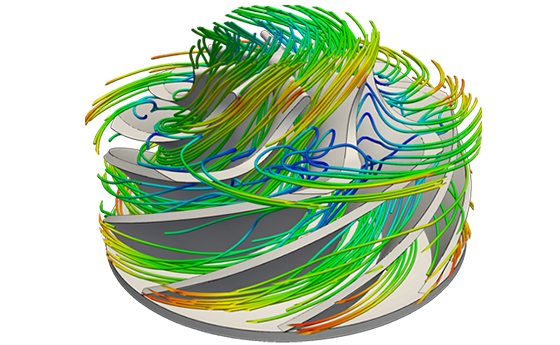
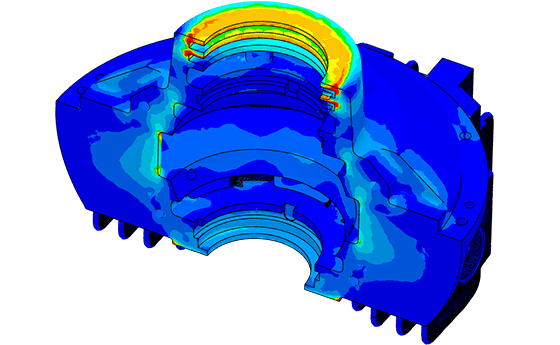
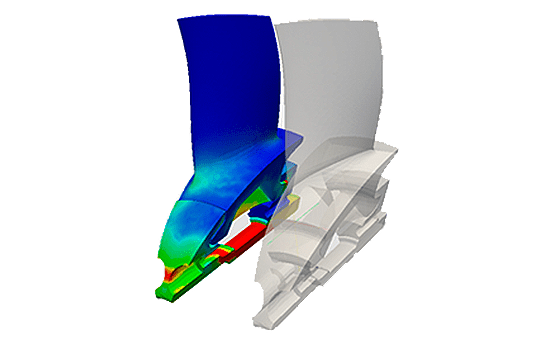
Cloud-optimized solvers make it possible to run transient CFD simulations in a fraction of the time taken by traditional CAE. For example, a full transient simulation for a centrifugal pump with a mesh size of nearly 0.6 million cells takes under 20 minutes. The same simulation in traditional CFD tools would take at least 12 hours.
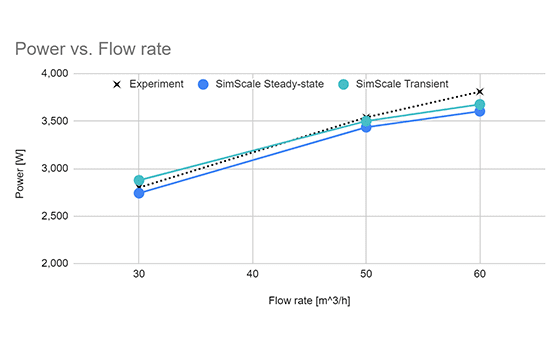
To establish the accuracy and reliability of the transient solution, we have validated the solver against a range of standard benchmarks. The chart shows the comparison of power vs. flow rate for a centrifugal pump. The results from the transient analysis are a very close match with the experimental results. Also, a mesh independence study for this case resulted in a model size of about 0.6 million cells and a full transient run for one flow rate took just 18 minutes to complete.
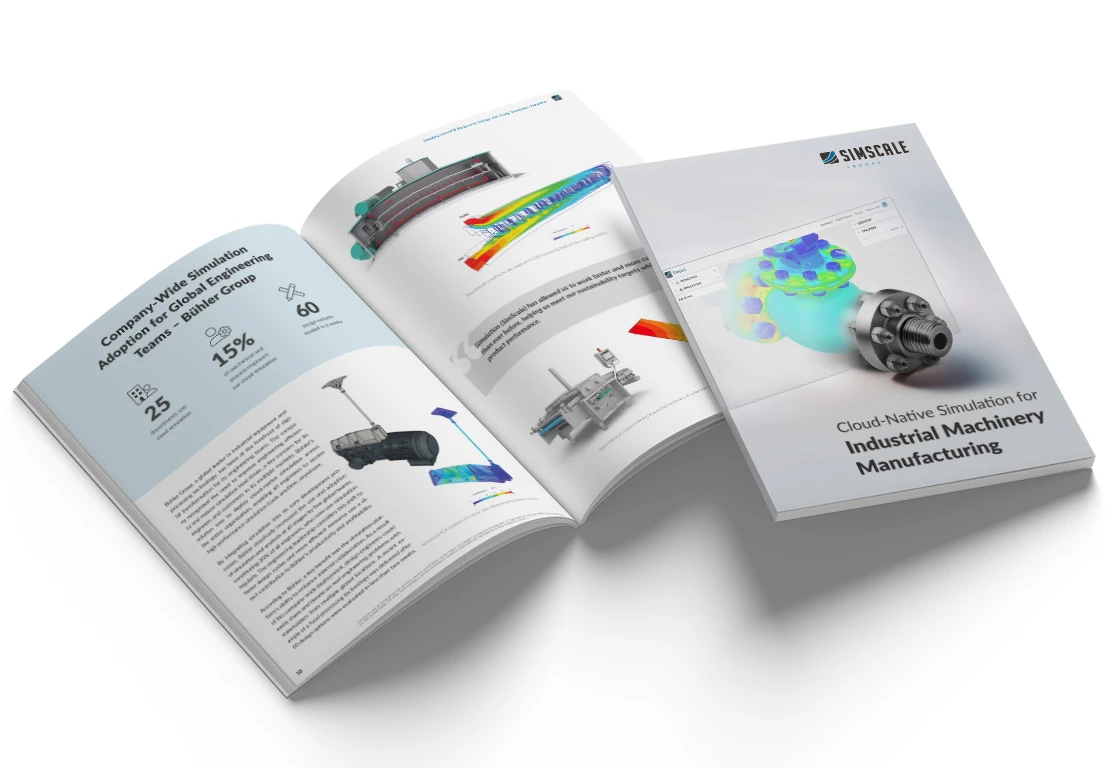
Our latest eBook explores how cloud-native simulation is transforming the challenges of industrial machinery manufacturing into opportunities. Download it for free by clicking the button below.
Customer Success
Hazleton Pumps used SimScale to obtain fast and accurate fluid flow and performance assessments for their pump designs. They realized 100% time savings and $10K reduction of HPC costs.
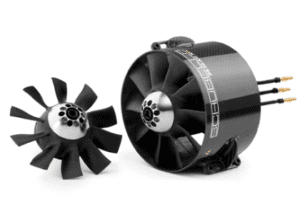




Check out all of our turbomachinery success stories including Designcraft, Guerriero Romani, and more.
See All Stories
Learn how to use cloud-native engineering simulation to design energy-efficient water pumps.


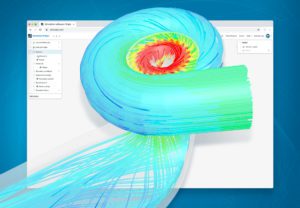
Learn how to use CFD on a Francis turbine to obtain the turbine performance curve within minutes, including transient and cavitation effects.
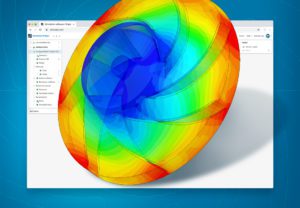
A webinar demonstrating the optimization of a KSB heating circulator pump, covering parameterization and computing hundreds of design of experiments (DoE) runs using the shape optimization tool CAESES.




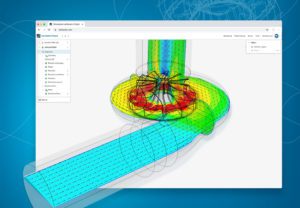
Learn how you can quantify the effect of cavitation on pump performance in minutes thanks to the practically unlimited computational power offered by engineering simulation in the cloud.

Yes. It is possible to factor in cavitation in SimScale i.e. The formation of vapor bubbles in when the pressure in the domain falls below the vapor pressure of the working liquid. Cavitation is a feature that can be enabled at the Create Simulation top level menu in SimScale, in the same dialog box where the user chooses steady state or transient simulation.
Yes. SimScale provides a conjugate heat transfer solver that simulates heat transfer from the fluid domain to the mechanical parts, or visa-versa where heat is transferred from the structure into a fluid. In this regard SimScale can also be used to simulate heat exchangers.
SimScale’s Multi-purpose analysis type can handle transonic and supersonic flows and as such, there is no limit of the turbine RPM.
For turbomachinery & flow control applications, SimScale uses a proprietary solver that is specifically tailored for such applications, it is based on the Simerics solver, and available within the SimScale Multi-purpose analysis type. SimScale also offers other CFD analysis types that are also suitable for turbo machinery rotating machinery and flow control applications, these are based on a proprietary version of OpenFoam.
Yes. SimScale supports one way coupled fluid-structural simulations. So in the case of a wind turbine you pass the CFD dynamic loads into a structural simulation to look at the stress and deflection of the blades.
SimScale provides a rotating wall and a rotating zone approach. Rotating walls are applicable to cylindrical surfaces which rotate. The Rotating zone approach is commonly used to simulate rotors and impellers that rotate on a fixed axis. There are two flavors of rotating zones: Multiple Reference Frames (MRF) is used for steady state; and Sliding Mesh technique is used for fully
transient simulations. Sliding mesh is computationally more expensive than MRF, as it takes into account all transient effects.
Yes. It is possible to simulate fluid viscosity as a function of temperature in Multi-purpose analysis type, when compressible mode is enabled.
Yes, it is possible to simulate Non-newtonian fluid flow in all the OpenFoam based solvers of SimScale. This capability is also on the Multi-purpose solver roadmap for a future release.
Cavitation is shown in post processing as total gas volume fraction, so you can see exactly the regions where cavitation is most likely to occur.
SimScale’s turbomachinery solver, Multi-purpose, can be used to run multiple flow rates simultaneously to automatically generate a pump/fan curve.
Sign up for SimScale
and start simulating now