
ISO 7730 is the international standard that turns thermal comfort into a number. If you are specifying an indoor environment anywhere outside the United States, it is most likely the document your design will be judged against, and as of September 2025 it exists in a new edition that changes how you are expected to arrive at that number.
The method behind it is shared with ASHRAE 55: both derive from the predicted mean vote (PMV) and predicted percentage of dissatisfied (PPD) indices to determine an acceptable range of thermal conditions for human occupancy. How the two standards apply that method, and how far each one goes, is where they part company. This article covers what ISO 7730 specifies, what the 2025 edition changed, and the differences that matter when you pick one standard over the other.
What is ISO 7730?
ISO 7730 is titled “Ergonomics of the thermal environment — Analytical determination and interpretation of thermal comfort using calculation of the PMV and PPD indices and local thermal comfort criteria”. It is maintained by ISO/TC 159/SC 5 (Ergonomics of the physical environment) under ICS 13.180, and it specifies methods for predicting whole-body thermal sensation and discomfort, along with criteria for local thermal discomfort.
The current edition is ISO 7730:2025, the fourth edition, published in September 2025. It supersedes ISO 7730:2005, which was the third edition and was formally withdrawn on 5 September 2025. In Europe it is adopted as EN ISO 7730, which is why the standard also appears as BS EN ISO 7730, DIN EN ISO 7730, PN-EN ISO 7730 and similar national designations.
The standard is organized into eight clauses plus seven annexes:
- Clause 1 Scope
- Clause 2 Normative references
- Clause 3 Terms and definitions
- Clause 4 Whole body thermal comfort, predicted mean vote (PMV)
- Clause 5 Predicted percentage dissatisfied (PPD)
- Clause 6 Local thermal comfort
- Clause 7 Thermal environments for comfort
- Clause 8 Non-steady-state thermal environments
Annex A gives examples of thermal comfort requirements, Annex B metabolic rates for different activities, Annex C estimation of clothing insulation, Annex D the computer program for calculating PMV and PPD (normative), Annex E graphics for determining PMV, Annex F humidity and Annex G air velocity.
Clause 6 is the part engineers most often overlook. Whole-body comfort can sit comfortably inside the acceptable band while a single occupant is still uncomfortable because of draught, a vertical air temperature difference between head and ankles, a floor that is too warm or too cold, or radiant asymmetry from a nearby surface. Those are separate criteria, and they are assessed at locations rather than as a space average.
The standard is not free. It is available from ISO and from national standards bodies. Copies of the 2005 edition circulate freely online; those are the withdrawn edition and should not be used to specify new work.
ISO 7730:2025: what changed
The 2025 edition is a shorter, tighter document than the one it replaces. Its foreword lists three main changes against ISO 7730:2005:
- deletion of sections of the text (long-term evaluations, adaptation and diversity)
- correction of the calculation program
- deletion of tables for predicting predicted mean vote (PMV)
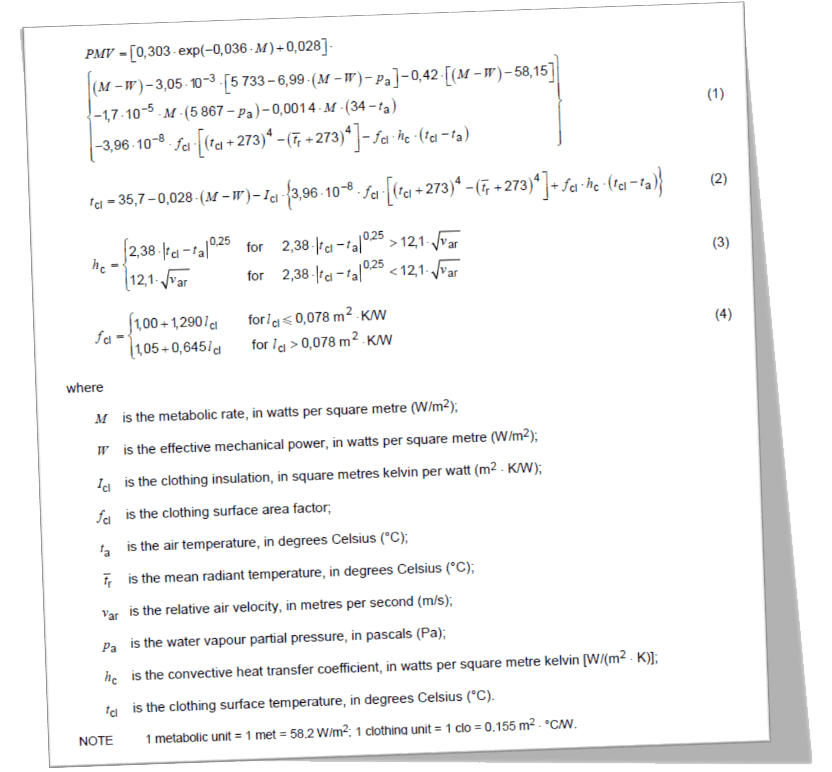
The third change is the one with practical consequences. The 2005 edition let you read PMV off printed lookup tables for common combinations of operative temperature, activity and clothing. Those tables are gone. PMV is now obtained by calculation, using the normative computer program in Annex D, which makes a computational route the expected one rather than a convenience.
That suits how the calculation is actually used. PMV and PPD vary across a room, so a single value taken from a table was always an approximation of a field. Computing the indices as fields, whether through the Annex D program or through CFD simulation, gives the distribution across the occupied zone and shows which locations fall outside the criteria.
Because the withdrawal is recent, most reference material online still describes the 2005 edition. Check which edition a specification, a national adoption or a rating system names before designing to it.
When are ASHRAE 55 and ISO 7730 employed as standards?
Both standards cover the evaluation of modern, indoor, thermal environments including residential and industrial. They both provide definitions, requirements, and parameters that need to be met within a certain range to predict an operative temperature and, ultimately, thermal comfort.
These standards can be employed for existing buildings as well as new builds in the design phase. Compliance with these standards can be ensured already from the design phase or renovation planning, which is why simulation using platforms like SimScale are invaluable to engineers. The strictness of the compliance range, however, differs for existing structures vs. new buildings, with lower requirements being applied for existing spaces.

How are PMV and PPD employed in each standard?
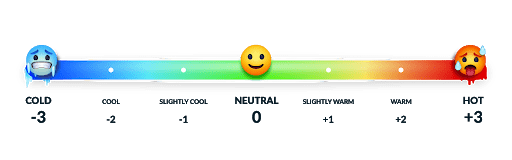
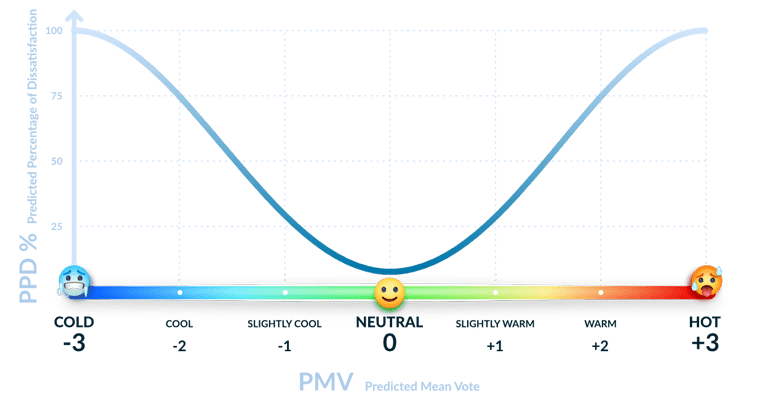
Although both standards go beyond these calculations when it comes to defining comfort, they require PMV to be calculated, which is then used to determine the range within the PPD index. In order to comply with ASHRAE 55, the thermal limit on the 7-point scale of PMV is between -0.5 and 0.5.
ISO 7730 elaborates on this limit, giving several indoor environments ranges. ISO defines the hard limit as ranging between -2 and +2, while for old buildings the acceptable comfort limits range between -0.7 and +0.7, and new buildings between -0.5 and +0.5.
PPD can range from 5% to 100%, depending on the estimated PMV. These comfort values will fluctuate depending on where the occupant is located within the given space. For comfort ranges to comply with standard criteria, no occupied point in space should be above 20% PPD (corresponding to the -0.5 to +0.5 range).
What are key differences between the two standards?
The two standards essentially cover the same variables, calculations, and ranges, but do differ in a few respects. ASHRAE, or the American Society of Heating, Refrigerating, and Air Conditioning Engineers, first published the 55 standard in 1966 and has continuously updated it every 3-7 years. While this standard is internationally intended, it is most well recognized within the United States. ISO, or the International Organization for Standardization, is a worldwide federation of national standards bodies, and is, therefore, broader and encompassing of more standards but at a less specified level. Each organized body has a series of standards that will be discussed below.
The ISO series vs. the ASHRAE series
The ISO 7730 standard was developed in parallel with ASHRAE 55, but is part of a series of ISO standards that are reviewed every 5 years and cover a range of thermal environments from mild to extreme. For example:
ISO 7243 This standard is used for hot environments, and is the assessment of heat stress using the WBGT (wet bulb globe temperature) index.
ISO 7933 This standard describes a method for predicting the sweat rate and the internal core temperature that the human body will develop in response to the working conditions, also for hot environments.
ISO/TR 14415 This standard explains the application of international standards for thermal comfort for people with special requirements (i.e., those with physical disabilities).
While the ISO series focuses on thermal comfort and expands upon the variables mentioned in ISO 7730 (metabolic rate, heat, etc.), the ASHRAE series has more documents pertaining to other HVAC applications. For example:
ASHRAE Standard 15 This document covers safety standards for refrigeration systems.
ASHRAE Standard 34 This standard is used for the designation and safety classification of different refrigerants used in HVAC systems.
ASHRAE Standard 100 This standard focuses on energy efficiency in existing buildings.
In Europe, ISO 7730 sits alongside EN 16798-1, which covers indoor air quality, lighting and acoustics in addition to thermal comfort, and which supersedes the older EN 15251.
Scope differences
The scope determined in both documents addresses the same environmental (temperature, thermal radiation, humidity, airspeed) and personal factors (level of activity, clothing insulation). ISO 7730 goes further to mention that cultural, national, and geographical differences need to be taken into account when evaluating non-air conditioned buildings, because it is more internationally recognized.
Terminology differences
The documents have some terminology inconsistencies, as ISO has an additional standard, ISO 13731, that covers thermal environment vocabulary and symbols. For example, when considering non-steady-state environments ISO 7730 defines ‘drift temperature’ as the passive monotonic, steady, non-cyclic change in the operative temperature of a space, and defines ‘ramp temperature’ as the same but as an active change, but fails to give a defined time period to mark this cyclic variation. ASHRAE 55 does not define these terms, but in section 5.2.5.1 defines that the temperature changes are treated as such if the time period exceeds 15 minutes. While ISO 7730 and ASHRAE 55 both include their key terminology in section 3, ASHRAE 55 has a more comprehensive list within the document itself.
Naturally ventilated space differences
While ASHRAE 55, specifically since the 2004 updated version, gives many liberties to naturally ventilated spaces (i.e., Section 5 states that temperature fluctuations under the control of occupants have no negative effect on thermal comfort and therefore do not need to adhere to certain requirements mechanically ventilated spaces need to), ISO 7730 doesn’t discuss it.
Compliance differences
ASHRAE 55 Section 6 is dedicated to prescribing what engineers need in order to comply with the standard. Given ranges for each index must be met and additional influencing conditions must be acknowledged. Achieving thermal comfort of an environment is an innately cumbersome task, but ASHRAE 55 provides the variable tables, equations, thermal environment survey, and even sample compliance documentation to make adhering to the standard as straightforward as possible. The criteria for compliance is not mentioned in ISO 7730.
Conclusion
No matter what standard you adhere to for your design, PMV and PPD must be calculated, and this can be done with the help of SimScale. While PMV and PPD are important to determine whether the building complies with either of the standards, they are not the only aspects to consider when determining thermal comfort compliance. To name a few other aspects, mentioned in the standards, draught, radiation asymmetry, whether the flow is controlled or not, and more should also be accounted for. In other words, they are helpful tools, but not necessarily the whole toolbelt.
If you’re building a structure in the United States with a natural or hybrid ventilation unit, ASHRAE 55 will most likely be a better compliance fit. If you’re updating a building in Europe and want to evaluate more extreme non-steady-state thermal environments, ISO 7730 should be your standard. The base source code which we use to calculate the values for PMV and PPD is the same in both of the standards.
Calculate PMV and PPD across your design, not at one point
Set up thermal comfort result fields on your own geometry and see where the criteria are met.
Additional thermal comfort resources from SimScale
- What Is PMV? What Is PPD? The Basics of Thermal Comfort
- What Is ASHRAE 55? Basics of Thermal Comfort
- What Is EN 16798?
- Thermal Comfort and Radiation with SimScale
- Radiation and Thermal Comfort for Indoor Spaces
- Ensuring Thermal Comfort with HVAC for a School Building Design: Case Study Ramboll
- How to Comply With EN 15251 and EPBD