
In the first session of our AI Engineering Bootcamp series, we explored the gap between the promise of AI and its practical applications – catch up below and watch the recording to learn more.
An AI Masterclass – How to Fit Months into Hours
The highlight of the session was a real-world case study from Armin Narimanzadeh, Senior Thermofluids Expert at Convon (part of HD Hyundai). Armin shared his first-hand experience of using SimScale’s AI-powered simulation to optimize a hydrogen ejector pump, building a reusable Physics AI model that produces instant performance predictions for new designs.
This transformative approach reduced a design optimization process that previously took months down to under an hour, enabling rapid iteration and data-driven decision-making.
The discussion, featuring insights from Mike LaFleche of PTC and Steve Lainé of SimScale, explored the crucial role of a cloud-native ecosystem in making these workflows possible and how to overcome common blockers like data availability and trust in AI.
Key Takeaways:
1. AI is an Amplifier, Not a Replacement for Expertise
A recurring theme was that AI serves as a powerful tool to amplify your engineering expertise. Armin emphasized that while the AI model delivered incredible speed, his engineering expertise was still crucial to guide the optimization, validate the final results against CFD, and make the final design decisions. The goal is to empower experts, not replace them.
2. The “Months to Hours” Transformation is Real
The most powerful takeaway was the quantifiable impact on the product development cycle. Having invested in the initial model training and data generation, Armin’s team now has a reusable AI model that can generate a new, optimized design for their ejector in under an hour. This is a game-changing acceleration that directly impacts business agility.
3. A Cloud-Native Ecosystem was Key
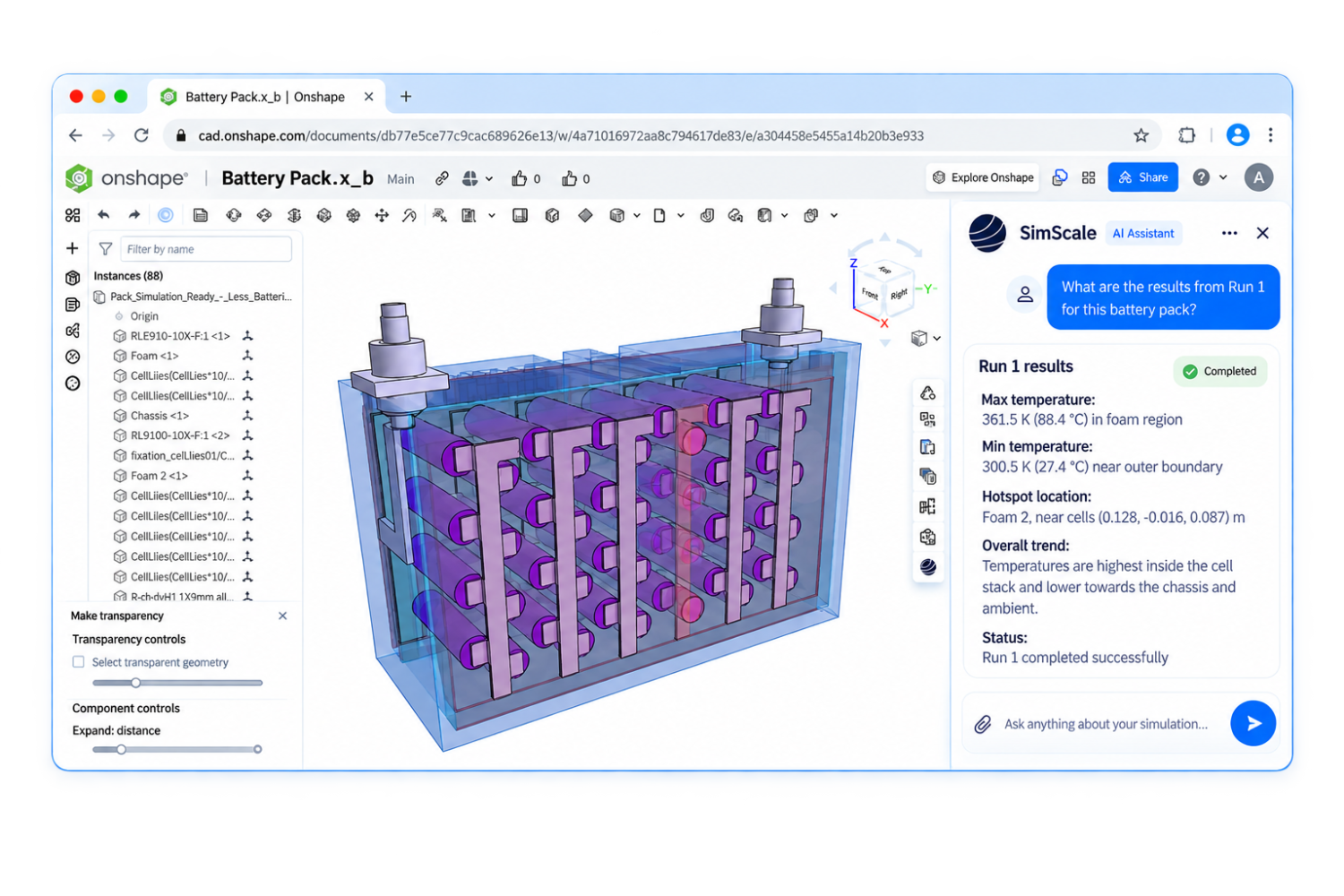
This level of automation and speed is only possible when the entire toolchain is cloud-native. The seamless, API-driven connection between a parametric model in Onshape and the simulation in SimScale was essential for automatically generating and testing hundreds of design variants to firstly map the design space and then to explore and optimize within.
4. You Can Start Now, Even Without Perfect Data
Armin carefully tested different training data sets to find the dataset ‘sweet spot’ – how much data was needed to build an accurate model. He found that the number of samples needed was not as large as originally expected, allowing him to refine his approach for future projects.
Watch the full webinar recording below. And if this seems interesting, be sure to register for the rest of the series!