Challenges
Results
HIGTEC is an engineering consultancy based in Zoetermeer, Netherlands, providing R&D mechanical engineering services to industrial clients. The company’s work spans process and system engineering, piping and plant engineering, and computer-aided engineering, including finite element stress and vibration analysis, CFD analysis, and thermal analysis. HIGTEC’s engineers take on projects across preliminary research, technical design, and development, often stepping in where clients need specialized simulation capability that isn’t available in-house.
Sarmand Morad is a Senior Mechanical Engineer at HIGTEC, specialized in fluid systems, mechanical design, and CFD-driven engineering. His work centers on translating industrial process challenges into validated simulation models and practical engineering recommendations. On this project, for a client facing unstable unloading of acrylonitrile from rail tank wagons, Sarmand’s team used validated CFD simulations to produce concrete recommendations for improving unloading performance and reducing gas suction risk.
From Operating Experience to Validated Simulation: HIGTEC’s Adoption of SimScale
When a process misbehaves, operators often have to draw on their own experience to guess at what’s happening and where to intervene. That experience is valuable, but it isn’t engineering evidence, and it doesn’t easily translate into a design change a client can commit to. HIGTEC uses simulation so its engineers can bring physics-based evidence into those conversations instead, augmenting operator intuition with a model of what’s actually happening in the system, one that can be checked against real measurements.

Sarmand Morad
Senior Mechanical Engineer, HIGTEC

“We use simulation to turn challenging process issues into something that we can actually see and measure, not just discuss based on operating experience.”
HIGTEC’s client already had detailed measurements of the unloading process: pressure readings, flow rates, how much product was typically left behind. What they didn’t have was visibility into why pressure was dropping and gas was entering the system, causing pressure fluctuations and increasing the risk of unstable pump operation and potential cavitation. Nitrogen was supplied to the tank to regulate pressure while maintaining an inert atmosphere during unloading. HIGTEC adopted simulation so its engineers could bring physics-based evidence into those conversations, augmenting the client’s own measurements with a model of what’s actually happening inside the tank.
Case Study: Diagnosing Gas Entrainment in Acrylonitrile Unloading with CFD Simulation
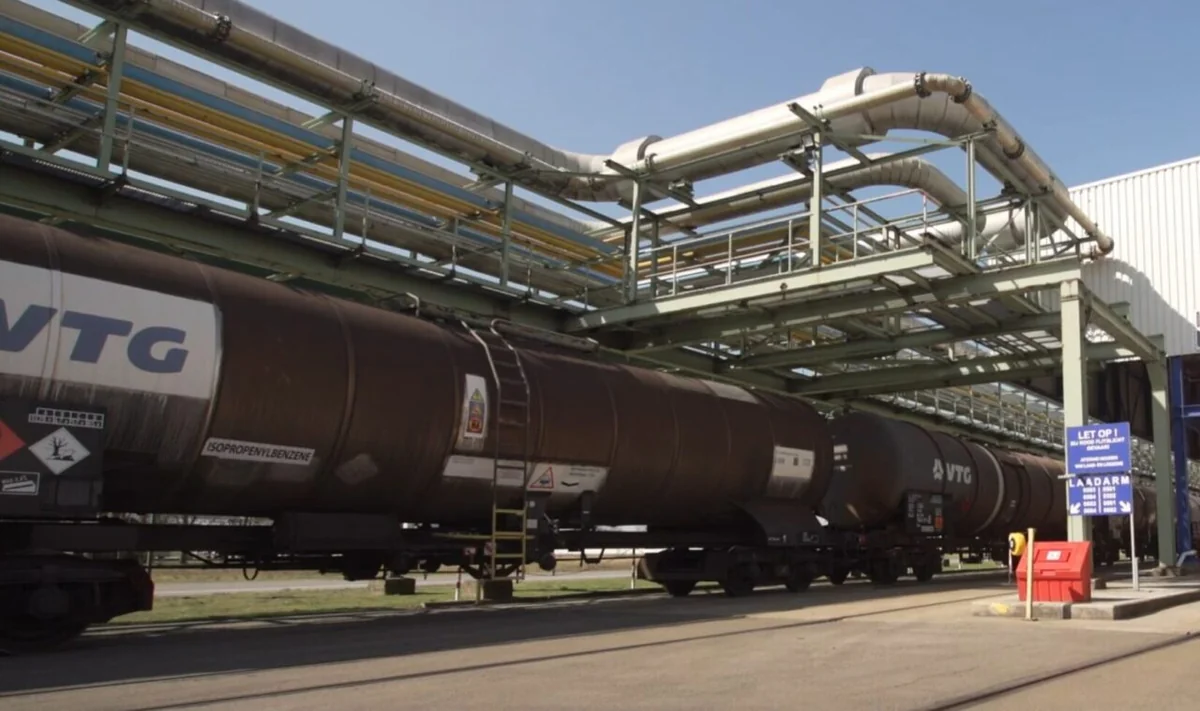
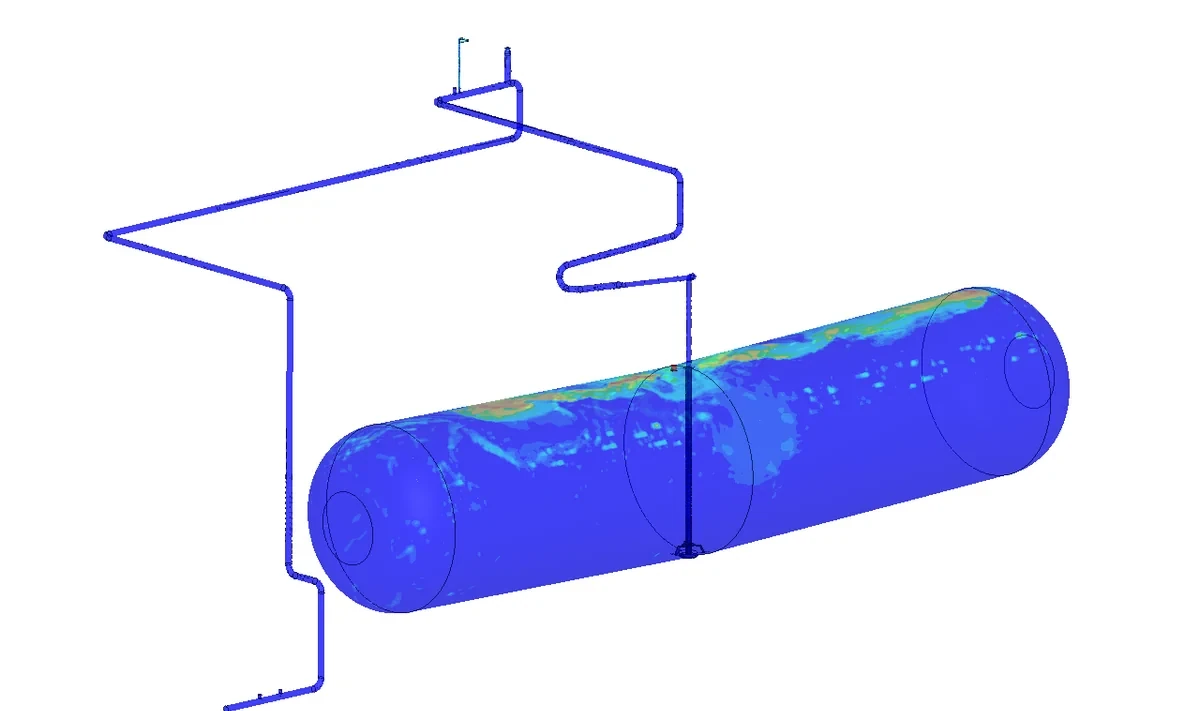
HIGTEC was recently engaged by a customer experiencing difficulties unloading acrylonitrile from rail tank wagons at a processing plant. Pumping out the tanks had become an increasingly unpredictable process – as the liquid level in the tank dropped, nitrogen used to pressurize the system was drawn into the suction line along with entrained gas, triggering pressure fluctuations and putting the client’s pumps at risk of cavitation. HIGTEC’s task was to understand exactly what was happening inside the tank and suction line as it emptied, and to build a model reliable enough to trust for engineering decisions.
Sarmand used a transient multiphase simulation using Volume of Fluid (VOF) model within SimScale to resolve the nitrogen-acrylonitrile interface, combined with k-epsilon turbulence modeling, gravity, surface tension, and pressure inlet/outlet boundary conditions. The team ran full-tank, half-full, and closing-stage cases, plus an additional validation case, comparing pressure, gas fraction, and mass flow results against the client’s process data at each stage. As Sarmand explains, “We needed a workflow that could handle gas-liquid interface tracking, pressure validation, and multiple unloading stages without adding unnecessary complexity to the engineering process.” The cloud-native platform meant these transient runs, each computationally demanding in its own right, could be prepared and executed without queuing on a single in-house workstation, keeping the project moving across all four cases in parallel.

Using the validated model, HIGTEC’s simulations made the root cause of the client’s unloading instability visible for the first time. The results showed that the beginning of the unloading process was relatively stable, with little gas ingestion into the suction line. “The model showed that the beginning of unloading was relatively stable, while the halfway and closing stages became increasingly gas-driven, with strong swirling, sloshing, and fluctuating pressure behavior,” Sarmand explains. As the liquid level dropped, gas vortices formed and intensified around the suction pipe, drawing nitrogen into the line and destabilizing flow exactly in the stages the client had flagged as problematic.
Validating Against Plant Data
To be usable in engineering decisions, the model had to hold up against real measurements. In the stable full-tank case, HIGTEC’s simulation predicted suction pressure at the main probe point to within about 2%, with mass flow rate values within 10%. A second validation case came in even closer on flow rate, with an error of only 7.7%.

Plant data showed that residual product could remain in the railcar during problematic unloadings. The CFD study helped explain the flow mechanisms contributing to this behaviour. “Instead of relying only on assumptions or operating experience, we were able to support discussions with simulation data, pressure validation, and phase-fraction trends,” Sarmand adds.
Conclusion: From Diagnosis to Design
This project turned a recurring operational headache into a quantified engineering problem. Rather than describing the instability in general terms, HIGTEC could show the client precisely when gas entrainment began, how it progressed stage by stage, and how much product it was costing them, all backed by simulation results validated against the client’s own plant data.
Process issues that used to be discussed through operator experience and general assumptions can now be modeled, validated, and quantified before any design change is proposed. That gives the client, and HIGTEC, a much stronger basis for deciding where to invest in fixes.
Sarmand’s team already has the next phase mapped out. Having established a validated baseline, they plan to use SimScale for optimization studies, testing geometric and process modifications such as changing pipe dimensions, adjusting pipe routing or vertical sections, increasing the collection zone size, or evaluating inclined piping and diffuser-like sections, all aimed at reducing gas carry-under and improving how completely the tank empties.
“The next step is using SimScale not just to validate what’s happening, but to test the fixes, different pipe routing, a bigger collection zone, diffuser sections, before anything gets built.”
Learn more about HIGTEC’s engineering and simulation work