Challenges
- Long development cycles driven by slow, sequential build-and-test prototyping process.
- High costs from creating multiple full-scale physical prototypes for HVAC and structural validation.
- Limited performance insight from physical tests, making it difficult to diagnose complex airflow, thermal, and structural issues.
- Legacy in-CAD simulation software creating severe bottlenecks with failed meshes and file corruption issues.
- High risk of late-stage design failures during physical testing, leading to project delays, budget overruns, and manufacturing rework.
Results
- SimScale’s cloud-native CFD and FEA platform enabled rapid virtual testing, reducing overall design cycle by 30%.
- Reduced physical prototyping costs by more than 60% using a simulation-driven design approach.
- Engineers could virtually test designs against wide-ranging operating conditions, ensuring final products passed all performance standards on the first physical test.
- Achieved a 90% reduction in FEA setup time, turning 10 hours of legacy software work into just 1 hour in the cloud.
- Provided simulation-backed approvals to the manufacturing floor in under two hours, significantly reducing costly rework
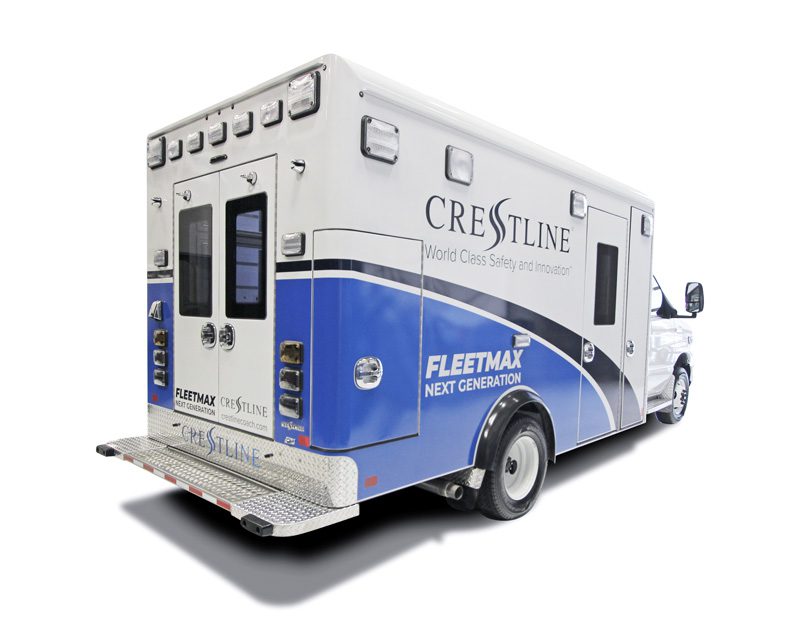
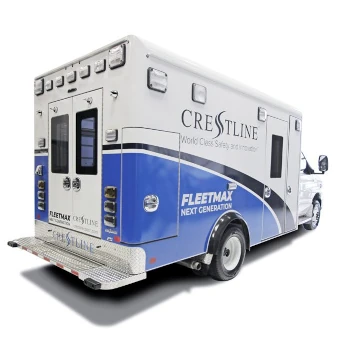
For nearly 50 years, Crestline Coach has designed and manufactured emergency vehicles from its headquarters in Saskatoon, Canada. Their core mission is to support first responders with reliable, highly customized ambulances, built to exact customer specifications and engineered to perform in the harshest conditions. An all-aluminum extruded body construction gives every vehicle lightweight strength that maximizes payload without compromising passenger safety.
The company is tackling an ambitious project to introduce a new, larger, vehicle to their range – scheduled to enter service for the 2026 FIFA World Cup events in Canada. This vehicle has a significantly larger body than previous models, measuring 240 inches in length, around 60% longer than a standard ambulance body.
Bihara Singh, an Automotive HVAC Product Engineer at Crestline Coach, is a Mechanical Engineer with a Master’s degree specializing in fluid mechanics and Computational Fluid Dynamics (CFD). With over four years of experience in automotive HVAC systems and thermal management system design, Bihara plays a crucial role in optimizing the design and performance of emergency vehicle climate control systems.

Bihara Singh
Automotive HVAC Product Engineer, Crestline Coach

“In the ambulance industry, where lives are at stake, the vehicles we design are not just products — they are critical tools for first responders. If our engineering falls short, it directly impacts the care a patient receives in their most vulnerable moments.”
Conlan Kirk works on Crestline’s New Product Development Team, bringing experience from mass-market automotive engineering and heavy industrial machinery design. His mandate is to engineer bespoke vehicles to specific customer requirements and regulatory standards. The work covers a range of structural analyses including frequency studies, harmonic simulations, nonlinear dynamic crash modeling.
From Physical Prototypes to Virtual Validation: Crestline’s Multi-Domain Adoption of SimScale
Both the HVAC and structural design teams faced the same challenge: their existing tools and processes couldn’t keep pace with the demands of bespoke vehicle development.
For the HVAC team, the design process was anchored by physical prototyping, a method that was both expensive and slow, often taking weeks for a single iteration. This approach offered limited insight into why a design failed, as the complex, three-dimensional airflow patterns and heat transfer effects remained invisible. A failure would trigger another lengthy and expensive cycle of modification and re-testing, hindering progress.
“With our traditional prototyping method, we were essentially designing in the dark. We’d build a full-scale model based on experience and hope for the best. The data we could gather was minimal, and a failure meant weeks of delays and significant cost.”
For the structural team, the problem was an analysis bottleneck. Legacy in-CAD simulation software generated meshes that frequently failed, lost geometry references, and offered entirely impractical solve times for dynamic analyses. More challenging analyses, such as a dynamic roll-over simulation or crash tests, proved to be intractable on the computational resources available in-house.
Crestline chose SimScale’s cloud-native platform as a single simulation platform to serve both teams, citing its accessibility, parallel simulation capability, and the ability to run high-fidelity analyses without dedicated hardware infrastructure. For both teams, the shift moved simulation from a late-stage validation step to an active part of the design process.
“SimScale was a complete paradigm shift. Suddenly, we could see everything — every vortex, every hot spot, every dead zone — on our screens within hours. It allowed us to move from a process of trial-and-error to one of true data-driven, predictive engineering.”
When working on time-critical projects, Crestline engineers also appreciate the near-immediate technical support that SimScale users can access directly in the platform. Bihara adds, “it is great to be able to message support directly, share my project and get help in 15 minutes or so – I’ve never encountered that level of support before. It’s valuable since no matter how experienced you are with simulation, there will always be new challenges.”
Flow & Thermal Case Study: Designing a High-Efficiency Air Mixer for Extreme Low Temperature Operation
During the development of a new ambulance model built to accommodate multiple casualties in Ontario’s extreme winter environment, Bihara faced a demanding thermal engineering challenge: warm the cabin from –35°C ambient to a patient-ready +22°C in under 30 minutes.
In larger vehicles, engine waste heat alone is insufficient to hit that target. An auxiliary, fuel-fired heater is required — but the air it produces is dangerously hot if delivered directly to the cabin. The solution requires a compact mixing conduit that blends hot heater air with cold ambient air before it reaches the occupants. The engineering constraint: achieve thermal mixing efficiency above 80%, keep pressure drop minimal, use no moving parts, and fit within the severe spatial restrictions of the vehicle interior.
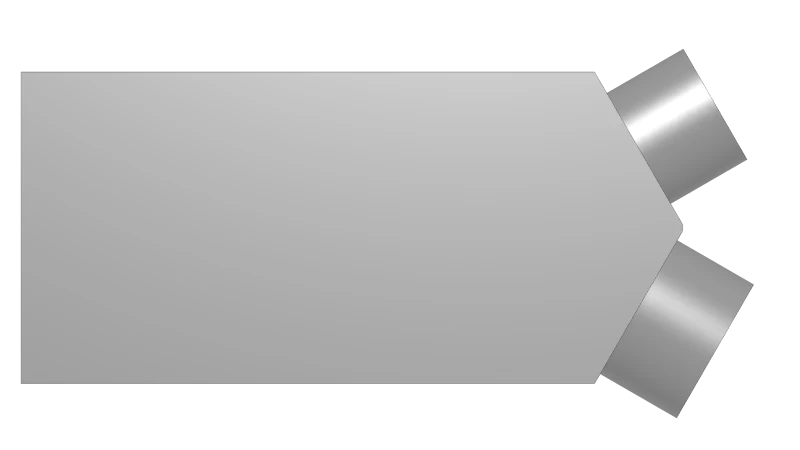
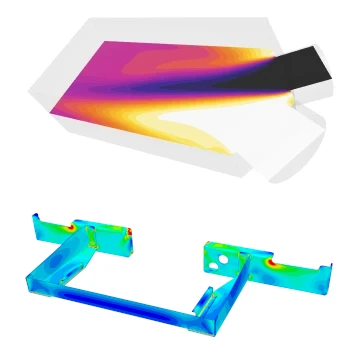
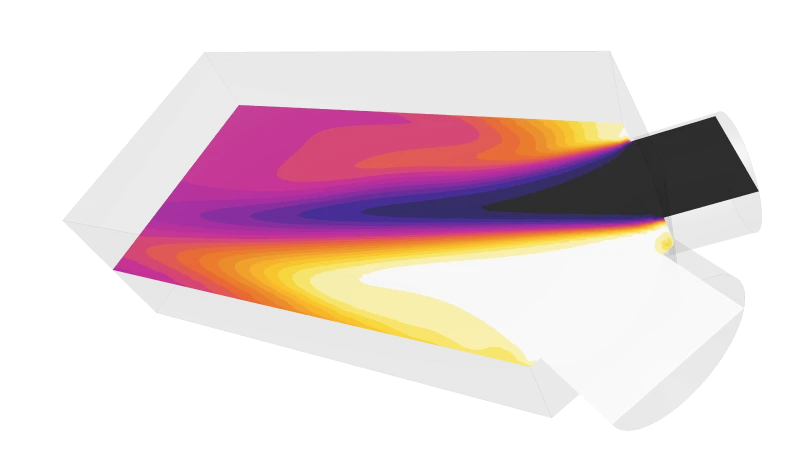
Taking inspiration from aerospace, Bihara applied controlled vortex principles to drive rapid mixing within the confined space available. Using Convective Heat Transfer analysis in SimScale, he ran 16 design iterations in concurrent batches, varying inlet offset and angle to optimize vortex position and temperature uniformity at the outlet.
“The ability to run simulations in concurrent batches allowed the entire virtual development process to be completed in just three to four weeks, in between other work — a fraction of the months it would have taken to build and test physical prototypes.”
The final vortex-based mixer achieved over 80% thermal effectiveness, ensuring patient comfort and safety in the harshest winter conditions. The entire design and validation process — from initial concept to a configuration ready for physical testing — took three to four weeks in simulation, compared to the months a physical prototyping approach would have required.
Structural Mechanics Case Study: The Front-Mounted Condenser Bracket
Conlan’s transition to SimScale coincided with the detailed design work for the World Cup ambulance project. The vehicle required a completely custom frame, more doors, and nearly ten times the typical volume of simulation.

Conlan Kirk
Mechanical Engineering Designer, Crestline Coach
“10 hours of work in our previous tool is equivalent to 1 hour in SimScale. The pre-processing speed is just so good… it’s 90% faster, at least.”
Because internal cabin space is needed for medical equipment and patient care, the ambulance carries its auxiliary HVAC condenser above the cab. The new vehicle required a larger, heavier condenser — making the mounting bracket naturally less stiff and more susceptible to vibration.

Conlan began by establishing a digital baseline of the initial sheet metal bracket design. The modal analysis revealed natural modes in the high-power vibration range below 100 Hz. The next step was to test the structure’s response for excitation at the frequencies of interest. Cross-referencing these results with accelerometer data from a vehicle in the field, he refined the model — finding that 2% global damping and a point-mass representation of the condenser perfectly correlated virtual behavior to real-world measurements.
“Once I got access to SimScale, I immediately crushed out the majority of what I needed to do for this project. The amount of throughput that SimScale lets me achieve with simulation is just awesome.”
A subsequent harmonic simulation identified a critical stress concentration at a weld joint, driven by a large sweep geometry that amplified stress during lateral swaying. With the failure mode understood, Conlan iterated the bracket design in the cloud: adding a flange at the top and replacing a standard L-channel with a stiffer channel profile. The lowest vertical natural frequency rose from a highly problematic 18 Hz to a stable 147 Hz.
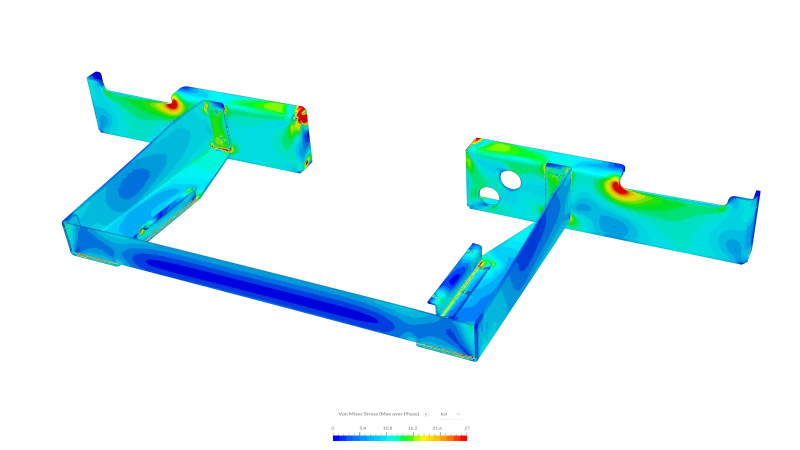
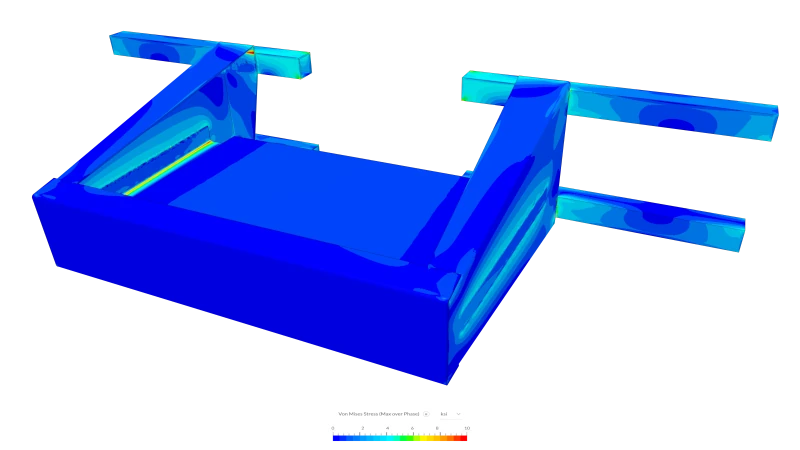
The redesigned bracket also eliminated the need for separate custom frame brackets, mounting directly to the vehicle’s frame tubes, simplifying factory assembly at the same time.
Simulation That Supports the Manufacturing Floor
Beyond initial design validation, the speed of cloud-native FEA has changed how Conlan’s team interacts with production. When a problem emerges on the manufacturing floor, the traditional answer has always been physical rework to correct it. This approach is slow, costly, and the only option available without a way to verify the safety of a time saving design change on the spot.
Now, armed with highly responsive simulation software, Conlan is able to prove whether any proposed design change can be accepted while maintaining safety and compliance. “I can think of two occasions now when this has happened and I’ve been told we can either go through 28 hours of physical rework or we can proceed in 6 hours if we deviate slightly from the as-drawn design. Because SimScale is so fast, I can now answer those questions and oftentimes we can go the faster route, because we can verify that it is safe.”
“With our previous tool, the answer was often ‘I can’t get it done today, I might have an answer for you by tomorrow.’ Whereas with SimScale, it’s ‘I’ll have an answer for you in 2 hours.’ It’s already avoided a lot of lost hours in production”
Conclusion
Bespoke design is Crestline’s competitive edge. It is also their engineering challenge: every modification to a vehicle’s configuration changes its structural, thermal, and aerodynamic profile. Validating those changes, at the pace modern production demands, requires simulation that can keep up. As Conlan explains, “Being able to run as many simulations as I need to answer a specific question, and have my results organized so I can act on them fast — that’s been a game-changer both for how we design and how we support the shop floor.”
The company has transitioned from a test-centric model built on physical iteration, to a predictive, simulation-led approach that supports design, validation, and real-time manufacturing decisions. Simulation is no longer a discrete phase in Crestline’s development process. It runs through all of it. “Our work with SimScale gives us the ability to design smarter, test faster, and validate ideas earlier in the process”, Bihara adds, “In our industry, where reliability and safety are non-negotiable, having confidence in our designs before we even build prototypes is a game changer.”
Looking ahead, Bihara’s team plans to extend simulation into external aerodynamics, HVAC noise mitigation, and battery-powered climate systems. Conlan anticipates applying advanced harmonic and frequency analysis more broadly across the vehicle’s NVH profile. At Crestline, the question is no longer whether to simulate — it’s where to apply it next.
“SimScale has changed what’s possible for our team. The ability to run complex analyses in the cloud, get results fast, and back up our decisions with real data, it’s not something we could do before. For anyone still working the old way, I’d say: you don’t know what you’re missing.”