Electronics Thermal Management Simulation Software
Keep PCBs, heat sinks, and sealed electronics enclosures inside their thermal limits
SimScale runs CFD, conjugate heat transfer, joule heating, and structural FEA on the full electronics enclosure — PCBs, heat sinks, busbars, sealed IP-rated cases, and data-center racks — in a cloud-native, browser-based platform. Predict component temperatures, validate passive cooling, and optimise heat-sink geometry for every design variant before the first prototype is machined.

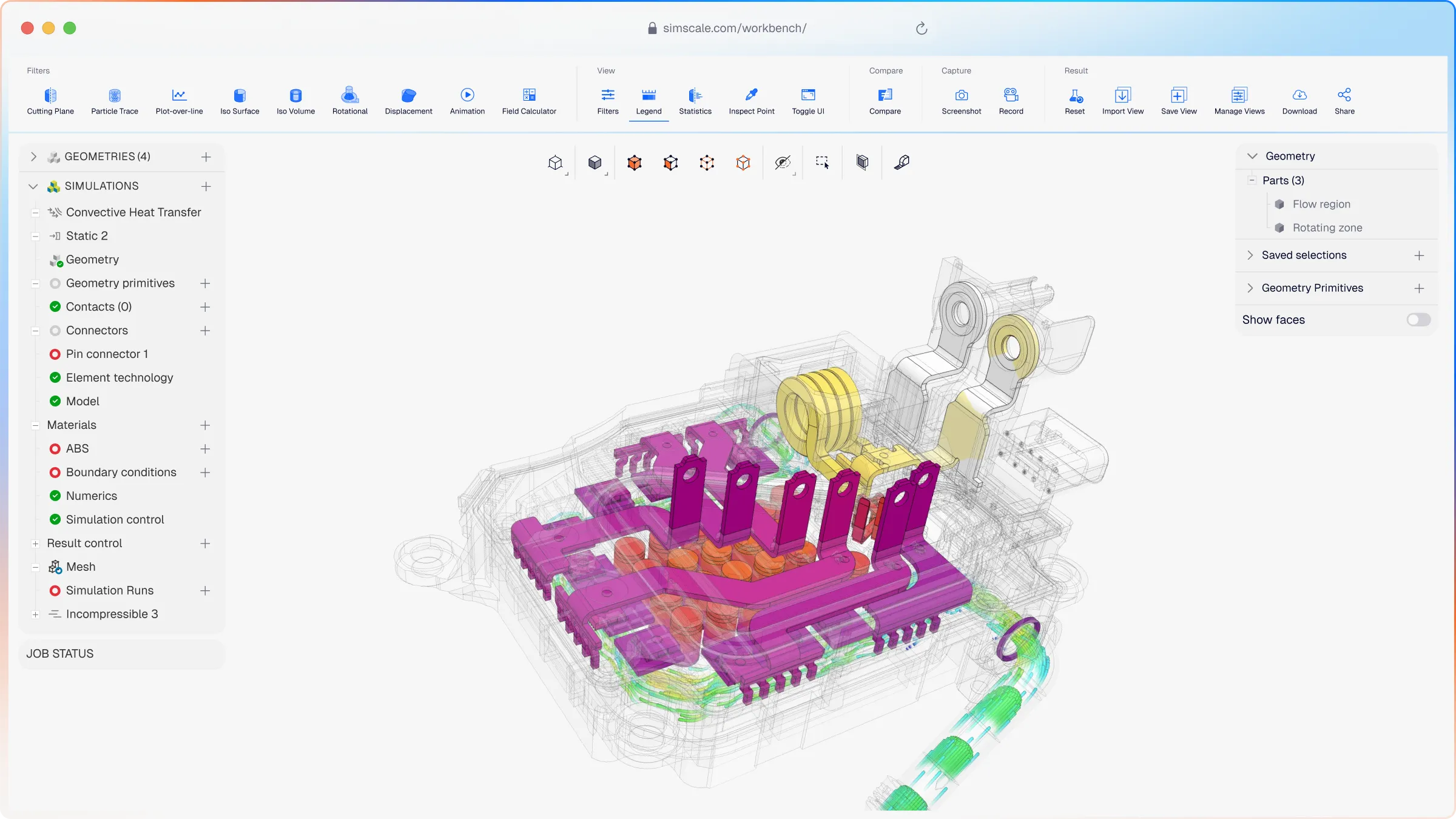












Predict hotspots, validate cooling strategies, and sweep dozens of component-placement and vent variants in parallel before the first chassis is cut.
Electronics enclosure thermal management that covers your full design challenge
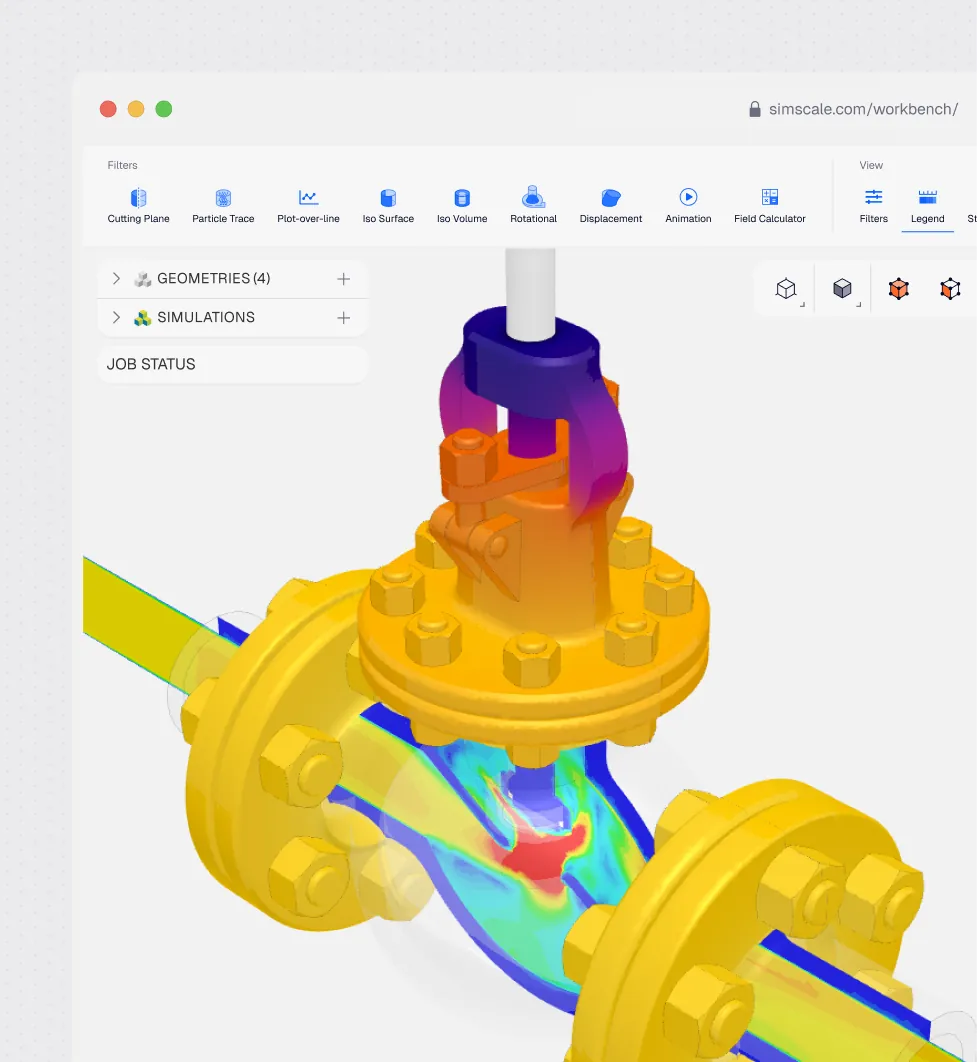
Multiphysics: CFD, conjugate heat transfer, joule heating, and FEA in one enclosure project
Electronics enclosures fail in coupled domains: a PCB hot spot the heat sink can't reach, a busbar carrying current with no thermal margin, a sealed IP-rated case where the chassis itself is the only heat exchanger, a vibration mode that drives solder fatigue near structural resonance. SimScale runs CFD, conjugate heat transfer, joule heating, and structural and harmonic FEA on shared geometry — one mesh, one results store — so the engineer evaluates the real enclosure, not four disconnected approximations.
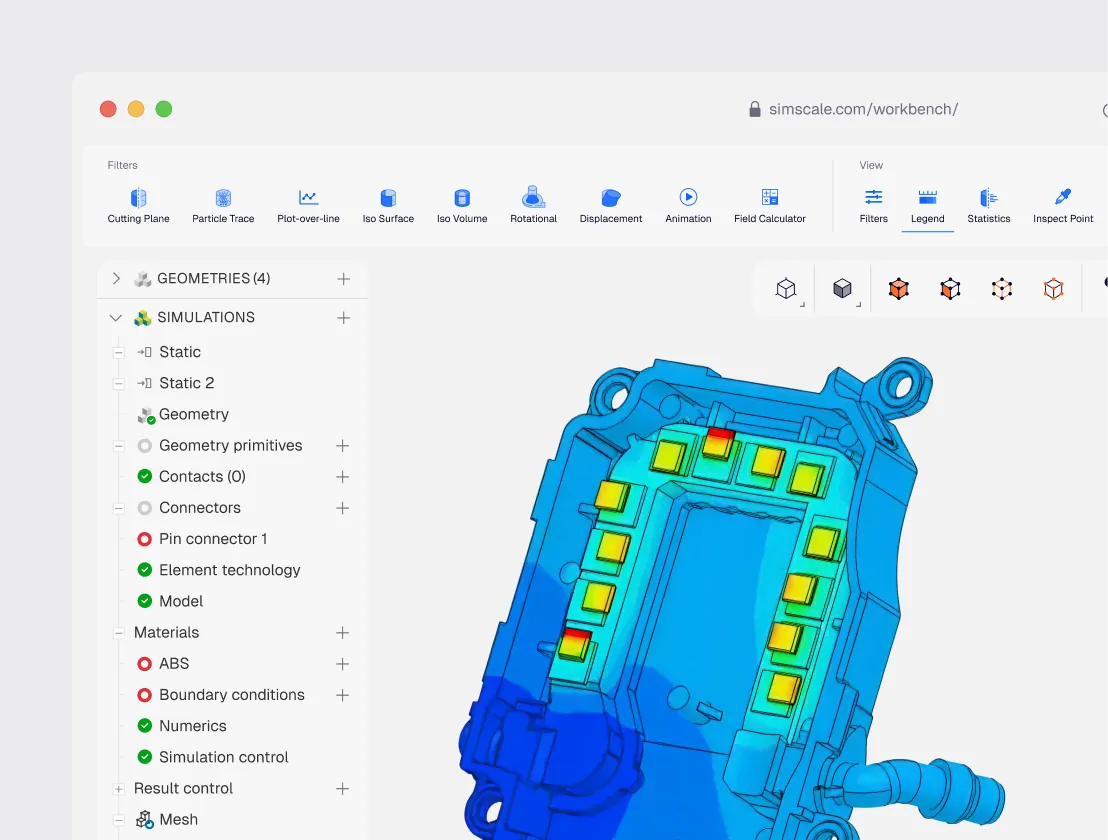
AI-native enclosure thermal design optimisation
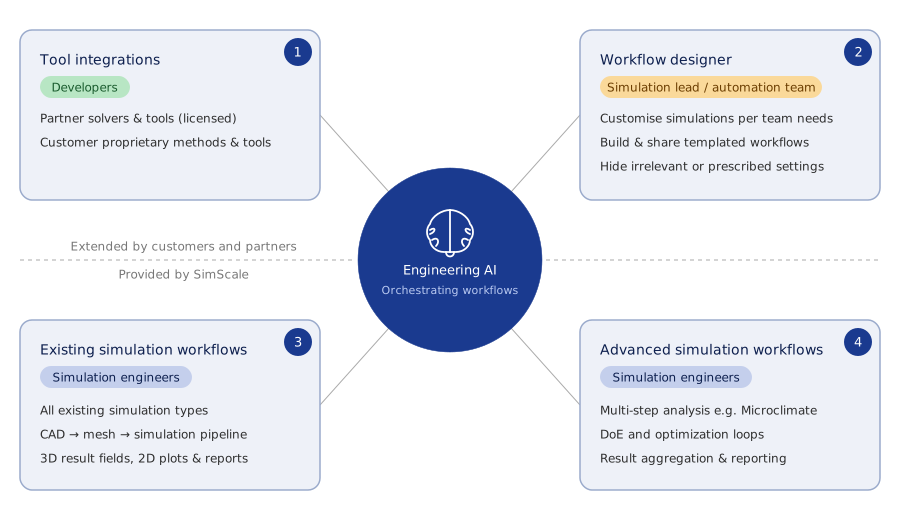
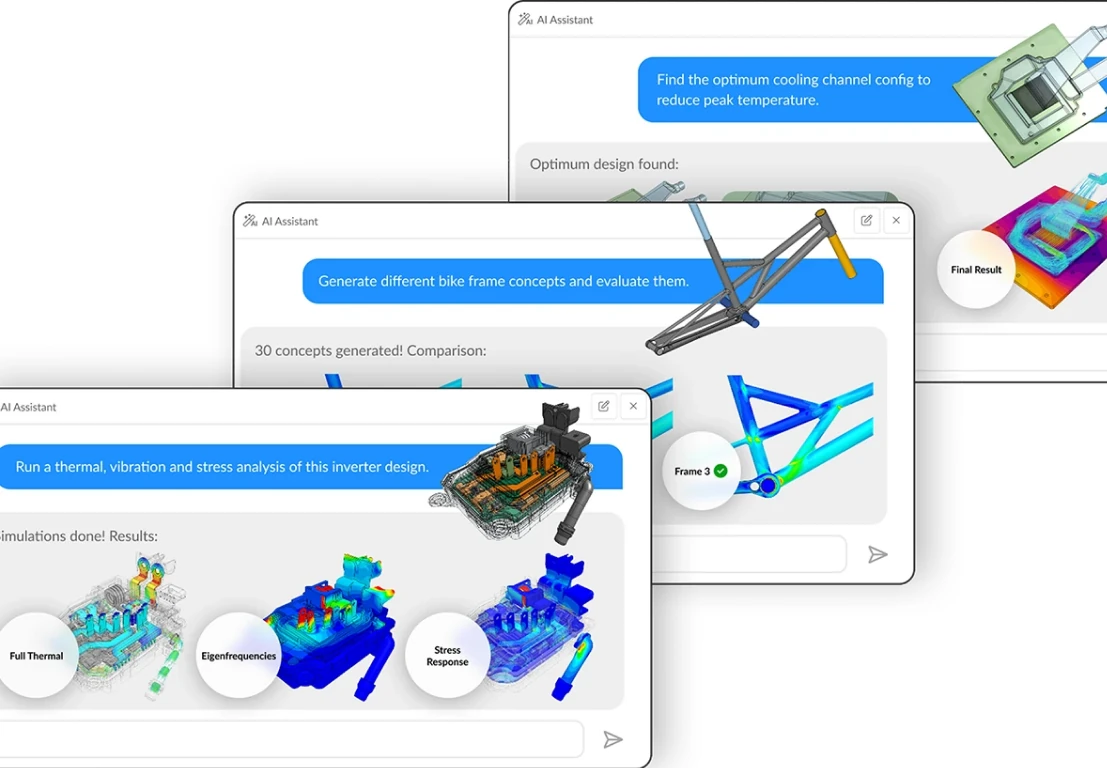
Engineering AI automates simulation setup, meshing and workflows so engineers spend time on decisions, not configuration. Physics AI then delivers near-instant predictions on heat-sink fin geometry, vent placement, and PCB component layout — exploring thousands of design decisions in seconds. Promote the strongest candidates to full CFD before committing to tooling and find the temperature / weight / cost frontier without 200 manual runs.
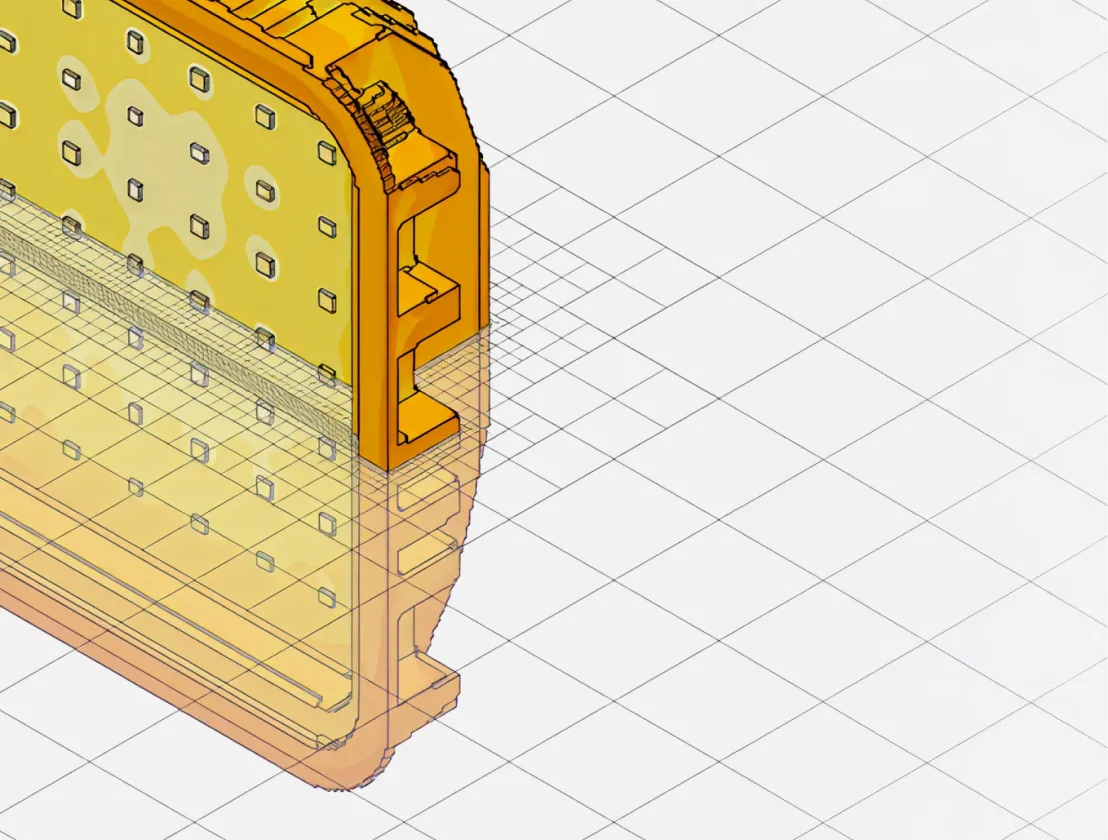
Cloud benefits: parallel sweeps and 10x faster meshing with immersed boundary
Run thermal and structural analyses on the same enclosure, in parallel, with simulations executing in the cloud while the team works on other tasks. SimScale's immersed-boundary meshing handles dense electronics geometry with no CAD cleanup required — reducing core-hour usage by ~10x versus traditional meshing workflows. No on-prem HPC, no VPN, no licence ceiling.
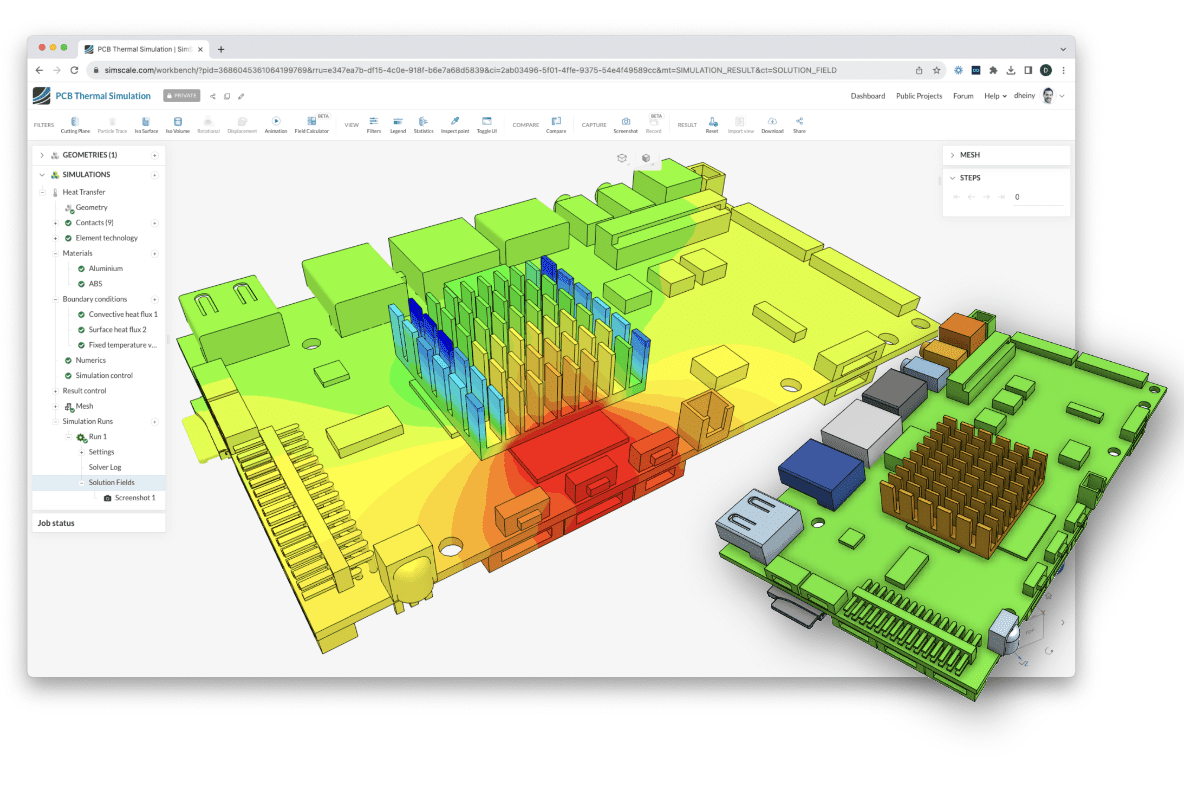
PCB hot-spot analysis and heat-sink coupling
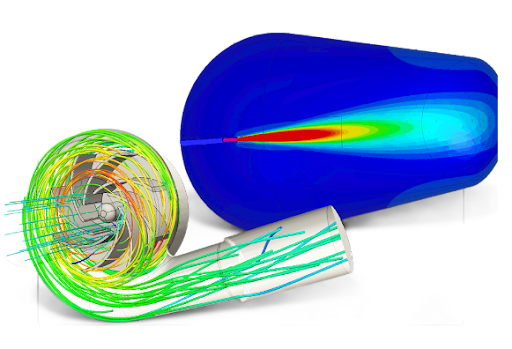
Predict temperature profiles at every PCB component, thermal-pad, thermal-paste, and heat-sink interface. Couple CFD airflow with conjugate heat transfer on the actual PCB geometry — resolving heat-sink fin performance, thermal interface resistance, and component junction temperatures under real heat loads and ambient conditions. Optimise fin geometry and chassis material against thermal limits and weight budget before the first prototype is cut.
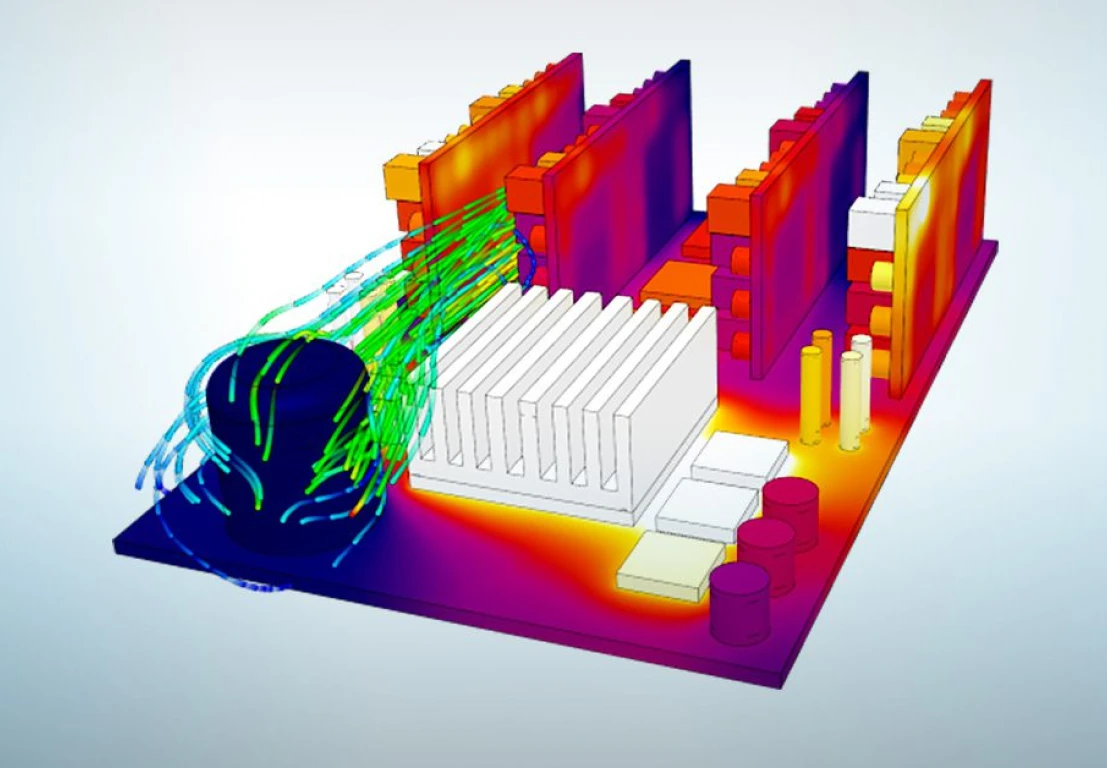
Passive cooling and IP-sealed outdoor enclosures
Simulate sealed IP65/IP67 enclosures where the chassis itself is the only heat exchanger — no vents, no fans, no mass transfer. Validate solar-gain loading, ambient-air natural convection on the exterior, and conduction pathways through cast aluminium chassis geometry. Predict peak component and heat-sink temperatures under worst-case ambient and solar conditions before committing to a passive architecture.
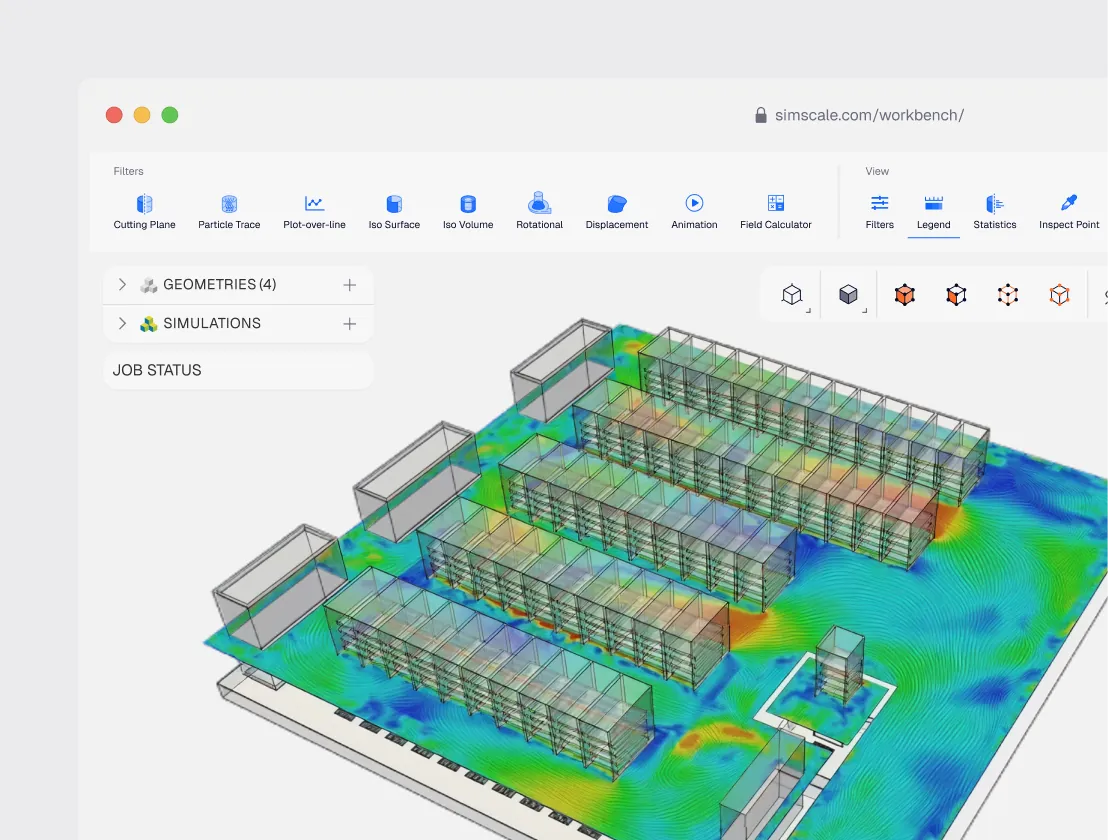
Data-center and server rack thermal management
Simulate high-end server CPU cooling, rack airflow, heat-pipe layouts, and connector thermal interfaces. Predict cooling-module performance across the full parameter space — fin pitch, heat-pipe geometry, fan curves — before committing to manufacturing. Run parallel variants in the cloud with conjugate heat transfer and validate against physical test requirements before tooling.
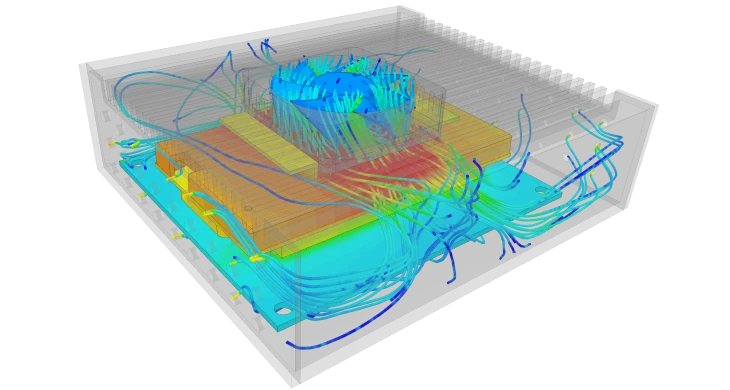
Heat-sink design: fin geometry, pin-fin, and forced convection
Sweep heat-sink fin pitch, fin height, pin-fin geometry, and base thickness against thermal performance and weight. Predict natural-convection performance for fan-less designs and forced-convection performance under specified airflow. Combine with structural analysis to validate mounting and vibration response — particularly for products operating in rail, off-road, or harsh-environment conditions.
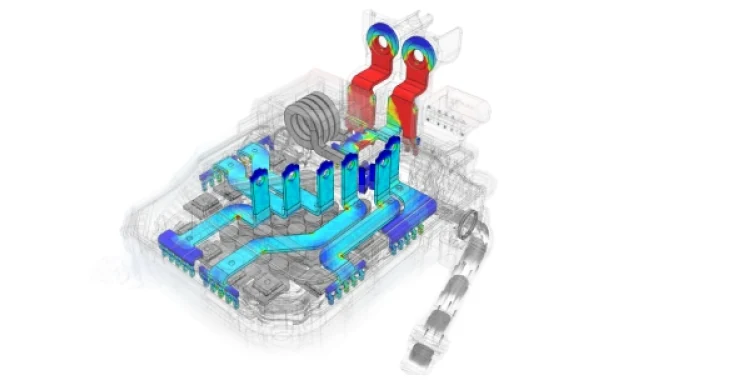
Joule heating in busbars, connectors, and conductors
Simulate resistive losses in busbars, terminal blocks, and connectors. Couple joule heating with conjugate heat transfer to predict conductor temperatures under peak current draw and validate connection design under combined thermal and electrical load. Critical for high-power electronics where conductor sizing decides whether the enclosure meets its thermal envelope at full load.
Active vs. passive cooling design comparison
Run side-by-side comparisons of active-cooled (fan, blower, Peltier) and passive-cooled (heat sink, heat pipe, natural convection) enclosure designs. Quantify the trade-offs in noise, reliability, contamination risk, and power draw before locking in an architecture. Commit to a cooling strategy with CFD evidence — not assumptions.

10x
faster simulation in core-hour usage via immersed-boundary meshing
“SimScale plays an integral role in the simulation stage of our design process at Blu Wireless. As recent users of SimScale, we have utilized the tool in one of our latest projects. We conducted a thermal performance analysis of the components designed for our application, and the results were instrumental in optimizing its design.”
Abhinav Kuchipudi. Mechanical Engineer at Blu Wireless

11%
reduction in internal heat-sink temperatures
“One of the biggest benefits of using SimScale is that it is cloud-based. We can run massive simulations and not need a local HPC setup that frees up our computational resources and time. We have observed faster solve times compared to legacy desktop software tools and the user interface is intuitive with a shallow learning curve. In the swimming pool chlorinator project we were able to reduce internal temperatures by 11% inside the heat sink and move to the physical testing and production stage much faster as a result.”
Davis Tolley, Product Design Engineer, Cobalt Design

100+
simulation runs on high-end server-CPU cooling
“A few highlights from my experience with SimScale are that UX/UI is very intuitive and easy to use, and as SimScale is running in the cloud we can work with the simulation and easily check/share the result no matter where we are. Since we are able to provide the clients with realistic data incorporating reasonable numbers generated with the relevant simulation, it has become much easier to discuss the problem to solve in the initial stage, thus expanding business opportunities.”
Seongsu Park, Research at Forwiz System
Related resources
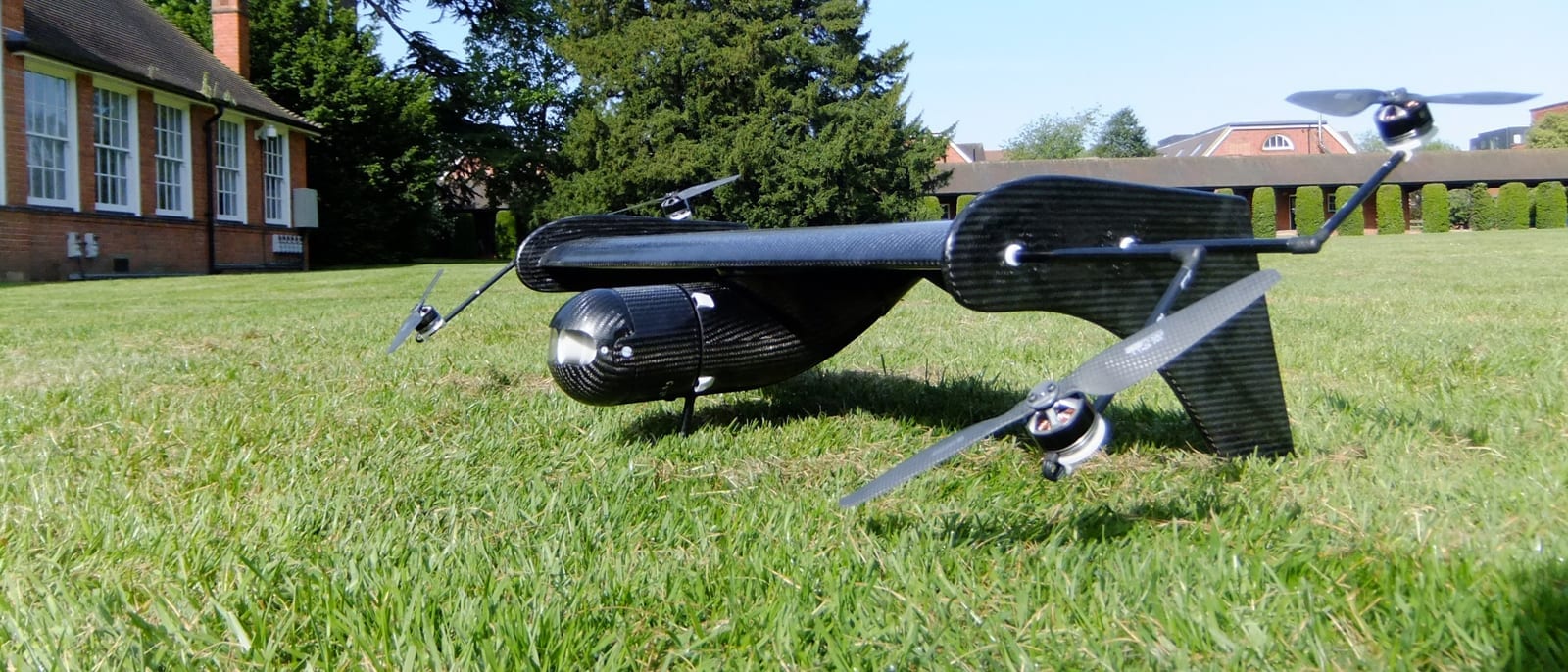
How Drone Teams Use CFD and FEA Simulation to Ship Faster
Discover how four drone teams slashed design time, cut costs, and unlocked breakthrough aerodynamic gains by moving cloud-based simulation to the start of development.

Alex Graham
May 15, 2026

Alexander Fischer
August 22, 2025

Peter Selmeczy
May 30, 2025



Luis Goncaves
June 18, 2026
Luis Goncaves
January 27, 2026

Paras Ghumare
December 4, 2025


Jon Wilde
June 16, 2026


David Heiny
June 15, 2026
Jon Wilde
June 3, 2026
Peter Selmeczy
March 24, 2026

Peter Selmeczy
September 10, 2025
Peter Selmeczy
June 25, 2025
Peter Selmeczy
May 29, 2026
Sealed IP-rated outdoor cases, ventilated chassis with forced-air cooling, passively cooled aluminium enclosures, data-center server racks, rugged enclosures for rail and off-road, and PCB-level thermal of any housing geometry. CFD, conjugate heat transfer, joule heating, and structural FEA all run on the same CAD model — from consumer electronics to industrial controllers, telecom radios, ADAS modules, and high-end servers.
Electronics enclosure thermal management is the discipline of moving heat from components (CPUs, GPUs, power electronics, busbars, transformers) to the outside environment fast enough to keep junction temperatures inside their reliability limits. It works through three mechanisms: conduction (through PCB layers, thermal interface materials, heat sinks, and the chassis itself), convection (natural or fan-forced airflow inside and around the enclosure), and radiation (from external surfaces). Simulation lets engineers predict where heat concentrates and validate that the chosen mix — heat sinks, vents, fans, heat pipes, sealed-chassis conduction paths — meets target temperatures before tooling is committed.
Established commercial tools include Ansys Icepak, Siemens Simcenter Flotherm, and 6SigmaET — strong solvers, but legacy desktop workflows, on-prem HPC, and per-seat licensing. SimScale runs the same physics — CFD, conjugate heat transfer, joule heating, structural FEA — in the cloud, on a browser-based subscription, with parallel sweeps, immersed-boundary meshing that cuts core-hour usage by ~10x on dense electronics, and no separate seats per discipline. Pricing is published transparently on the SimScale website.
In a sealed enclosure the chassis becomes the only heat exchanger. Conjugate heat transfer models the conduction path from each component, through thermal interface materials and PCB layers, into the chassis, and then external natural convection and radiation off the chassis to ambient air. Cobalt Design used this approach on a passively cooled, outdoor wall-mounted pool chlorinator controller — modelling solar gain, ambient air at 45 °C, non-isotropic transformer conductivity, and aluminium-cast heat-sink fin geometry — to reduce internal temperatures by 11% in the final iteration.
Passive cooling (heat sinks, heat pipes, natural convection, conduction-to-chassis) wins when fans are not permitted (contamination, noise, maintenance, sealed IP rating, or low maintenance budgets). Active cooling (fans, blowers, Peltier modules, liquid cooling) wins when heat density exceeds what passive can dissipate or when ambient conditions demand it. Both Blu Wireless (mmWave outdoor radios) and Cobalt Design (pool chlorinator) chose passive after CFD evidence; high-end server and data-center deployments typically require active. SimScale lets engineers run both architectures on the same CAD before locking in the decision.