Simulate sloshing, wave impact, free-surface flow with smoothed particle hydrodynamics. SimScale runs GPU-accelerated SPH simulations in the browser, with Engineering AI orchestrating your workflow and Physics AI delivering instant predictions.


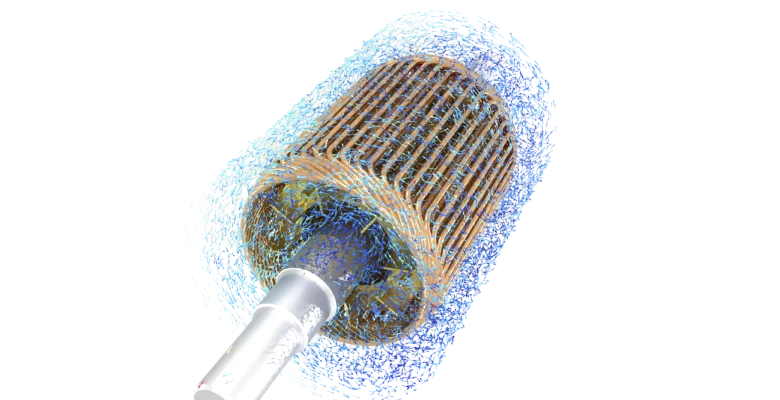











Model oil churning, free-surface sloshing, and air-fluid interfaces without generating a mesh. SPH tracks each fluid particle individually, so complex geometries, moving boundaries, and large interface deformations are handled natively — no remeshing, no interface reconstruction.
Check Simulation FeaturesEngineering AI configures particle resolution, time step and boundary conditions from the geometry and intent. Physics AI delivers instant outcome predictions on trained design spaces, so the first SPH iteration takes hours, not days.
Check AI FeaturesSimScale runs SPH cases on elastic cloud compute. Browser-based, instant scale-out, no queue. Share the live project link with the team for review, no install required.

Check Cloud FeaturesPredict oil distribution, film formation, and thermal behaviour in gearboxes, differentials, and electric motor housings under real operating conditions. SPH handles churning, splashing, and free-surface oil dynamics without geometry simplification, capturing lubrication starvation and hotspot formation at realistic rotational speeds.
Predict free-surface motion in fuel tanks, road tankers and offshore vessel holds. Quantify pressure on baffles and walls under transient excitation, including roll, pitch and acceleration profiles.
Simulate spillways, dam break, river hydraulics and overtopping where the air-water interface is the primary unknown. No interface tracking, no remeshing.
Resolve impeller-driven mixing and stirred-tank flow with free-surface and multiphase capture. SPH avoids the meshing pain of moving impellers and small clearances.
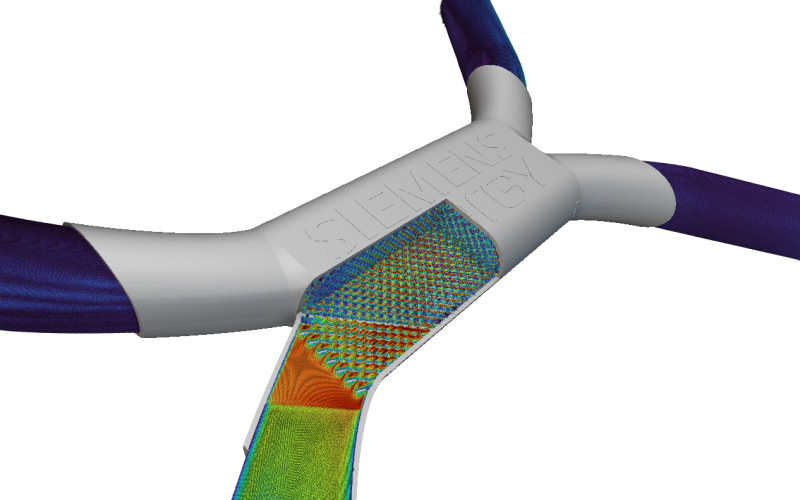
Siemens Energy cut design iteration time by 30% using SimScale’s cloud-native CFD to optimize 3D-printed heat exchangers. By eliminating pre-processing bottlenecks and enabling parallel validation, the team accelerated thermal performance optimization for complex additive manufacturing geometries.
Check out the latest thermal management simulations performed in SimScale and validated against experimental and/or analytical results.
Check out the latest thermal management simulations performed in SimScale and validated against experimental and/or analytical results.
Check out the latest thermal management simulations performed in SimScale and validated against experimental and/or analytical results.
Subscription Plans Adapted to Your Needs
Free for testing & learning
For structural & thermal simulation work
For higher fidelity simulation work
For broad simulation roll-outs
Answers to the most common questions about smoothed particle hydrodynamics, SimScale’s SPH workflow, and when SPH is the right method for your problem.
Smoothed particle hydrodynamics (SPH) is a mesh-free, Lagrangian numerical method that represents fluids and solids as a cloud of particles carrying mass, velocity and other properties. Each particle’s value is computed by smoothing over its neighbours through a kernel function. SPH is used where free surfaces, large deformations or multi-phase flows make mesh-based methods break down.
Yes. SPH is one branch of computational fluid dynamics, alongside finite volume (FVM) and finite element (FEM). The difference: SPH is mesh-free and Lagrangian (particles move with the flow), where FVM and FEM are mesh-based and typically Eulerian. SPH is preferred for free-surface, multi-phase and large-deformation problems; FVM remains the default for steady-state and confined flows.
Choose SPH when the flow has a free surface or air-water interface, when the geometry deforms significantly, or when multi-phase mixing and splashing matter to the result. Stick with mesh-based CFD for steady-state internal flows, aerodynamic external flows, and cases where the Reynolds number is high and the mesh resolves the boundary layer well.
Real-time SPH is possible for low particle counts (under ~100,000) on GPU-accelerated hardware, used mostly in graphics and visualisation. Engineering-grade SPH (millions of particles, accurate kernel functions, validated against experiment) runs in batch, not real time. SimScale’s cloud compute keeps batch turnaround within hours rather than days, which is the practical equivalent for design iteration.
Sign up for SimScale
and start simulating now
