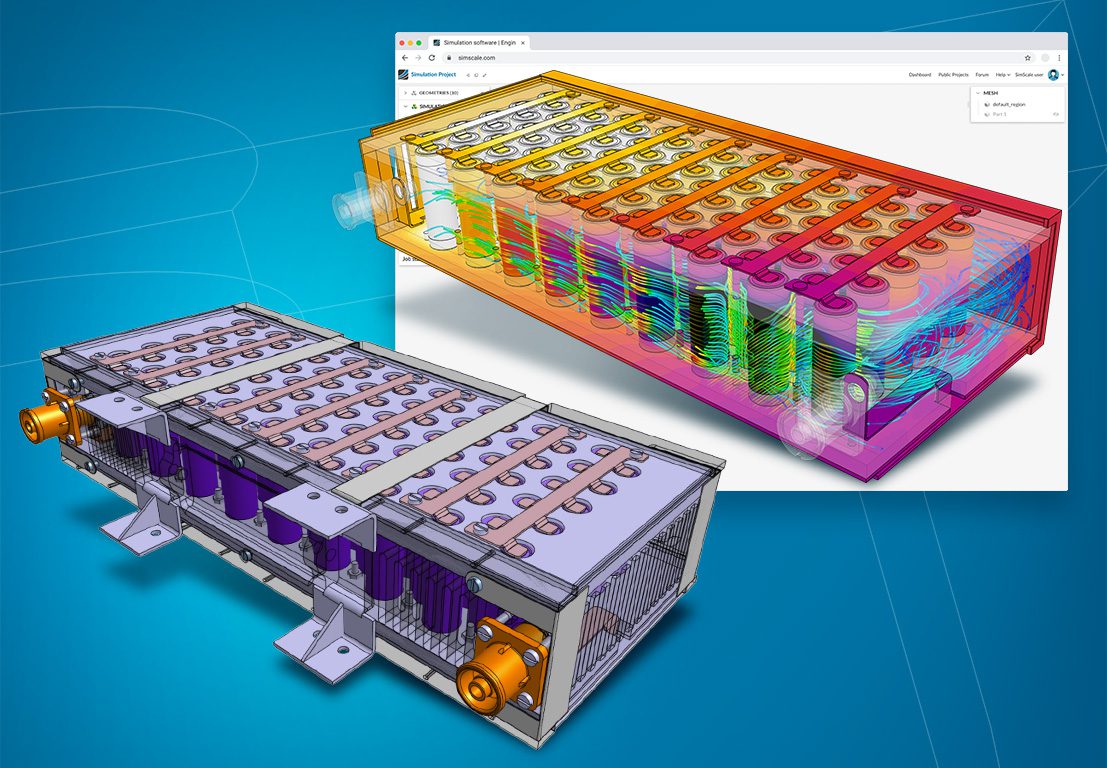

SimScale has introduced new features to conduct Joule heating simulations through a user-friendly interface equipped with robust and automated post-processing capabilities.
Simulating Joule heating is necessary for various industry applications, particularly where resistive heating is a prevalent occurrence. More frequently, the temperature rise resulting from the conversion of electrical energy into thermal energy is an undesired effect that can diminish the overall efficiency of components. Examples include busbars and wiring in power electronics, where efficiency decreases inversely with rising temperatures. A similar impact is observed in batteries, where operating above the ideal temperature range leads to degraded performance and shortened lifespan.
In this webinar, we demonstrated the use of new Joule heating predictions to calculate the electric potential, heat generated, and current density across electronic components. Our experts presented industry-relevant examples of Joule heating simulation applied to various models including battery modules, inverters, fuses, and resistors.
Specifically, an electric vehicle battery model is used. The battery module of a small electric race car uses forced convection air cooling for thermal management and has copper busbars. It has 90 lithium-ion cells in an 18S5P arrangement (18 cells in series, 5 cells in parallel).
Watch this webinar to learn how to:
- Easily import your CAD models of devices such as an inverter, fuse, resistor, or battery module for thermal analysis and predicting Joule heating effects
- Run a Joule heating simulation on the electric vehicle (EV) battery module and post-process the results
- Predict heat gain from current flowing through the battery components and test optimal cooling strategies
- Get started with SimScale