
Catalytic Consulting: Disrupting the PFAS Filtration Market with Simulation-Driven Hydraulic Design

Up to $1 million annual operational cost savings per system

NPI process shortened by 12-16 weeks
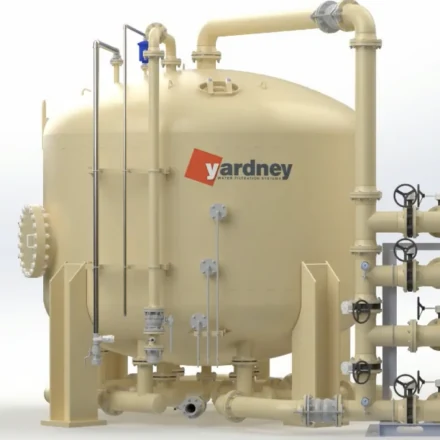
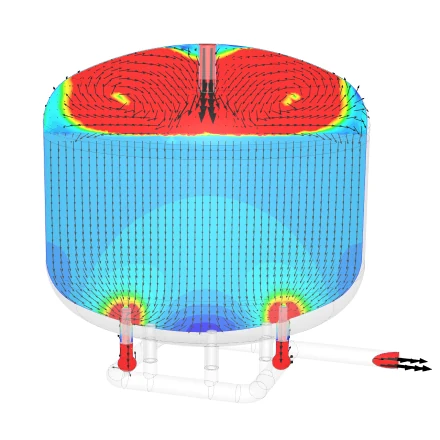
Catalytic Consulting Inc., based in Hudson, Massachusetts, is an interdisciplinary R&D strategy firm dedicated to hardware engineering innovation. Operating under the mission “Innovation, accelerated,” the consultancy assists manufacturing enterprises in defining and executing complex product roadmaps. By leveraging expertise across mechanical, electrical, and chemical engineering, Catalytic Consulting provides hands-on guidance to drive business profitability and technology leadership. The firm actively contributes to the ISO 56000 innovation management standards as experts representing the United States.
For each new innovation project, the firm conducts rigorous stakeholder interviews to understand the operational burdens placed on end-users, ensuring that hardware innovations solve systemic industry pain points. Recently, Catalytic Consulting worked with Yardney Water Filtration Systems to develop a next-generation filtration pressure vessel designed to disrupt the Per- and Polyfluoroalkyl Substances (PFAS) water treatment market.
Leading the technical execution was Abishek Arumugam Navukkarasan, Lead Engineer at Catalytic Consulting. Abishek brings a robust background in cloud computing, aerospace, and electromechanical systems to the firm’s hardware innovation division. Operating within an agile team, Abishek worked alongside simulation specialist Anthony Drinkwater to transform a research-driven design concept into a patent-pending physical product. This project combined advanced multiphysics simulation with environmental engineering to address one of the most pressing public health crises of the modern era.
Founded in 1965 and headquartered in Riverside, California, Yardney Water Filtration Systems designs, engineers, and manufactures water filtration solutions for irrigation, golf, turf, landscape, industrial, commercial, and municipal markets worldwide. The firm’s ASME U-stamp-certified manufacturing facility produces carbon-steel and stainless-steel pressure vessels — in standard and high-pressure configurations up to 144 inches in diameter — supported by a global network spanning the United States, Mexico, and Europe. Originally focused on agricultural water purification, Yardney has expanded over six decades into specialty media and resin systems for the removal of iron, manganese, arsenic, PFAS, and other contaminants — uniquely positioning the company to commercialize the new co-planar dual-ring header vessel as its FreeFlow product line..
The urgency of the project was driven by unprecedented regulatory shifts. In 2024, the U.S. Environmental Protection Agency (EPA) issued standards establishing strict Maximum Contaminant Levels of 4.0 parts per trillion for certain PFAS compounds. Known as “forever chemicals” due to their extreme stability, PFAS have been linked to severe health impacts, including suppressed immune systems and certain cancers.
To meet these standards, municipalities rely on Granular Activated Carbon (GAC) or Ion Exchange (IX) resins. Contaminated water is pumped through a pressurized steel vessel where it percolates through a deep bed of this media. The success of this process depends on Empty Bed Contact Time (EBCT)—a measure of the duration the water spends in contact with the media. If fluid dynamics are poorly controlled, water moves too quickly through the bed, causing contaminants to “break through” the filter.
Abishek and the team identified that the prevailing industry-standard eight-septa (eight-nozzle) vessel design had significant limitations. They observed that removing fluid in this way caused stagnation zones in the filtration media, meaning that those regions of the media were effectively not being used. This inefficient use of expensive filtration media shortens the life of the overall bed while increasing the chances of contaminant break through.

“Forever Chemicals such as PFAS exist everywhere. Current filtration systems are inefficient with utilizing filtration media because of dead zones and low velocity regions. They also are energy inefficient with higher pressure drops across the system.”
Lead Engineer, Catalytic Consulting
To prove these flaws and engineer a superior alternative, Abishek required Computational Fluid Dynamics (CFD) simulation. However, legacy CFD software packages were prohibitively expensive and demanded extraordinary localized hardware resources, often taking weeks to complete single runs.
To eliminate this bottleneck, Catalytic Consulting transitioned to SimScale to scale out their simulation work in the cloud. “SimScale offered browser-based cloud computing capability,” Abishek explains, “so we can launch dozens of simulations in parallel using the elastic cloud compute”. This empowered them to understand the flow characteristics of many different design concepts quickly, and gain rapid insights into the system’s driving parameters.
Using the Volume of Fluid (VOF) method and porous media definitions, the team constructed a digital twin of the filtration vessel to track exactly how fluid pressure and flow velocity behaved as water was forced through the media bed.
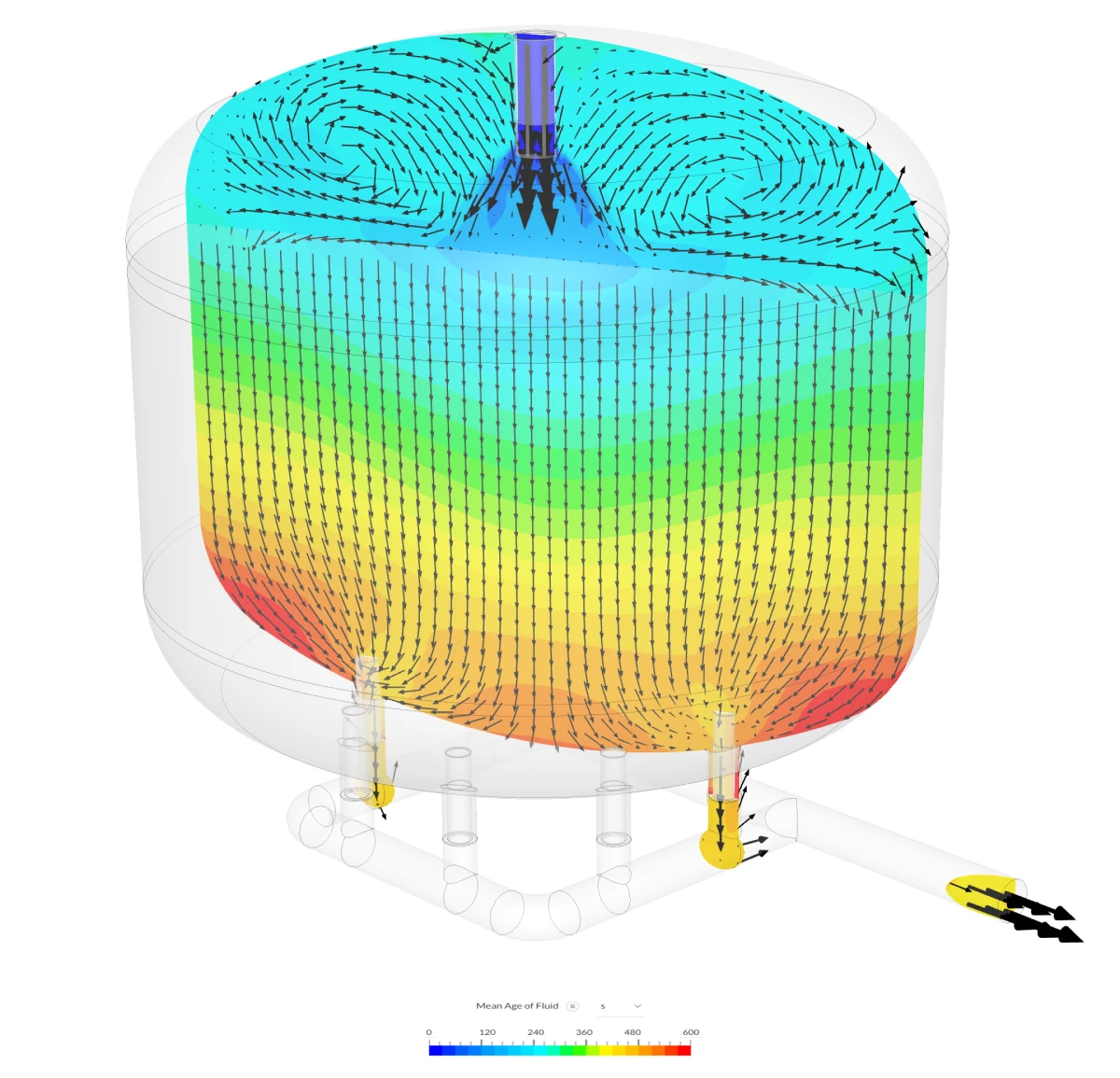
Anthony used SimScale’s built-in Simulation Process and Data Management (SPDM) to organize the work: “during the design phase we were using CFD intensively, running 5-10 simulations daily, and then performing the analysis to decide on the next refinements to test”. After 6 weeks of development work, the team had explored over 75 design variants, covering several different aspects of the overall vessel design.
“It’s not just about the software, but also the support. Igor pretty much took us through the project and anytime we need him, he’s always there. This is probably the best investment we’ve made in our company since in the past few years.”
Abishek Arumugam Navukkarasan
Lead Engineer, Catalytic Consulting
Based on insights from simulation, the team conceptualized a novel 12-septa dual-ring co-planar vessel. “By studying the legacy designs, we were able to identify and focus on various issues that are not immediately visible in field operation,” Abishek says. By increasing the number of under-drain collection points and spreading them more effectively across the bottom of the vessel, the new design forced the water to distribute smoothly across the entire media bed, eradicating stagnant dead zones.
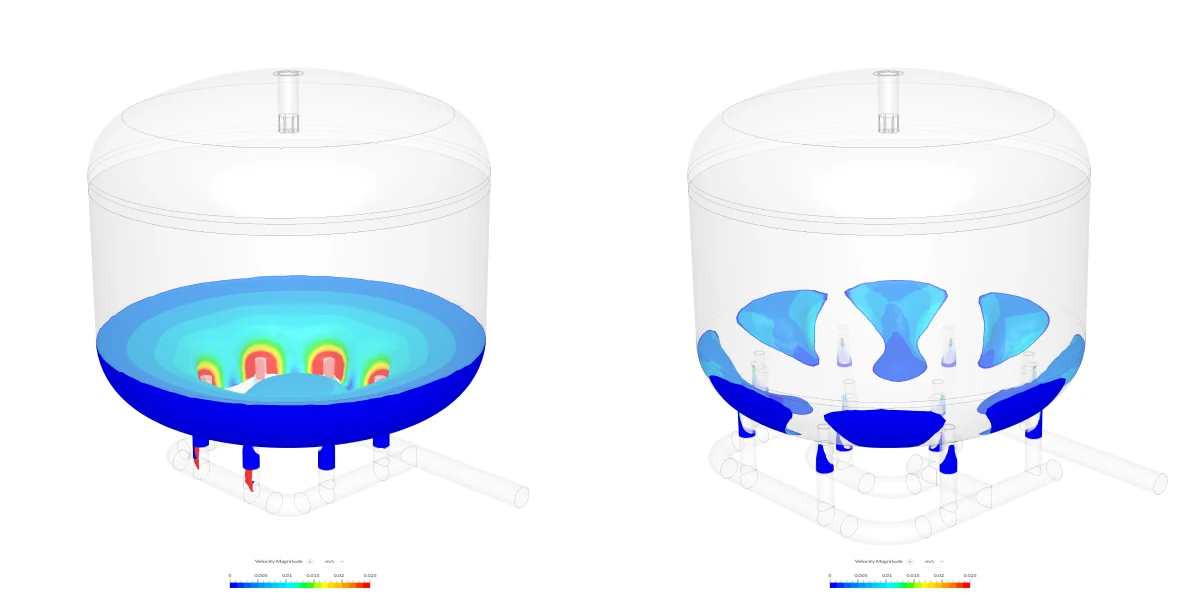
Detailed analysis revealed that the new design reduced the total volume of stagnant zones in the filtration media by 27.25% compared to the industry standard. Benchtop testing on scaled physical models validated the software’s accuracy, confirming that the optimized hydraulics extended the operational lifespan of the media by 20%.
The financial impact is transformative for municipalities. PFAS-specific media can cost $100 per cubic foot. “Our innovative PFAS system design makes much more efficient use of the expensive filtration media, as well as requiring much less energy to run” Abishek explains. Overall, the 12-septa design saves roughly up to $1,000,000 per two-vessel system over a year of operations.
>This figure represents an engineering estimate based on representative operating conditions; actual savings vary by customer based on media type (GAC vs. IX), media cost, and system configuration.
“If we were running the simulations locally, it would have been impossible. I think it’s just the coolest thing about SimScale that we can just run all the simulations we need concurrently in the cloud. The iterative speed enabled us to rapidly evaluate concept designs and guided us to come up with a novel design that solves multiple pain points of the PFAS system and saves municipalities millions of dollars annually.”
Abishek Arumugam Navukkarasan
Lead Engineer, Catalytic Consulting
By integrating cloud simulation into an agile consulting environment, Catalytic Consulting guided its client into a highly regulated market with a patent-pending technology that outperforms legacy solutions. This success is deeply rooted in the firm’s core philosophy. As Abishek explains, “Empathy is a core guiding principle. We have to start with the situation and need of the end user and go from there” In this way, Catalytic Consulting is able to deliver true “disruptive innovation for our clients,” ensuring their hardware solves real-world operational and environmental crises.
Looking forward, Abishek plans to expand the use of the SimScale platform by integrating advanced AI engineering features. “We plan to venture into using the AI engineering features to accelerate our speed further and help create hardware innovation,” he notes. This continuous evolution of their technology stack guarantees that Catalytic Consulting will achieve even faster parametric optimizations, tackling the complex challenges of tomorrow with unmatched velocity.
Set up your own cloud-native simulation via the web in minutes by creating an account on the SimScale platform. No installation, special hardware, or credit card is required.

Subscribe to our newsletter
By subscribing you agree to with our Privacy Policy
Product
Solutions
Resources
Sign up for SimScale
and start simulating now