Break free from hardware limitations. Design, analyze, and optimize electric motors, transformers, and actuators directly in your browser with high-fidelity electromagnetic simulation solvers and parallel cloud computing — no downloads, no queues, no license bottlenecks.


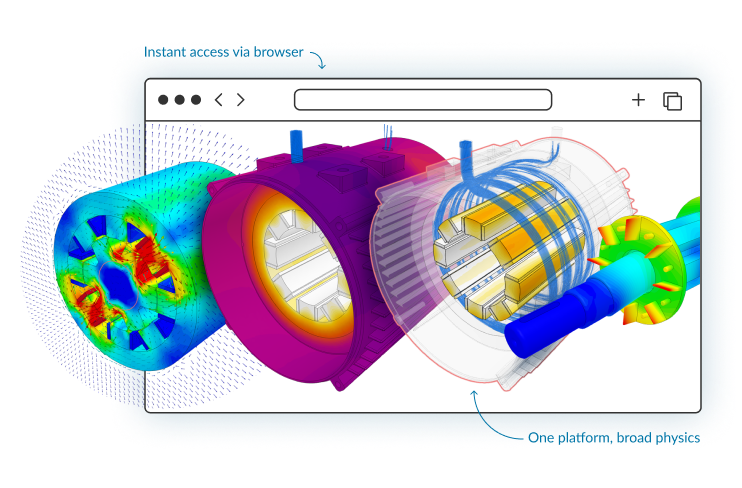











Accelerate your electric motor simulation workflow with cloud-native multiphysics. Simulate electromagnetics, thermal dynamics, and structural performance simultaneously — and test motors, transformers, and actuators under real-world operating conditions without building a single prototype.
SimScale provides a unified electric motor design software environment to solve the coupled physics challenges inherent in modern motor engineering: Electromagnetics (EM), Computational Fluid Dynamics (CFD) and Thermal Analysis, and Finite Element Analysis (FEA). Iterate on geometry, winding configurations, and operating points in seconds – not days – to ensure your design delivers peak efficiency, thermal safety, and mechanical durability.
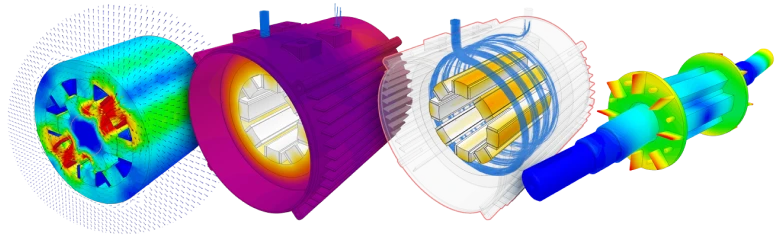

Use AI surrogates and pre-trained foundation models to get performance predictions in seconds. Explore thousands of design variants—from winding configurations to rotor geometries—and identify winning concepts before committing to high-fidelity analysis.
SimScale AI unlocks new ways to innovate in electromagnetic design. Explore whole design spaces in minutes and make design decisions with confidence, reducing iterations and increasing engineering velocity.
Analyze static magnetic fields generated by steady DC currents or permanent magnets. Essential for engineers designing electromechanical devices, such as BLDC motors, sensors, and actuators, where time-varying effects like eddy currents can be neglected. Visualize flux density, calculate forces, and optimize magnet placement before prototyping.
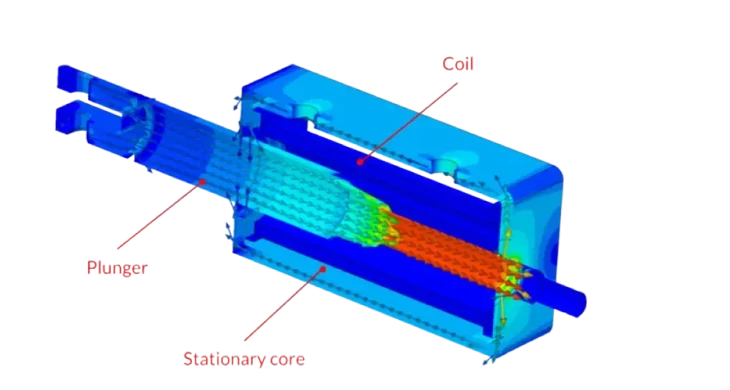
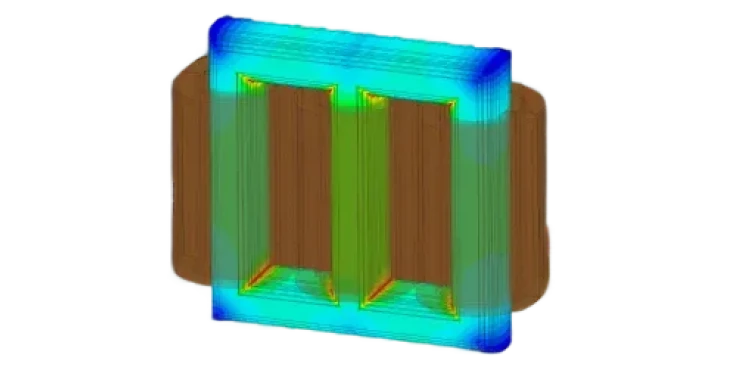
Analyze the effects of alternating currents (AC) and electromagnetic induction in frequency-domain simulations. Model eddy current losses, skin effects, and proximity effects in motor windings and laminated cores. Critical for predicting efficiency and heat generation in AC and induction motors.
A multiphysics approach that connects electrical performance to temperature distribution. Automatically map electromagnetic losses as heat sources in a steady-state thermal analysis. This two-way coupling captures how rising temperatures affect material properties like resistivity and permeability, giving engineers a holistic view of motor performance under continuous operation.
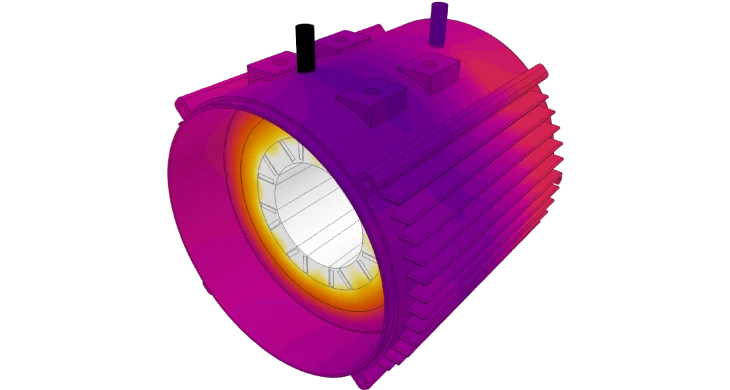
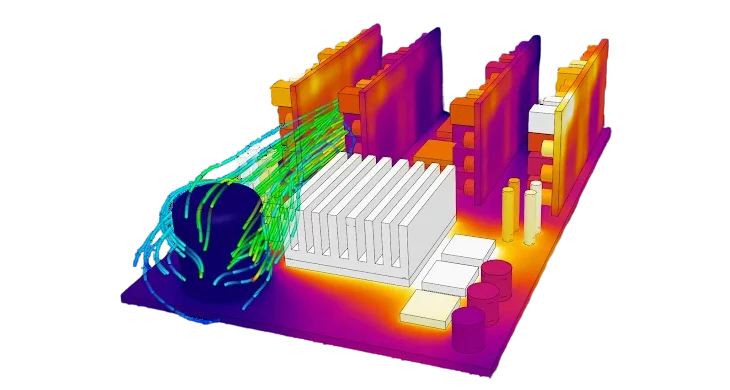
Calculate heat conduction through solid components (stator, windings, housing) and heat convection within the cooling fluid (air or liquid) to optimize thermal management systems.
Identify areas of excessive deformation or von Mises stress, ensuring that the electric motor or its component can withstand the extreme mechanical pressures of rapid acceleration and high RPMs without catastrophic failure.
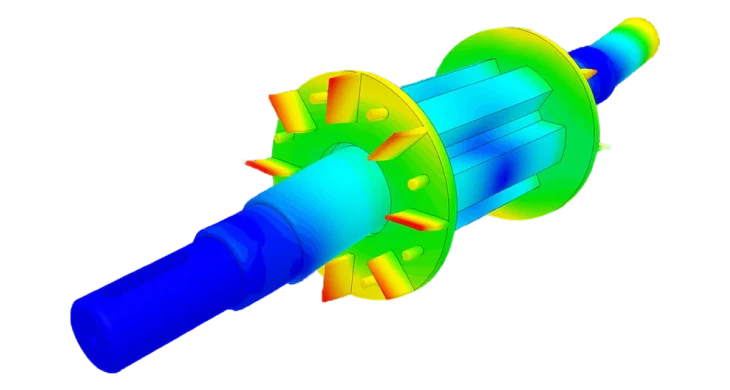

Ensure that the natural frequencies of the motor housing, stator, and support brackets do not coincide with the excitation frequencies generated by the electromagnetic forces or rotational speeds. Visualize the full response spectrum and apply global damping to minimize specific frequencies that contribute most to the “whine” of electric machines.
Simulate switched reluctance motors without permanent magnets—ideal for cost-effective, rare-earth-free motor designs. Analyze torque generation, flux distribution, and minimize torque ripple through electromagnetic simulation.
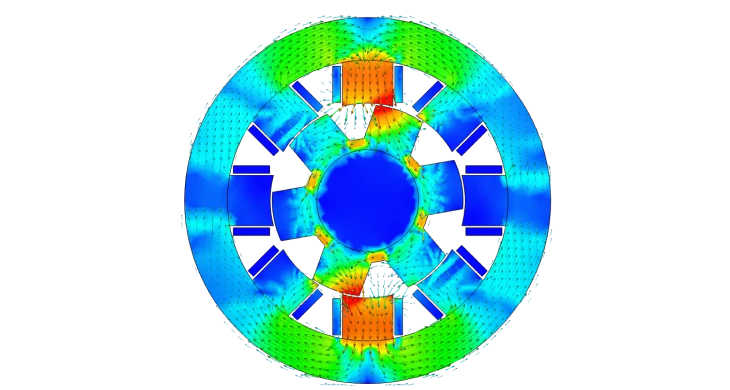
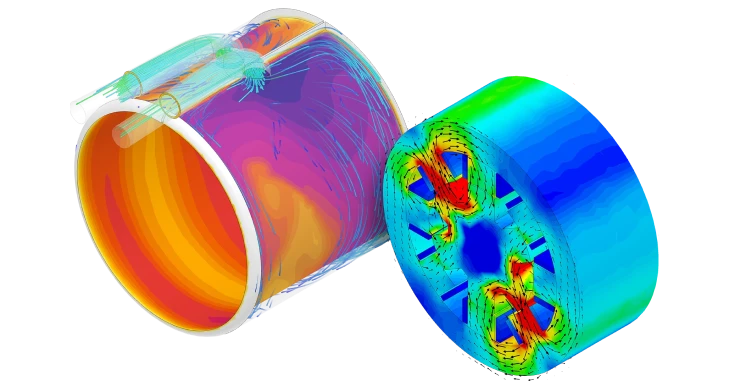
Analyze AC motors and induction machines with time-harmonic electromagnetic solvers. Model slip, starting torque, and steady-state performance for single-phase and three-phase induction motors.
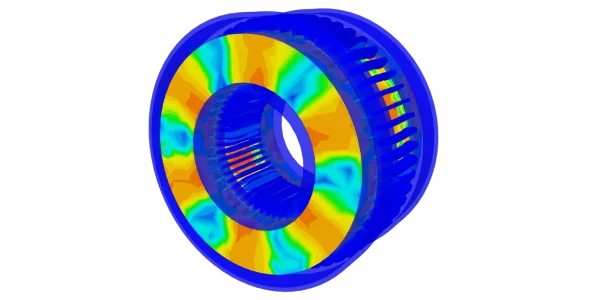
Emil Motors utilized SimScale’s cloud-native multiphysics platform to halve development costs and double iteration speeds while engineering a high-performance, magnet-free axial flux induction motor for electric vehicles.
Check out the latest thermal management simulations performed in SimScale and validated against experimental and/or analytical results.
Check out the latest thermal management simulations performed in SimScale and validated against experimental and/or analytical results.
Check out the latest thermal management simulations performed in SimScale and validated against experimental and/or analytical results.
Subscription Plans Adapted to Your Needs
Free for testing & learning
For higher fidelity simulation work
For team collaboration
For broad simulation roll-outs
Sign up for a free Community account, then open one of SimScale’s public electric motor projects to explore a pre-configured simulation setup. Modify the geometry, adjust operating parameters, and run your first electromagnetic or thermal simulation — all within your browser in minutes.
SimScale supports a wide range of motor topologies including brushless DC (BLDC) motors, permanent magnet synchronous motors (PMSM), induction motors (single-phase and three-phase), switched reluctance motors (SRM), and axial flux machines. Each can be analyzed for electromagnetic performance, thermal behavior, and structural integrity.
Traditional motor design software like Ansys Motor-CAD or Siemens Simcenter runs on local workstations, requiring hardware investment and license management. SimScale runs entirely in your browser — no installation, no hardware constraints. You get access to scalable cloud computing for running multiple simulations in parallel, which dramatically accelerates design iteration. Teams can collaborate on the same project from anywhere.
Yes. SimScale automatically maps electromagnetic losses (Joule heating, core losses) as heat sources in thermal analyses. This two-way coupling captures how temperature changes affect material properties like resistivity and magnetic permeability, giving you accurate predictions of motor performance under sustained operation.
SimScale offers modal and harmonic analysis to identify natural frequencies and resonance risks in motor housings, stators, and mounting structures. This helps engineers avoid frequency coincidence between electromagnetic excitation forces and structural modes — the primary cause of electric motor whine and vibration noise.
SimScale covers magnetostatics, time-harmonic magnetics, electromagnetic-thermal coupling, conjugate heat transfer (CHT), static stress analysis, and modal/harmonic response analysis. This multiphysics coverage lets you evaluate your motor’s electrical efficiency, cooling performance, and mechanical durability in a single platform.
Yes. SimScale AI uses surrogate models and pre-trained foundation models to deliver performance predictions in seconds. You can explore thousands of design variants — varying winding configurations, rotor geometries, and magnet placement — and shortlist the best candidates before running full-fidelity electromagnetic simulations.
Absolutely. SimScale’s multiphysics capabilities are well-suited for EV traction motor design where electromagnetic efficiency, thermal management of permanent magnets, and NVH performance are all critical. Customers like Emil Motors and Rimac Automobili have used SimScale to accelerate electric vehicle motor development.
Sign up for SimScale
and start simulating now
