Your linear FEA results say the bracket is fine. The prototype just cracked in testing. What went wrong?
Chances are, the part entered the plastic range. While your linear model flagged the high stress, it couldn’t tell you what happens next.
Does the part redistribute load and survive? Does it deform permanently but still function? Or does it fail catastrophically?
To answer those questions, or to model materials like rubber and polymers that are inherently nonlinear, you need nonlinear material models.
Linear elastic analysis assumes constant stiffness and infinitely small deformations. For a lightly loaded component well below yield, that’s perfectly adequate. But the moment your design sees real-world loads; metals yielding, rubber seals stretching 300%, polymers creeping at temperature, linear analysis quietly stops telling the truth.
““The real world doesn’t behave linearly: materials yield, creep, and undergo stress relaxation. Rubber seals stretch and recover. Thermoplastics soften permanently under repeated loading. Parts come into and out of contact, slide, stick, and separate.””
SimScale Webinar: Democratizing Advanced Nonlinear Simulation with Marc and AI
This guide cuts through the textbook theory and gives you the practical decision framework for nonlinear material models in FEA: which model to pick, what data it requires, and to build models that will reliably converge. Geometric nonlinearity (large displacements) and contact nonlinearity (changing boundary conditions) are separate topics, though real problems often combine all three.
The Four Nonlinear Material Model Types
There are four broad categories of material model in nonlinear analysis. Understanding the abilities of each one is key to making the right selection for the material you’re dealing with.
1. Elastoplastic Models
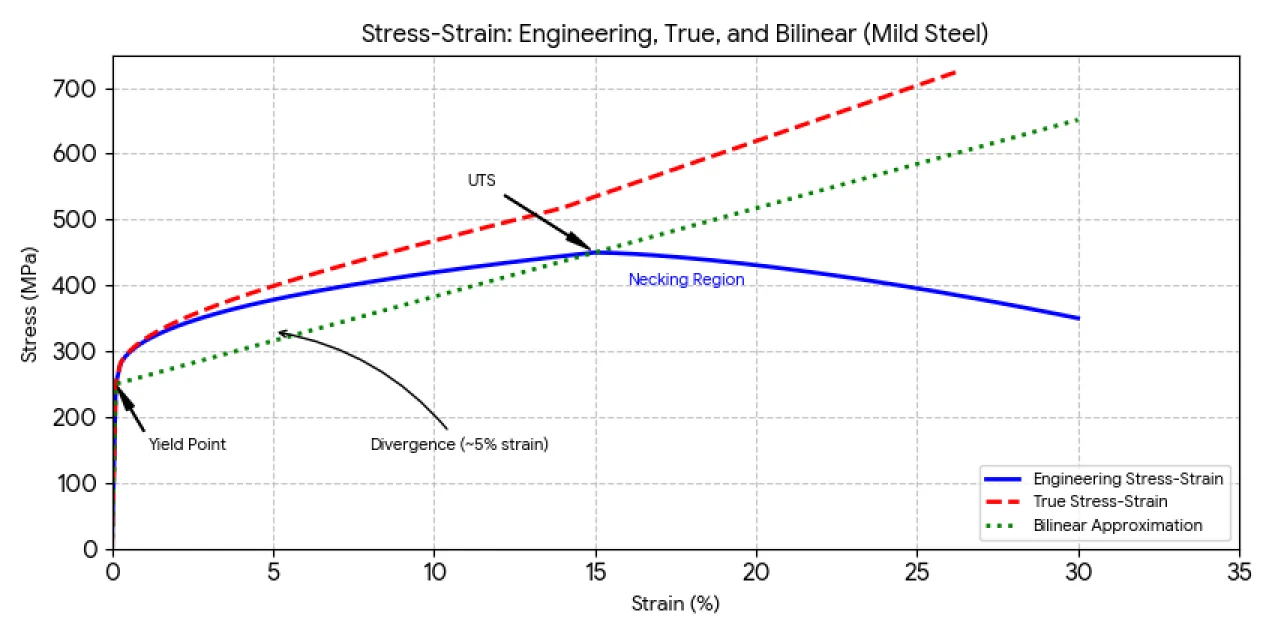
The workhorse of nonlinear FEA. These describe materials that deform elastically up to a yield point, then undergo permanent plastic deformation. The fundamental relationship is:
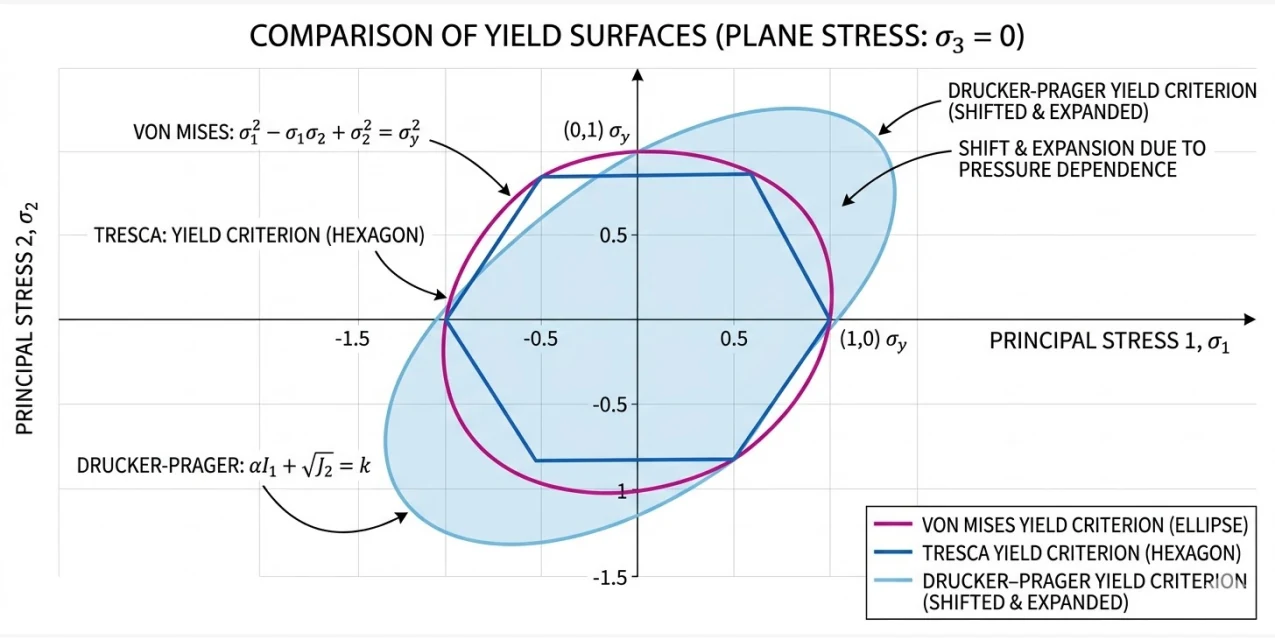
where elastic strain recovers on unloading and plastic strain is permanent. The yield point is typically defined by the von Mises criterion:
SimScale supports several variants of non-linear structural analysis through its Static and Dynamic solvers (using the Code_Aster solver) and Nonlinear Mechanical (Marc) analysis types: elastic-perfectly plastic, bilinear hardening, multilinear hardening, and Johnson-Cook (rate/temperature-dependent).
Best for: Structural steels, aluminum alloys, titanium, copper. See the elasto-plastic materials documentation for setup details and Modeling Inelasticity: Plasticity and Creep for a deeper dive on the fundamentals.

“Sheet metal forming is a highly nonlinear analysis. We use steel for the tools and an elastoplastic material model with multilinear specification for the aluminum. We solve this in three steps to determine the final shape of the sheet metal part.; tool positioning, the punch, and retraction”
Watch: Sheet Metal Forming Simulation
Ioannis Tsavlidis
Senior Application Engineer, SimScale
2. Hyperelastic Models
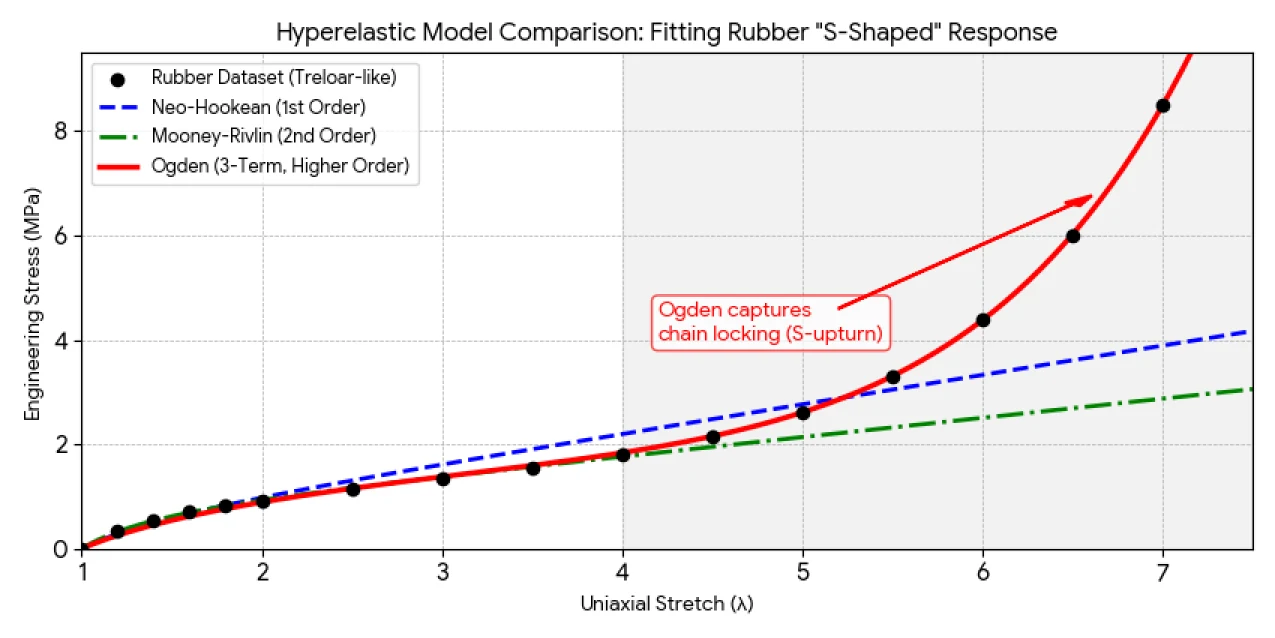
For materials that undergo huge elastic deformations (100–700% strain) and fully recover. Defined by a strain energy density function rather than a simple modulus. For example, the Neo-Hookean model uses:
where is the shear parameter, is the first deviatoric strain invariant, is the volume ratio, and controls compressibility. Higher-order models like Mooney-Rivlin and Ogden add additional terms to capture the S-shaped stress upturn at large stretches.
SimScale supports Neo-Hookean, Mooney-Rivlin, Ogden, Yeoh/Signorini, and Marlow (no calibration needed — Marc solver only).
Best for: Rubber seals, O-rings, elastomeric bushings, silicone, foams, biological tissue. See How to Choose a Hyperelastic Material Model.
3. Viscoelastic and Viscoplastic Models
Time-dependent behavior: stress response depends on strain rate and duration, not just magnitude. The most common structural application is creep — progressive deformation under constant load at elevated temperature, often modeled with a Norton-Bailey power law:
where and are material constants, is activation energy, is the gas constant, and is absolute temperature. SimScale supports creep modeling for high-temperature components.
Best for: Polymers, high-temperature metals (turbine blades, exhaust manifolds), solder joints, sustained-load applications.
4. Damage and Failure Models
Track progressive stiffness degradation leading to fracture. Johnson-Cook in SimScale can be extended with damage criteria for crash, impact, and composite failure scenarios.
Best for: Crash/impact events, progressive failure assessment, composite damage, fatigue crack growth.
Elastoplastic vs. Hyperelastic: How to Decide
Choosing the right model starts with your material, not the deformation. Here’s a practical decision path:
- What’s your material group?
- Metals → linear elastic or elastoplastic (depending on whether you need to predict post-yield behavior).
- Rubber/elastomers → hyperelastic, unless deformation is very small.
- Thermoplastics → viscoplastic (or elastoplastic for short-duration loads).
- For metals: do you need to understand post-yield behavior, or just confirm you’re below yield? If the latter, linear elastic + yield criterion may be enough.
- For rubber-like materials: are deformations large enough that a linear stiffness assumption breaks down? → hyperelastic.
- Time or temperature effects? Creep, stress relaxation, rate-dependence → viscoelastic or viscoplastic.
- Do you have test data? Higher-order models need more calibration data.
| Elastoplastic | Hyperelastic | |
|---|---|---|
| Deformation | Permanent above yield | Fully recoverable |
| Strain range | 0.1–20% | 10–700%+ |
| Stiffness | Young’s modulus + hardening slope | Strain energy density function |
| Unloading | Returns along elastic slope, leaves residual strain | Returns to original shape |
| Typical materials | Steel, aluminum, titanium | Rubber, silicone, elastomers, foams |
Model Selection Quick Reference
| Application | Materials | Recommended Model |
|---|---|---|
| Structural overload | Steel, aluminum | Bilinear / multilinear elastoplastic |
| Metal forming | Sheet metal | Multilinear or Johnson-Cook |
| Rubber seal / bushing | Elastomers, silicone | Mooney-Rivlin, Ogden, or Marlow |
| Snap-fit assembly | ABS, nylon | Multilinear elastoplastic |
| High-temp piping | Stainless, Inconel | Elastoplastic + creep |
| Crash / impact | Metals, foams | Johnson-Cook + damage |
Choosing Your Model Parameters
Once you’ve identified the material type, three further decisions shape your simulation setup.
1. Which Yield Criterion?
The yield criterion determines when the material transitions from elastic to plastic. For metals, this is almost always von Mises. You only need alternatives for pressure-dependent materials:
| Criterion | Best For | When to Use |
|---|---|---|
| von Mises | Ductile metals (steel, aluminum, copper) | Default for engineering metals. Yielding depends on distortional energy. |
| Tresca | Ductile metals (conservative) | ~15% more conservative than von Mises. Required by some pressure vessel codes. |
| Mohr-Coulomb | Soils, concrete, rock | Shear strength depends on normal stress. Standard for geotechnical work. |
| Drucker-Prager | Soils, concrete, polymers, foams | Smooth 3D version of Mohr-Coulomb. Easier FEA implementation. |
2. Bilinear or Multilinear Hardening?
Bilinear uses a single post-yield slope defined by three parameters . Fast to set up, good for initial sizing. Multilinear traces the actual stress-strain curve with multiple data points — always more accurate when test data is available.
| Aspect | Bilinear | Multilinear |
|---|---|---|
| Parameters | EE E, σy\sigma_y σy, ETE_T ET (3 values) | EE E + *n* stress-strain data points |
| Accuracy | Good for small plastic strains | Follows actual material curve |
| Setup time | Minutes | Moderate (need test data) |
| Best when… | Quick check, limited data | Accuracy matters, data available |
Quick estimate when you only have yield and UTS:
For mild steel, is typically 1–2 GPa compared to GPa.
3. Which Hardening Rule?
This governs how the yield surface evolves with plastic strain — critical for cyclic loading accuracy:
| Rule | Yield Surface Behavior | Use When |
|---|---|---|
| Isotropic | Expands uniformly | Monotonic loading (single overload) |
| Kinematic | Translates (shifts position) | Cyclic loading, seismic, fatigue |
| Combined | Expands + translates | Complex histories, accurate cyclic modeling |
Rule of thumb: load applied once → isotropic. Load reversals (bolt tightening/loosening, pressure cycling, seismic) → kinematic or combined. Getting this wrong gives non-conservative cyclic results.
Getting the Material Data Right
A nonlinear model is only as good as its input data.
For metals: the uniaxial tensile test (ASTM E8 / ISO 6892) gives you everything – , and the full stress-strain curve. The critical step is converting to true stress and true strain:
These formulas are valid up to the onset of necking. SimScale’s documentation provides detailed conversion guidance.
For rubber/elastomers: you need multiple test modes (uniaxial, equibiaxial, shear) because hyperelastic behavior varies with loading mode. Rule of thumb: at least as many independent tests as model parameters. A comprehensive comparison of 85 hyperelastic constitutive models by Dal et al. (2021) provides useful guidance on which strain energy functions best fit different rubber compounds [1].
No test data? Use material databases (MatWeb, MMPDS, CES EduPack) or SimScale’s built-in library. Just verify alloy designation, temper condition, and temperature range — database values are typical properties, not guaranteed minimums.
When Do You Actually Need Nonlinear Materials?
Now that you know the model types, here’s a quick decision filter for whether you need them at all:
| Indicator | Linear Is Fine | Go Nonlinear |
|---|---|---|
| Max stress vs. yield | Well below yield (FoS > 2) | Near, at, or above yield |
| Material class | Metals under light loads | Rubber, elastomers, polymers, foams |
| Strain magnitude | < 1–2% | > 2–5% or material-dependent |
| Design function | Stiffness-driven | Energy absorption, forming, sealing |
| Code compliance | Allowable stress only | Plastic analysis (ASME, Eurocode, AISC) |
| Loading | Static, monotonic | Cyclic, impact, path-dependent |
The trade-off is compute time: nonlinear runs take 5–20× longer than linear. Cloud platforms like SimScale (up to 192 cores per run) shrink that gap significantly.

“By using the novel mechanical simulation based in the cloud offered by SimScale, we engineers at Withings have been able to reduce our design-to-prototype cycles from weeks to days.”
Victor Pimenta
Mechanical Engineer, Withings
Getting It to Converge
Nonlinear problems require iterative solvers (typically Newton-Raphson), which means convergence isn’t guaranteed. Here’s how to fix the most common failures:
| Problem | Likely Cause | Fix |
|---|---|---|
| Divergence at yielding | Step too large across elastic-plastic transition | Reduce step size; use automatic stepping |
| Oscillation without converging | Perfect plasticity | Add small tangent modulus; increase max iterations |
| Element distortion errors | Excessive strain in coarse mesh | Refine mesh in plastic zones |
| Slow convergence (rubber) | Volumetric locking from incompressibility | Reduced integration elements; check D1 parameter (Code_aster) or bulk modulus (Marc) |
| Non-convergence with contact | Combined nonlinearities | Smaller load steps; verify contact; use Marc auto-detect |

Watch this live demo where we set up a nonlinear rubber bushing simulation from scratch in just minutes. Import your CAD, let automatic contact detection handle the assembly, assign a Mooney-Rivlin hyperelastic model, define your loads, and run.”
Democratizing Advanced Nonlinear Simulation with Marc and AI
Richard Szöke-Schuller
Lead Product Manager AI / Structural/ AEC, SimScale
Design Code Limits
A critical question in any nonlinear analysis: how much plastic strain is acceptable? Design codes provide the answer:
| Code | Application | Allowable Plastic Strain | Notes |
|---|---|---|---|
| ASME BPVC Sec. VIII Div. 2 | Pressure vessels | 5% local membrane + bending | Triaxiality and forming strain considered |
| EN 1993-1-6 | Steel shells | Up to 5% equivalent | Buckling interaction must also be checked |
| DNV-RP-C208 | Offshore structures | 2–5% depending on criticality | Fracture mechanics screening above 2% |
| AISC 360 | Steel buildings | Implicit via shape factor | Full plastification of compact sections allowed |
These are design margins, not material failure limits. They account for fabrication imperfections, residual stresses, and fracture toughness. Exceeding them doesn’t mean immediate failure — it means the design no longer meets code safety requirements.
Getting Started with SimScale
Setting up a nonlinear material analysis follows five steps:
- Upload your CAD and choose Nonlinear Static (Code_Aster) or Nonlinear Mechanical (Marc).
- Define your material — select from the library or enter custom parameters / stress-strain data.
- Set up contacts, BCs, and loads — Marc offers automatic contact detection for assemblies.
- Configure mesh and numerics — refine where plastic strains are expected; adjust load stepping as needed.
- Run and post-process — von Mises stress, plastic strain, displacements, and reaction forces available in the browser.
Start from a template: try the snap-fit assembly tutorial or the FSAE impact attenuator crash test.
“Months of engineering work can now be done in an evening.”
Shane McConn
Lead Mechanical Design Engineer, Silent-Aire
Related Research Papers
- Dal, H., Açıkgöz, K., & Badienia, Y. (2021). “On the performance of isotropic hyperelastic constitutive models for rubber-like materials: A state of the art review.” Applied Mechanics Reviews, 73(2).
- Simo, J. C., & Taylor, R. L. (1985). “Consistent tangent operators for rate-independent elastoplasticity.” Computer Methods in Applied Mechanics and Engineering, 48(1), 101–118.
- Simo, J. C., & Armero, F. (1992). “Geometrically non-linear enhanced strain mixed methods and the method of incompatible modes.” International Journal for Numerical Methods in Engineering, 33(7), 1413–1449.
- Chaboche, J. L. (1986). “Time-independent constitutive theories for cyclic plasticity.” International Journal of Plasticity, 2(2), 149–188.
- Ogden, R. W. (1972). “Large deformation isotropic elasticity — on the correlation of theory and experiment for incompressible rubberlike solids.” Proceedings of the Royal Society of London A, 326(1567), 565–584.
- Bathe, K. J. (1996). Finite Element Procedures. Prentice Hall.