The servers keeping global AI workloads running generate more heat per rack than most facilities were built to handle. A modern GPU cluster can push 50 kW per rack, ten times the load of a standard compute server from a decade ago. Cooling infrastructure that was adequate for traditional IT simply cannot scale to meet that demand, and the cost of getting it wrong is severe: thermal throttling, hardware failure, downtime, and in the worst cases, data loss at the moment of peak demand.
The engineers solving this problem are increasingly doing so before a single cable is run or a tile is lifted. Instead of discovering cooling failures during commissioning (or worse, during operation), they are finding them in simulation. Cloud-based CFD (computational fluid dynamics) has made it possible to model airflow, temperature distribution, and thermal resilience across an entire data center floor in hours, not weeks, and without the overhead of specialist workstations or outsourced consultants.
This post draws on four real engineering stories: a hyperscale cooling manufacturer, a European data center developer with a patented cooling technology, a liquid immersion pioneer, and a design engineering firm that brought CFD in-house to offer it on every project. Their experiences map out a practical playbook for anyone building or retrofitting data center cooling today.
Lesson 1: A Digital Twin Catches What a First Prototype Misses
Silent-Aire is a technology company that designs, engineers, and manufactures hyperscale cooling and modular data center solutions. With 3,000 employees and 13 manufacturing facilities, their products end up in some of the largest and most demanding facilities in the world. For a recent project requiring 320 custom air handling units (AHUs) for a critical facility, the performance bar was extremely high: no part of the downstream airflow could vary more than ±0.8°C from the average supply air temperature.
Validating that tolerance through physical prototyping alone would have been slow and expensive. Lead Mechanical Design Engineer Shane McConn and his team instead built a digital twin of the AHU in SimScale, placing 24 virtual temperature probes at the exact locations where 24 physical sensors would be mounted in the factory witness test. This matched the physical test precisely enough to de-risk the design before the first unit was built.
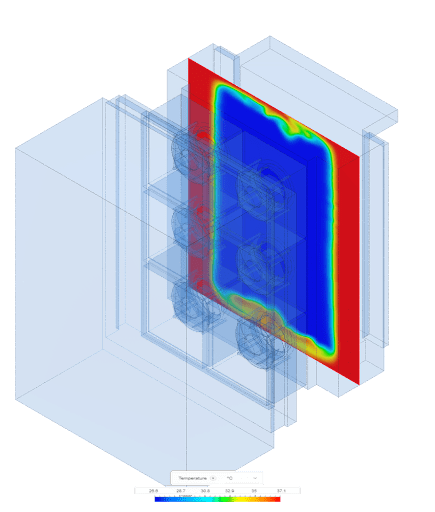
The team modeled several different internal layouts to find the configuration that achieved optimal mixing performance. They ran iterations of the design digitally, converging on a near-final solution before any material or manufacturing time was committed. By the time physical prototyping began, the design was already well-validated.
The results were significant. A process that previously required 4–6 weeks of pre-testing and 85 engineering man-hours was reduced to 2–3 weeks and 40 man-hours, a 50% reduction in both time and cost. The number of defects found in first-generation build units dropped substantially, because more validation had been completed upstream.
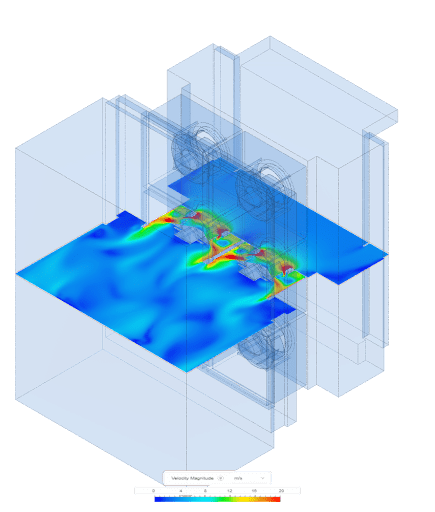
The lesson here is not simply that simulation saves time. It is that a closely matched digital twin gives engineers a deep understanding of product performance and the confidence to commit to a design.
Read the full Silent-Aire case study
Lesson 2: Simulate the Failure Scenario, Not Just the Steady State
Most data center cooling simulations focus on steady-state performance: is the baseline cooling strategy working under normal conditions? NDC-GARBE, a German data center developer, asked a more challenging question. Their patented cooling technology uses rear-door heat exchangers mounted directly on server rack rows, supplying cold water to extract heat at the point of generation rather than routing hot air across a room. They needed to prove to clients and operators not just that the system worked, but that it was resilient when it did not.
The specific question was: if the water supply to a rack row’s heat exchanger fails, how long does the operator have to intervene before the intake air temperature at surrounding racks reaches a critical level?
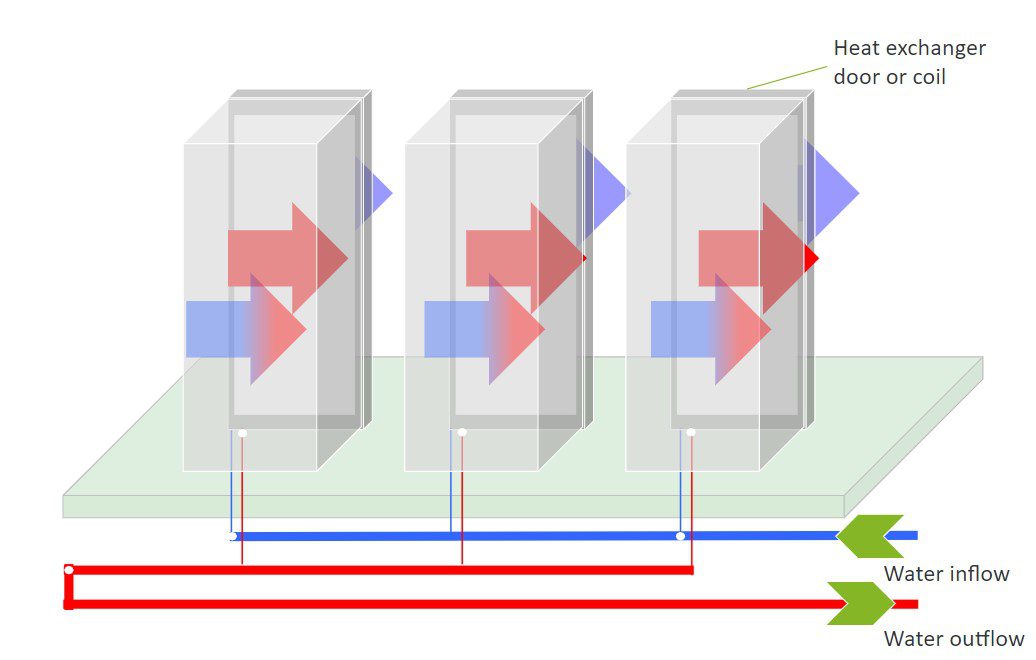
To answer this, CTO Herbert Radlinger’s team ran a transient convective heat transfer simulation in SimScale, tracking how temperatures evolved across the data center over a 16-minute window following a simulated cooling failure. The setup required accounting for the thermal mass and water capacity of the physical materials, parameters fed in from an Excel file imported directly into the platform. The simulation was not just a flow study; it was a time-resolved model of a failure event.
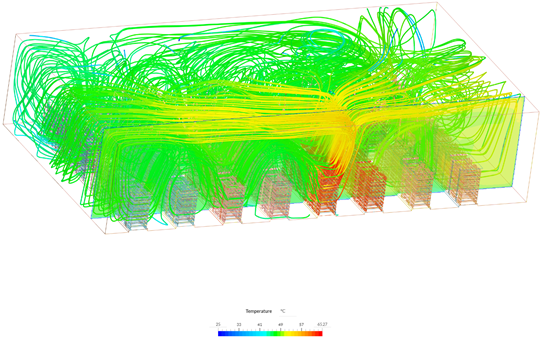
The result was a defensible, data-backed intervention window of 16 minutes: the period within which an operator must respond to a cooling supply failure to prevent critical temperature thresholds from being breached. This is not a number that can be extracted from a brochure or inferred from a datasheet. It comes from physics-based modelling of a specific system in a specific scenario.
Radlinger put it plainly: “We use CFD simulation to prove to our clients how resilient our cooling systems are.” Simulation, in this context, is as much a sales and compliance tool as it is a design tool. The team needed a solution that did not require specialist in-house expertise or ongoing consulting fees, and cloud-native CFD delivered exactly that.
The takeaway for data center operators and technology vendors is clear. Steady-state performance validation is necessary but not sufficient for mission-critical facilities. Transient failure simulations (testing what happens when cooling is interrupted, when loads spike, when containment is breached) provide the resilience evidence that operators and insurers increasingly require.
Read the full NDC-GARBE case study
Lesson 3: Liquid and Immersion Cooling Changes Your Whole Strategy
For years, hot aisle/cold aisle air management has been the dominant paradigm for data center cooling. Immersion cooling, which involves submerging IT hardware directly in a dielectric fluid bath, offers dramatically superior thermal conductivity but introduces design challenges that air-side CFD cannot address. Submer Technologies, the Barcelona-based liquid cooling specialist, needed to evaluate both the cooling performance and the spatial constraints of their SmartPod product, and they needed to do it across multiple design variants without building physical prototypes for each.
The specific challenge was an electrical enclosure positioned very close to the IT tank, in a location where the clearances were so tight that forced convective cooling was not an option. Natural convection (the passive movement of fluid driven by temperature differentials) was the only viable cooling mechanism. The question was which heat sink geometry and fluid path would produce the most effective cooling under those constraints.
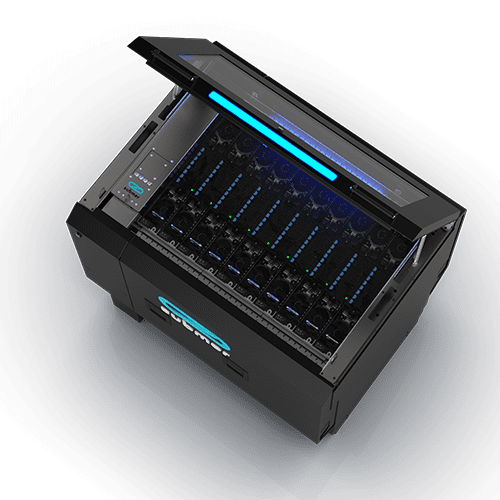
Submer engineer Jaime Pita used SimScale to evaluate five different cooling configurations using both the conjugate heat transfer (CHT) solver and the convective heat transfer solver, both in laminar flow regime (appropriate for the low velocities generated by natural convection). Each simulation ran for 1,000 iterations over 1.5 to 2.5 hours using 32 computational cores. Particle traces and cutting planes made it possible to visualise the convective currents directly, guiding the team toward designs that took advantage of the predicted flow profile rather than fighting it.
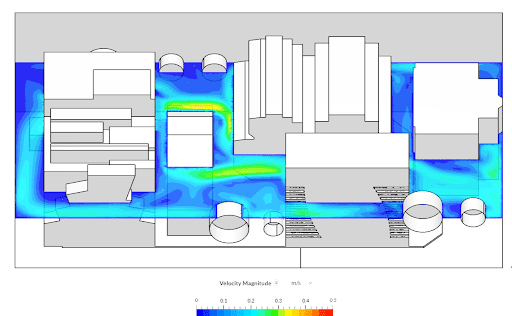
The ability to test five configurations without building five physical prototypes compressed what would have been a multi-month development cycle into a matter of weeks. Submer has since embedded SimScale across its R&D pipeline, applying the same approach to a broad range of engineering challenges as the company grows.
Read the full Submer Technologies case study
Lesson 4: Bringing CFD In-House Changes What You Can Offer Every Client
Design Management Group (DMG) is a US-based architectural engineering firm specialising in mission-critical facilities, with data centers at the core of their practice. Until recently, CFD analysis was something DMG outsourced to specialist consultants, a service reserved for premium clients willing to pay a significant premium. The result was a two-tier service: high-value clients got simulation-backed designs; smaller projects did not.
DMG design engineer Katie Bahnck made the case for bringing simulation in-house using SimScale. The decision transformed not just the firm’s internal workflow but its commercial proposition. CFD analysis became affordable enough to offer on projects that would previously have been designed without it, extending simulation-backed confidence to a much broader range of clients.
A recent example involved a 10,000-square-foot data center with a varied density of server racks. The team imported CAD geometry from Autodesk Fusion 360 directly into SimScale, then ran CFD simulations mapping underfloor velocity and temperature profiles across a range from 23 to 124°F. The simulation identified hot spots, informed the optimal placement of air terminals and containment systems, and ensured that the hot aisle containment strategy would perform as intended before construction began.
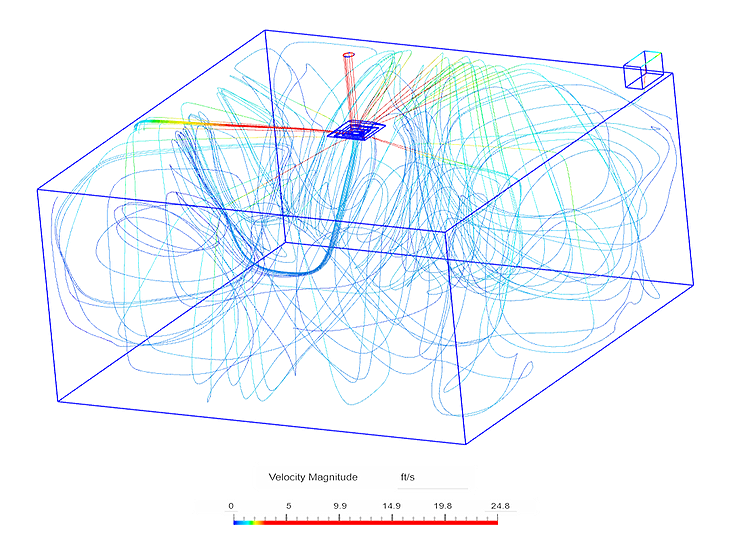

Every project DMG takes on now includes a simulation validation phase that checks design intent against ASHRAE 90.4 requirements before a single component is installed. Mechanical engineer Ryan J. Wanko summarised the value directly: “Being able to utilize a web-based software package significantly reduces computation time and increases productivity.” The firm reports 35% savings on labour costs per project compared to outsourcing, savings that are passed on to clients.

DMG is already planning its next steps: using simulation to analyse external site conditions (preventing exhaust re-entrainment at air intakes) and to evaluate direct-to-chip and water-cooling architectures as client demands evolve.
Democratized, Cloud-Native Simulation for Data Centers
The teams at Silent-Aire, NDC-GARBE, Submer, and DMG work in very different corners of the data center industry: HVAC manufacturing, data center development, liquid cooling technology, and architectural engineering. Their simulation use cases are equally varied: pre-testing AHU mixing performance, validating failure resilience, comparing immersion cooling geometries, and compliant thermal design for clients. But several common themes run through all four stories.
Moving validation upstream. In every case, the goal was to answer critical engineering questions earlier, before prototypes were built, before contracts were signed, before construction began. Earlier validation means cheaper course corrections and more confidence at each downstream stage.
Cloud-native simulation removed bottlenecks. Each team cited accessibility as a meaningful factor. No specialist workstations. No complex installation. No recurring consulting fees for each project. The browser-based nature of SimScale meant that engineers who had some CFD exposure could get productive quickly, and that teams could share, review, and iterate on simulation results without a dedicated CAE department.
Simulation results not only support decisions but build consensus. In several of these cases, the simulation was not just an internal engineering tool: it was a deliverable. NDC-GARBE used it to demonstrate resilience to clients. DMG used it to achieve ASHRAE compliance documentation. Silent-Aire used it to get sign-off from client engineering consultants. When CFD outputs are accurate and professionally presented, they carry weight with stakeholders well beyond the engineering team.
The shift to next-generation cooling is happening now. Submer’s immersion work and DMG’s planned expansion into direct-to-chip and water-cooling designs point in the same direction: air cooling alone is reaching its limits for high-density AI and HPC workloads. The engineering teams that build simulation competency for these emerging architectures now will be the ones best positioned when the next wave of infrastructure projects arrives.
Ready to Validate Your Data Center Cooling Design?
Whether you are designing a new facility, retrofitting for AI workloads, or validating a novel cooling technology, cloud-based simulation gives your engineering team the tools to answer the hard questions before they become expensive problems.
Explore SimScale’s data center cooling simulation capabilities, including hot aisle containment analysis, ASHRAE compliance validation, liquid and immersion cooling modelling, and AI-accelerated thermal design, or sign up free to run your first simulation in the browser today.