
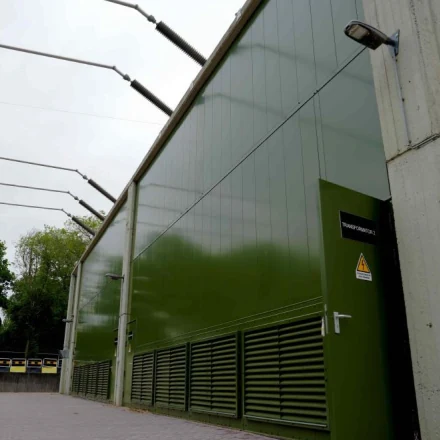
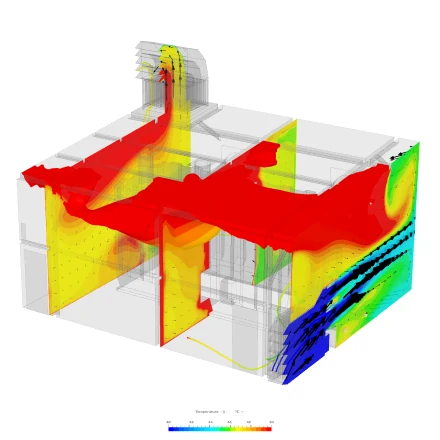
Merford is an internationally recognized engineering and manufacturing firm specializing in industrial noise control and the bespoke design of acoustic enclosures. In 2019, Merford expanded its technological capabilities by acquiring Sonobex Limited, a pioneering acoustics research firm that originated as a spin-out from Loughborough University’s Department of Physics.
This acquisition integrated proprietary acoustic metamaterial technology—marketed as the NoiseTrap® product line—into Merford’s industrial portfolio. Traditional noise control relies on thick, heavy barriers to block sound. In contrast, acoustic metamaterials utilize engineered geometric structures and coupled resonators to physically trap specific wavelengths of sound. This allows Merford to effectively mitigate notoriously difficult low-frequency industrial noise while simultaneously allowing for enhanced natural airflow, a critical factor when encapsulating heavy machinery.
Dr. Richard Wilson leads acoustic engineering and specializes in numerical methods and simulation in Merford’s UK-based advanced engineering division. Richard brings a deeply analytical foundation to the role, having earned his PhD in computational physics from Loughborough University.
The global transition toward renewable energy requires a massive expansion and renewal of electrical grid infrastructure, heavily reliant on large, high-voltage power transformers. Due to a physical phenomenon called magnetostriction—where the magnetic core of the transformer microscopically expands and contracts as electrical currents pass through it—these transformers emit intense, pervasive 100 Hz low-frequency hums.
To meet strict environmental noise regulations, these transformers must be sealed inside highly insulated acoustic enclosures. However, the transformers also radiate significant thermal energy. With rising global temperatures, utility companies now frequently mandate that enclosures maintain safe internal limits against maximum ambient temperatures of up to 40°C, putting pressure on safety margins during the design process.
This compressed thermal safety margin meant Merford could no longer rely on simplified spreadsheets or their legacy Finite Element Method (FEM) analysis tool to assess thermal performance of their enclosures. Their older software was computationally expensive, unstable on large models, and severely restricted by the processing power of local hardware workstations. They needed a versatile and scalable mechanical analysis and CFD solution.
Richard led the effort to find a practical and effective solution to their analysis needs and arrived at SimScale, being impressed by the usability of the tool as well as the convenience of working in the cloud, rather than using local compute resources.
Adopting SimScale as a standard simulation tool provided two significant advantages. SimScale ships best-in-class solvers for each physics domain, offering users the optimal numerical methods for each application. “The CFD solvers available in SimScale are much better suited to what we are doing, so transitioning tools has completely eliminated the issues we used to experience when meshing large, complex acoustic geometries,” notes Richard. Operationally, the cloud-native architecture uncoupled Merford’s engineering velocity from its local hardware.

“The choice of SimScale was heavily influenced by its cloud-based nature, which provides flexibility and independence from local hardware. We move through design cycles much faster now, without being bottlenecked by workstation limits.”
Acoustic Design Engineer, Merford
Richard can now pull 3D models directly from Autodesk Inventor, set up highly complex transient simulations during working hours, and rely on remote cloud servers to process the massive datasets without freezing local machines.
When designing an acoustic enclosure, achieving a safe average temperature is not enough; temperature uniformity is also critical. Even if the temperature of the transformer is kept stable, a poorly designed thermal management system can result in localized areas of high temperature that could be capable of damaging vulnerable control electronics or sensors.
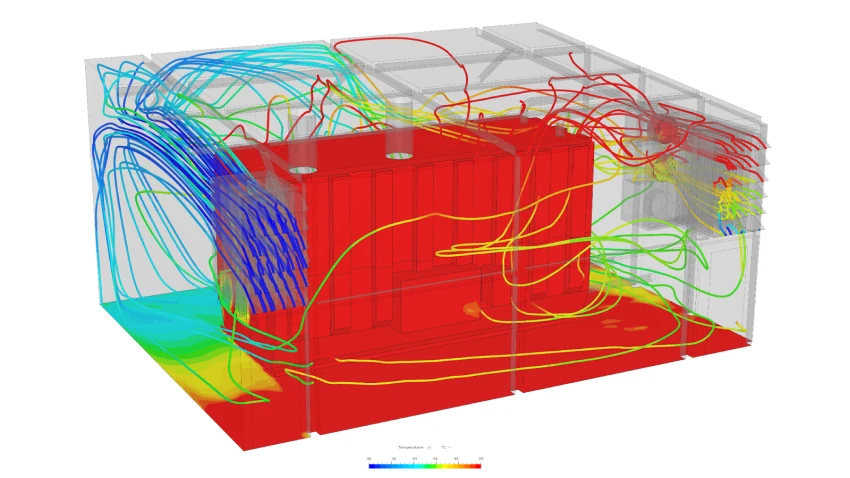
Using cloud-based CFD, Richard’s team can quickly simulate the internal thermal environment, including the effects of internal obstacles, such as the large steel beams supporting the roof and ceramic bushings protruding from the transformer body, which act as aerodynamic barriers to heat convection.
To detect thermal stagnation, Richard uses SimScale to calculate the Mean Age of Air. This algorithm calculates how long a specific parcel of air has been trapped inside the enclosure. “By overlaying the Mean Age of Air with the thermal maps, we can instantly visualize dead zones and assess how problematic they are”, explains Richard, “we might then make adjustments to the internal steelwork or the vent positions to force fresh air into those high-risk pockets,” explains Richard.
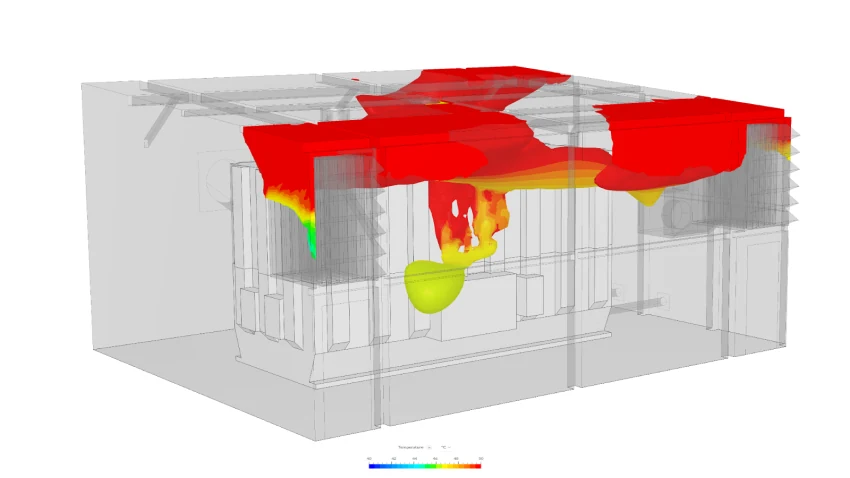
Furthermore, these enclosures operate under extreme mechanical constraints. Because transformers require rapid replacement during a grid failure, the enclosure roofs are completely demountable. Furthermore, any active components such as fans and blowers must be N+1 Redundant. Merford uses CFD simulation to devise a cooling system design that takes into account this limitation on the positioning of fans and ventilation, as well as customer requirements for access and maintainability.
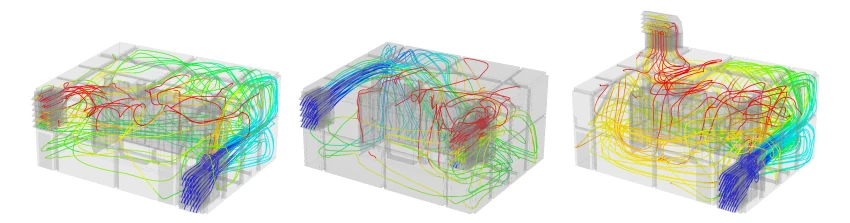
The strategic adoption of cloud-native CFD has fundamentally transformed Merford’s commercial and engineering workflows. Moving away from one-dimensional analytical calculations to high-fidelity, digital twins, they have eliminated guesswork from their design cycles.
As well as in up-front design and engineering work, Richard notes how simulation can impact the later stages of the product lifecycle too: “the models we create during the design phase are invaluable if we need to troubleshoot something or figure out how to adapt the design to work with different equipment, for example”.
Crucially, this technology has been integrated directly into their commercial bidding process. This proactive approach drastically elevates the trustworthiness and competitiveness of their proposals and helps them to secure valuable infrastructure contracts. “It’s a trend I see continuing,” concludes Richard, “as the ambient environment changes and noise requirements become even more stringent, the thermal management becomes an ever bigger part of the overall engineering challenge.”
“Simulation allows us to present prospective clients with highly accurate, data-driven proofs of our ventilation strategies during the tender phase”
Dr. Richard Wilson
Acoustic Design Engineer, Merford
Set up your own cloud-native simulation via the web in minutes by creating an account on the SimScale platform. No installation, special hardware, or credit card is required.
Sign up for SimScale
and start simulating now
