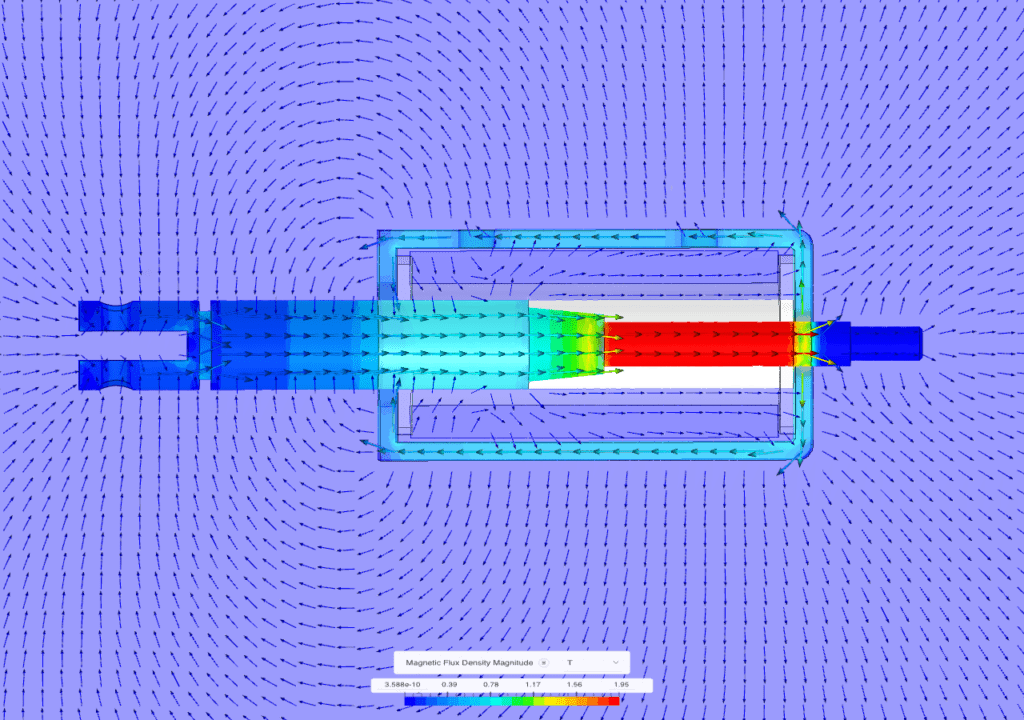
Given their strong magnetic field and ease of manufacture, solenoids are essential in many industrial applications. Whether fuel is used in injection, braking system, or valve activation, solenoids provide reliable and efficient operations through electromagnetic activation. Their performance directly affects system efficiency, energy consumption, and response time.
Electromagnetic simulation (EM simulation) plays an important role in adapting solenoid design. By providing deep insight into magnetic field distribution, coil efficiency, electromagnetic force generation, and thermal behavior, the simulation allows engineers to refine the solenoid performance before the physical prototype.
This article will explore the different types of solenoids, their design principles, and how cloud-native multiple physics simulation can improve development processes.
Introduction to Solenoids
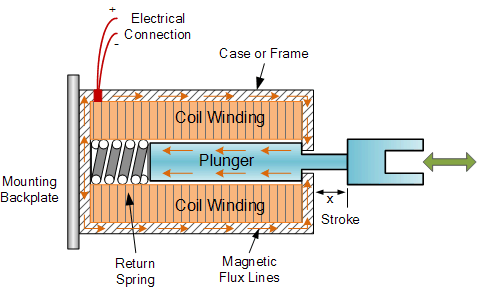
A solenoid is a device that consists of a housing, a moving plunger (armature), and a coil winding. A magnetic field surrounds the coil when an electrical current is applied, drawing the plunger in. A solenoid, to put it simply, transforms electrical energy into mechanical work.
Solenoid Design Principles
Electromagnetic Design Principles
- Coil Design and Specifications: The solenoid coil is the central component. Usually, copper wire is twisted around a core to form it. The strength of the magnetic field and power consumption is influenced by the wire gauge and the number of turns. A well-defined solenoid coil specification ensures optimal performance. Key factors include:
- Electrical Properties: Resistance, inductance, and capacitance must be optimized for efficiency.
- Material Selection: Copper is commonly used for winding due to its conductivity.
- Coil Winding Techniques: Layering techniques impact performance and thermal behavior.
- Manufacturing Considerations: Space availability, cost constraints, and production lead times dictate coil design feasibility.
- Core Material: To strengthen the magnetic field, ferromagnetic elements such as iron are utilized for the core. The performance and saturation point of the solenoid are influenced by the material selection. Evaluating the advantages and disadvantages of each material ensures the best fit for application-specific needs. Common materials include:
- Amorphous and Nano-Crystalline Materials: Offer high permeability and low core losses.
- Neodymium: Provides high magnetic saturation for strong field generation.
- Copper Clad Steel: Balances cost-effectiveness with performance.
- Magnetic Circuit: Effective force creation requires magnetic circuit optimization. Taking into account the air gap, which influences the force-stroke characteristics, is part of this.
- Saturation: The “knee” of the B-H curve, where maximal domain alignment happens with the least amount of current, should be the target of design. For solenoid design, this is regarded as the optimal point.
Thermal Design Principles
- Heat Dissipation: Resistive losses in the coil cause solenoids to produce heat. To avoid overheating, proper thermal management is vital.
- Temperature Rise: Until thermal stabilization is achieved, the coil temperature rises. The resistance of the coil and, consequently, the current and magnetic force are impacted by this temperature increase.
- Insulation Class: It is critical to choose the right insulation materials depending on the anticipated operation temperatures. This choice is guided by the IEC’s thermal classes, such as Class B or H.
- Cooling Techniques: Additional cooling techniques like heat sinks or water cooling can be required for high-power applications.
Challenges in Solenoid Design
The challenges in solenoid electromagnetic design must balance practical limitations with performance optimization. Designers must ensure longevity in a variety of climatic situations while navigating size and weight constraints, particularly in consumer electronics and automotive applications. There is ongoing pressure on businesses to cut expenses, speed up development cycles, and satisfy a variety of customized requirements. To be competitive in the market, designers also need to adhere to legal requirements, maximize performance indicators like efficiency and response speed, and consistently innovate. Advanced design methods and a thorough comprehension of electromagnetic principles and particular application needs are necessary to meet these complex problems.
Operational Challenges
- Power Efficiency: Reducing energy consumption without compromising performance.
- Response Time Optimization: Enhancing speed while maintaining precision.
- Durability and Reliability: Ensuring solenoids operate efficiently under extreme conditions.
Engineering and Manufacturing Challenges
- Size and Weight Limitations: Particularly relevant in consumer electronics and automotive applications.
- Environmental Conditions: Temperature, humidity, and vibration impact long-term performance and reliability.
- Regulatory Compliance: Meeting efficiency, safety, and performance standards is crucial.
- Manufacturing Constraints: Factors like production costs, material sourcing, and lead times influence design choices.
Simulation for Solenoid Design and Modeling
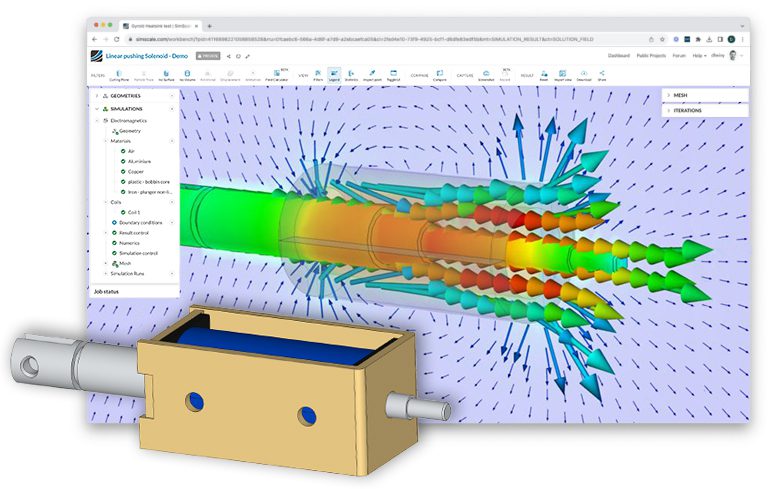
Traditional solenoid designs often depend on iterative prototyping and physical testing processes that can be expensive and time-consuming. However, cloud-native 3D electromagnetic simulation enables engineers to rapidly explore a huge design space, adapting solenoid geometry, materials, and coil configurations much before the physical tests begin.
With real-time computational insight, design teams can evaluate the impact of parameters such as electromagnetic force, electromagnetic losses, and thermal behavior under various operating conditions.
Benefits of Cloud-Native EM Simulation
- Rapid Design Iterations: Engineers can test multiple solenoid configurations quickly.
- Comprehensive Multiphysics Analysis: Evaluates electromagnetic forces, losses, and thermal behavior under various operating conditions.
- Optimized Performance: Identifies energy-efficient and high-reliability designs before production.
SimScale’s cloud-native simulation platform empowers engineers with real-time computational insights, allowing them to:
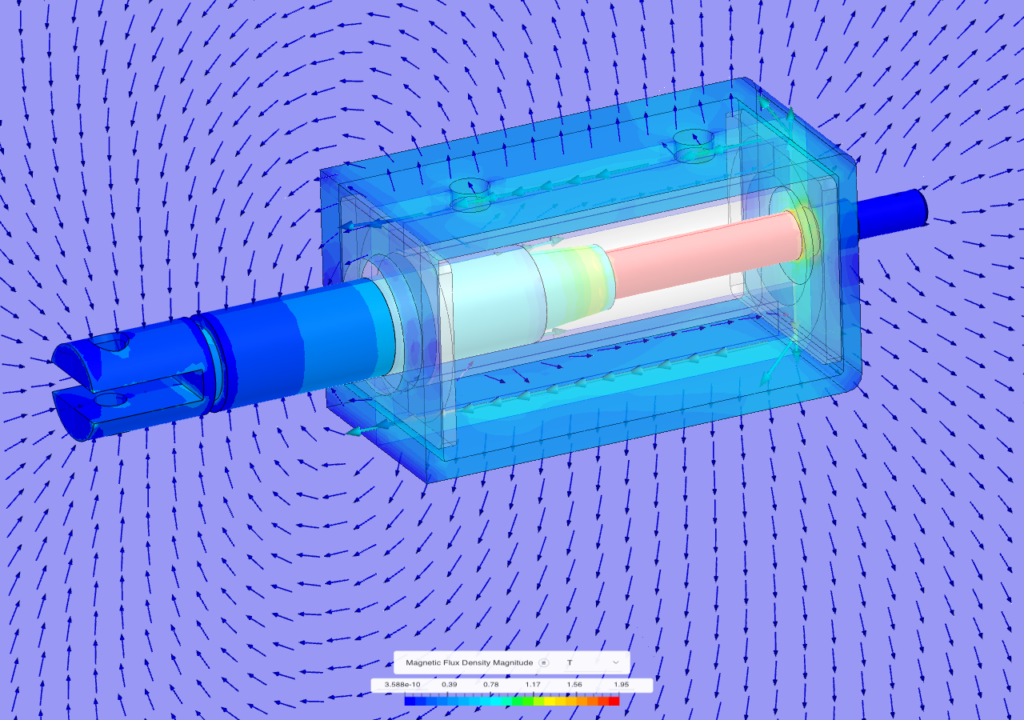
- Evaluate electromagnetic field distribution and coil efficiency.
- Analyze force-stroke characteristics for improved response time.
- Predict and mitigate thermal issues with advanced thermal simulation tools.
With SimScale, solenoid design engineers can make data-driven decisions, significantly reducing development time and improving overall solenoid efficiency and reliability.
By following the linked tutorial below, you can learn how to run an electromagnetics simulation on a Linear Pushing Solenoid using SimScale, where the objective is to achieve the linear pushing force of the solenoid.
Tutorial: Electromagnetics Simulation on a Linear Pushing Solenoid