

Ramped to full productivity within 60 days

9% material cost saving while increasing product quality
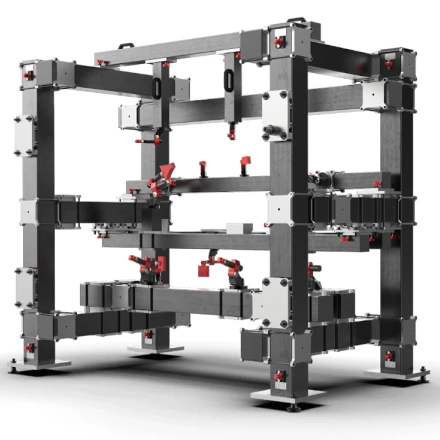
Harcourt Industrial is a premier global supplier of aerospace tooling and precision assembly solutions, engineering bespoke solutions to support manufacturing operations. An award-winning partner in Boeing’s massive supply chain, the Madison Heights, Michigan-based company specializes in highly engineered systems. Their innovations include Captive products – tooling designed to eliminate catastrophic Foreign Object Debris (FOD) during airframe assembly – and the proprietary HBOX construction framework.
Unlike traditional aerospace jigs built with permanent welds, the HBOX system relies entirely on standard structural beams joined by highly specialized modular plates and high-tensile bolts. By pulling these bolts to a specific torque, the resulting friction joint achieves structural stiffness equal to a weld. This weld-free approach allows massive fixtures to be rapidly assembled, reconfigured, or recycled, reducing hard tooling costs by up to 80% and lead times by 50%.
Kenneth Barredo is Harcourt’s dedicated FEA Engineer, supporting the company’s diverse portfolio of custom tooling projects, from multi-level access platforms to ultra-precise metrology gauges.
Prior to adopting an internal simulation platform, Harcourt faced a severe bottleneck: complete reliance on external engineering consultancies for all finite element analysis (FEA) needed to make sure that proposed designs meet or exceed the precise requirements set by clients.
Outsourcing CAD models to a third-party FEA firm introduced massive costs, often tens of thousands of dollars per project, and unpredictable lead time delays. Because testing was so expensive and slow, the team could only afford one or two design iterations before signing off the final proposal. To guarantee a design would pass the external stress test on the first attempt, Harcourt frequently over-engineered its fixtures, resulting in heavier, more expensive structures than needed.
To successfully practice Value Engineering (maximizing functional utility while systematically minimizing material costs) Harcourt needed the ability to more frequently test, iterate, and validate designs autonomously. They needed hands-on access to the structural simulation models.
Kenneth and the Harcourt team decided to bring structural analysis completely in-house by adopting SimScale’s cloud-native engineering simulation platform for all FEA work, and set about building out a dedicated team of analysts, including Kenneth.
Kenneth had experience working with other legacy, on-premise FEA tooling and appreciated the freedom afforded by running simulation workflows entirely in the cloud, uncoupled from local IT hardware: “I can launch, run, and evaluate multiple heavy structural simulations simultaneously,” Kenneth comments, “as a remote worker, I also find it very convenient to be able to share projects with colleagues without figuring out file storage and access.”
The engineering team achieved an impressive ramp up speed with SimScale: “The training and onboarding process was great, and our support engineer Ricardo was really helpful. I was up and running at full productivity within 60 days”. Kenneth adds “I also find SimScale’s AI chatbot was handy for quick questions at any time of the day (or night). If I need more then I can easily reach the support team in the same way.”

“We no longer have to pay a company to run that analysis for us. We can do it internally and we are now using it heavily so we can explore every way to make sure we’re giving our customer the best product while minimizing costs. The quality of our product has just gone up tenfold.”
Kenneth Barredo
Mechanical Engineer, Harcourt Industrial
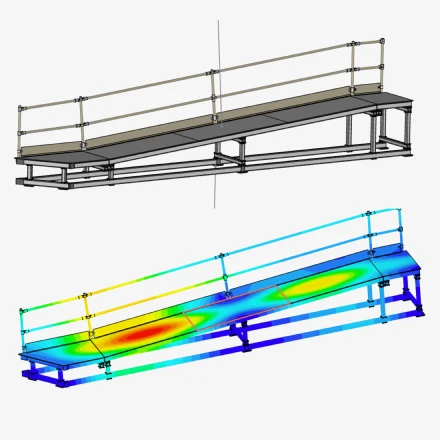
Because they are designing bespoke systems, structural requirements are usually very clearly defined. Harcourt now use simulation as a standard part of their tendering and design process, allowing them to target requirements with much greater precision and confidence. A recent contract for an access platform is a good example of such a “right-sizing” exercise. Structurally, the platform had to easily withstand a concentrated 600-pound vertical load while limiting maximum deflection to less than one-eighth of an inch.
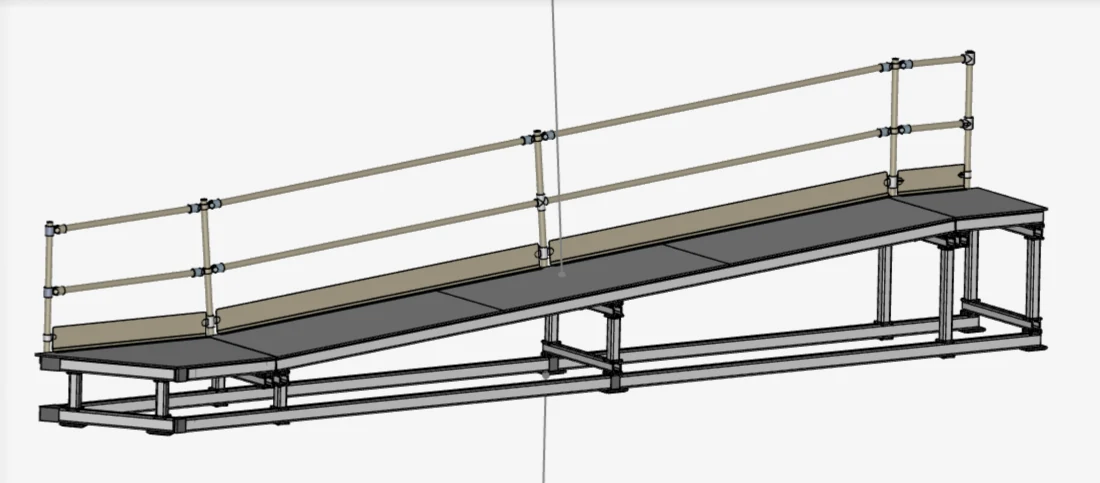
Under the old outsourcing paradigm, the team would have used heavier materials to guarantee passing requirements verification. Kenneth saw an opportunity to improve ease of assembly and use by the end customer by using alternative materials and sizing. To scope out the options, he initiated an optimization loop with SimScale.
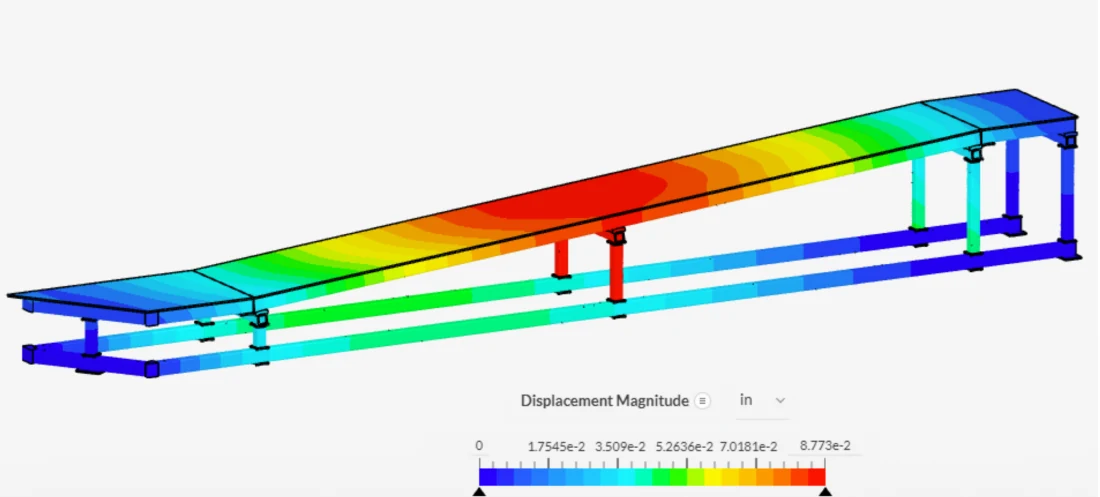
By systematically testing different materials and cross-sections, Kenneth successfully validated a switch from steel to much lighter aluminum. Furthermore, he optimized the specific structural member sizes, changing them from 3x3x0.325-inch tubes to 4x3x0.25-inch profiles. The analytical results proved this new configuration would still easily meet the strict structural requirements while drastically easing the physical assembly process. Additionally, the optimized aluminum profiles reduced costs by $25 per tube – a 9% material cost saving.
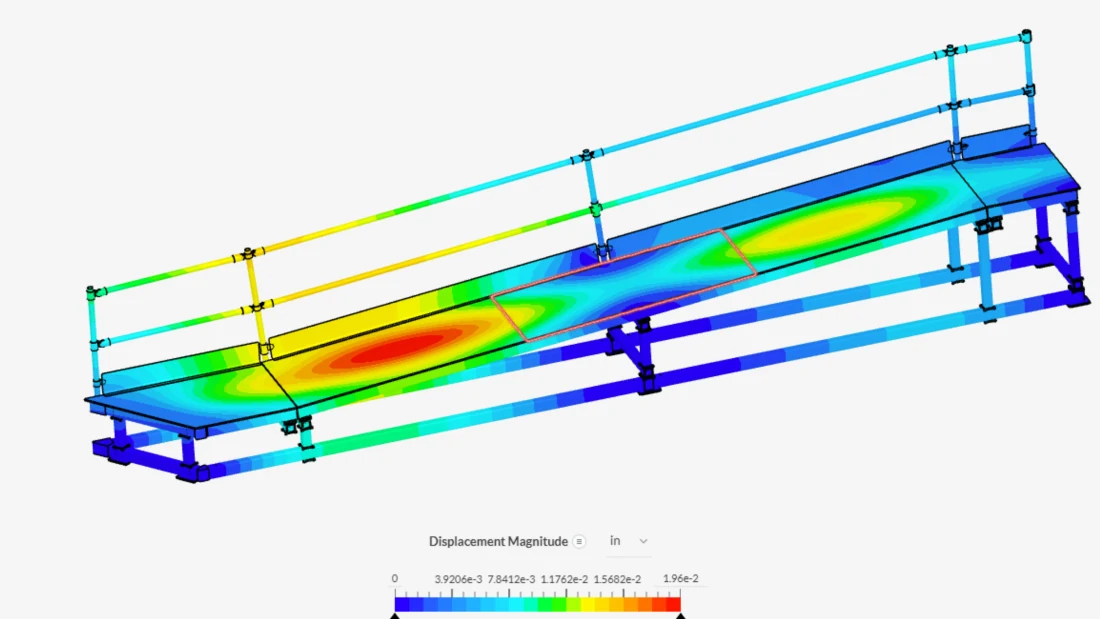
“SimScale really helped see the impact of the changes and make confident design decisions, especially in terms of cost and performance,” Kenneth noted. Because the optimized, lightweight structure utilized the proprietary HBOX system, the Harcourt team assembled the entire fixture in a mere two days, significantly faster than other construction methods.
Harcourt’s engineering department is actively pushing into advanced physics, utilizing non-linear analysis to mathematically study total part failure and yielding on custom telescopic leg systems before physical prototypes are ever cut.
The operational and financial success of in-house simulation has propelled Harcourt to expand simulation activity to support more project work and to expand the FEA team. Simulation is no longer viewed as an optional, expensive verification step; it is the fundamental engine driving Value Engineering, enabling Harcourt to rapidly deliver mathematically optimized, highly profitable structural products.
Set up your own cloud-native simulation via the web in minutes by creating an account on the SimScale platform. No installation, special hardware, or credit card is required.
Sign up for SimScale
and start simulating now
