

DLR Group is an integrated design firm that has been delivering architecture, engineering, planning, and interior design services for over 50 years. With a global presence and a portfolio spanning diverse sectors, the firm operates on a core promise: to elevate the human experience through design. Their methodology hinges on deep collaboration and a commitment to exploring innovative ‘what if’ scenarios. By using data to validate every decision, they go beyond simply meeting code to deliver truly exceptional outcomes. This integrated approach ensures that performance and sustainability are foundational elements of the architectural vision.
The firm’s mechanical engineering teams are central to this mission, responsible for delivering high-performance building systems that prioritize energy efficiency and comfort. By bringing data-driven insights into the earliest design conversations, they help create structures that are not only aesthetically compelling but also functionally exceptional and sustainable.
Mark Hahn is a Mechanical Engineer based in DLR Group’s Orlando office. Specializing in HVAC, building performance, and Computational Fluid Dynamics (CFD), Mark works on a wide range of high-profile projects. His focus is on bridging the gap between advanced simulation and real-world constructability. For Mark, engineering isn’t just about solving problems or meeting minimum requirements; it’s about proactively shaping better design outcomes by exploring every possibility to deliver the best solution for the client. He champions the use of early-stage analysis to ensure that engineering intelligence is woven into the fabric of the architecture from day one.
Before adopting SimScale, DLR Group’s simulation workflows were constrained by the limitations of traditional, desktop-based software. The process was slow, required specialized hardware, and often occurred too late in the design timeline to have a meaningful impact. Seeking a more agile and collaborative solution, the team turned to SimScale’s cloud-native simulation platform.

“SimScale allows us to embed simulation insight at the moment when decisions are being made, not after drawings are complete.”
Mark Hahn
Mechanical Engineer, DLR Group
The primary driver for the switch was the need to make CFD accessible and immediate, and the team found that being able to run complex simulations in a web browser, without the need for high-performance local machines, was a game-changer. It transformed performance analysis from an isolated, specialized task into a dynamic, collaborative process. Mark, currently the primary user, can now work in real-time with architects and clients, sharing vivid, easy-to-understand visualizations and iterating on designs instantly. This has dramatically shortened feedback loops—by an estimated 50-70%—and empowered the team to validate concepts on the fly.
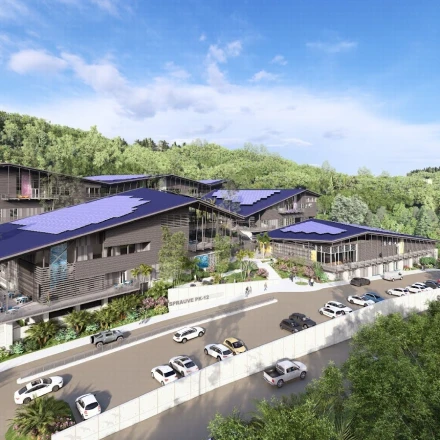
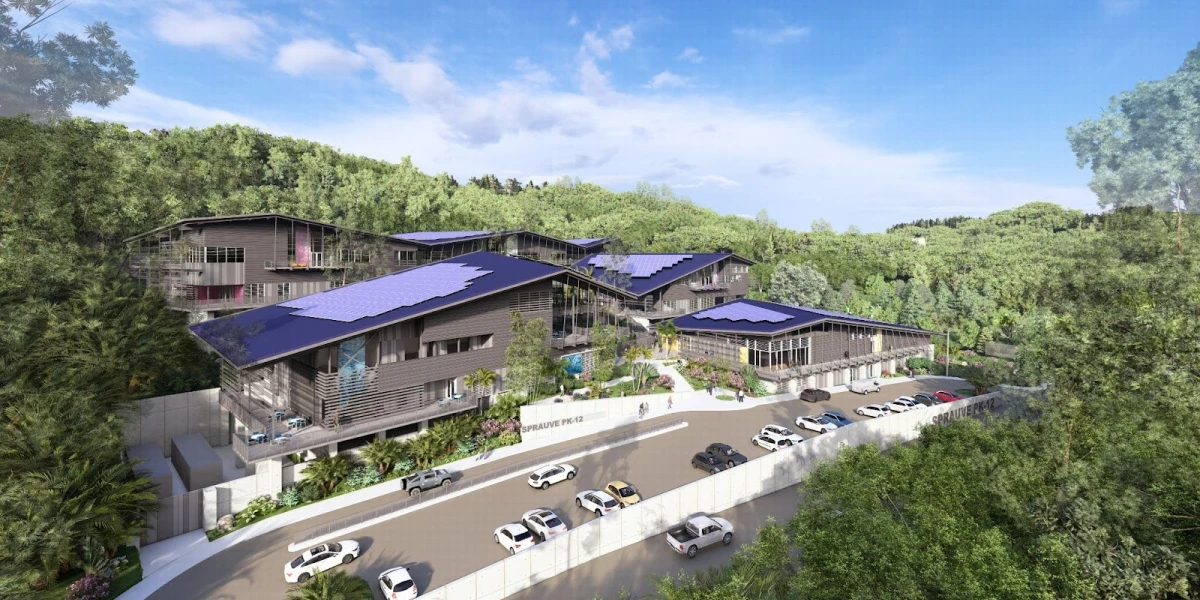
DLR Group’s commitment to going beyond the brief was perfectly demonstrated on the New Schools of VIDE (Virgin Islands Department of Education) project. Tasked with designing two new, future-ready educational facilities in the U.S. Virgin Islands, the team had to deliver a design that was sustainable, resilient to hurricanes, and deeply connected to the local community and environment. Using SimScale, Mark conducted a series of targeted simulations to resolve multiple critical challenges with data-driven confidence.
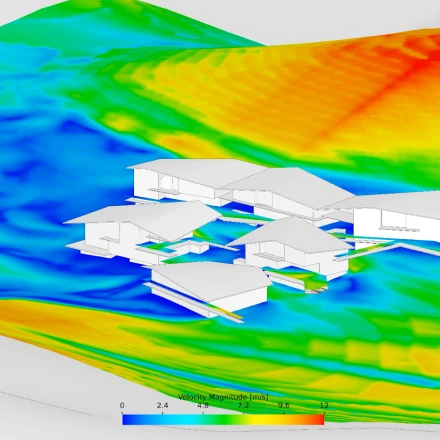
To meet ambitious sustainability goals for LEED certification—the world’s most widely used green building rating system—the design included a large solar panel array. The engineering team proposed an innovative idea: raising the panels significantly off the roof’s surface to create a “chimney effect.” The hypothesis was that this would induce an upward airflow that would not only cool the panels for better efficiency but also help cool the roof itself.
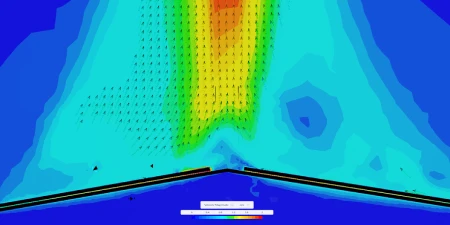
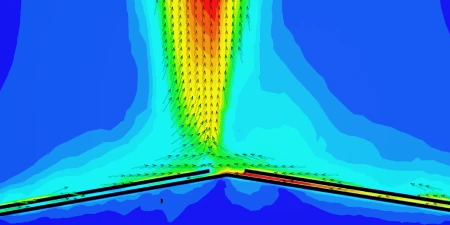
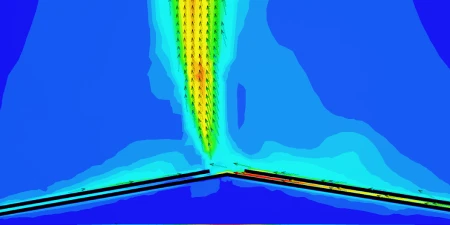
Using SimScale, Mark ran a conjugate heat transfer simulation to quantify the cooling benefit at various heights, remarking “SimScale has a built-in tool for calculating solar loads, so I got up and running quickly, even though this was an unfamiliar analysis to run”.
The analysis quickly revealed that for the chimney effect to be significant, the panels needed to be raised to a height that would necessitate major structural and cost additions to withstand hurricane-force winds. The data-driven insight meant they could confidently discard the impractical concept and proceed with a standard, low-profile mounting solution.
To conceal HVAC machinery, the classroom ceilings featured large, perforated metal panels that allowed air to circulate. In the humid, tropical climate of the Virgin Islands, these panels represented a condensation risk; their large thermal mass could cause their surface temperature to drop to the dew point of the room’s air.
To accurately assess this risk, Mark conducted a detailed thermal simulation. He modeled all heat sources in the room—including lighting, IT equipment, and the occupants themselves—to predict the precise surface temperature of the panels. The analysis confirmed that the proposed ventilation strategy provided enough air movement to keep the panels above the dew point, preventing condensation without the need for expensive reheat coils. This insight saved significant upfront and long-term energy costs.
Beyond the buildings themselves, another critical step in the planning process was to ensure safety and comfort in the outdoor spaces. The school’s hilly, coastal location and high hurricane risk required careful attention to layout and wind funnelling effects to avoid risk of late-stage modifications.
Mark used SimScale’s built-in pedestrian wind comfort analysis type to automatically import geographical wind data and run transient simulations of wind flow in 16 wind directions, studying both individual and aggregated flow fields and comfort criteria to validate the design and suitability of the building facades and outdoor play spaces.
By integrating SimScale into its workflow, DLR Group has reinforced its commitment to performance-driven design. The VIDE school project perfectly illustrates the power of this approach, with three distinct simulations delivering crucial insights that led to significant cost savings, improved energy efficiency, and validated occupant comfort. The platform has enabled the team to move faster, collaborate more effectively, and make critical engineering decisions with greater confidence.
“Our aim is to deliver designs that go beyond meeting code, and meaningfully improve comfort, resilience, and sustainability in ways that can’t be value-engineered out. It’s about bringing performance intelligence early into design so that engineering decisions become essential to the architecture, not just an afterthought.”
Mark Hahn
Mechanical Engineer, DLR Group
Looking ahead, DLR Group plans to expand its simulation capabilities significantly. The goal is to grow the team to four or five dedicated simulation users, creating a centralized hub of performance expertise. By continuing to leverage cloud-native tools like SimScale, the firm can scale its operations without investing in costly on-premise hardware, further democratizing high-performance design for all its projects.
Set up your own cloud-native simulation via the web in minutes by creating an account on the SimScale platform. No installation, special hardware, or credit card is required.
Sign up for SimScale
and start simulating now
