


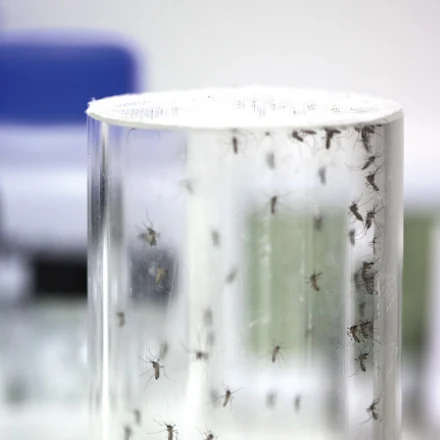
Biogents AG specializes in innovative, insecticide-free insect traps, backed by over 20 years of entomological research. Founded in 2002 as a spin-off from the University of Regensburg in Germany, the company engineers selective traps that capture disease-carrying vectors, like the Asian tiger mosquito, by simulating human biological signatures. With shifting climate patterns driving market growth across consumer and professional sectors, Biogents requires highly agile engineering to meet global demand.
Armin Kordus has been a core engineer and developer at Biogents for 17 years. He bridges the gap between aesthetic product design and functional mechanical engineering. While external designers focus on a trap’s visual appeal, Armin handles the internal engineering, ensuring products are aerodynamically viable, cost-effective, and suitable for commercial tooling. His role is to guarantee each trap operates with precise fluid dynamic efficiency.
The company’s insect traps typically rely on internal and external airflows to pull insects inside and, historically, Biogents relied on physical testing and smoke flow visualization to evaluate prototype airflow.
While smoke testing is an effective way to visualize flow around the entrance to the traps, it is of much more limited effectiveness for exploring flows inside the devices. There, the presence of internal structural ribs and mesh baskets present obstacles to the flow which must be managed by careful aerodynamic design. Relying solely on physical prototypes meant flawed designs often advanced too far into the cycle. Armin needed “shorter development time by identifying and creating good flow patterns” before machining physical models.
To overcome these bottlenecks, Biogents integrated SimScale’s computational fluid dynamics (CFD) into their workflow. Armin uses the platform to run incompressible flow simulations, uploading simplified CAD files directly into his browser to test design variations.

“The biggest advantage of a cloud-based solution is the convenience of not needing a supercomputer on-site. Of course the fact that it is also browser-based also allows easy access from anywhere, including from home office settings.”
Engineer, Biogents AG
Because Biogents’ design cycle is project-based, often involving intense simulation activity followed by months of field testing, SimScale’s flexible subscription model proved to be a perfect operational fit.
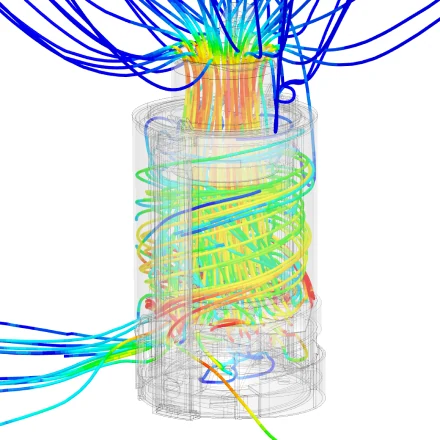
A recent engineering challenge Armin faced was in developing a new product for catching fruit flies. The design featured a gravity-assisted butterfly valve at the top, allowing air to flow in while the device’s fan runs, but automatically closing then the fan (and the associated airflow) stops. The same fan also pushes air out of the bottom of the device, where it comes into contact with the attractant, or lure, for the trap.
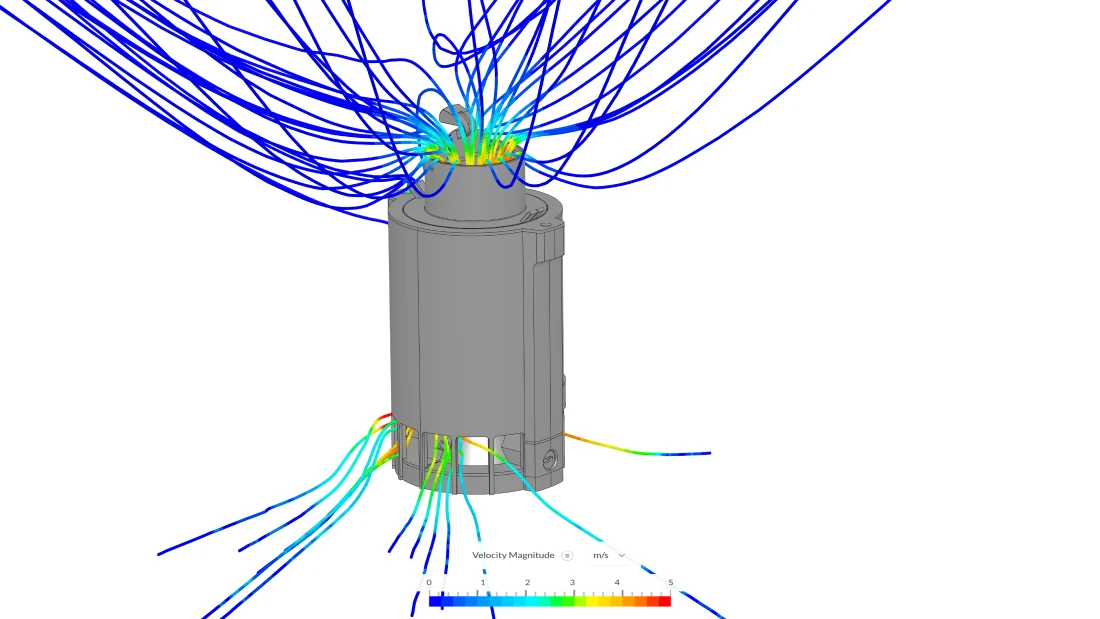
Selecting the right motor and fan combination is critical for the operation of the device. Too much mass flow would result in excessive circulation and noise, but too little mass flow would risk the valve not opening properly, or the insects not being pulled inside quickly enough.
Armin explained the need to find the right regime for the air flow. “The fan had to be “strong enough to suck in the fruit flies but not so strong that the device becomes too loud for indoor use.”
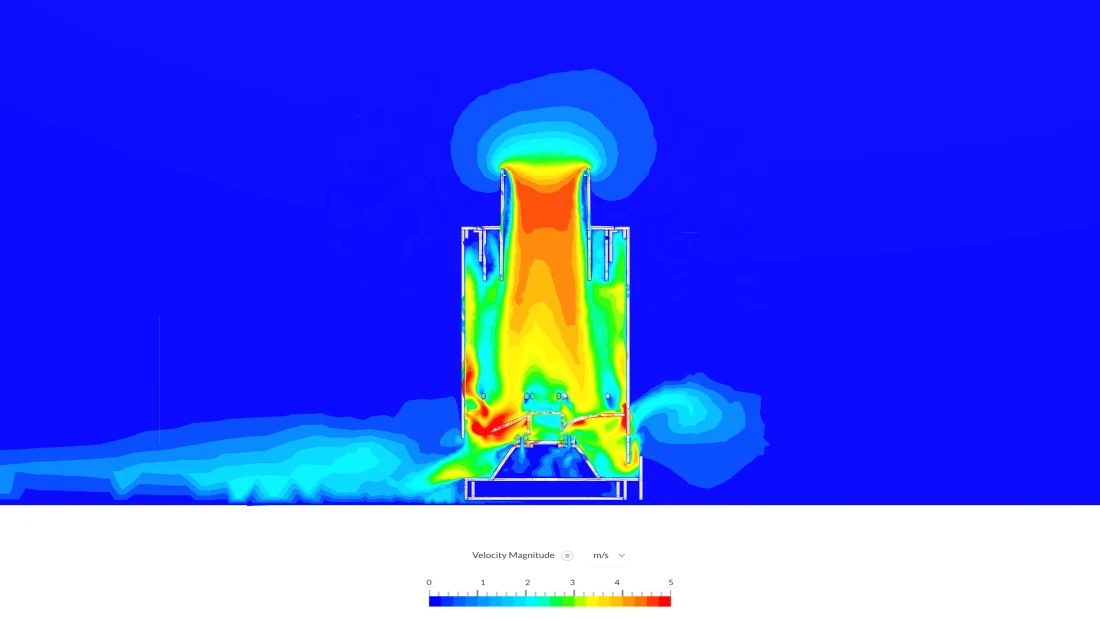
Using SimScale, Armin evaluated the device’s resistance to airflow and mapped internal velocity vectors to balance maximum suction with minimum acoustic output. The simulations also visualized how exhaust air interacts with the internal lure housing, optimizing how the attractant plume distributes into the room.
Transitioning to high-fidelity CFD has drastically accelerated Biogents’ engineering velocity. The key benefit of SimScale, according to Armin, is the “visualisation of flow patterns.”
This allows the team to eliminate flawed designs digitally, resulting in better products with fewer physical prototype iterations. Furthermore, this data has improved alignment, helping the engineering and design teams to communicate and exchange ideas and insights.
While outdoor field testing remains the only way to measure the overall device effectiveness in terms of biological capture rates, cloud-native simulation ensures Biogents’ traps operate at peak aerodynamic efficiency long before reaching the field.
Set up your own cloud-native simulation via the web in minutes by creating an account on the SimScale platform. No installation, special hardware, or credit card is required.
Sign up for SimScale
and start simulating now
