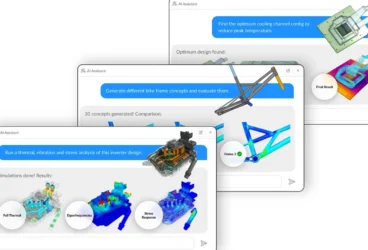
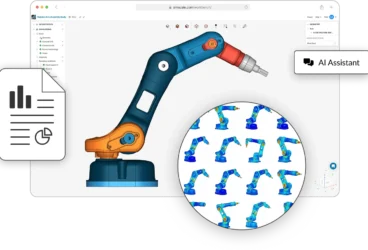
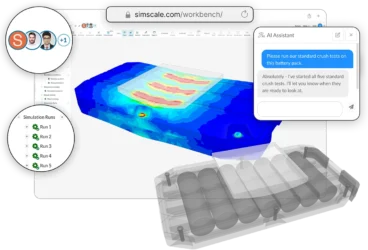
Having grown up on a diet of “traditional” simulation tools (meaning on-premises software of varying shapes, sizes and degrees of modernity), I can confirm that working in a cloud-native environment takes you to an entirely new plane of simplicity, ease of use and convenience.
I no longer think about managing local files, software versions, license servers or finding the right compute resources (enormous laptops, workstations or clusters).
Since all of that complexity is taken care of behind the scenes, complex simulations become as easy to work with, share, and collaborate on as a Google Doc.
It means that the cloud-native simulation engineer can concentrate on the ‘what’ and not be distracted by the ‘how’.
It’s no surprise then that almost all new entrants to the simulation market in recent years have been cloud-native tools. The benefits I outlined above are compelling arguments for using this architecture to build a next-generation tool. But it goes much deeper than an amazing user experience, with greater productivity and cost-efficiency. Yes – these are all nice-to-have advantages, game-changers even… but the playing field is shifting.
That was then, this is now – the era of AI-native simulation
Today, the pace of change has accelerated and the world of engineering sits on the cusp of a new technological epoch: the age of artificial intelligence. This new era brings a great potential to unshackle us from lots of the slow or manual parts of simulation and analysis. It can gallop through workflows and deliver thousands of predictions in a matter of seconds.
It can gather all the data we need to make decisions, so we can focus on engineering and value-add tasks.
AI can do all of these things in an instant if, and only if, we remove all obstacles from its path. That means no shuffling data from one place to another, translating, exporting and importing, uploading or downloading. The whole technology stack, physics solvers, AI solvers and data all need to be co-located and seamlessly integrated.
Ask the audience, what’s stopping you?
In a recent survey we conducted across 300 engineering leaders, we asked what were the most significant barriers to AI adoption in their simulation teams. The responses show that data accessibility and infrastructure are seen as two of the most critical factors.
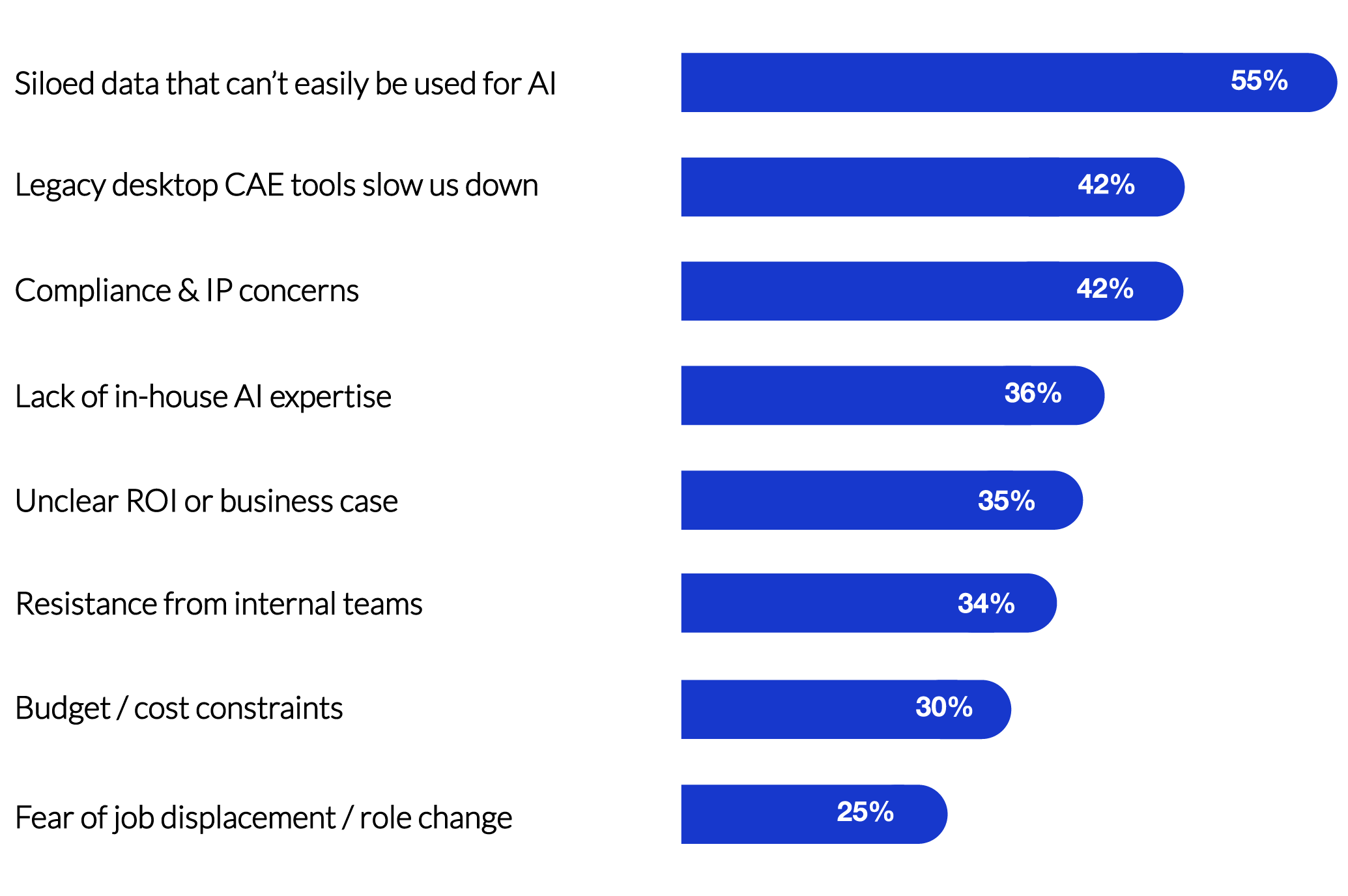
Companies that are locked into on-premises tool stacks are faced with a good deal of complexity when ‘retrofitting’ AI into their existing processes and workflows, perhaps requiring them to develop or hire specialized expertise to do so.
What these results demonstrate is that it is infrastructure and platform that are the biggest barriers to adoption, and not resistance to change, lack of willingness or budget.
Watch out: cloud-native adopters are pulling ahead
Unsurprisingly, we found that nearly every company contacted by the survey was either actively working on incorporating AI into their simulation programs or was planning to do so in 2025. Even so, only 7% of respondents were already at the stage of having mature AI programs in place.
What is special about those 7% though?
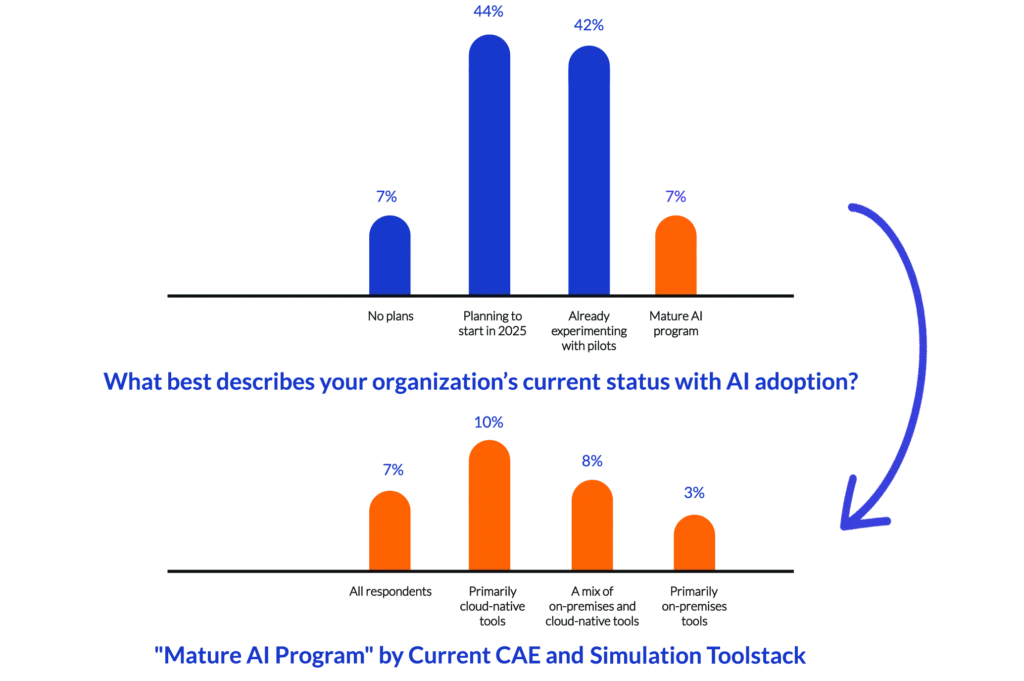
This breakdown very clearly show that the likelihood of a company being able to successfully leverage AI is closely linked to the type of technology stack they are using.
Organizations using cloud-native simulation tools are 3x more likely to have mature AI programs and 6x more likely to have clean, centralized data—critical for scaling AI. They are also twice as confident in achieving AI goals within the next 12 months.
The question is no longer, “Should we go cloud-native?” but, rather, “What is at stake if we don’t?”
We are still at the start of the AI revolution in engineering. The rate of development is fast, and while the engineering community has seen enough evidence to convince them that significant benefits can be achieved, there remains a big gap between expectation and execution. The question is how to progress from pilots and proof-of-concept to profitability?
Survey results show that for every organization seeing significant benefits of AI in production, there are ten others who see the same opportunity but have not yet been able to realize the gains.
Survey respondents also make it clear that legacy tools are not simply slower or less convenient—they are a source of active risk. Two-thirds of all respondents state it is difficult to integrate AI practices using their current stacks. These difficulties are multiplied in on-premise setups, which tend to fragment data and create manual, brittle integrations between systems.
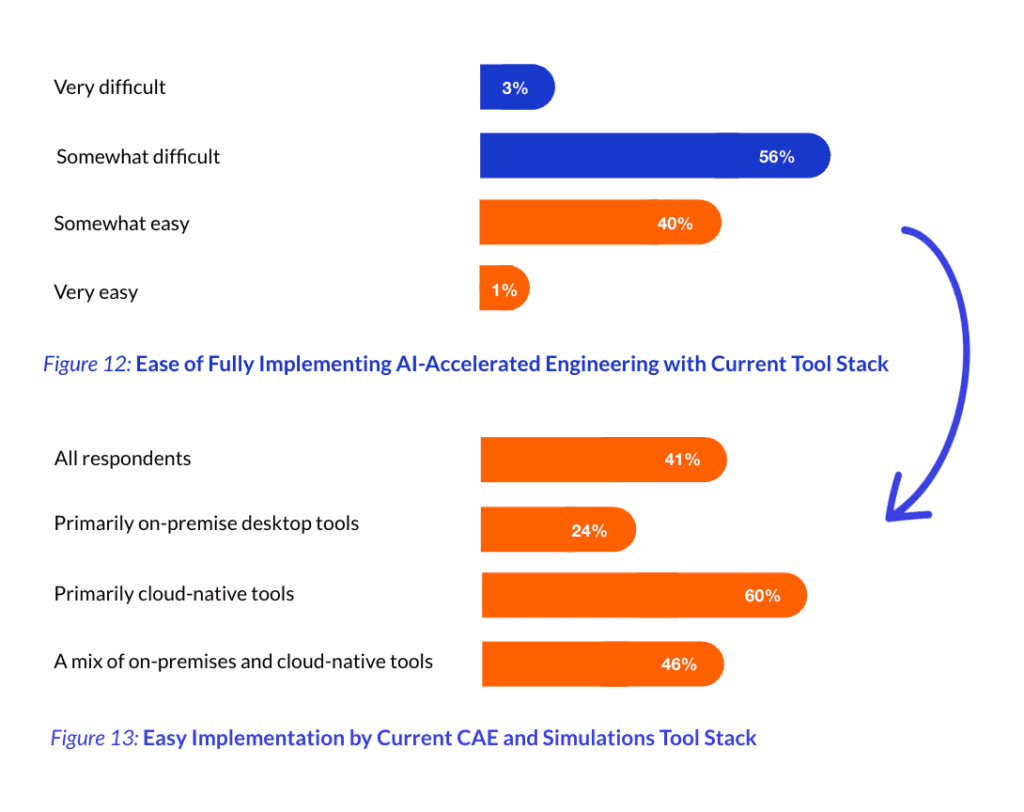
Cloud-native, AI-native engineering simulation: build your AI powered future on the right foundations
Cloud-native organizations are more than just early adopters; they are realizing AI’s potential at a greater rate and, crucially, preparing for scale.
But why do cloud-native tools have the advantage?
I can think of three primary reasons:
- AI needs data, and quickly. Transformational AI cannot be a ‘bolt-on’ capability. It needs a deep and immediate connection to simulation models and data. And that data needs to be unified and structured. The cloud is ideally suited to creating this sort of environment.
- Once you have built out AI-powered simulation workflows, some of the most significant benefits will come from being able to further democratize access and foster collaboration between engineers and teams, or even between AI agents operating across your toolchain. Again, cloud-native platforms like SimScale are designed from the ground up to maximize accessibility and collaboration.
- Developments in this space, both in terms of software and hardware, are moving extremely fast. Cloud-native, AI-native platforms which are intuitive to use and keep the complexity transparent to the user are the only way to keep your engineering teams at the cutting edge.
Looking to the future, our survey found cloud-native adopters are more than twice as likely to express confidence in meeting AI goals in the next twelve months than their on-premises counterparts.
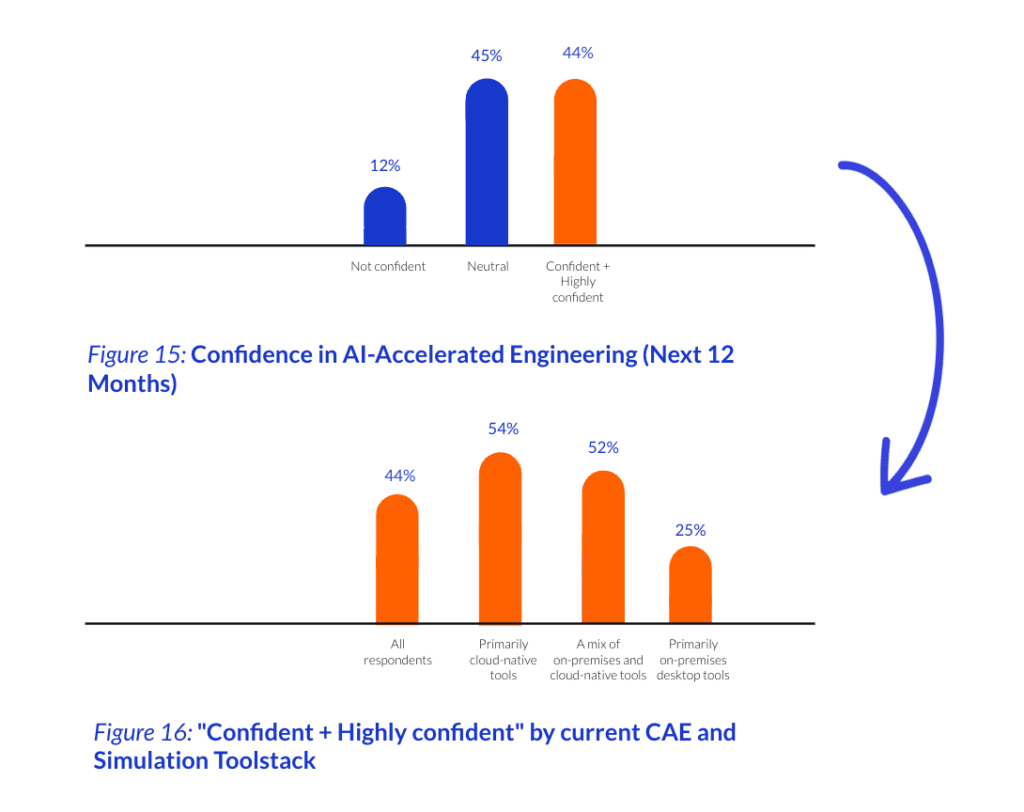
For those still waiting, the risk is clear. In today’s market, failing to bring cloud-native platforms into your engineering organization’s stack is not just a missed opportunity for efficiency. It is a competitive liability, one that will become more pronounced as AI matures and industry leaders start to benefit from the transformational engineering velocity that it will unlock.
If you are responsible for the future direction of engineering in your company, now is the time to ensure your foundation is ready. The evidence is conclusive: cloud-native software was a competitive advantage. Now, in the era of AI, it is the essential condition for modern engineering success. The next wave of engineering innovation demands it.
Don’t wait for the gap to widen. Close it now and lead your industry into the future.
Learn more: https://www.simscale.com/webinars-workshops/engineering-teams-struggling-realize-ai-opportunity-how-fix-it/