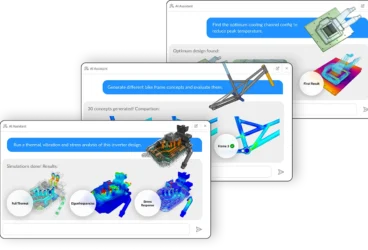
What happens when you replace the simulation bottleneck with an AI that thinks like your best engineer? That’s the question at the heart of SimScale’s latest webinar, featuring Jon Wilde, VP of Product at SimScale, and Armin Narimanzadeh, Manager of Thermofluids & Simulations at Convion.
Between them, they covered everything from why AI has conquered software but stalled in hardware, to how one engineering team compressed a months-long design optimization into under an hour — and found a geometry they never would have thought to look for.
Here are the five things that stuck with us.
Watch On Demand
Watch the full webinar, part of Engineering.com’s Digital Transformation Week 2026.
1. AI has transformed software engineering — but hardware is still waiting
Jon opened with a provocation: AI has essentially solved the engineering problem within software. Developers are iterating in seconds, with AI co-pilots embedded in almost every step. But in hardware? A single design iteration — from CAD model to simulated result — still routinely takes weeks.
The core reason isn’t a lack of capability. It’s fragmentation. Simulation data lives across workstations, clusters, pre-processors, solvers, and CAD tools, often spread across multiple people and systems with no connective tissue. That makes it nearly impossible for AI to operate coherently.
Jon cited one company currently waiting 18 months between design and simulation feedback. As he put it: “This seems totally unacceptable to me, and this is what we’re focused on improving.”
Want to hear more about why the silo problem is the real barrier to AI in hardware? Catch the full explanation in the recording.
2. Physics AI and Engineering AI are solving different problems — and you need both
One of the clearest conceptual contributions of the webinar was Jon’s distinction between two types of AI at play in modern simulation workflows:
Physics AI is about speed of prediction. Once you’ve run enough simulations to train a model, you no longer need to run more. Instead of waiting minutes or hours for a solver to compute, Physics AI delivers an instantaneous result — comparable accuracy, zero wait time.
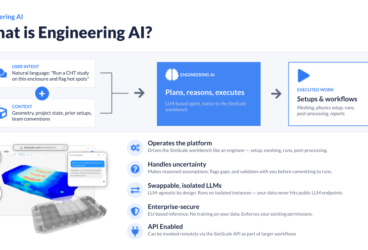
Engineering AI is about orchestration. It’s the agentic layer — powered by LLMs with full platform access — that decides when to simulate, selects the right models, sets up simulation conditions, interprets results, and guides engineers through the workflow. It doesn’t need large amounts of training data. It needs engineering knowledge, which it already has.
Using SimScale’s AI-native cloud architecture, Engineering AI can call Physics AI and iterate in a tight loop — running thousands of design evaluations in the time it used to take to run one.
Jon walked through live demos of both in action. Watch the recording to see how the agent sets up a structural simulation, tests a mouse drop test, and runs a full server rack thermal optimization — all without manual setup.
3. Convion compressed months of optimization into under an hour — and found a better design
This was the highlight of the session for many attendees. Armin Narimanzadeh walked through how his team at Convion — a solid oxide fuel cell and electrolyzer manufacturer — used SimScale’s Physics AI to transform their ejector design process.
Ejectors are notoriously sensitive devices. The nozzle diameter, mixer chamber length, diffuser angles, and pressure ratios are all tightly interdependent. Optimization traditionally meant running thousands of CFD simulations, which — given the compressible fluid dynamics involved — could take weeks or months per cycle.
Here’s what Convion did instead:
- Built a parametric CAD model in Onshape
- Ran roughly 200 CFD simulations in SimScale to generate training data
- Trained a Physics AI model on those results
- Substituted that model into the optimization loop in place of CFD
The result: a full optimization run now takes tens of minutes, not months. And the winning design — found by the AI exploring the full design space — was a geometry that reduced physical volume by 50% while meeting all performance targets. A result, as Armin noted, that no one on the team had intuited or would have proposed manually.
Click here to learn more about how Convion uses SimScale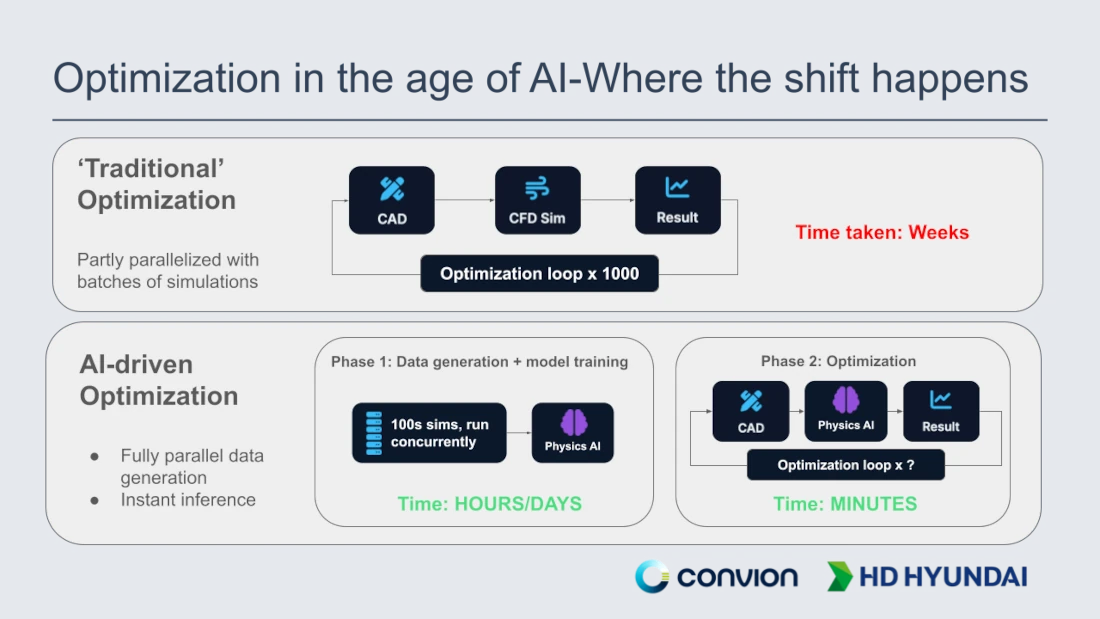
Armin also covered why CFD expertise still matters for training data quality, and how he validates the AI results before committing to a design. Get the full walkthrough in the recording.
4. The model doesn’t stay on one desk — it becomes a shared team asset
Armin made an interesting point: once a Physics AI model is trained, it doesn’t just live on the simulation engineer’s machine. In SimScale, it can be shared across the entire team.
For Convion, this means colleagues who aren’t CFD specialists can use the same validated model to run fast evaluations for their own design questions — without needing to re-run simulations from scratch. As the team trains more models across more components, that shared library grows, making the whole engineering organization faster and more self-sufficient.
As Armin put it: “Over time, as we train more and more Physics AI models, it would just make everything more fast, agile and more accessible.”
Jon also demonstrated how Engineering AI can share and leverage these models at the platform level. See it in action in the replay.
5. “Measure twice, cut once” — trust but verify is still the right mindset
Both Jon and Armin were consistent on one point: AI accelerates the work, but it doesn’t replace the engineering judgment at the end.
Armin always runs CFD validation on the top designs before committing. Jon’s advice on the probabilistic nature of LLM-based agents was similarly grounded: “It saves hours, maybe weeks or months of work — but I still, before I put a stamp on it, want to say yes, that’s a great design.”
The session also surfaced a nuanced point from the Q&A: Physics AI models are trained on predicted (simulated) data, so there’s an error-within-an-error to be aware of. The practical answer — which SimScale is designed to support — is that traditional simulation and Physics AI prediction sit side by side on the platform, so validation is always one click away.
Click here to watch the recording