The engineering sector is undergoing a significant transformation driven by Artificial Intelligence. While the industry has been slower to adopt AI due to complex engineering data management requirements and proprietary systems, this is rapidly changing. AI agents are evolving from a concept into practical tools that automate workflows, accelerate innovation, and redefine what’s possible in product development.
Our recent webinar, “The Rise of AI Agents in Engineering,” featuring SimScale’s CEO David Heiny and Application Engineering Manager Dr. Steve Lainé, explored this exciting frontier. Here are five key takeaways from the discussion.
On-Demand Webinar
If the highlights caught your interest, there are many more to see. Watch the on-demand Engineering Leaders Series webinar from SimScale on how real-time simulation with AI is driving faster design cycles and superior products by clicking the link below.

1. Agentic AI is a Leap Beyond Traditional Automation
For decades, engineers have relied on rigid scripts and macros for automation. While useful, these tools are often brittle, difficult to maintain, and only viable for highly repetitive workflows where the upfront cost is justified.
Agentic AI is different.
Instead of following a fixed script, an AI agent can:
- Interpret Intent: An engineer can state a high-level goal, and the agent can interpret it to determine the necessary actions.
- Reason and Adapt: The agent uses reasoning to navigate deviations from a standard process, handling unexpected variables that would break a traditional script.
- Leverage Context: It learns from past simulations and organizational best practices to make intelligent decisions, such as applying the correct materials and boundary conditions without explicit, step-by-step instructions.
This flexible, intelligent approach makes automation more powerful and applicable to a wider range of engineering challenges.
2. AI Agents Eliminate Manual, Repetitive Work
A significant portion of an engineer’s time is spent on low-level tasks rather than creative problem-solving and innovation. AI agents are designed to take over this manual work, freeing up engineering teams to focus on high-value activities.
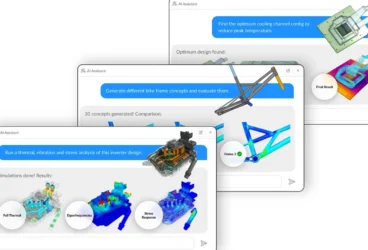
In a live demo, we showed how an AI agent could set up three different simulations in just minutes; a manifold stress analysis, an inverter NVH analysis, and a valve CV assessment. The agent autonomously:
- Created the required analysis type in the platform.
- Assigned materials based on past projects and internal data.
- Applied relevant forces, pressures, and other boundary conditions.
- Launched the simulation to run in the cloud.
By automating these manual setup processes, engineers can get critical performance feedback in minutes or hours instead of weeks, directly addressing the bottleneck of simulation lead time.
3. AI Agents Can Unlock Rapid Design Exploration
The webinar highlighted how SimScale’s unique combination of predictive Physics AI and agentic Engineering AI can work together to dramatically speed up innovation:
- Engineering AI (Agentic AI): This system automates the manual work of setting up and managing simulations.
- Physics AI: This system uses deep learning to accelerate the computational work, predicting simulation outcomes in seconds instead of hours.
When combined, these two systems create a powerful framework for design space exploration. An Engineering AI agent can autonomously generate and test hundreds of design variations, with each one being evaluated almost instantly by a Physics AI model. An example showed this in action, where a centrifugal pump was optimized by evaluating 400 different designs in approximately five minutes. A task that would take hours or even days using traditional solvers and programmatic automation.
4. Trust is Built Through Transparency, Not Black Boxes
A primary concern with AI in engineering is whether its output can be trusted. SimScale’s approach addresses this by making the AI’s process fully inspectable, not a “black box”.
Engineers can review, and even discuss, every step the agent takes:
- every material it assigns,
- every boundary condition it creates,
- and every setting it chooses.
This transparency allows for complete oversight and can agents can operate in a fully automatic or human-supervised manner as desired. Furthermore, teams can implement “guardrails” and provide instructions based on their specific best practices, ensuring the agent operates within established organizational standards for quality and accuracy.
5. The Future is Collaborative, Agent-to-Agent Workflows
In this webinar we showcasing the ‘art of the possible’ in terms of interaction between a human engineer and a single AI agent, the natural first step in embracing this technology. Agentic AI in engineering also opens up a rich set of possibilities for even greater transformation: a collaborative ecosystem where specialized AI agents interact with each other.
Imagine a workflow where:
- A CAD agent generates a new design based on system-level requirements.
- It automatically passes the design to a simulation agent (like SimScale’s) for performance validation.
- The results are then sent to a DFM (Design for Manufacturing) agent to check for manufacturability.
This seamless agent-to-agent communication, managed by an orchestration platform, will further break down silos and accelerate the entire product development lifecycle, allowing engineers to operate at a higher, more strategic level.
Watch Now
Experience the full potential of AI in engineering by watching our on-demand webinar. Delve into detailed demonstrations and discussions to understand how you can leverage SimScale’s AI capabilities in your projects. Watch the full webinar here.