AI in engineering is graduating from chatbot to colleague. Autonomous AI agents; systems that reason, act, and execute multi-step workflows with minimal oversight are arriving in engineering simulation. For the engineering community, 2026 is the inflection point: the year to stop experimenting with AI and start integrating it.
What Is Agentic AI — and Why Should Engineers Care?
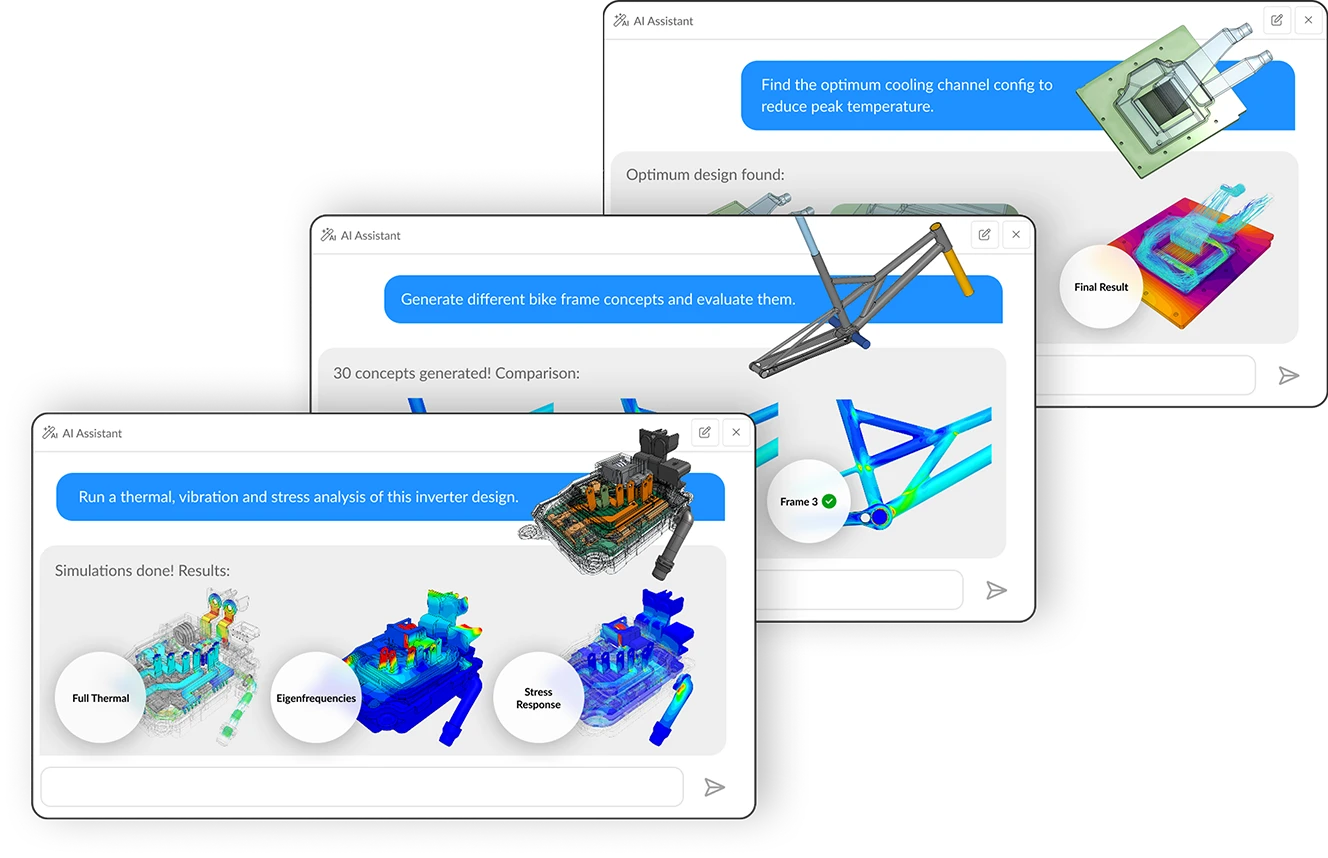
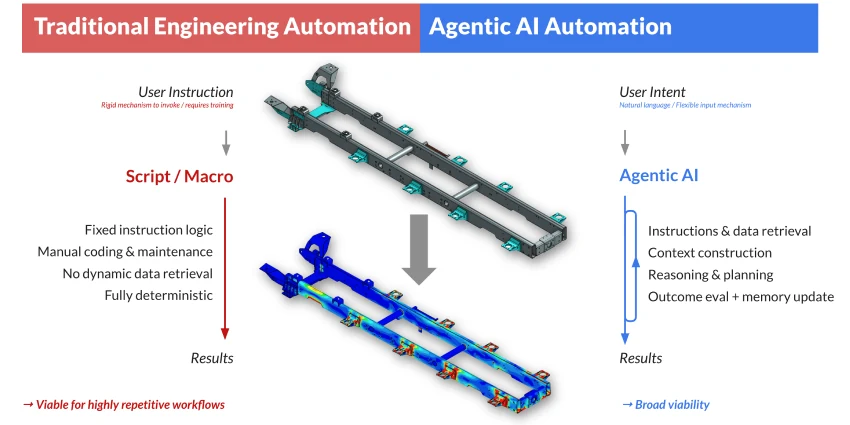
Most AI tools in engineering today are passive: you ask a question or run an inference, you get an answer. Agentic AI is fundamentally different. An AI agent not only understands context (your CAD geometry, your simulation setup, your organization’s standards), it can take action too. Agents can spot and resolve problems before you encounter them, recommend and implement setups based on your geometry and what you want to do with it, and orchestrate entire workflows from setup to post-processing.
This matters because engineering simulation has always been bottlenecked by expertise. Geometry preparation, boundary condition and physics model selection, meshing… these tasks require deep knowledge and eat time. Agentic AI embeds that expertise directly into the workflow, making it accessible to every engineer regardless of their simulation experience.
And beyond providing assistance and guidance, AI agents have the capacity to run entire multi-step and even multi-tool workflows. These tasks have always been particularly challenging to automate using procedural programming, easily breaking down on edge cases where a single error can spell disaster. AI agents, on the other hand, thrive on that kind of ‘fuzzy’ decision making and error recovery that is needed, and that previously only a human operator could provide.
Five Agentic Workflows Already Reshaping Simulation
Here are five concrete ways agentic AI in engineering is changing how simulation gets done — some available today, others maturing fast.
1. Guided Onboarding for New Simulation Users
Making simulation accessible to new users has always been a core industry challenge. Engineering AI agents turbocharge this democratization. Rather than relying on static documentation, an agent understands your CAD model in real time, guides you step-by-step toward a viable setup, diagnoses missing inputs, and flags challenges before you hit “run.”
A mechanical engineer who has never run a CFD analysis can reach a working simulation in a fraction of the usual time. Onboarding transforms from a knowledge hurdle into a guided experience.
2. Intelligent Simulation Setup Automation
Setting up a simulation is often the most time-consuming phase — preparing CAD geometry, assigning boundary conditions, materials, and physics models. An agentic Engineering AI leverages geometric information and vast simulation knowledge to streamline this. The agent recognizes context from your geometry, recommends or auto-applies suitable settings, and raises issues only when human judgment is genuinely needed.
What once took hours of manual configuration can be reduced to minutes of guided collaboration with an AI agent. This pattern is emerging across the engineering software stack and particularly amongst modern cloud-native tools. PTC’s Onshape AI Advisor, for instance, now provides step-by-step recommendations and troubleshooting directly within the CAD environment, and CoLab Software’s AutoReview feature, which uses agentic automation to instantly verify that designs adhere to organizational standards and best practices before they ever reach a human reviewer.
When cloud-native engineering tools come together with easily accessible APIs, AI agents and MCP connections, the entire design-to-analysis loop becomes intelligent end to end. No clunky file transfers, no firewalls, no version incompatibilities.
3. Enforcing Organizational Best Practices at Scale
Scaling simulation quality across distributed teams remains a persistent pain point. Agentic AI addresses this by actively reinforcing organizational best practices throughout the workflow — surfacing internal guidelines, guarding against common pitfalls, and consolidating hard-won expertise.
Over time, these agents learn from recurring team mistakes and successes, driving continuous improvement. This is particularly valuable where knowledge transfer between experienced and junior analysts has traditionally been slow and inconsistent.
4. Multi-Agent Collaboration Across Engineering Tools
Some of the most transformative potential emerges when AI agents collaborate with each other — not just with humans. Multiple specialized agents, each with domain-specific reasoning, can work together across complex engineering challenges.

“SimScale allows us to embed simulation insight at the moment when decisions are being made, not after drawings are complete.”
Jon Wilde
VP of Product, SimScale
This kind of agent-to-agent orchestration is already taking shape. Violet Labs, which provides a cloud-based integration platform for hardware engineering, connects live data from requirements management, CAD, and analysis tools into a centralized engineering source of truth. Through its integration with SimScale, simulations can auto-execute whenever an input variable changes — and results feed back directly into the wider engineering stack. It is exactly this kind of connected, event-driven infrastructure that makes multi-agent workflows viable: when your data, requirements, and simulation tools all speak to each other, agents can act on changes without waiting for a human to initiate each step.
5. Automated RFQ Response Generation
In high-stakes engineering environments, agentic engineering transforms speed into a decisive competitive weapon. By leveraging engineering agents to compress the transition from an initial requirement to a physics-validated design from days into minutes, organizations can move from a reactive “best effort” stance to a proactive market position. This shift allows firms to gain an edge where it matters most: at the very start of the design cycle, before the competition has even finished their manual configuration.
A prime application of this strategic speed is the automation of RFQ (Request for Quotation) responses. Mature engineering agents can ingest customer requirements, map them to design specs, and run simulations to validate performance criteria—all automatically. This not only increases bid throughput without adding headcount but also allows teams to win contracts with greater confidence. Because these agents instantly identify cost and feasibility risks, firms can protect their margins while offering a level of technical certainty that manual workflows simply cannot match, effectively turning the engineering function into a primary engine for top-line growth.
The Execution Gap: Why 93% of Engineering Leaders Are Still Waiting
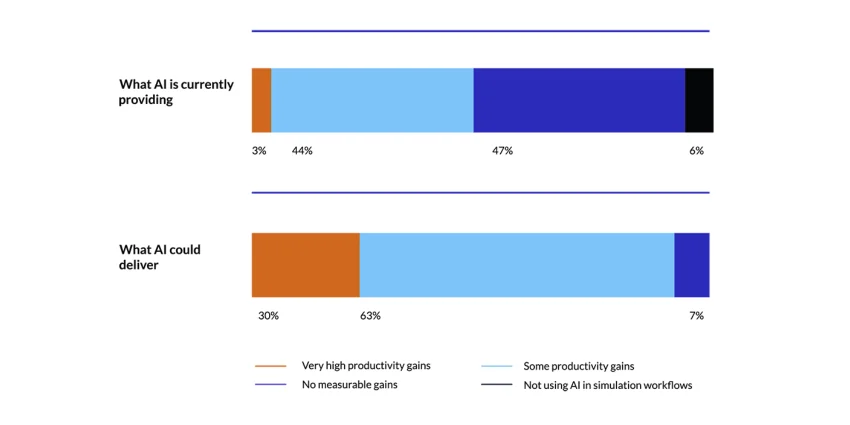
Despite the promise, the gap between expectation and reality is stark. The urgency is real — a recent CoLab survey of 250 engineering leaders found that 95% view AI adoption as essential over the next two years, with nearly half calling it a matter of survival. Yet SimScale’s State of Engineering AI 2025 survey reveals that while 93% of engineering leaders expect AI to deliver substantial productivity gains, only 3% report achieving transformational impact.
For this technology to help rather than hinder, the AI agents and models need to be so deeply and logically integrated into simulation tools that their use becomes second nature.”
Jon Wilde
VP of Product, SimScale
The root cause is infrastructure, not intent. Agentic AI cannot reason effectively over fragmented data stored across disconnected desktop tools. It requires a cloud-native environment where geometry, physics data, simulation history, and organizational knowledge live in a single connected platform.
What Could Go Wrong: Challenges to Watch
No technology shift is without risk, and agentic AI in engineering is no exception. Organizations adopting these workflows need to think carefully about validation and trust — how do you verify that an agent’s simulation setup is correct before committing compute resources? Human-in-the-loop checkpoints remain critical, especially for safety-critical applications in aerospace, automotive, and medical devices.
Data quality is another hurdle. Agents are only as good as the data and knowledge they can access. Organizations with fragmented CAD libraries, inconsistent naming conventions, and undocumented tribal knowledge will find that AI amplifies existing problems rather than solving them. Getting your digital house in order is a prerequisite, not a follow-up task.
Finally, there is the change management dimension. Engineers accustomed to full manual control may resist delegating decisions to an agent. Successful adoption requires demonstrating reliability incrementally — starting with low-risk workflows and expanding as trust builds.
The Winning Strategy: Engineering AI Meets Physics AI
A useful framework — outlined by CoLab, who are working with dozens of engineering leadership teams on agentic AI strategy — distinguishes three layers of AI in engineering: Prediction (Physics AI that uses deep learning surrogates to forecast outcomes in milliseconds), Automation (Engineering AI agents that orchestrate setup, meshing, and debugging), and Validation (Test AI that confirms real-world performance). When all three converge, the result is what CoLab and others are calling Generative Engineering — a mode where engineers define requirements and the system autonomously generates, evaluates, and validates design candidates.
In practice, leading organizations are starting with the first two layers. Engineering AI handles the process — setup, meshing, compliance checks, and workflow orchestration. Physics AI handles the predictions — reducing solve times from hours to seconds. When these merge, the result is a high-value loop: engineers provide design intent, and the system handles rigorous execution. Organizations like Convion (part of HD Hyundai) are deploying this combined approach today.
How to Get Started With Agentic AI in Engineering
The transition to agentic workflows is no longer a question of “if” but “how fast.” Here’s a practical starting point:
- Assess your readiness. Use SimScale’s AI Capability Index to benchmark your organization against the industry and identify where your infrastructure needs to evolve.
- Start small. Pick a single, repeatable simulation workflow — a routine thermal analysis, a standard valve CFD study — and pilot the AI agent on that. Build trust before expanding scope.
- Consolidate your data. AI agents need connected, well-organized data. Migrating to cloud-native simulation infrastructure is the highest-leverage investment you can make toward an agentic future.
- Learn from peers. SimScale’s Engineering AI Hub documents real-world case studies showing how industry leaders are already incorporating agentic AI into their engineering workflows.
The engineering teams that embrace this shift now will not just be more productive — they will be defining the standard for how engineering gets done in the age of AI.