The AI Blueprint Every Engineering Leader is Searching For
The question is no longer if you should adopt AI in your engineering workflows, but how to do it effectively and at scale. Across industries, engineering leaders are experimenting with AI pilots, but many are finding it difficult to move from isolated experiments to production-scale adoption. The result is often a collection of stalled initiatives and an uncertain return on investment.
For many engineering teams, the core challenge is the lack of a clear blueprint – what does success look like? Unlike other business functions, engineering has unique data and workflow complexities. Your proprietary design data is complex, multimodal, and not easily digestible by the large, general-purpose AI models that have captured the public imagination. A “one-size-fits-all” strategy simply doesn’t work.
A successful AI strategy in engineering isn’t a case of finding one algorithm or system to do everything. The key is to identify points in your workflow where it can add the most value – in other words so you can tackle the most significant bottlenecks in your product development cycle. This is the path from experimentation to transformation.
Two Bottlenecks, Two AIs
The product development process is a race against time. The goal is to shorten the loop from the moment a design is created to the moment its performance is fully understood. This delay is caused by two fundamental bottlenecks:
- Simulation Lead Time: This is the manual effort and human waiting time. It includes the handoffs between teams, CAD preparation, meshing, and the entire simulation setup process. It’s the time spent preparing to get an answer.
- Simulation Cycle Time: This is the raw compute time. It’s the hours—or even days—your high-fidelity solvers need to run to deliver a single, accurate result. It’s the time spent waiting for an answer.
To truly accelerate innovation, you need to attack both bottlenecks simultaneously. SimScale does this with a two-pronged AI strategy, deploying a purpose-built AI to solve each problem:
- Engineering AI: An autonomous agent designed to eliminate Simulation Lead Time by automating the entire workflow from setup to execution.
- Physics AI: A predictive system designed to eliminate Simulation Cycle Time by providing instant performance insights without running a full simulation.
Engineering AI in Action: Your New Autonomous Teammate
Consider the following engineering challenge: designing a cold plate for cooling electronics. The goal is to find the right trade-off between thermal performance (cooling) and pressure drop (efficiency).
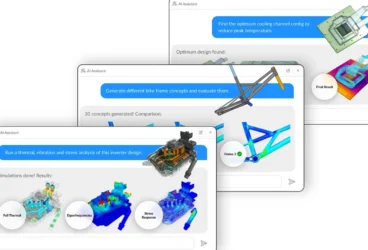
Usually, an engineer would manually or programmatically set up a simulation for each design iteration—a repetitive and time-consuming process. Engineering AI transforms this. It acts as an autonomous agent that can perceive the simulation context (the geometry, the physics) and execute the entire workflow based on simple instructions. It becomes a new kind of teammate, handling the mundane tasks so your experts can focus on analysis and innovation.
The payoff here isn’t just about speed; it’s about liberating your most valuable engineering talent. By automating the setup, you empower your team to focus on the high-value work of interpreting results and driving design decisions.
Physics AI in Action: Real-Time Insight
Even with a fully automated setup, complex physics can take hours to compute. This inherent delay makes rapid, comprehensive design space exploration impossible.
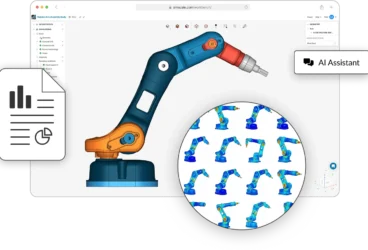
This is where Physics AI comes in. By training on the results of previous high-fidelity simulations, it learns the physics of your design. It can then infer the performance of a new design variant in seconds, without ever running a full solver. This transforms the workflow from a slow, iterative process into an interactive design session.
As noted in our recent webinar with Ian Pegler from NVIDIA, this capability finally makes comprehensive design space exploration feasible for complex problems. It’s the difference between testing a handful of ideas and exploring thousands.
The Blueprint: How Engineering and Physics AI Work Together
The true revolution happens when these two systems work in concert. They are symbiotic, creating a workflow that is both automated and instantaneous. This is a day in the life of the modern, agent-augmented engineering team:
- An engineer wishes to kick off a project to optimize a design (let’s say it’s a hydraulic manifold). Instead of digging out CAD files and simulation templates, they instead brief a customized Engineering AI agent in SimScale to perform the study, based on some simple instructions.
- As part of the study, the AI agent chooses to make use of a relevant pre-trained Physics AI model which can immediately run inferences to provide a real-time prediction of each design’s thermal and hydraulic performance. The engineer, supervising the process, can interactively explore dozens of variations in minutes.
- The human engineer and Engineering AI discuss the foremost design candidates, selecting a promising variant which demonstrates the desired characteristics spanning performance, cost and manufacturability.
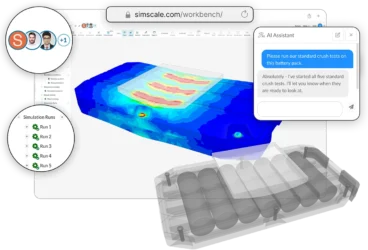
- Then it is back to the Engineering AI agent to autonomously set up and run a full, high-fidelity simulation in the background for final validation, while the engineer is already moving on to the next creative task.
The total time from a design change to a fully validated performance insight drops from days or hours to minutes. This isn’t a minor improvement; it’s a fundamental acceleration of the entire innovation cycle.
With expert knowledge captured in the AI agent, the whole workflow described above is now accessible to less expert, junior engineers. It is this democratization that allows engineering teams to scale and move faster.
Your Starting Point
Look at your own organization and ask: which bottleneck is slowing you down the most? Is it the manual lead time spent on setup and preparation, or the computational cycle time spent waiting for solvers?
Answering that question will reveal your starting point for a scalable AI strategy that delivers tangible results. If you would like to discuss your strategy with one of our experts, get in touch today.
Catch up on the webinar
Learn more about deploying AI in engineering with SimScale and NVIDIA as part of engineering.com’s Digital Transformation Week