Hi, is it possible to simulate the effect of using materials with high thermal mass on the thermal comfort of a building at night on the basis that materials with high thermal mass store heat during the day and release it at night?
Thanks.

Hi, is it possible to simulate the effect of using materials with high thermal mass on the thermal comfort of a building at night on the basis that materials with high thermal mass store heat during the day and release it at night?
Thanks.
Hi CRSylvester,
A problem that someone more advanced than me might answer concisely, like @anon41772514 but I did find the following items that are related and seem to suggest to me that it is possible, but I can’t find something close to your proposed project at the moment.
Conjugate Heat Transfer v2.0 solver
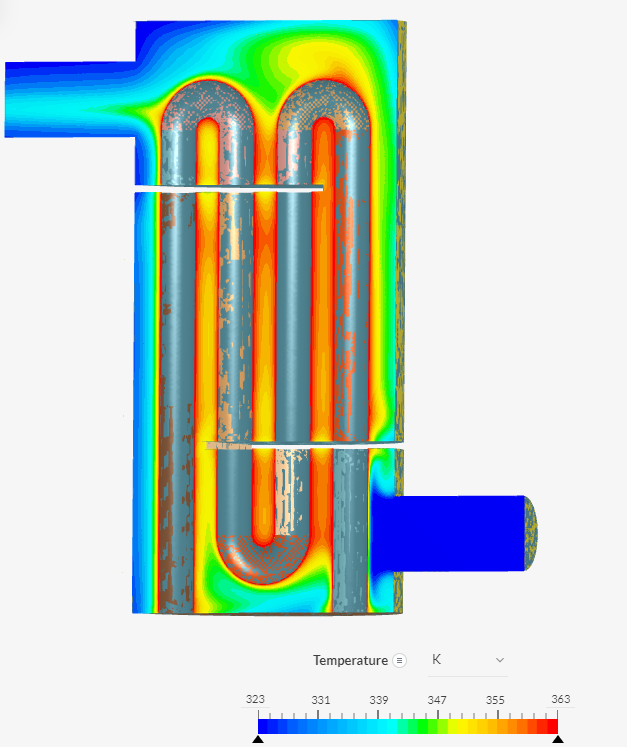
Conjugate heat transfer v2.0 is a multi-purpose mass and heat transfer analysis. It can simulate one or more fluid regions and an arbitrary number of solid regions. Heat is exchanged at the interfaces and transported via conduction within the solids and additionally, convection and radiation within fluid regions. With this analysis type applications such as electronic enclosures, heat exchangers and HVAC systems can be analyzed accurately. It differs from the standard conjugate and convective heat transfer analyses in two important ways: 1) The energy equation is strongly coupled between all regions (solid and fluid) and 2) A novel radiation modelling approach is used. The differences enable significantly faster convergence, at the cost of a slightly reduced feature set. Learn more
This thermal simulation is sort of related in terms of its thermal/solar storage
This examples shows passenger comfort in a car using V2 of the Conjugate heat transfer solver & the boundary conditions indicate that you can create specific heat/mass parameters
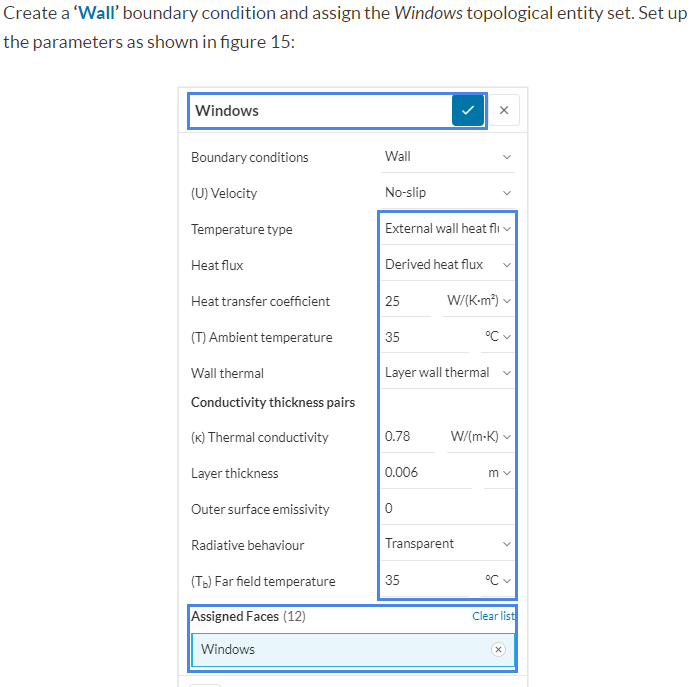
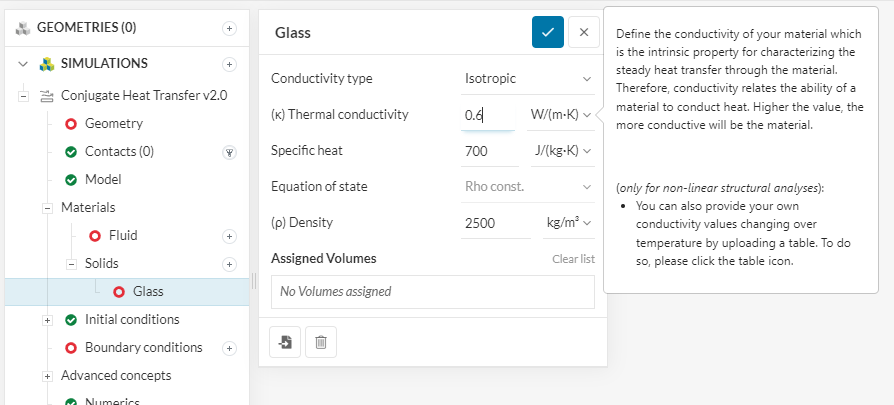
In this tutorial Thermal Management Tutorial: Electronics Box Cooling | SimScale it shows how to assign materials with various heat/mass/thermal properties and I had a quick look to see if you can amend the properties and it appears you can, as per the numerical areas seem to be able to be alerted.
This is also possibly useful to consider from Public projects.
Sorry my searching hasn’t given you a Yes / No answer.
Kind regards
Ted
@CRSylvester Sorry for being slightly negative. I will explain the current capabilities so that you could decide to move on or not.
What you mention requires the following:
Currently, we don’t have any solver that includes all those three items. Here is what we have instead:
Conjugate Heat Transfer Analysis (Not the v2.0!)
Convective Heat Transfer Analysis
As you may see, conjugate heat transfer analysis is the right one to investigate the impact of thermal mass. However, it’s not very easy, therefore you need to consider the following: