Hi @tansari,
Regarding imprint, it seems that it does nothing more than split the faces to allow an exact match of the contact areas, I assume it would be equivalent to do this in my external CAD preparation?
Yes, it allows the exact match of the contact areas. No, it is not equivalent to your CAD preparation, since you just have overlap on bush to hinge interface, as you can see in this before-and-after imprint operation:
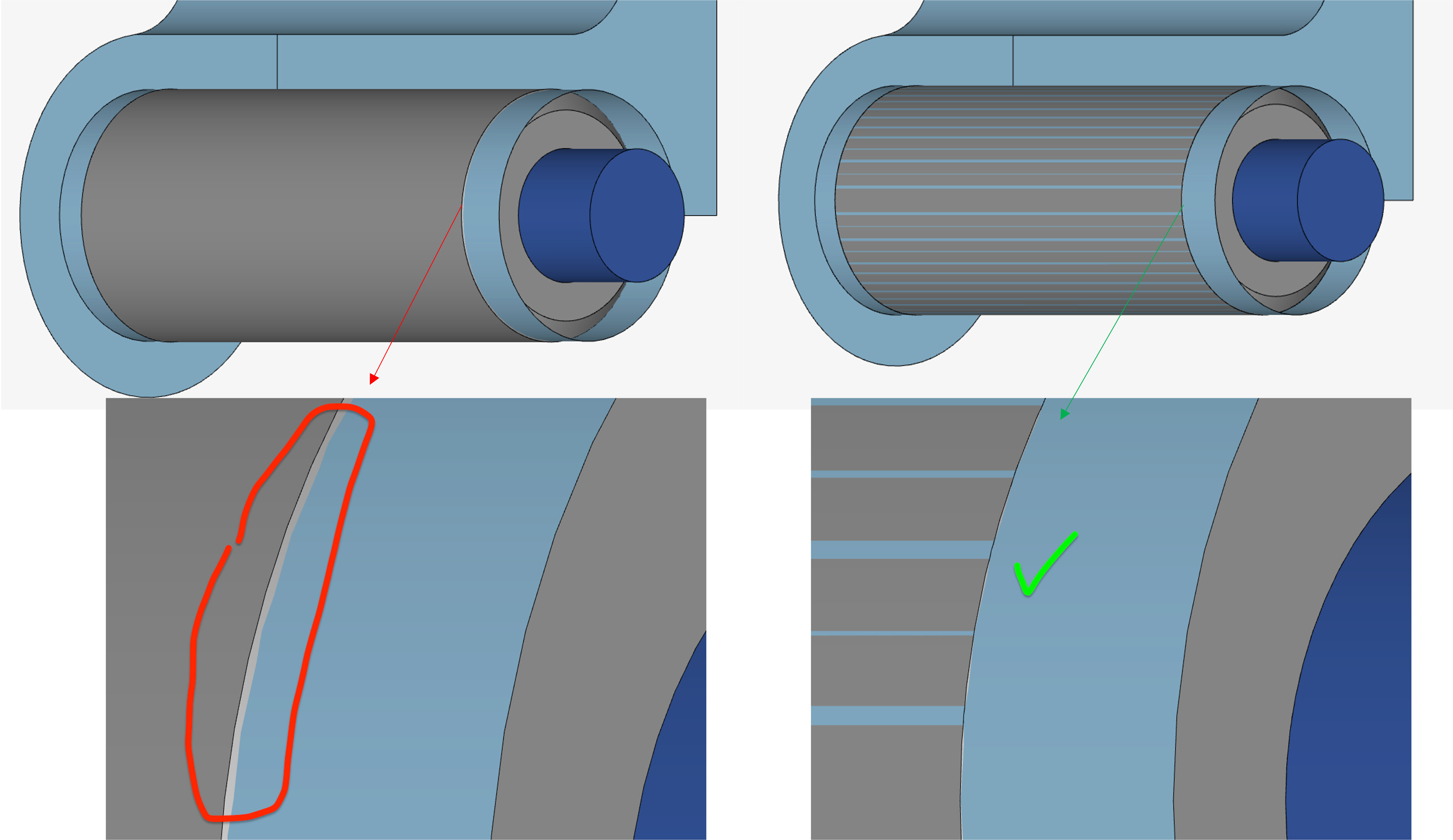
In the simulation those are defined exclusively as physical contact , so I am not sure how much effect precisely matching face boundary to contact has?
The precision to matching face boundary to contact is defined by contact penetration between two faces. If you do have large penetrations, you will miss a good amount of real forces in the simulation, so that is why the importance of imprint operation as well, for a good contact definition. As small this contact penetration is in the simulation, close the results are to the reality. To summarize, aiming to get precision in the contact boundary definition, you must do:
- Reduce the size of penetration as much as you can, for that you can assure that in the CAD drawing and then applying a good mesh refinement.
- Adequately consider friction coefficient to correctly distribute forces between faces.
To know more about it, please take a look at this page.
Why the suggestion of rotating the outside region vs. the face where the pin would continue and torque would be transmitted in the real material?
Applying torque in external surfaces is the typical approach if you are aiming to get the correct structural behavior, once torque is a rotational force acting around a geometry (It should be applied in the end face just in very particular cases. Here you have a nut, so it is not the particular case). I see from your explanation that the pin is continuing, so in this case the right approach should be applying this remote displacement in a point in the fictitious end, assigning the external surfaces, as shown below (assuming the fictitious continuity of the pin for 0.02m):
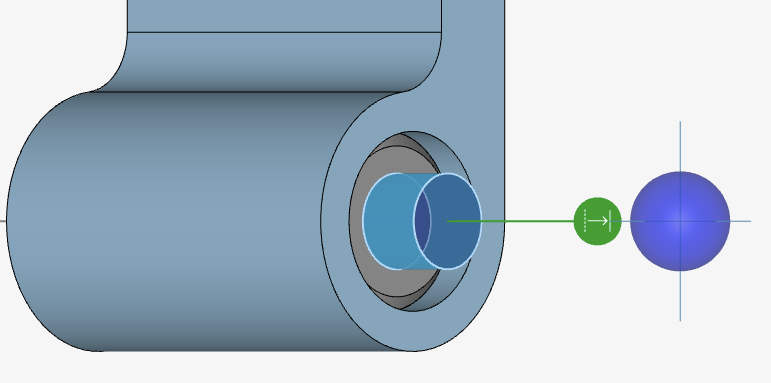
Please let me know if it doesn’t make sense.
best,