Divergence in CHT Simulation

Hello Everyone,

I am a graduate student and I am new to SimScale. I am trying to simulate conjugate heat transfer on a machine that contains a core sample that heats up to 350 degrees celcius and the objective is to identify the temperature at other elements sorounding the core sample to see if they can withstand the temperature and how efficient natural convection could be . The problem I am having is that the solution diverges possibly caused by bad elements in the mesh. I have followed the procedure on a tutorial video provided by SimScale “Conjugate Heat Transfer Simulation of an LED Spotlight” and I asked SimScale AI agent help several time which led me to modify the fineness, small feature suppression and the relaxation factor. I simplified the geometry and I have also checked the Mesh quality metrics and they are inside the acceptable range; but the solutions keeps diverging. The URL of the project is: Conjugate Heat Transfer - Israel | SimScale Workbench Thank you in advance for your response and help.
Hi @i033h276, thanks for posting!

By looking at the project you’ve shared, it seems like all runs converged except for the IBM run and that they were created after you’ve posted your initial topic. Could you share with the SimScale Community what was the solution you’ve found?

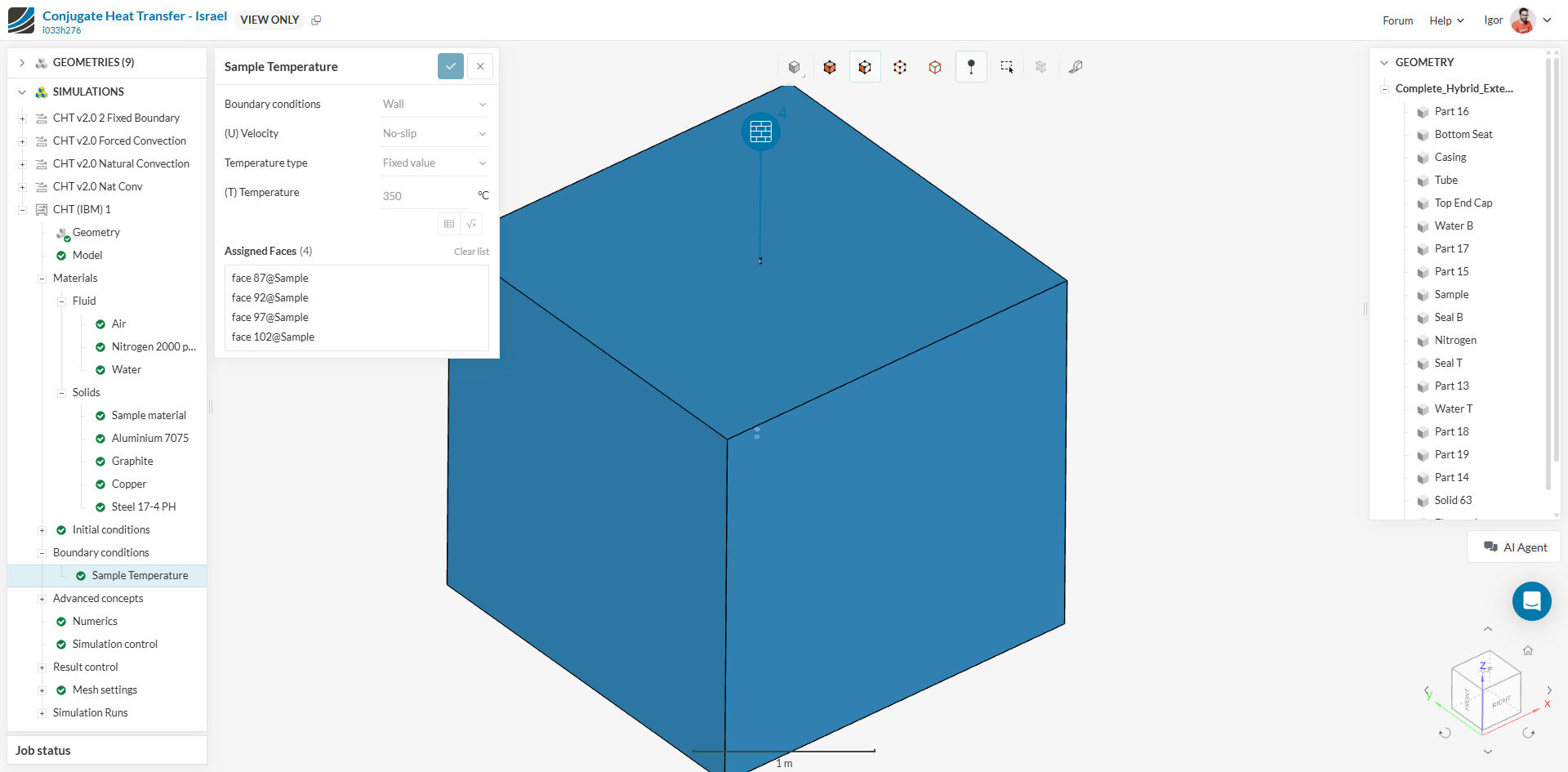
A quick comment on your project however: unlike the LED Spotlight Tutorial (see Advanced Concepts section), you’re defining your heat source as a Fixed value temperature:

Two comments on that:

  1. This will generate an “infinite heat source” scenario, since the walls will constantly be at 350ºC, no matter the environmental conditions around it. A better approach is to go for a power source advanced concept instead
  2. Since the rest of your walls will be adiabatic, there’s no way for the heat to leave the system, which means that the whole domain will be at thermal equilibrium at 350ºC

A final note is also that, if you’re expecting temperatures as high as 350ºC, you should toggle the compressibility option on for this study.

Cheers

Igor