Hi,
I have seen this years ago in my NACA0012 analysis. I suspected then that the randomness of turbulence handling was the issue.
And your current CL < 0 issue has influenced me enough to have another look at studying the NACA0012 at 0 degrees AOA using the current version of the Standard Mesh Algorithm that auto generates boundary layers.
So I started with a project setup from back then and I have not exhaustively determined that I have used current best practices on the results I will show you now but it does seem to match your results.
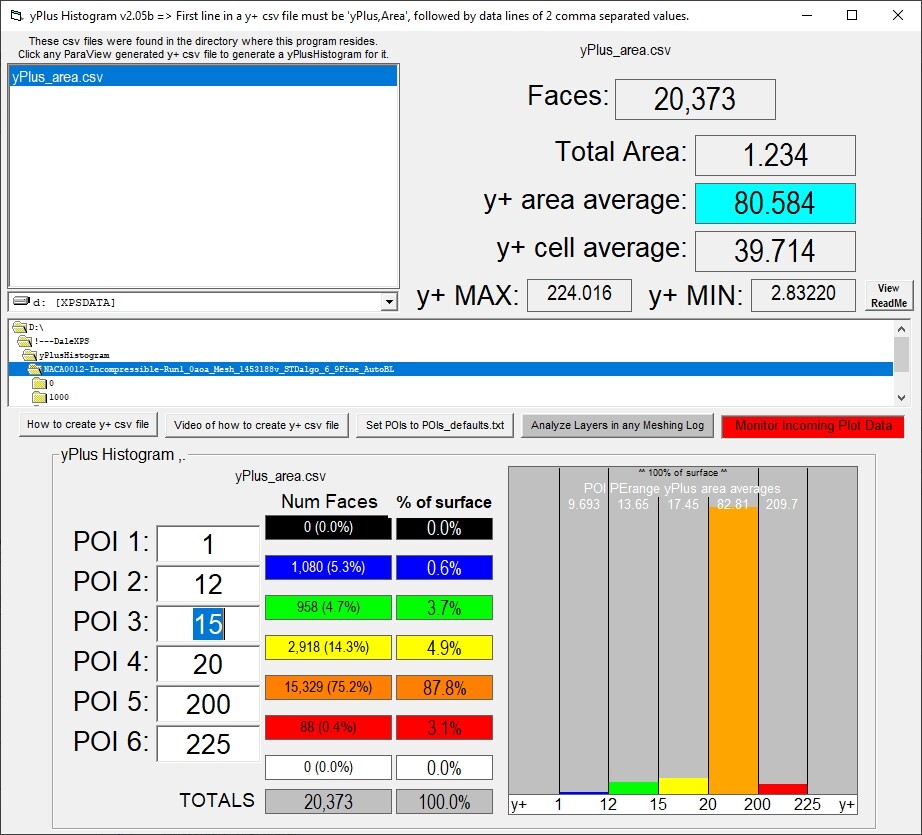
I used yPlusHistogram to determine that the overall yPlus was acceptable to use for the log-log region and got this (I am a little concerned about the 4.3% of the total cells below a value of 15) :
.
.
Then I analyzed the convergence stability of the Coefficients using the ORSI feature of yPlusHistogram and got this output that shows the yellow CL results plotted in the image:
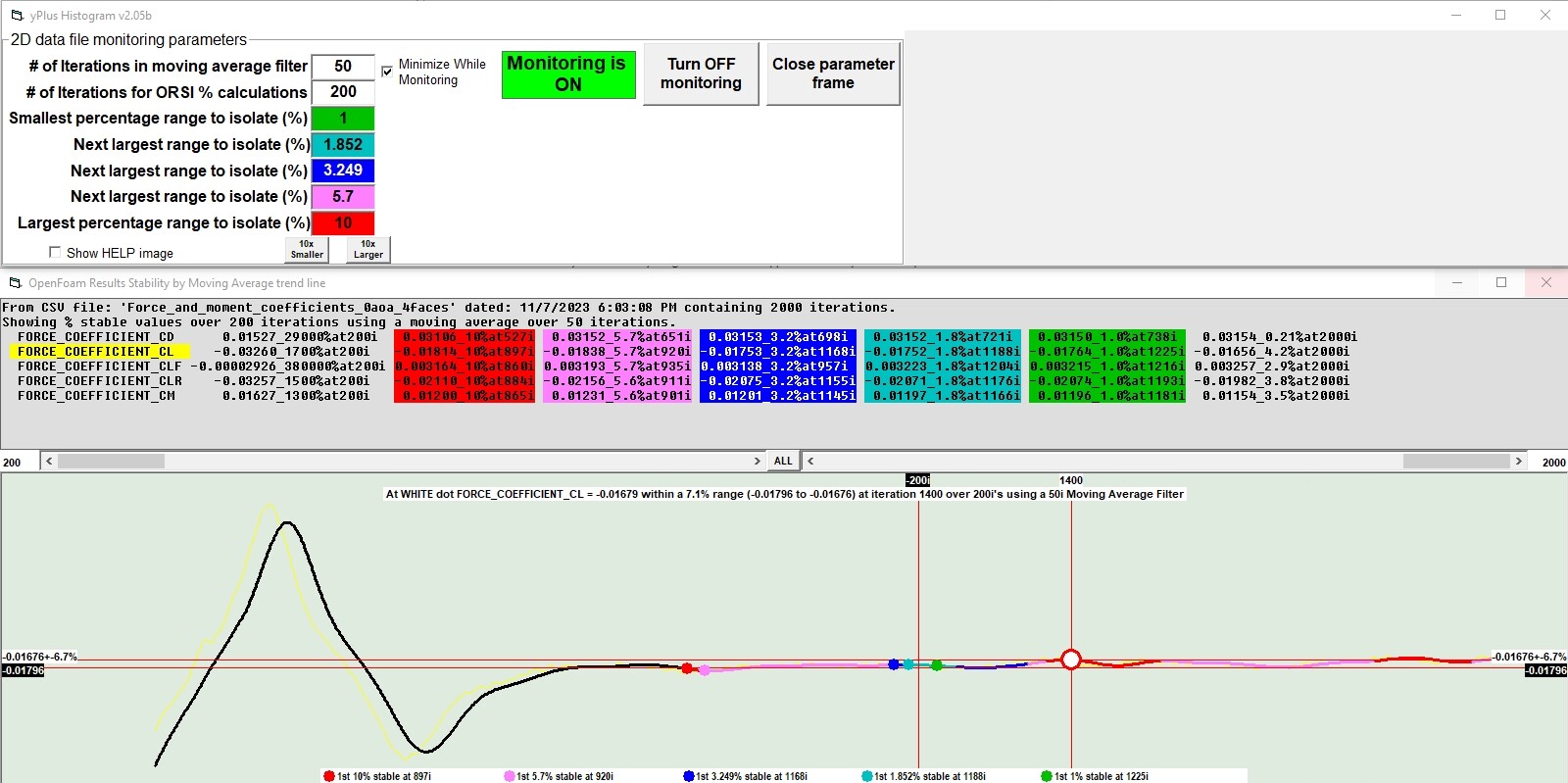
The Yellow plotted line is the actual results from a downloaded csv file of SimScales results.
The multi color line is the moving average of the actual results using the moving average parameters shown at the top.
The colors of the multicolor line show where the moving average plot is stable over the number of iterations and color ranging specified at the top of the image.
My conclusion from looking at this ORSI analysis is that the CL stability is not highly stable. I like to see a continuous GREEN line of a few hundred iterations in length (<1% data variation) at the last iteration of the plot. We did hit green at one point, but only for a short time.
In any case of stability analysis we can only say the results are stable to only about 5%, which is OK in some peoples books for certain applications. The ‘sorta 5%’ stable values run from -.017 to -.018 which seems intuitively incorrect and matches your experience with your flat plate analysis.
So, this issue still exists, as it did over 3 years ago.
I still think it has to do with how turbulence is handled in the code which generates these results.
I hope a more learned scholar on this issue can jump in here and ‘shed some light’ on the situation 