
Chapter 5 - Results & conclusion
5.1 Drag force chart
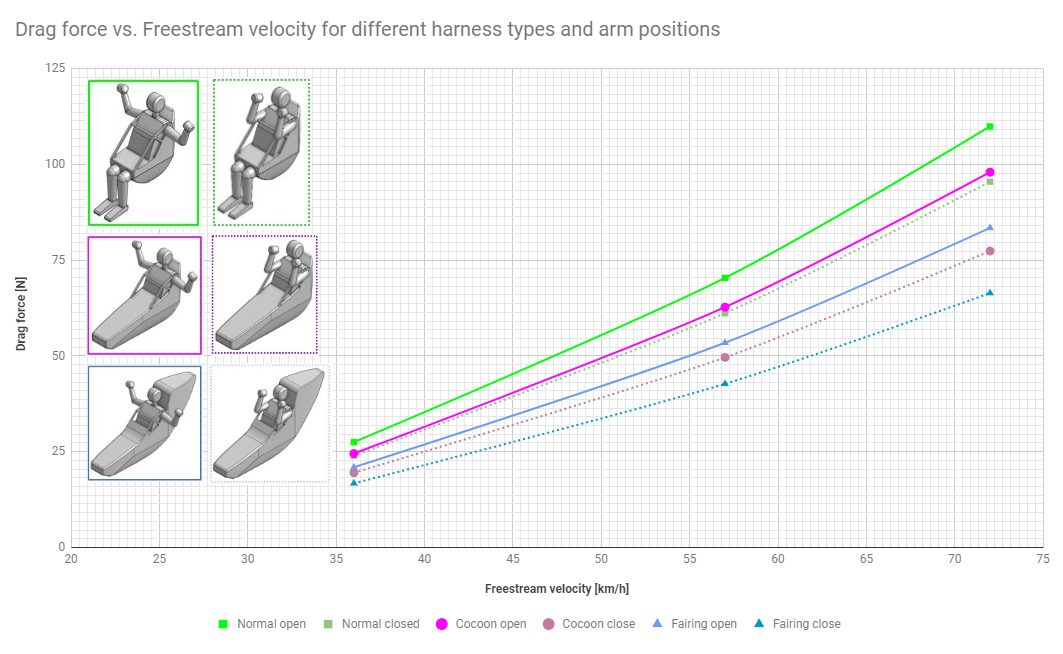
This chart is the essence of the analysis.
Multiple conclusions can be drawn here:
-
Theoretically one can achieve less drag by simply closing his/her arms than switching to a more advanced harness type (Normal closed drag < Cocoon open drag or Cocoon closed drag < Fairing open drag)
-
The advantage of an advanced harness type is only well-marked at higher speeds. Flying on trim speed most of the time doesn’t require such streamlined outline. Like by bicycle. If you are a hobby bicyclist riding around your place, you don’t need any special gear. But if you are to compete, every detail gets more important.

5.2 Drag coefficient
Drag force is closely related to drag coefficient [7].
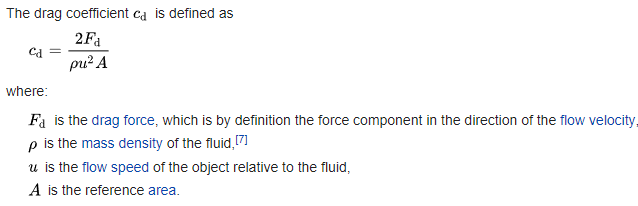
If the medium’s properties and the geometry of the investigated object remains the same and drag coefficient is known than drag force can be calculated for “any” flow speed.
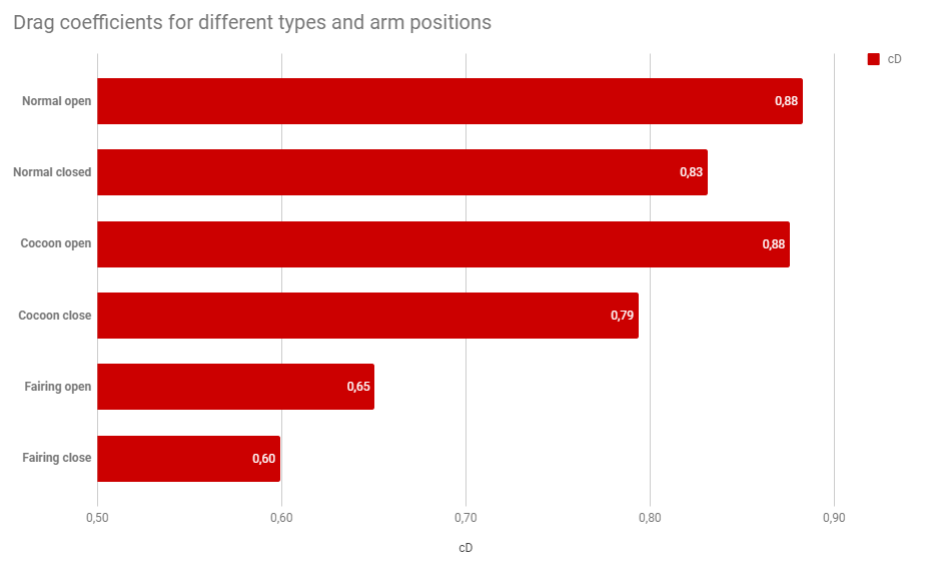
That’s one way to simplify the previous chart:
5.3 What’s the point?
The two charts above clearly show that Normal open is the “worst” while Fairing close is the “best” when it comes to cross country or competition flights.
But what does it actually mean? What is the profit when the tire hits the road? What will be the advantage of a pilot flying a fairing over the one flying a normal harness?
I found a short article in the topic [8]:
Chart from Cross Country Magazine:
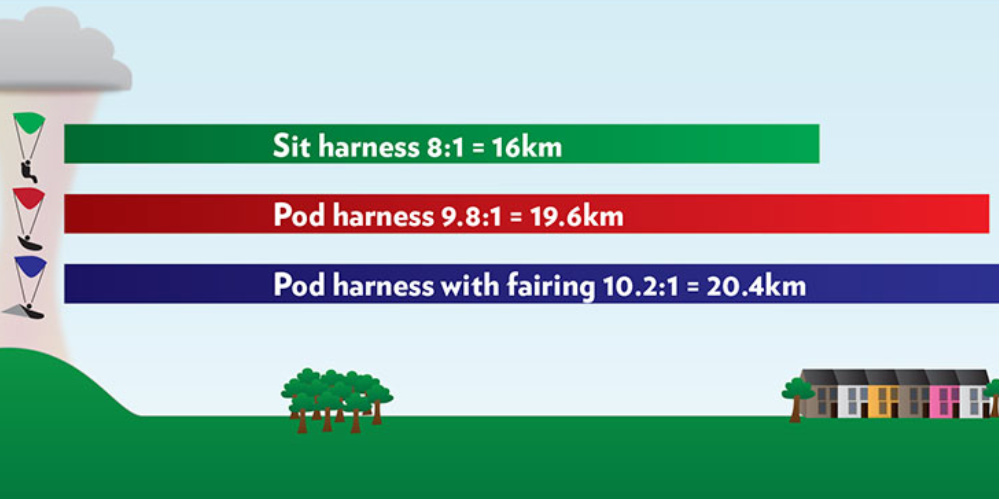
“Wind tunnel tests show that at trim speed, a faired pod harness (Fairing) has roughly half the drag coefficient of a seated harness (Normal).”
During this analysis this ratio proved to be less, only 0.6/0.88=68%.
The article also claimes that:
“Gliding from 2,000m in still air, a pilot with a fairing will fly around 800 metres further than a pilot in a standard pod.”
After these results one can decide wether he/she wants to switch to a more streamlined gear.
Main points:
You should consider switching to more streamlined harness if you:
- compete
- have a high performance glider
- use speedbar frequently