
Chapter 4 - Simulation setup
4.1 Analysis type
Acquiring the drag forces on the paraglider harnesses, Incompressible Flow simulations were ran.
As mentioned before, steady state k-omega SST turbulence model was applied with SIMPLE solver. This setup is suitable for the majority of problems dealing with external aerodynamic investigation of cars airplanes and buildings.
K-omega SST is a great choice when both the flow near the walls and farther from the walls are interesting.
You can find a lot of very detailed literature in the topic online, but I suggest to read [6] at least.
4.2 Settings
-
Domain was chosen according to the scenario to be investigated.
-
The material was the Air model from the built-in library
-
Initial velocity was equal to the inlet velocity
-
The inserted k and omega values were calculated in the Google spreadsheet
-
By the inlet surface a fix velocity value was defined
-
Outlet was zero pressure Boundary condition
-
Walls of the domain were set “No slip”, while the object’s surfaces were set “Slip” walls
-
32 cores were used
-
By the Numerics the following solvers were set:
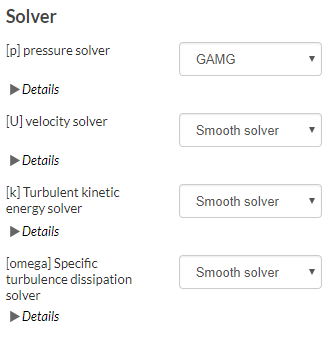
By the solvers I just used the settings applied by the Drone design workshop.
4.3 Result control
The scope of interest is the drag force.
It can be added by the “Forces and moments” command.
To have the possibility to double-check the results drag coefficient was also calculated. Here, according to the scenario, Fresstream velocity, Reference length and Reference area had to be updated. The reference length and area were measured in Onshape.
Please note that it is also important to set direction by defining the coefficients.
4.4 Simulation runs
The avarage run time for a simulation was 10-15 min.
The residuals were in the 1e-4 - 1e-5 range, which is a sign of successful, converged analysis.
4.4.1 Analysis scenarios
The following 18 scenarios were investigated:
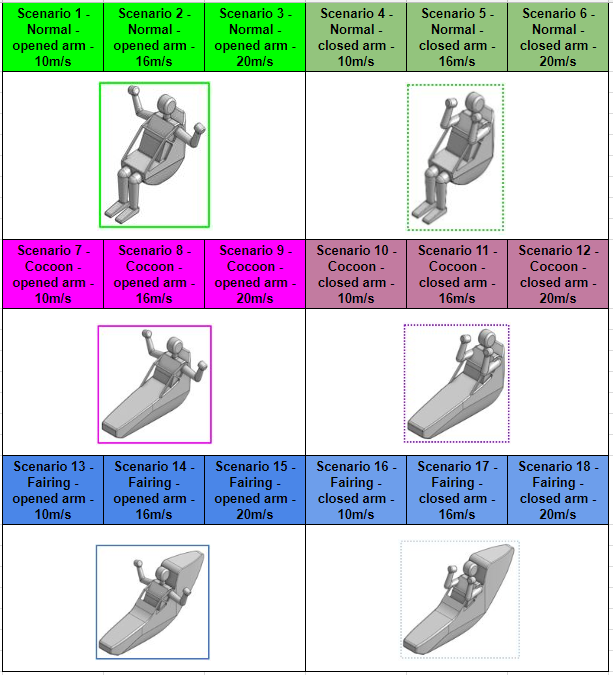
Harness types:
- Normal
- Cocoon
- Fairing
Arm positions:
- Opened
- Closed (more streamlined)
Flow velocities:
- 10 m/s (36 km/h) - Trim speed (normal speed, cruising speed)
- 16 m/s (58 km/h) - Accelerated flight speed by using speedbar
- 20 m/s (70km/h) - vmax (high-end competition gliders only)
4.4.2 Why were these setups investigated?
Harness type
As mentioned before, these harness types are the most common in the paraglider community when it comes to cross country flights. Some say that the use of more streamlined harness is not a key to fly longer distances while other parties claim that it has a significant effect on the performance.
The main purpose of this analysis is to help deciding which group is closer to the truth.
But besides the harness type there are other factors influencing the drag force.
I believe there are two other really important points which are the following:
Arm position
Closing the arms add up to 8% decrease in the frontal area. It will lead the drag to be decrased as well.
Flow velocity
Drag force is proportional to velocity squared so the higher the speed, the more you need to take care of the shape. That’s why high speed cars and airplanes have an aerodynamically tailored outline.
Three characteristic flight speeds were selected which covers the speed range of a modern paraglider.