Hey @DaleKramer
There are some mistakes in the verification method that you follow. The problems that you have encountered as a result are generally not an issue if you had used a different mesh generation algorithm. Fortunately, there is a way to do proper verification using snappyhexmesh that comes with OpenFOAM.
Before we dive into the details, please remember to avoid ‘halving cell size in one or more directions until results converge to a value’. It is unrealistic.
First of all, you want to locate (as many cells on the wall surface as possible) in the log layer, which is where y+>30, if you are modelling an entire plane. This saves the computation effort, and can actually be done in OpenFOAM.
Secondly, once you have an initial mesh, vary
- inlet, outlet, sides, top and buttom boundary locations so that Cd and Cl do not change more than 1%
- the number of cells in the boundary layer ( try 3, 4, 5, and 6) until Cd and Cl do not change more than 1%
- the size of the first layer, which controls y+, so that Cd and Cl do not change more than 1%. Note that you want to maintain 30<y+<100 for majority of the surface area. If the averaged y+ is 30, then you will have many areas below 30. But if the averaged y+ is 50, then you will get more of them above 30, which is what you want.
- the refinement levels around the plane, say level n, n+1 and n+2. Note that you want to keep the refinement levels on the plane surface unaltered for two reasons: 1) RANS does not require a lot of cells. As long as the plane surface is described by the Cartesian surface mesh, chances are you have more than enough cells already. 2) You should use the relative setting in addLayer - it gives you better control over the coverage% on the wall. If you alter the surface mesh sizing, the boundary layer sizing will change as a result, but you don’t want to change more than one parameter at a time. Simply make sure the refinement levels in space are always smaller than the refinement levels on the plane surface.
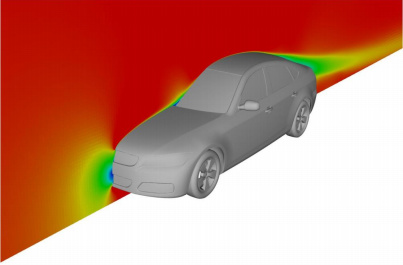
I have obtained good results with high y+ modelling. See the DrivAer model (different configurations) drag prediction: