Hello,
I am working on a nonlinear static simulation of a soft hydrogel sphere compressed between two annular Plexiglas rings. I have managed to obtain converged solutions for several displacement levels, but the deformation of the hydrogel is physically incorrect.
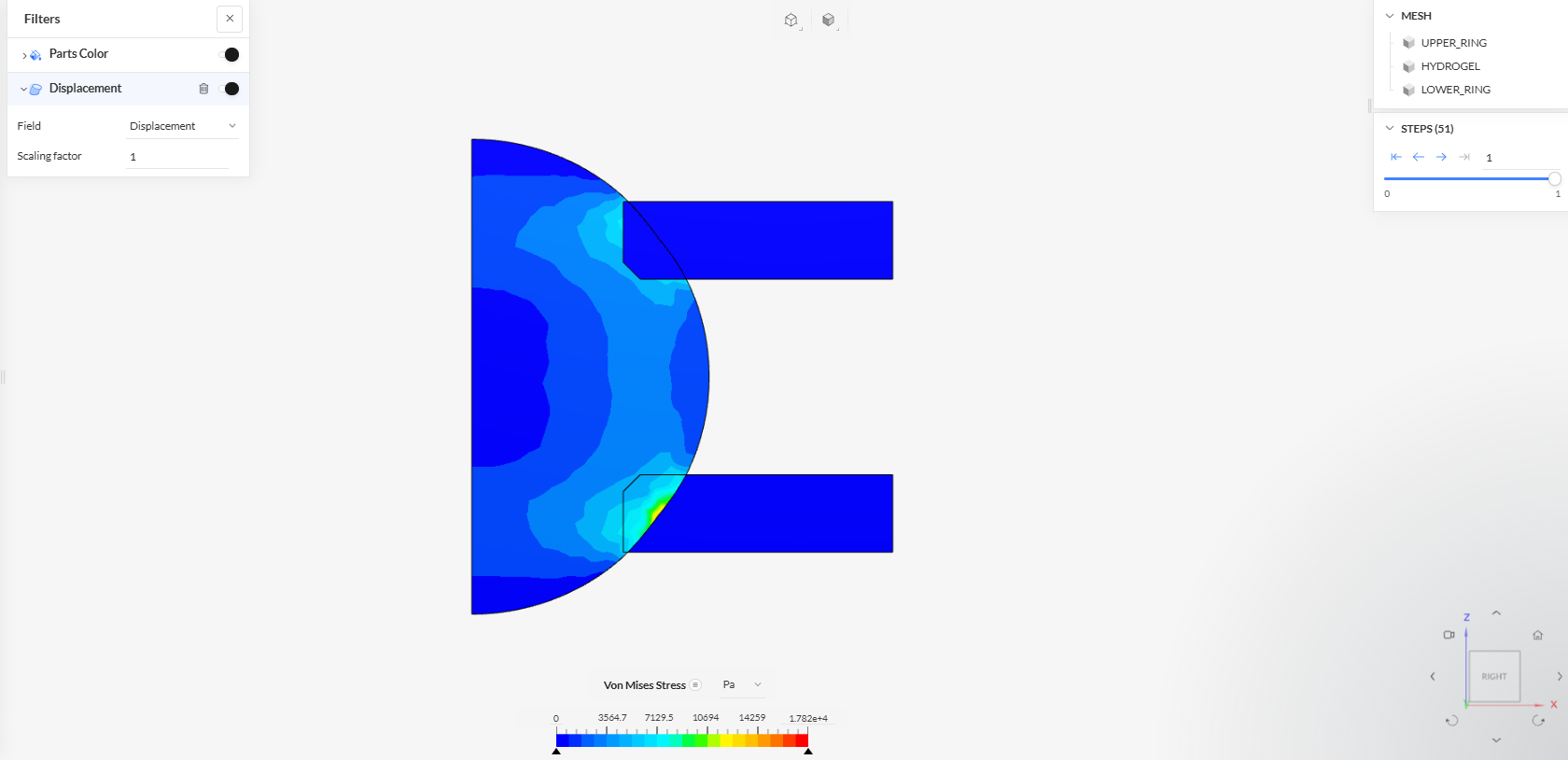
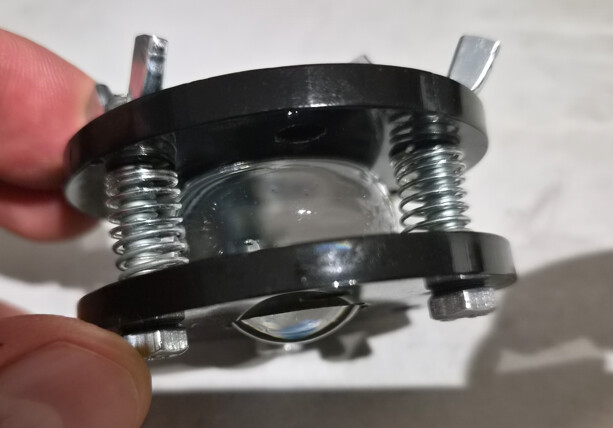
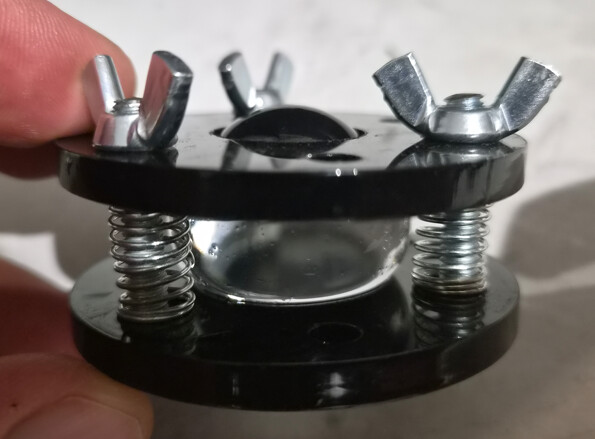
The real hydrogel bead clearly bulges radially between the rings and also protrudes through the central holes of both rings when compressed. In the simulation, however, the sphere retains almost its original shape. For larger compression it mainly translates in the Z direction while the rings appear to move into the sphere, instead of producing the expected large deformation.
My current model is a quarter-symmetry model with two symmetry planes. The initial hydrogel sphere diameter is 28 mm. The rings have approximately 50 mm outer diameter, 18 mm inner diameter and 4.6 mm thickness, with a chamfer at the inner edge.
The main setup is:
- Hydrogel: Neo-Hookean hyperelastic material,
C10 = 1.724e4 Pa,D1 = 5.8e-7 1/Pa. - Plexiglas rings: linear elastic.
- Second-order tetrahedral elements, reduced integration OFF.
- Current mesh: approximately 15,547 nodes.
- Lower ring: Fixed Support.
- Upper ring: prescribed Z displacement, currently testing up to 8 mm compression using a smooth displacement ramp.
- Quarter symmetry:
Ux = 0on the X=0 hydrogel cut face andUy = 0on the Y=0 cut face. - Small Elastic Support on the hydrogel,
K = 1000 N/m³, used only as numerical stabilization. - Contact: frictionless Penalty contact.
- Penalty coefficient: currently approximately
5e6 Pa. - Fictitious clearance:
5e-7 mfor master and slave. - Contact smoothing ON.
- Solver: Direct MUMPS, Newton nonlinear solver, tangent matrix updated every iteration.
- Maximum timestep length currently restored to
0.02 s, minimum timestep1e-6 s.
An important observation is that the hydrogel volume is practically constant during the simulation. The calculated volume is approximately 2.869e-6 m³ initially and 2.868e-6 m³ at the end, so compressibility does not appear to be the main problem.
I also checked the displacement components of the hydrogel for an 8 mm upper-ring displacement. The results were approximately:
Ux: -0.175 mm to +0.100 mm
Uy: -0.186 mm to +0.098 mm
Uz: -4.186 mm to -3.795 mm
This seems particularly suspicious. Instead of the upper part of the sphere moving significantly relative to the lower part, almost the entire hydrogel translates by approximately 4 mm downward as a nearly rigid body, while the internal Z deformation is only about 0.39 mm. Radial deformation is also only around 0.2–0.3 mm, whereas experimentally the hydrogel bulges by several millimetres.
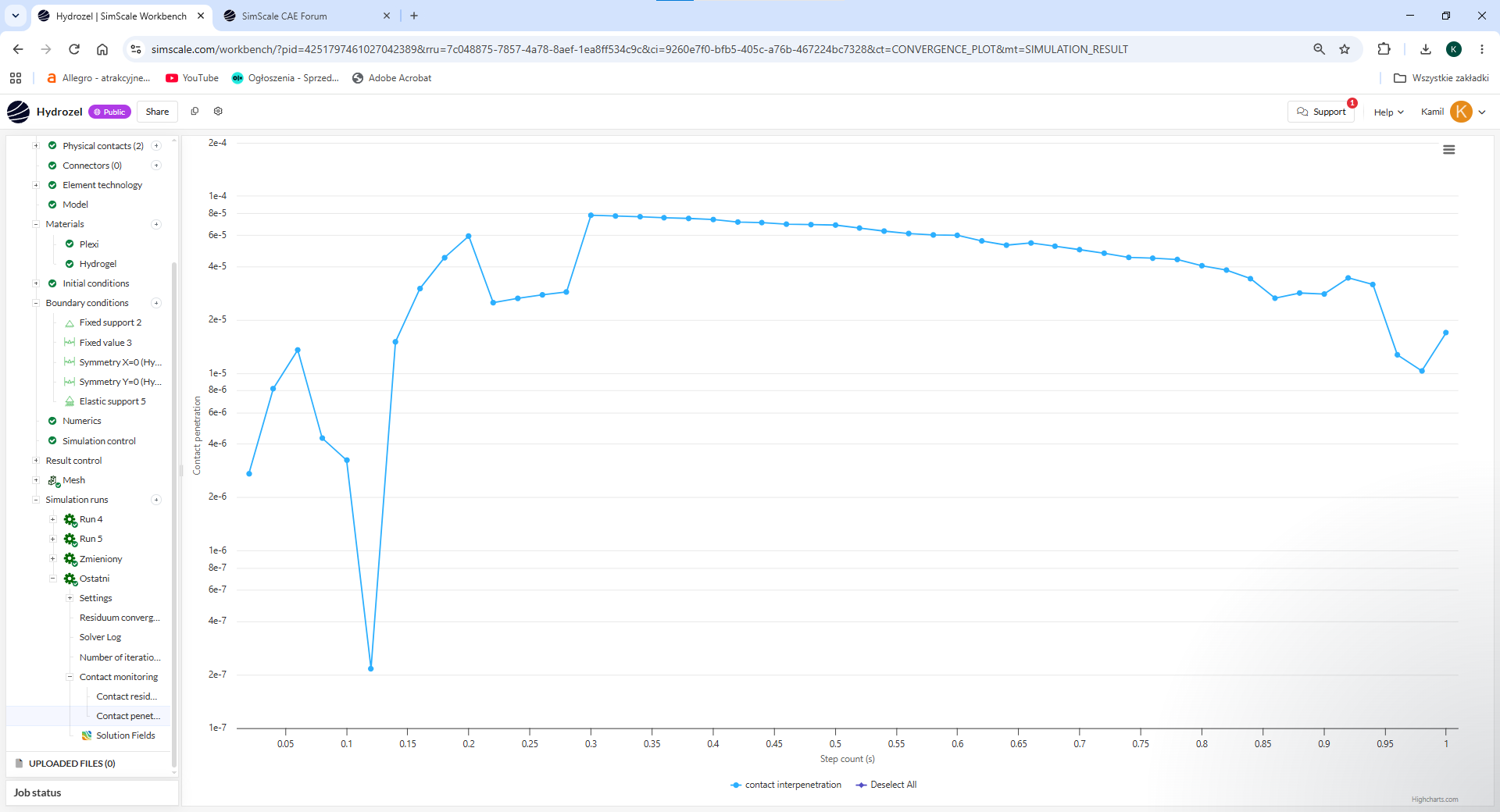
I checked the contact penetration result as well. The maximum reported contact interpenetration during the 8 mm run was only about 7.5e-5 m and at the end it was approximately 1–2e-5 m. Therefore I am not sure whether the apparent overlap visible in the section view is actual penetration or whether the current contact definition is not transferring the displacement to the hydrogel correctly.
Originally I used one Physical Contact with both upper and lower ring surfaces as Master and the hydrogel outer surface as Slave. This configuration could converge up to the full 8 mm displacement, but produced the unrealistic rigid-body-like motion described above.
I then tried separating it into two Physical Contacts. SimScale does not allow the same hydrogel surface to be Slave in both contacts because of shared slave nodes, so I currently use the ring as Master / hydrogel as Slave for one contact and reverse Master/Slave for the second contact. This configuration behaves differently, but Newton convergence fails at approximately 77% of the simulation with Maximum time step length = 0.02 s. Reducing the maximum timestep to 0.005 s did not help and the simulation failed even earlier, at about 69%.
I also tested Augmented Lagrange, but it caused convergence/factorization problems very early in the simulation, so I returned to the Penalty method.
What I would especially appreciate advice on is whether my contact strategy is appropriate for this problem. Should the upper and lower ring contacts be defined separately, and if so, what is the recommended Master/Slave configuration when the same hydrogel surface can potentially contact both rings? Is the small Elastic Support likely to suppress the real deformation mode? Could the nearly rigid translation of the hydrogel indicate an incorrectly constrained rigid-body mode or incorrectly detected contact? Finally, would you recommend a different contact formulation, penalty stiffness, stabilization method, or boundary-condition strategy for a very soft nearly incompressible Neo-Hookean body undergoing this level of deformation?
I can provide screenshots of the physical experiment, the undeformed and deformed cross-sections, the contact penetration history, the contact assignments, solver settings and mesh.
Thank you in advance for any suggestions.
Help me SimScale CAE Forum you’re my only hope.