Hello @choirul ,
I’d like to make a few things clear before we proceed with the reference area definition. First of all, we need to understand the need of non-dimensionalization of forces in aerodynamic simulations. Non-dimensionalization allows you to compare resultant forces properly regardless of the scale of application and to reduce the need of large number of simulations. In theory, designer is free to follow any convention (e.g. using side/top/front view) while defining the necessary parameters (e.g. reference area, reference length) as long as they stick with the same convention during the whole design process. However, there are already a set of conventions that are determined in each industrial application that we are recommended to follow.
In aerospace applications, usual convention is to use the top view of the wing as the reference area. Using a simplified trapezoidal shape to represent the reference area for swept or rounded wings is an acceptable approach in early design stages. In the figure below, you’ll see how the reference wing area of a Tecnam p2002 can be calculated:
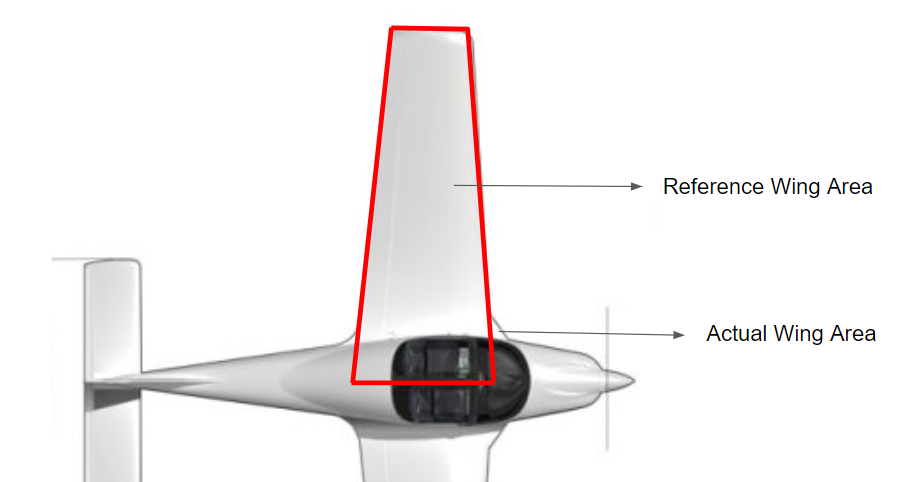
Please be aware that here, the reference wing is imaginary and extends to the fuselage of the aircraft. If you’re not working with a full aircraft configuration, you can follow the same procedure with only top view of the wing.
Hope these are helpful.