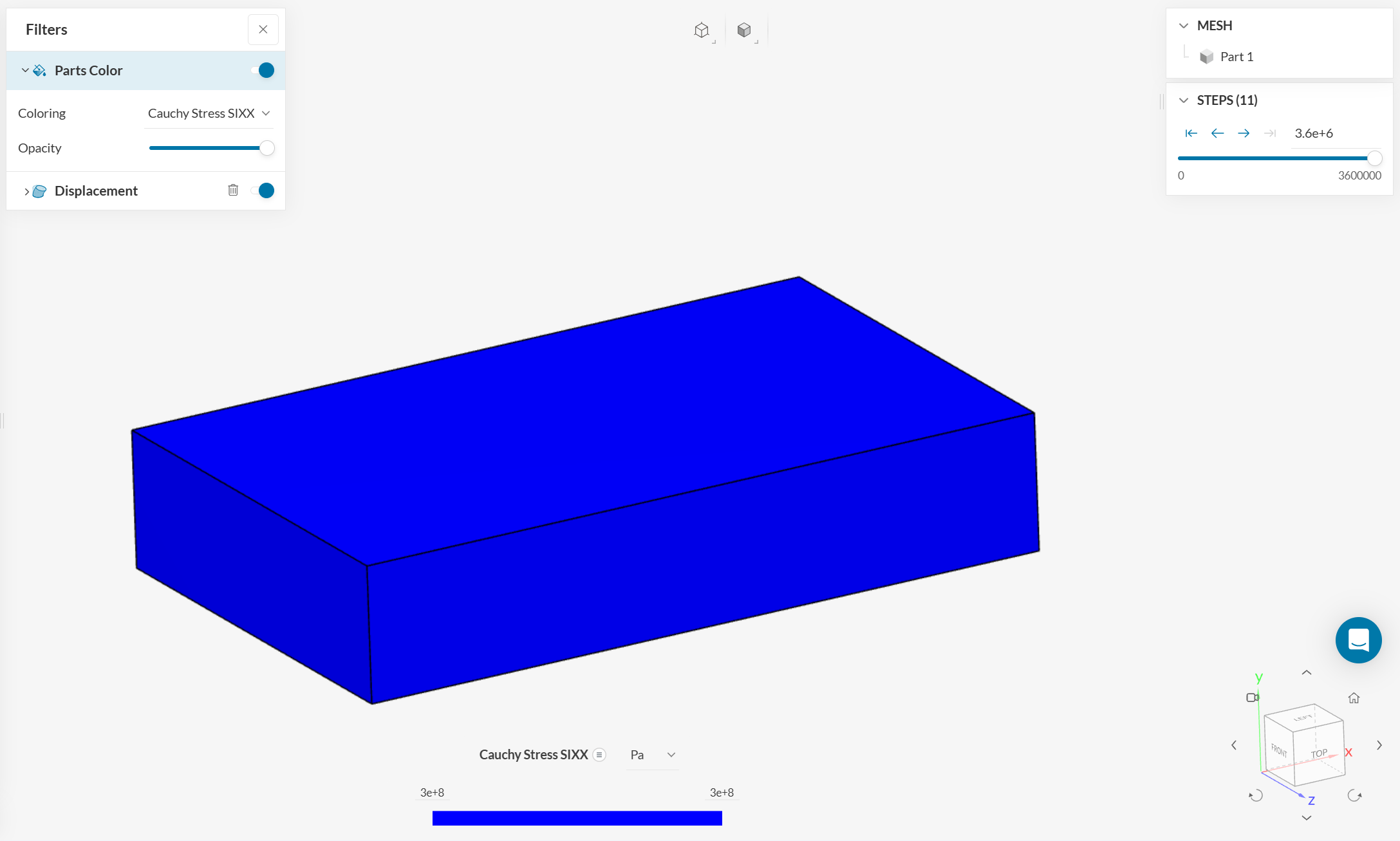
I am comparing a very simple uniaxial bar problem between Abaqus and SimScale and observing a discrepancy that I would like to understand better.
Problem setup
-
Simple rectangular 3D bar
-
Linear elastic steel
-
Pure hexahedral mesh in SimScale:
-
160 hexahedra
-
0 triangles
-
-
Uniform pressure/load applied in X direction on right face
-
Left face constrained
The mesh in SimScale reports:
-
Mesh order: 2nd
-
Number of hexahedra: 160
-
Number of triangles: 0
So this appears to be a genuine structured hex mesh.
Expectation
For ideal uniaxial loading, I expect approximately uniform axial stress:
σxx = F/A
especially away from the constrained edge.
Observation in Abaqus
Using a structured hex mesh:
-
the stress field becomes almost perfectly uniform (~25 MPa)
-
even when only UX = 0 is prescribed on the left face, Abaqus solves without singularity/convergence issues
Observation in SimScale
Even with the pure hex mesh:
-
I still observe stress disturbances/gradients near the constrained edge
-
if I constrain only UX = 0, the solver reports singularity/convergence issues
-
the simulation only runs robustly when additional constraints (UY/UZ) are added
This surprised me because the same conceptual setup runs smoothly in Abaqus.
My questions
-
Is this primarily due to differences in:
-
rigid body mode handling,
-
solver stabilization,
-
stress recovery/averaging,
-
or element formulation?
-
-
Does SimScale require stricter removal of rigid body modes for full 3D solid mechanics problems?
-
Is Abaqus internally stabilizing or regularizing this near-singular system automatically?
-
Are the stress gradients near the support physically expected due to Saint-Venant / Poisson constraint effects, while Abaqus visually smooths them more aggressively?
I am asking partly because I plan to use this example pedagogically to teach:
-
structured vs unstructured meshes,
-
convergence,
-
and boundary-condition effects.
Any clarification would be greatly appreciated.